
You're probably here because the idea sounds simple. Open a menu, pick a few products, wait at home, and skip the drive. Then the questions start. Is delivery handled the same way in DC, Maryland, and Virginia? What do you need ready? What slows the process down?
For first-time customers in the DMV, smooth delivery usually comes down to basic prep, not luck. The people who have the easiest experience tend to do the same few things well. They confirm the rules where they are, use a real delivery-ready address, keep their ID handy, and answer the phone when the courier is close.
That's the practical version of how to prepare for delivery. Not theory. Not cannabis culture talk. Just the steps that make your first order feel normal, quick, and low-stress.
Your First Cannabis Delivery in the DMV
A first delivery often looks the same at the start. Someone in DC, Bethesda, Silver Spring, Arlington, or Alexandria opens a menu late in the day, sees a few flower strains, a vape, maybe some edibles, and thinks, “This would be easier than going out.” Then uncertainty kicks in. They don't want to place the order wrong, miss the driver, or find out too late that their building setup makes handoff awkward.
That anxiety is reasonable. The DMV isn't one market with one set of expectations. DC, Maryland, and Virginia each have different legal realities, and that affects how customers should prepare before they order. A resident in the District may be used to one type of transaction, while someone crossing over from Maryland or Virginia may assume the process works the same everywhere. It doesn't.
The easiest first deliveries usually feel boring in the best way. The customer has already checked the rules, picked a private residential address, kept their phone close, and set out what they need before the courier arrives. The exchange is brief, professional, and discreet.
If you're ordering in the District and want to see what a standard menu-and-checkout flow looks like, browsing a dedicated DC weed delivery page helps set expectations before you commit to anything.
Practical rule: Treat cannabis delivery like any other age-verified delivery. The more complete your details are before checkout, the less friction you'll have at the door.
What doesn't work is waiting until the courier is nearby to figure out whether your ID is current, whether your apartment call box works, or whether the address you entered sends drivers to the wrong entrance. Those are the little mistakes that create delays.
A clean first experience starts before the menu. It starts with eligibility, location, and logistics.
Getting Ready Before You Even Browse the Menu
The strongest move is to pause before shopping and confirm the basics. New customers often jump straight to product selection, but pre-order prep matters more than strain names if you want a smooth handoff.
Start with the legal reality where you live
In the DMV, the first question isn't “What do I want?” It's “What rules apply where I am receiving this delivery?” DC, Maryland, and Virginia don't operate under one simple framework, so don't assume advice from one area carries cleanly into another.
That matters most for people who move around the region for work or spend time in more than one jurisdiction. A delivery that makes sense at a private address in one place may not be appropriate somewhere else. Keep your prep tied to the location of the handoff, not just where you usually live.
If you're unsure, the safest approach is practical, not complicated:
- Check local rules first: Make sure delivery is appropriate for your exact location before you build a cart.
- Use a private residential address: Public handoffs create confusion and can put both you and the courier in a bad spot.
- Stay off federal property: In and around DC, this is especially important.
- Don't assume cross-border convenience: The DMV feels connected, but cannabis rules still change by jurisdiction.
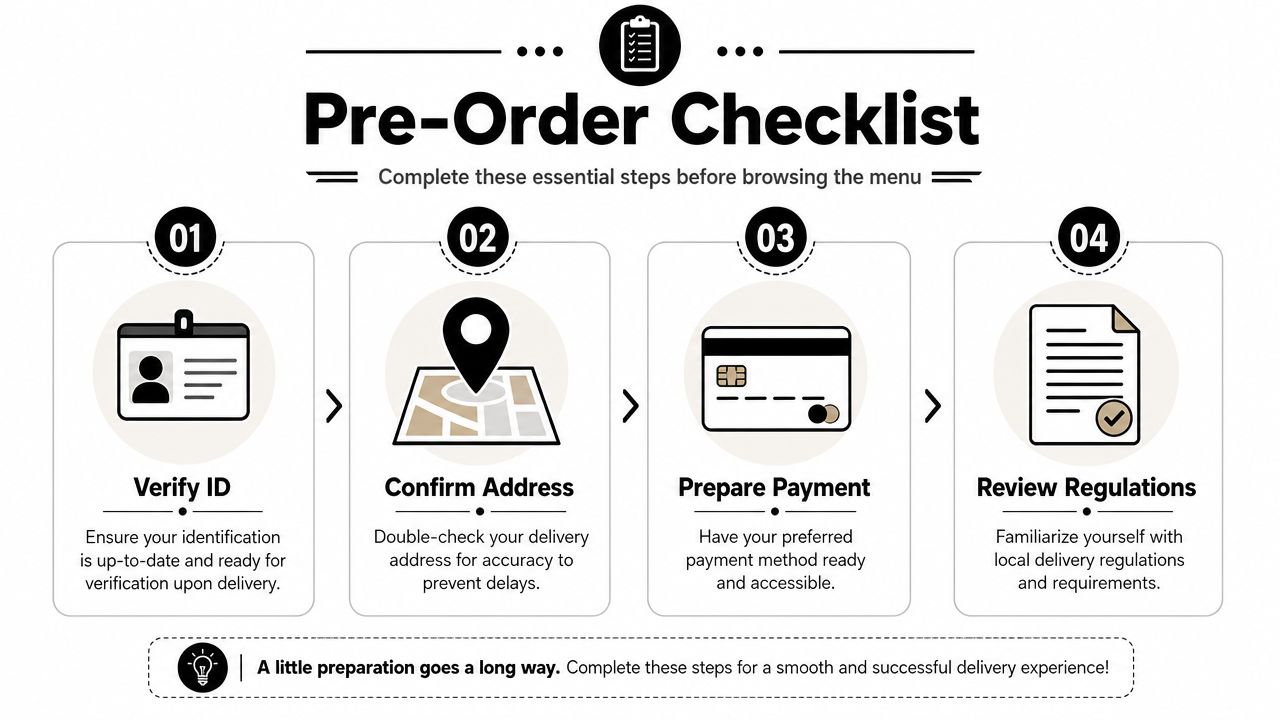
This quick visual covers the basics worth confirming before you browse:
Have your ID and order basics sorted
Your valid, unexpired government-issued ID is not a minor detail. It's the first thing to sort out because age verification is a core part of the process. If you're 21 or older, make sure the physical ID is available and current before you browse. A dead phone battery, a photo of your license, or an expired card can turn a simple drop-off into a failed one.
Then think about your cart like a practical purchase, not a casual scroll. Some services have minimums. A common real-world example is a $50 minimum with Green Express DC, so it helps to know your budget before you start adding items.
Know enough about products to choose calmly
You don't need expert-level cannabis knowledge to place a good first order. You just need enough to avoid buying the wrong type of experience.
A simple way to think about menu basics:
| Product type | Best for | What to keep in mind |
|---|---|---|
| Indica | Evening use, winding down | Often chosen by customers looking for a heavier feel |
| Sativa | Daytime or social use | Often picked for a more upbeat experience |
| Hybrid | Balanced middle ground | Useful if you don't want to lean too far either way |
| Edibles | Smoke-free use | Slower onset, so patience matters |
| Vapes | Fast, convenient use | Effects tend to arrive faster than edibles |
Don't overcomplicate the first order. Pick one format you understand, one effect profile you want, and a quantity that fits the minimum without pushing you into impulse buys.
Placing Your Order for a Flawless Drop-Off
Once the basics are handled, the order itself should be simple. At this stage, customers either make the handoff easy or accidentally create a scavenger hunt for the courier.

Your address needs to work in real life
A correct address isn't always a useful address. That's the difference many first-time customers miss.
If you live in a rowhouse, things are usually straightforward. If you live in a large apartment building, condo tower, or gated property, the courier may need more than the street number and unit. The best orders include the information someone would need if they had never visited the building before.
Use the delivery notes field for details like:
- Entry instructions: Gate code, call box name, lobby access details.
- Best entrance: Front desk entrance, side entrance, loading-side entrance if that's where guests are admitted.
- Parking or pickup note: If your street is hard to stop on, give a short practical note.
- Contact preference: If calling upon arrival works better than buzzing, say so clearly.
A missed delivery often starts as a communication problem, not a driving problem.
That fits a broader delivery lesson from logistics tracking. Modern operations usually monitor a small set of core KPIs instead of one single measure, with on-time delivery rate, first-attempt success rate, and cost per delivery commonly treated as the first metrics to watch because they reflect reliability, repeat-visit waste, and unit economics in a simple framework. Industry guidance also recommends reviewing fast-moving metrics weekly and using standardized definitions so comparisons stay fair, and notes that failed deliveries waste resources and frustrate customers (delivery KPI guidance from Locus).
You don't need to run a logistics team to use that lesson. For a customer, the takeaway is simple: good notes improve first-attempt success.
Choose the ordering method that fits your confidence level
Some people prefer ordering online because they can read slowly, compare options, and check the cart before submitting. Others do better by phone because they can ask one or two direct questions and confirm details in real time.
If payment happens at the door, it helps to understand the process before you place the order. Reviewing how cash on delivery works can remove a lot of uncertainty for first-time customers.
Here's what works best during checkout:
- Keep your phone number current: If the courier needs to reach you, they need the right number.
- Use your full legal first and last name if requested: Don't create ID confusion with nicknames.
- Double-check the address line: Typos in apartment numbers are more common than people think.
- Read your order once before submitting: Most preventable mistakes happen in the last ten seconds.
What doesn't help is writing vague notes like “text me when here” without saying how to enter the building, or using a friend's address without confirming that they'll be present and available.
Preparing for the Courier's Arrival
This part should feel easy. By the time the courier is close, your only job is to be reachable and ready.
Keep three things within arm's reach
First-time customers often overthink the moment of arrival. In practice, the cleanest handoffs are quick because the customer already has what matters.
Keep these ready:
- Your physical ID: Not a screenshot. Not a photo in your camera roll. The actual card.
- Your payment: If the service uses cash on delivery, have it ready before the driver arrives.
- Your phone: Keep the ringer on during the delivery window in case the courier calls or texts.
If you're in a building with poor cell service, stand somewhere you can receive a call. That sounds obvious, but it causes more problems than people expect.
Make the handoff easy, not theatrical
You don't need to wait at the curb unless your building setup requires it. You do need to stay available. If you know your lobby is confusing, go downstairs a few minutes early when the courier is close. If your front gate sticks, have it open ahead of time if that's possible.
A useful mindset is to reduce every avoidable pause. That means shoes on, ID visible, payment counted, and no last-minute search through drawers while the courier waits.
What works: a responsive customer who's ready when contacted.
What fails: a silent phone, unclear apartment access, and an ID that “should be somewhere.”
There's another operations lesson that applies here. Delivery prep isn't just about speed. It increasingly depends on completion and accuracy rates, too. In delivery analytics, order completion rate is calculated as completed deliveries divided by total orders received, multiplied by 100, and one industry example shows that if 100 orders are confirmed and 97 are delivered, the completion rate is 97%. Guidance in the same area also treats order accuracy rate as a core indicator because on time but wrong still fails the experience (food delivery metrics overview from FulFllld).
For customers, that translates into a practical rule. Be present, verify promptly, and keep the exchange simple so the order can be completed accurately on the first try.
After the Drop-Off Safety and First Use
The actual exchange is usually brief. The courier arrives, verifies what needs to be verified, hands off the order, and leaves. If you prepared well, the entire interaction feels routine.
After that, the important part starts. Delivery success isn't only about getting the package. It's also about what you do once it's in your hands.
Check, store, then slow down
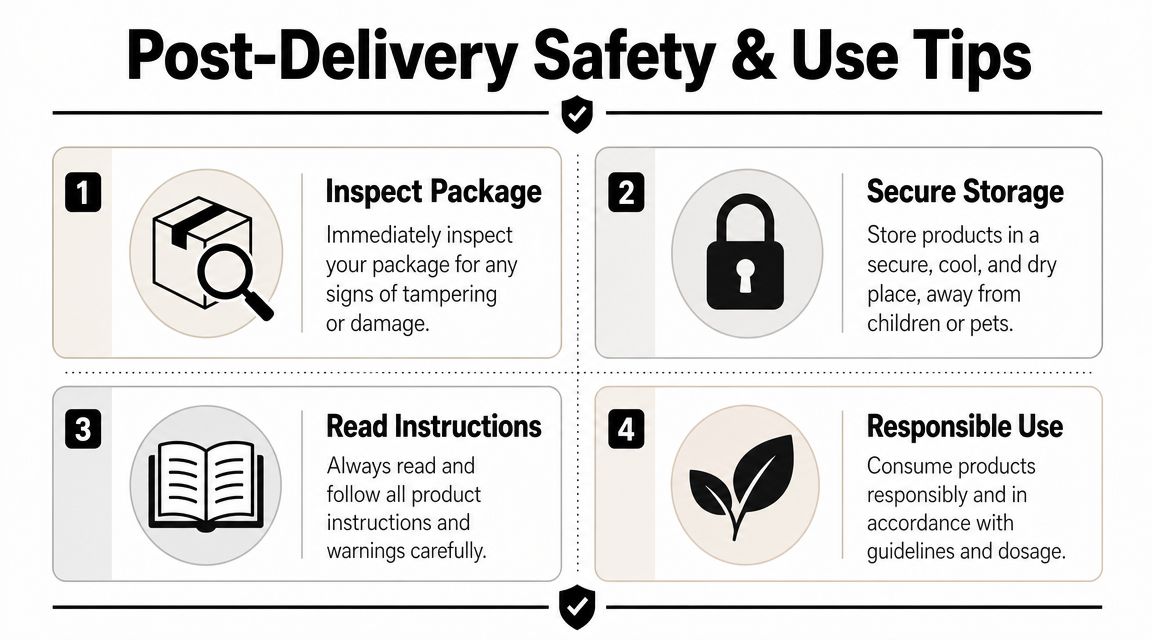
Do a quick visual check of the package. You're not looking for drama. You're making sure the order appears intact and matches what you expected.
Then store products with intention:
- Keep them secure: Away from children, pets, and casual access.
- Choose a stable spot: Cool, dark, and dry is better than a sunny windowsill or hot car.
- Use proper containers when needed: Airtight storage helps preserve flower quality.
- Separate products clearly: Don't toss edibles, vapes, and flower together and hope you remember what's what later.
A lot of first-time regret has nothing to do with delivery. It comes from poor storage or rushing into use without reading the label.
Start low and go slow
This is the advice I'd give any new customer, especially one who's anxious. Don't judge a product by how friendly the packaging looks. Judge it by how cautiously you approach your first session.
Different product types behave differently:
| Product | General experience pattern | Best first-time approach |
|---|---|---|
| Flower | Easier to pace gradually | Take a small amount and wait before more |
| Vape | Faster onset | One small pull can be enough to assess |
| Edible | Delayed onset, longer-lasting feel | Be patient and don't stack more too soon |
| Tincture | Controlled, measured use | Read directions carefully and track your response |
If you're trying edibles for the first time, don't treat the delay as proof that nothing is happening. That's how people overshoot. If you want a better sense of the timing differences, this guide on when edibles kick in is a useful starting point.
New users usually have the best experience when they leave room to adjust. The worst first sessions usually start with impatience.
If you're sharing with friends, keep your own pace. Don't let someone with a higher tolerance set the tempo for your first use. Comfortable and controlled is a better outcome than impressive.
DMV Cannabis Delivery Frequently Asked Questions
Is cannabis delivery the same in DC, Maryland, and Virginia
No. The DMV is a patchwork, not a single cannabis market. DC, Maryland, and Virginia each sit in their own legal context, so always prepare based on the exact place where delivery will happen. Don't assume that because something feels common in one area, it carries over cleanly into the next.
Can I receive a delivery anywhere I happen to be
Stick to a private residential location. Public handoffs create problems. So does trying to receive delivery at or near federal property. In the District especially, customers should be careful about where a handoff is arranged.
Should I tip the driver
Tipping is generally treated as normal delivery etiquette when the experience is smooth, professional, and on time. There isn't one universal rule, so use judgment. If the courier handled a difficult building, found you quickly, and kept the process easy, many customers choose to tip.
What happens if I miss the delivery
That depends on the service, but the usual result is delay, failed handoff, or the need to reschedule. The easiest way to avoid that is to stay reachable during the delivery window and respond quickly if the courier contacts you.
What is the biggest mistake first-time customers make
They focus on products and ignore logistics. A first order usually goes smoothly when the customer has four things lined up: a legal delivery location, a valid physical ID, accurate entry instructions, and payment ready at the door.
Is discreet delivery actually discreet
Usually, yes, when you use a professional service and do your part. Discretion works best when you don't force the courier to wait outside, call repeatedly, or search a building for you.
If you want a reliable option in the District, Green Express DC makes the process straightforward for adults 21+ with discreet delivery, a clear menu, cash-on-delivery convenience, and professional ID verification at drop-off. If it's your first time ordering, start simple, prepare well, and let the delivery feel as easy as it should.