
Posted on Leave a comment

Edibles vs Tinctures DC: A Professional’s Guide to High-Potency Choice

Edibles vs Tinctures DC: A Professional’s Guide to High-Potency Choice

Precision is the ultimate luxury for the modern professional. In a city where your schedule is your most valuable asset, leaving your cannabis experience to chance isn’t an option. When weighing edibles vs tinctures dc, the choice often comes down to tactical control over your day. You need a solution that fits into a high-stakes lifestyle without the unpredictability of traditional methods.

It’s frustrating when an edible takes two hours to kick in during a rare window of downtime. We understand that you require consistency, safety, and absolute discretion. This guide identifies the critical differences in onset, duration, and purity to help you select the perfect premium cannabis experience. You will discover how to achieve predictable, controlled effects through lab-tested, organic products delivered directly to your door. We explore the mechanics of sublingual absorption versus digestive processing and show you how to maintain a professional edge while enjoying high-potency relief.

Key Takeaways

  • Understand the critical differences in bioavailability to choose between the sustained release of edibles or the rapid onset of sublingual tinctures.
  • Evaluate edibles vs tinctures dc based on your specific professional schedule and the need for immediate versus prolonged effects.
  • Prioritize safety and consistency by selecting lab-tested, organic products that guarantee verified potency and purity.
  • Maintain absolute discretion in high-stakes environments with odorless, portable options designed for the modern DC lifestyle.
  • Access premium cannabis through 24/7 same-day delivery across Washington DC and Northern Virginia for ultimate reliability and convenience.

Understanding the Edible and Tincture Landscape in DC

The District of Columbia cannabis market has matured significantly since the passage of Initiative 71. For the modern professional, the choice between edibles vs tinctures dc is no longer just about potency. It’s about finding a functional, high-tier solution that integrates into a packed schedule. Modern edibles have evolved far beyond the standard, sugar-heavy gummies of the past. They now include artisanal, high-potency options designed for sustained relief and sophisticated palates. Simultaneously, tinctures have emerged as a premier wellness tool for those who value efficiency. These liquid extracts provide a level of dosing precision that traditional methods cannot match.

A comprehensive Cannabis Tincture Overview reveals that these preparations have a long history of use for targeted relief. Their resurgence in the DC market reflects a growing demand for clinical-grade reliability and rapid absorption. Whether you’re looking for a long-lasting evening experience or a quick-acting daytime solution, understanding the biological differences between these formats is essential for a curated experience.

The Professional Shift to Smoke-Free Cannabis

Discretion drives the current market shift. Residents in high-density neighborhoods like Navy Yard or Logan Circle often face strict non-smoking policies in luxury residential buildings. Smoke-free alternatives eliminate the risk of lingering odors, allowing for private consumption that doesn’t disrupt your environment. Health-conscious users are also moving away from inhalation to protect their respiratory health. This transition toward organic, lab-tested ingredients ensures that your cannabis use remains a clean, professional part of your wellness routine. By choosing smoke-free options, you prioritize both your health and your privacy without sacrificing the high-potency effects you require.

Defining High Potency in 2026

In the 2026 market, high potency is defined by more than just a high THC percentage. It encompasses the presence of full-spectrum extracts that retain essential terpenes and minor cannabinoids. This synergy provides a more nuanced and effective outcome than isolated compounds. Green Express DC prioritizes artisanal quality over mass-produced goods, ensuring every product meets rigorous purity standards. High-potency choices in our catalog are vetted for consistency, so you get the same reliable results with every order. We focus on organic, non-GMO ingredients to provide a premium utility that fits the high standards of the DC professional community. Choosing a lab-verified product removes the guesswork, providing peace of mind alongside powerful effects.

Bioavailability and Onset: The Science of Choice

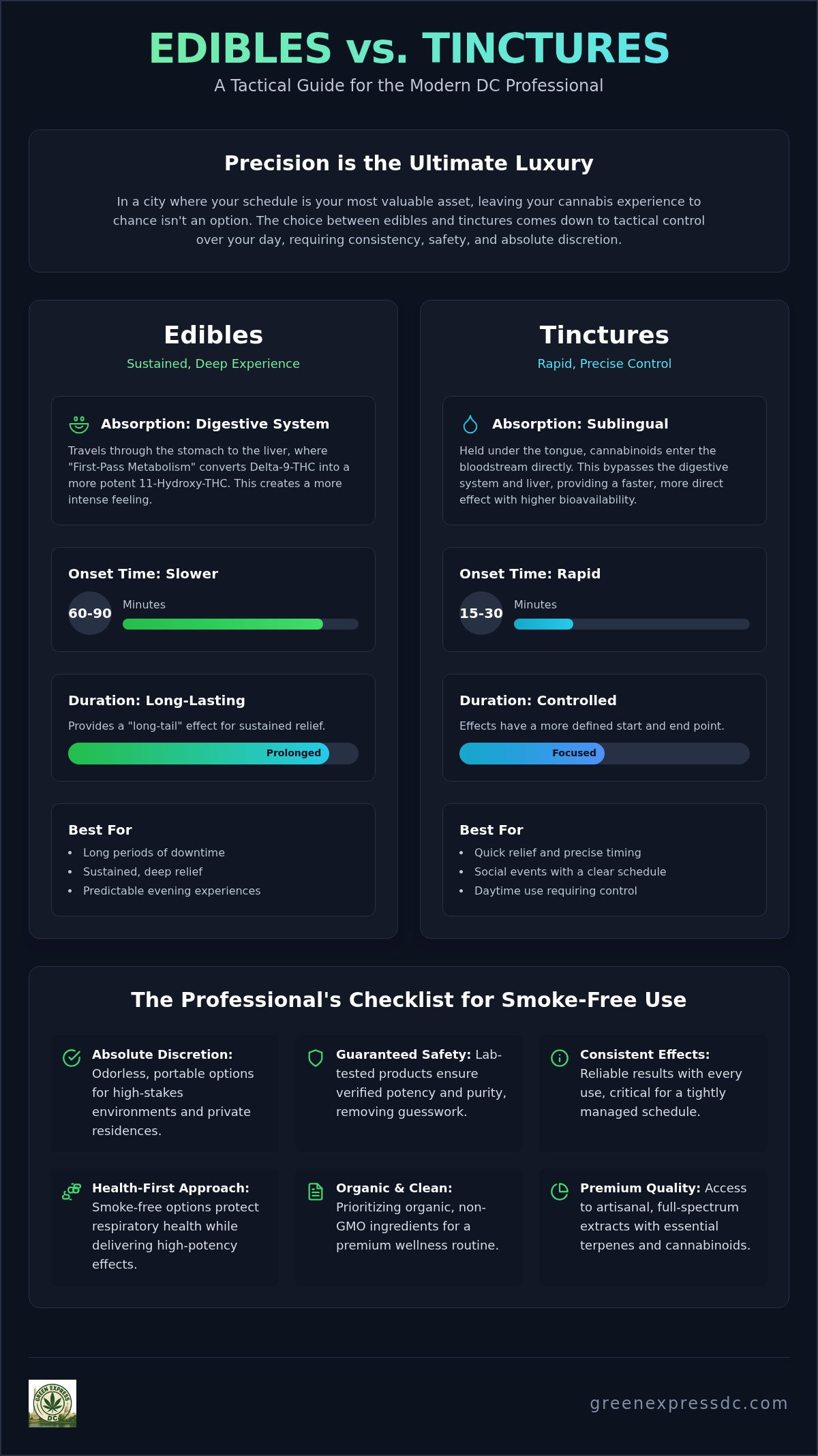
Bioavailability determines how much of a substance actually reaches your bloodstream to produce an effect. It’s the difference between a wasted milligram and a transformative experience. When evaluating edibles vs tinctures dc, understanding this mechanism is vital for controlling your schedule. Edibles rely on the digestive system to process cannabinoids, while tinctures utilize sublingual absorption to provide a more immediate impact. The choice depends on whether you value a quick onset or a sustained, deep experience.

First-Pass Metabolism vs. Sublingual Entry

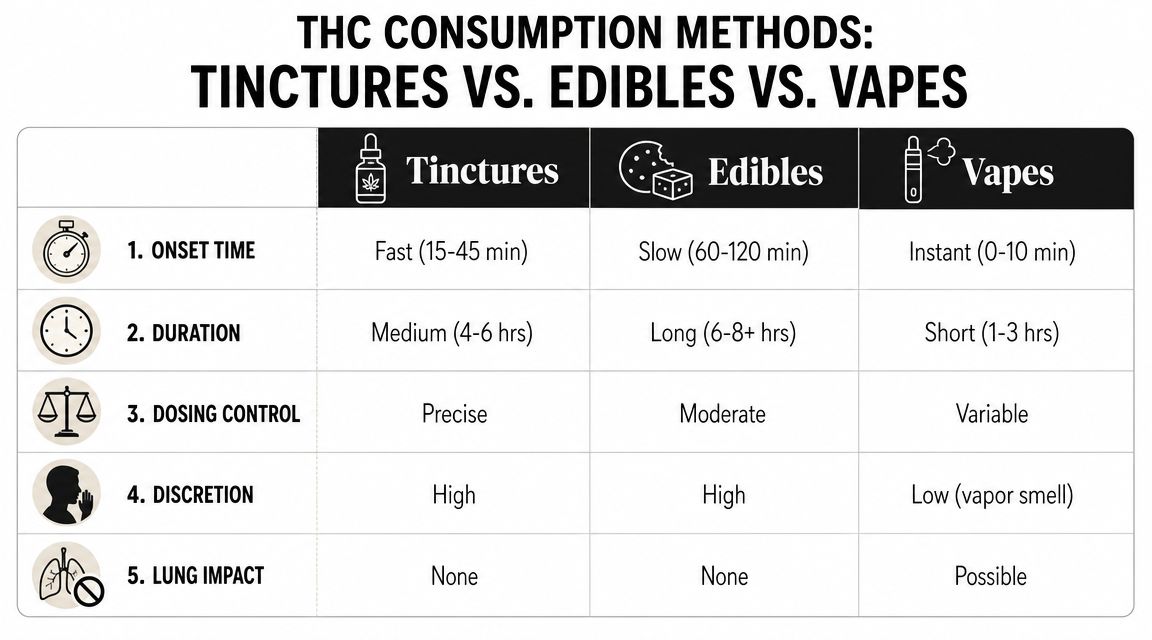
Edibles follow a complex biological path. Once swallowed, the THC travels through the stomach and into the liver. Here, a process called first-pass metabolism occurs. Your liver converts Delta-9-THC into 11-Hydroxy-THC, a metabolite that is significantly more potent and crosses the blood-brain barrier more efficiently. This conversion explains why edible effects often feel more intense than inhalation. However, this process takes time. You may wait 60 to 90 minutes to reach your peak. Research on Cannabinoid Pharmacokinetics shows that oral ingestion results in lower overall bioavailability compared to other methods because the digestive process filters out a portion of the compounds.

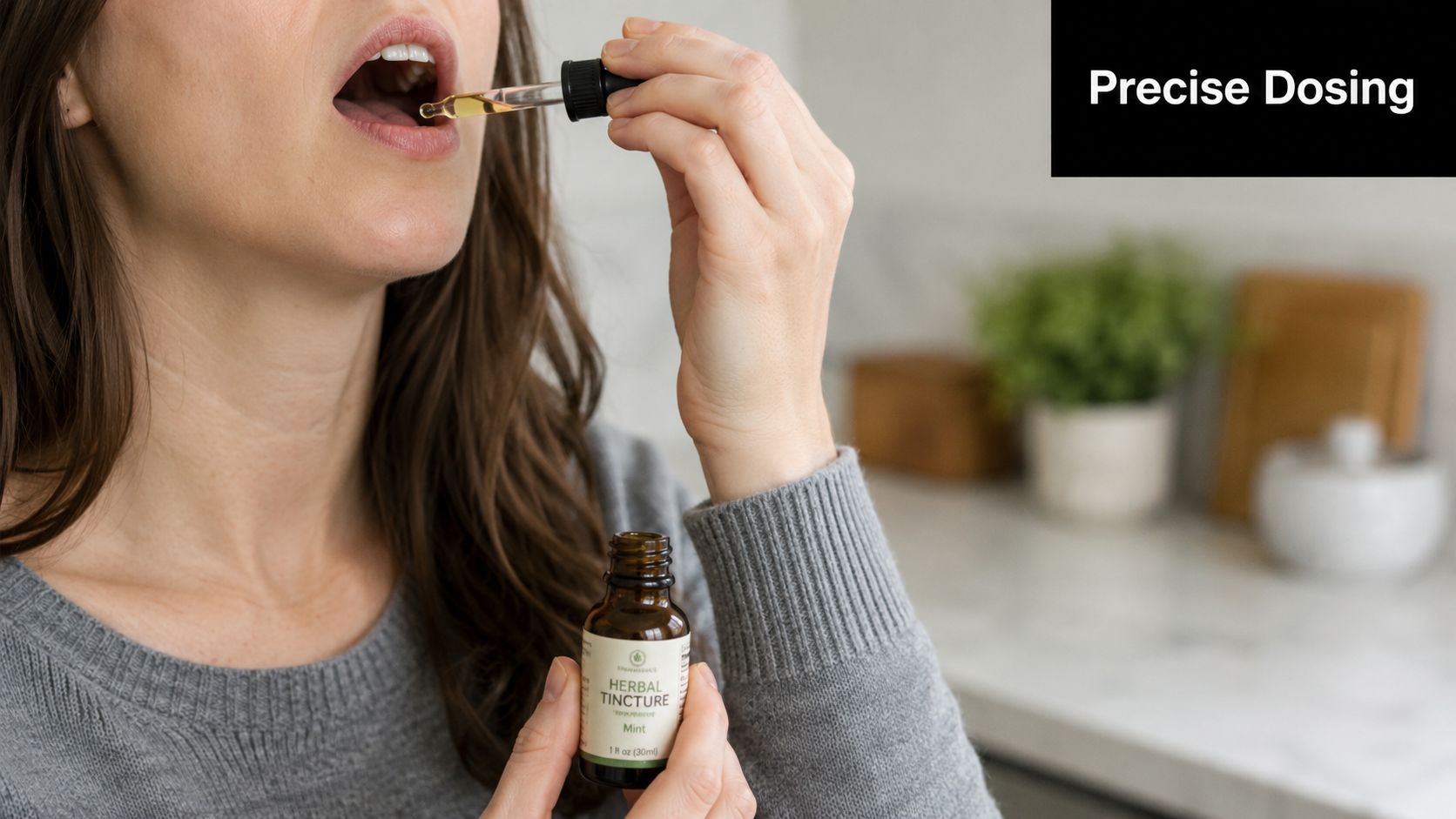
Tinctures offer a tactical shortcut. By holding the extract under your tongue, cannabinoids enter the bloodstream directly through the sublingual mucosa. This bypasses the digestive tract and the liver’s initial filtration entirely. You feel the effects much faster, usually within 15 to 30 minutes. This makes tinctures the superior choice for professionals who need to time their experience precisely for a social event or a specific window of downtime. If you require this level of rapid control, you can explore premium THC tinctures designed for immediate integration into your routine.

Duration and the “Long-Tail” Effect

The primary advantage of the edible’s long journey is its duration. Edibles provide a “long-tail” effect that typically lasts between 6 and 8 hours. This is ideal for sustained relief during a long evening or for ensuring deep, uninterrupted rest throughout the night. The slow release of 11-Hydroxy-THC creates a steady plateau rather than a sharp spike. Tinctures offer a more condensed and controlled experience, usually lasting 2 to 4 hours. This shorter window is perfect for those who need to remain functional and sharp the following morning without any lingering fog. Matching the duration to your lifestyle is the key to a successful experience. Use edibles for a Saturday night dinner party and tinctures for a focused, late-night relaxation session.

Edibles vs. Tinctures: A Tactical Comparison for DC Professionals

Tactical utility defines the cannabis toolkit of a high-performing professional. While the biological differences dictate the internal experience, the physical format of your choice dictates your external convenience. Deciding between edibles vs tinctures dc often rests on where you are and how much attention you wish to draw. Both options provide an smoke-free advantage, but they serve different logistical purposes throughout a busy District workday. Whether you are navigating a commute to Chinatown or preparing for a late-night strategy session, your product must be as efficient as your schedule.

The Discretion Factor in the District

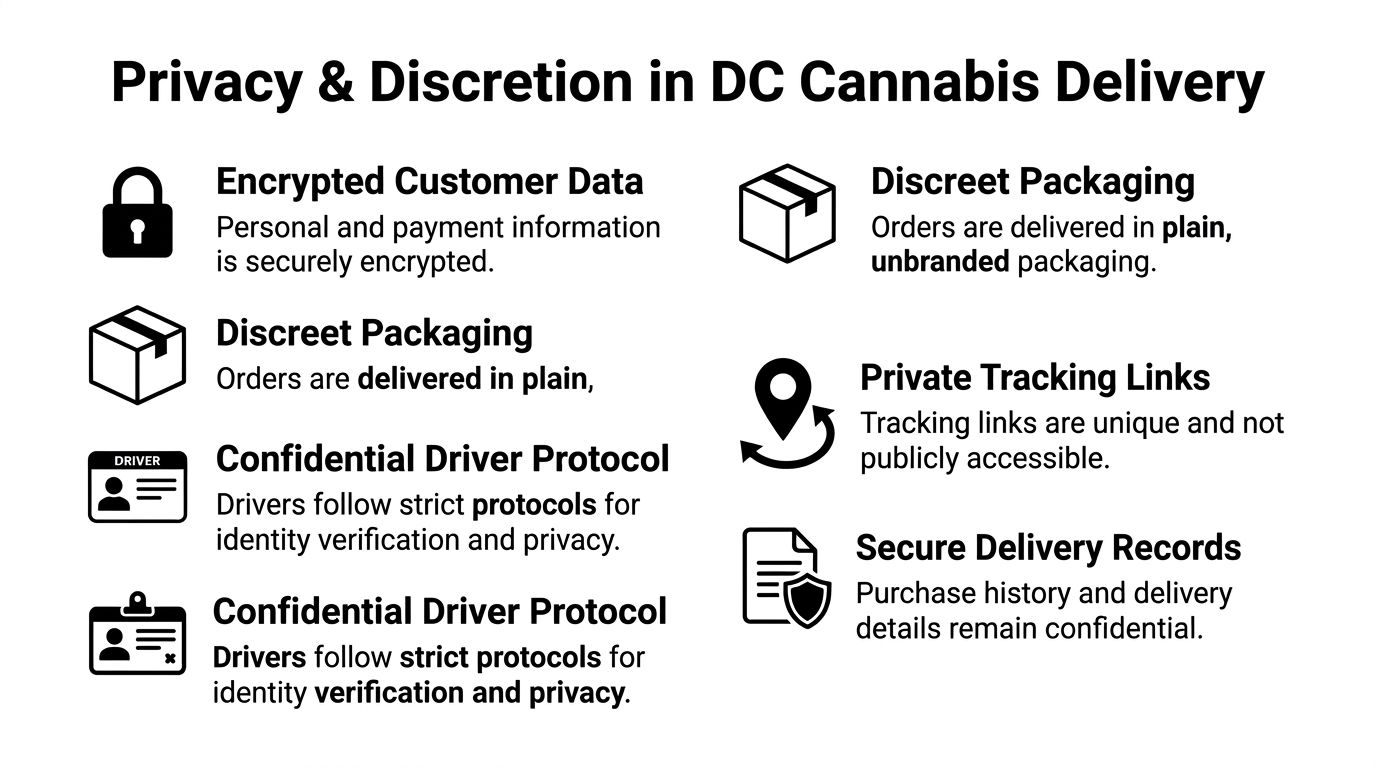
Discretion remains the primary driver for DC consumers who prioritize privacy. Tinctures offer a clinical, understated profile. A small dropper bottle fits seamlessly into a leather briefcase or a desk drawer, appearing no different than a standard wellness supplement or essential oil. This allows for rapid, sublingual use in professional settings without detection. Conversely, high-potency gummies and artisanal chocolates are the ultimate travel companions. They are shelf-stable, portable, and look like any other premium snack. For those living in high-density areas like Navy Yard, the lack of odor is a non-negotiable benefit. Green Express DC ensures that all products arrive in discreet packaging, maintaining your privacy from the moment of 24/7 delivery to the moment of consumption.

Granular Control and Microdosing

Precision is where tinctures outperform almost every other category. The graduated dropper allows for absolute titration, enabling you to measure your intake down to the milligram. This is essential for microdosing during the day when you need to maintain focus while managing stress. Splitting a high-potency edible can be imprecise, as the cannabinoids may not be perfectly distributed throughout a single piece of chocolate or a gummy. If you require incremental effect management to stay sharp, THC tinctures provide the most reliable tool for the job. This level of control removes the guesswork and prevents the “too much, too soon” scenario often associated with oral ingestion.

While tinctures lead in precision, edibles win on the sensory experience. Premium chocolates and infused treats offer a culinary appeal that clinical tinctures often lack. For many, the ritual of enjoying a high-quality edible at the end of a long day is a reward in itself. Consider these tactical points when making your selection:

  • Tinctures: Best for rapid onset, precise microdosing, and clinical discretion.
  • Edibles: Best for sustained relief, portability, and a superior taste profile.
  • Commute Readiness: Gummies are easier to handle on the Metro; tinctures are better for the office.

Choosing the right format ensures your cannabis use supports your lifestyle rather than complicating it. By matching the product to your specific “Window of Opportunity,” you maintain total control over your professional and personal time.
Edibles vs Tinctures DC: A Professional’s Guide to High-Potency Choice

Selection Guide for High-Potency Products

Choosing between edibles vs tinctures dc requires more than just picking a flavor. It demands a strategic understanding of your own “Window of Opportunity.” High-potency products offer significant benefits, but their efficacy depends on how well you match the product to your intended outcome. Selecting the right format ensures you maximize the therapeutic or recreational value of every milligram. This guide focuses on the technical markers of quality that separate premium offerings from standard retail items.

Matching Product to Schedule

Your daily itinerary is the most reliable guide for product selection. We categorize high-potency chocolates and gummies as the “Evening Anchor.” These products provide a slow, steady release that is perfect for late-night relaxation or deep recovery after a high-pressure workday. Because the effects are prolonged, they anchor your evening in a state of consistent calm. Conversely, tinctures act as a “Social Catalyst.” Their rapid sublingual onset allows you to engage with social or professional events on your own terms. You don’t have to wait for digestion to catch up with your plans.

Experienced users often employ tactical layering to create a customized experience. This involves taking a low-dose tincture for immediate effect while simultaneously consuming a high-potency edible. The tincture provides the initial lift, while the edible takes over as the tincture begins to fade. This method ensures there are no gaps in your experience. To master this approach, you can order premium cannabis delivery to ensure you have both formats on hand for any scenario.

Verifying Quality and Safety

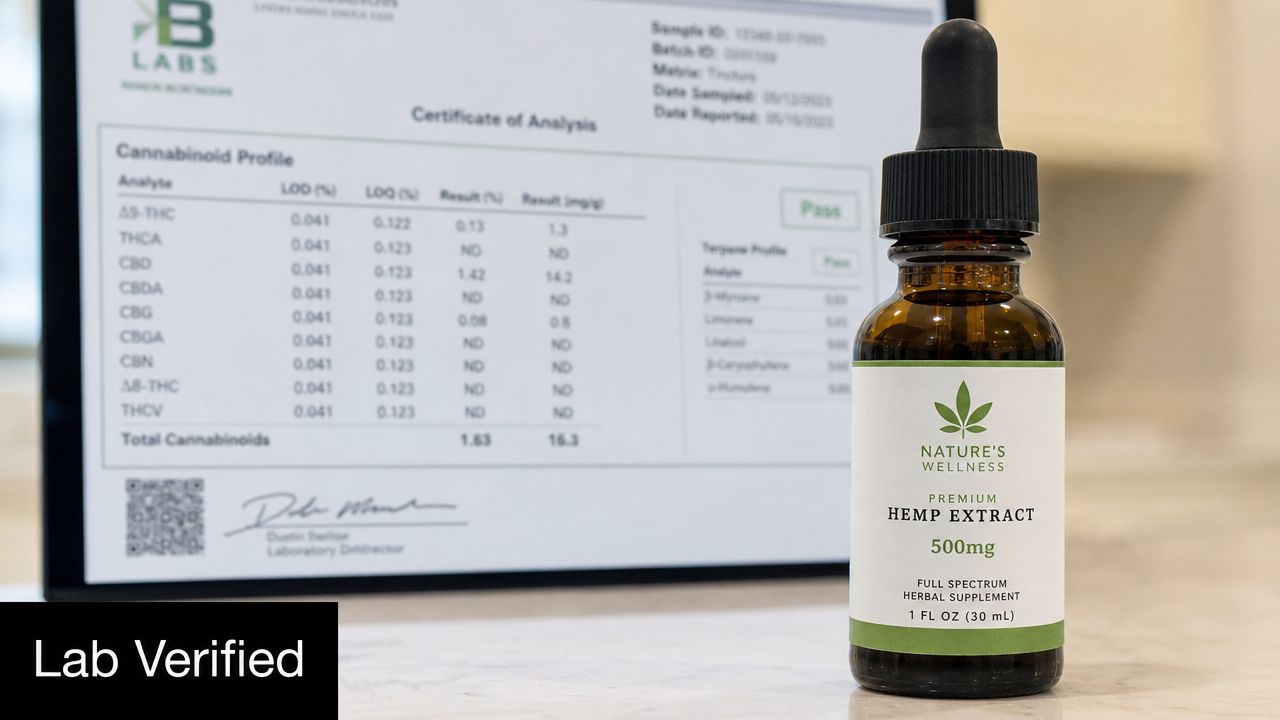
Purity is the hallmark of a professional-grade product. You should always look for organic, non-GMO labels and verify the presence of a Certificate of Analysis (COA). A COA confirms that the product has undergone third-party lab testing for potency, heavy metals, and residual solvents. This transparency is vital in the DC market, where quality can vary significantly between providers. Green Express DC maintains a commitment to these rigorous standards, ensuring every item in our catalog is safe and effective.

The type of extract used also impacts the final result. Distillates offer high THC purity, while Live Resin preserves the plant’s original terpene profile. Understanding terpenes is essential when selecting high potency edibles, as these aromatic compounds influence whether an effect is more uplifting or sedating. Beyond terpenes, the strain profile of your edible also plays a significant role in the final experience; understanding the differences between indica vs sativa edibles can help you select a product precisely calibrated for relaxation or daytime focus. Additionally, pay attention to carrier oils in tinctures. MCT oil is the gold standard for efficacy because it’s a medium-chain triglyceride that the body absorbs rapidly. Alcohol-based tinctures are also available, though many professionals prefer the smoother, neutral taste of MCT-based extracts. Prioritizing these technical details guarantees a clean, predictable, and premium experience every time. For a deeper look at how to evaluate ingredient transparency and lab documentation when shopping, the guide to buying lab-tested organic edibles in DC provides a comprehensive framework for identifying truly verified organic options in the local market.

Premium Delivery: Accessing Edibles and Tinctures in DC

Selecting the ideal product is only the first step toward a refined cannabis experience. In a fast-paced environment like Washington DC, reliability and speed are just as critical as product potency. When you decide between edibles vs tinctures dc, you need a distribution partner that respects your time and absolute privacy. Green Express DC operates as a premium concierge service, bridging the gap between high-end product standards and the logistical demands of a professional schedule. Whether you are situated in a historic Georgetown townhouse or a modern condo near H Street NE, access to lab-tested cannabis is now a streamlined, 24/7 reality.

Same-Day Delivery Dynamics

Efficiency is the cornerstone of our service. We provide 24/7 same-day delivery across the District and into surrounding areas, including Arlington, VA, and Alexandria, VA. This constant availability ensures that you are never without your preferred relief, regardless of when your workday ends. We understand that discretion is paramount for our clients. Our delivery team utilizes unbranded vehicles to maintain complete privacy during every drop-off. This commitment to anonymity allows you to receive your order at your primary residence without attracting unnecessary attention. By prioritizing a secure and rapid logistics chain, we remove the friction often associated with the local market.

The Green Express DC Experience

Quality control is our non-negotiable gold standard. Every item in our catalog undergoes rigorous vetting to ensure it meets organic, lab-tested benchmarks. We provide a curated menu that simplifies the decision-making process for busy individuals. You can easily access high-potency gummies or secure professional THC tincture delivery in DC through our intuitive platform. This focus on purity guarantees that the effects remain predictable and the experience remains premium. We act as a knowledgeable guide, ensuring that you receive the exact results you expect from a high-tier utility brand.

Placing your first order is a straightforward process designed for maximum ease. Simply browse our current selection of flower, edibles, and tinctures to find the match for your specific lifestyle needs. Once you submit your request, our team coordinates a seamless delivery window that fits your calendar. We handle the logistics so you can focus on your professional and personal priorities. By understanding the nuances of edibles vs tinctures dc, you can make an informed choice that our delivery service brings directly to your door. Choose a service that mirrors your own standards for excellence and efficiency. Start your journey with the District’s reliable gold standard for cannabis delivery today.

Secure Your Ideal Cannabis Experience Today

Mastering your cannabis routine requires a balance of timing and potency. Whether you require the rapid, sublingual control of a tincture or the sustained relief of a high-potency edible, your choice must support your professional standards. We provide the clinical-grade reliability you need to maintain focus and relaxation on your terms. You don’t have to settle for unpredictable results when your schedule is on the line.

When evaluating edibles vs tinctures dc, prioritize products that offer verified purity and absolute discretion. Our lab-tested catalog ensures every milligram is safe, organic, and effective. We facilitate your lifestyle with 24/7 same-day delivery across Washington DC, Arlington, and Alexandria. Every order arrives via discreet, unbranded vehicles to guarantee your privacy is never compromised. This concierge-style approach removes the guesswork from your procurement process.

It’s time to elevate your wellness strategy with a service that understands the value of your time. Order Premium Edibles and Tinctures for 24/7 DC Delivery and experience the District’s gold standard for yourself. You’re ready to enjoy a curated cannabis experience that fits perfectly into your high-stakes schedule.

Frequently Asked Questions

Are edibles or tinctures better for beginners in DC?

Tinctures are the superior choice for beginners due to their unparalleled dosing precision. The graduated dropper allows you to start with a minimal amount and increase it incrementally. When comparing edibles vs tinctures dc, beginners often find edibles difficult because splitting a high-potency gummy can lead to uneven dosing. Tinctures remove this guesswork, providing a safer and more controlled introduction to premium cannabis.

How long do high-potency edibles take to kick in compared to tinctures?

High-potency edibles typically require 60 to 90 minutes to take effect because they must pass through the entire digestive system. In contrast, tinctures act much faster, usually within 15 to 30 minutes when administered sublingually. This rapid onset makes tinctures ideal for users with tight schedules. Edibles provide a longer duration of relief, making them better suited for evenings when immediate onset is not a priority.

Can I get same-day delivery of tinctures in Arlington and Alexandria?

Yes, you can access 24/7 same-day delivery for tinctures and edibles in Arlington and Alexandria. Green Express DC prioritizes efficiency for Northern Virginia professionals who need reliable access outside of standard business hours. Our delivery team operates with absolute discretion, utilizing unbranded vehicles to ensure your order remains private. Simply place your order online to receive premium, lab-tested products at your primary residence.

Do tinctures taste like cannabis, or are they flavoured?

Tinctures vary in taste depending on the carrier oil and added extracts. Many premium options utilize MCT oil, which provides a neutral, slightly oily profile that is easy to consume. Some formulations include natural flavors like peppermint or citrus to mask the earthy notes of the cannabis plant. If you prefer a clinical experience without any lingering aftertaste, MCT-based tinctures are the gold standard for purity and palatability.

How should I store my high-potency edibles to maintain freshness?

Store your high-potency edibles in a cool, dark, and airtight environment to preserve their chemical integrity. Heat and light degrade cannabinoids over time, which can reduce the effectiveness of the product. Keep chocolates in a climate-controlled space to prevent melting and maintain a consistent texture. Proper storage ensures that every serving delivers the exact potency and flavor profile promised on the lab-tested label.

What is the most discreet way to consume cannabis in a DC office setting?

Tinctures offer the most discreet consumption method for a professional office setting. The small dropper bottle resembles a standard vitamin or herbal supplement, allowing for quick use without drawing attention. Unlike smoking or vaping, tinctures are entirely odorless and leave no trace. Edibles are also a viable option, but the immediate sublingual entry of a tincture provides a tactical advantage for professionals who need precision.

Why does 11-Hydroxy-THC make edibles feel stronger than tinctures?

Edibles feel stronger because the liver converts Delta-9-THC into 11-Hydroxy-THC during digestion. This metabolite is significantly more potent and crosses the blood-brain barrier with greater ease than standard THC. Tinctures bypass this initial liver metabolism when absorbed sublingually, resulting in a cleaner and more predictable effect. Understanding this biological difference is key when choosing between edibles vs tinctures dc for specific potency requirements.

Is a medical card required for cannabis delivery in Washington DC?

No, a medical card is not required for cannabis delivery in Washington DC for adults 21 and over. The District operates under Initiative 71, which allows for the gifting of cannabis alongside the purchase of a non-cannabis item. Green Express DC facilitates this process legally and efficiently for all adult residents. You only need to provide a valid government-issued ID to verify your age and secure your premium delivery.

Posted on

The Science and Lifestyle Benefits of THC Tinctures: A Comprehensive Guide

The Science and Lifestyle Benefits of THC Tinctures: A Comprehensive Guide

Traditional smoking is becoming a relic for the modern professional who prioritizes lung health and social discretion. You likely appreciate the therapeutic benefits of cannabis but find the unpredictable timing of gummies or the lingering scent of flower incompatible with a demanding schedule. Securing a reliable thc tincture delivery dc service is the first step toward a more controlled and sophisticated experience. You deserve a solution that fits into a high-performance lifestyle without any of the traditional guesswork.

This guide explains why THC tinctures are the precision instruments of the cannabis world. You’ll discover how these lab-verified extracts offer a health-conscious alternative that bypasses the lungs and provides measurable results every time. We will explore the clinical science of sublingual absorption, the lifestyle advantages of scentless dosing, and how to identify a trusted concierge for your wellness needs. It is time to replace the edible roulette with a method that respects your schedule and your standards.

Key Takeaways

  • Learn how THC tinctures provide exact dosing down to the milligram, eliminating the uncertainty and long wait times associated with traditional edibles.
  • Understand the science of sublingual absorption, which allows cannabinoids to enter the bloodstream directly for faster and more predictable effects.
  • Discover the health advantages of a smoke-free delivery method that protects your respiratory wellness while maintaining total social discretion.
  • Identify the essential criteria for a premium thc tincture delivery dc service to ensure you receive lab-tested, organic products through a secure concierge.
  • Explore how to integrate tinctures into a professional routine using a scentless application that mimics a standard wellness supplement.

What is a THC Tincture? Understanding the Liquid Gold of Cannabis

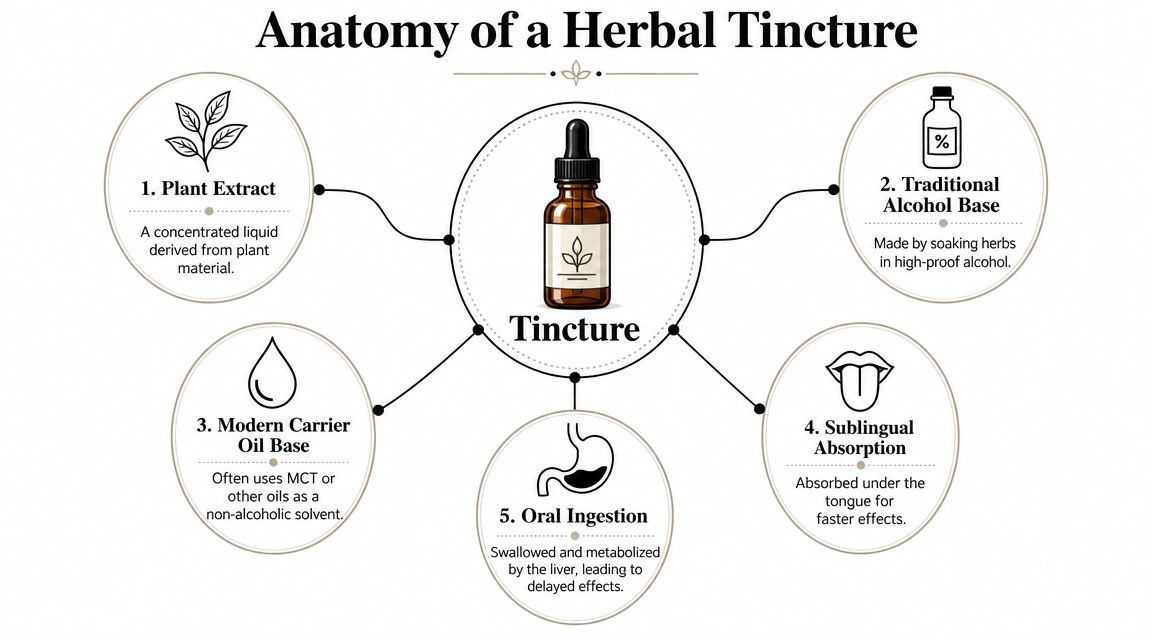
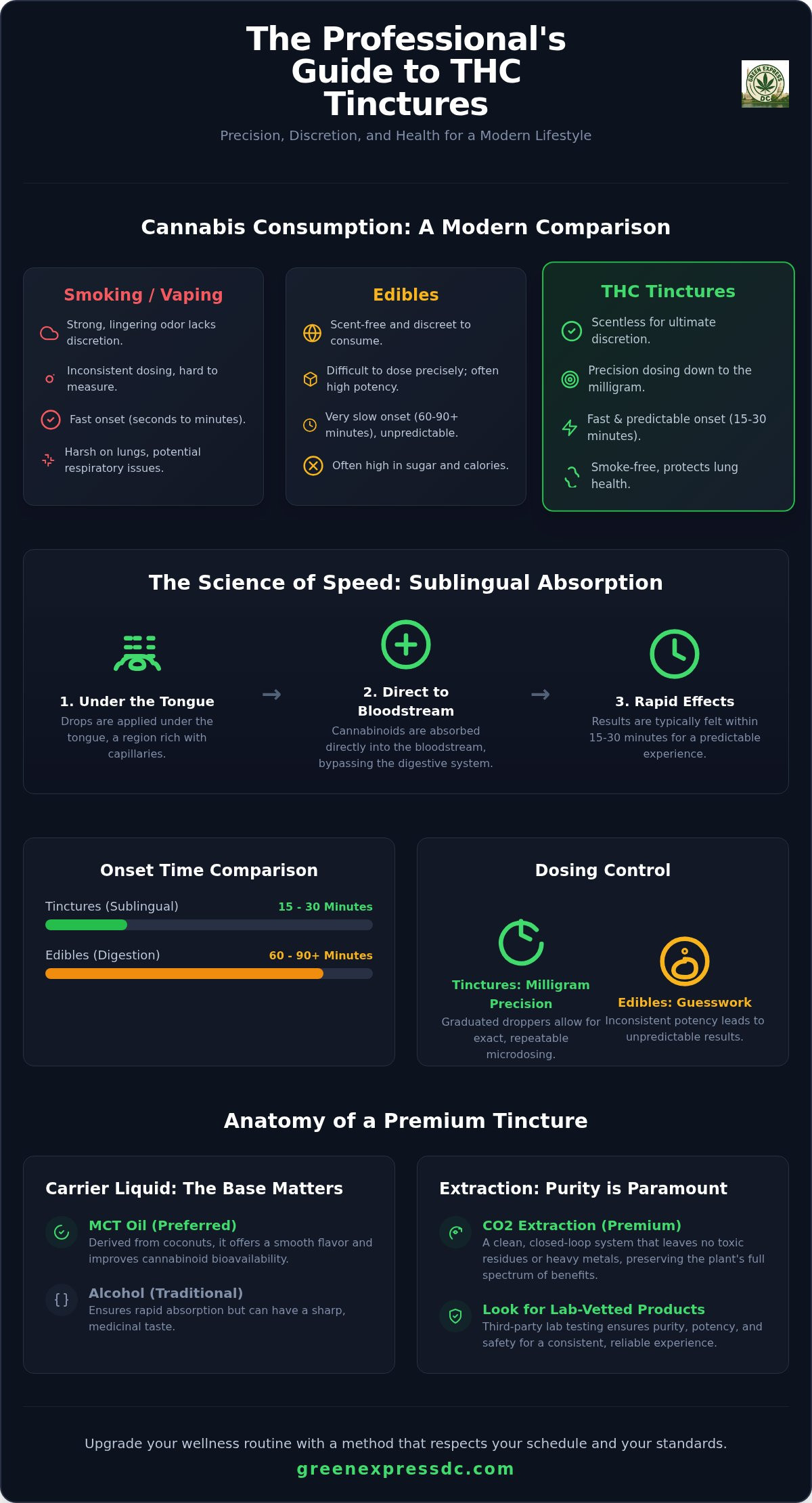
A THC tincture is a concentrated liquid extract designed for precision and efficiency. Unlike traditional smoking, this format uses a carrier liquid, typically high-grade MCT oil or food-grade alcohol, to suspend cannabinoids in a shelf-stable solution. If you are researching What is a THC Tincture?, you’ll find it was the primary delivery method for medical cannabis in the United States throughout the 19th century. Today, the resurgence of this format is driven by professionals who require a clean, measurable experience. Utilizing a premium thc tincture delivery dc service ensures you receive a product that meets these exacting standards.

Tinctures are distinct from standard cannabis oils or RSO. While oils are often thick and intended for ingestion, tinctures are specifically formulated for sublingual use. They also differ from edibles because they don’t rely solely on the digestive system. The integrated dropper acts as a precision tool. It allows you to control your experience down to the milligram. This level of accuracy is impossible with flower or generic gummies. It makes microdosing simple and repeatable.

Alcohol-Based vs. Oil-Based Tinctures

The choice of carrier liquid significantly impacts your experience. Alcohol-based tinctures are the traditional choice. They offer rapid absorption but often carry a sharp, medicinal taste. Most modern users prefer MCT oil bases. Derived from coconuts, MCT oil provides a smooth flavor profile and excellent shelf stability. These healthy fats also help your body process cannabinoids more efficiently. This improves the overall bioavailability of the THC, ensuring you get the most out of every drop.

The Extraction Process: Purity and Potency

Quality begins with the extraction method. Premium brands prioritize CO2 extraction because it leaves no toxic residues or heavy metals. This method uses pressurized carbon dioxide to pull cannabinoids and terpenes from the plant material. It is a clean, closed-loop system that preserves the “entourage effect.” This means you get the full spectrum of the plant’s benefits rather than a flat, isolated high. When you order thc tincture delivery dc, always look for products that undergo rigorous lab vetting to confirm these purity levels. Verified sourcing is the only way to guarantee a safe and consistent outcome.

Key THC Tinctures Benefits: Why Professionals are Switching

Modern cannabis use focuses on efficiency and control. Professionals are moving away from traditional methods because they require absolute reliability. Tinctures offer a calorie-free alternative to sugary gummies or brownies. You’ll get the therapeutic benefits without unwanted glucose spikes or dietary interruptions. They also provide a significantly extended shelf life. While flower degrades over time and baked goods quickly go stale, a high-quality tincture remains potent for many months. This longevity makes it a cost-effective and dependable choice for those who value long-term consistency.

Sublingual Absorption: The Science of Speed

Speed is essential for a busy schedule. When you apply drops under the tongue, the liquid interacts with mucous membranes. This allows THC to enter your bloodstream directly. You’ll avoid the “first-pass metabolism” of the liver that slows down other methods. Most users experience effects within 15 to 30 minutes. In contrast, standard edibles often take 60 to 90 minutes to manifest. Understanding what you need to know about cannabis absorption helps you plan your day with confidence. Sublingual bioavailability is defined as the specific percentage of THC that reaches systemic circulation after bypassing the digestive tract.

Precision Dosing and Microdosing

Precision is the primary hallmark of the tincture experience. The included graduated dropper allows you to measure your intake down to the milligram. This is vital for establishing a “functional baseline” during a busy work week. You can find the exact amount that provides relief or focus without the risk of over-impairment. Adjusting your dose by a single drop enables incremental changes that are impossible with high-potency edibles. You effectively eliminate the “all-or-nothing” risk often associated with homemade or poorly labeled products. This level of control is why many high-performers utilize a thc tincture delivery dc service to maintain their wellness routines with total confidence.

Reliability matters when your reputation and productivity are on the line. Choosing a trusted source ensures that the milligram count on the label matches the liquid in the bottle every time. If you’re ready to upgrade your routine, you can view our premium menu to find the right strength for your needs. Fast, discreet thc tincture delivery dc options make it easy to stay stocked without the need for a physical store visit.

A Health-Conscious Choice: Tinctures vs. Smoking and Vaping

Choosing a health-conscious delivery method is a priority for the modern consumer. Smoking or vaping involves high temperatures and the inhalation of particulate matter. Tinctures eliminate these respiratory risks entirely. There is no smoke, no vapor, and zero lung impact. You receive pure cannabinoids without the carbon monoxide produced by combustion. This results in what many describe as a cleaner experience. It avoids the heavy, foggy sensation often associated with traditional smoking. You can maintain mental clarity while still achieving the desired therapeutic effects.

Tinctures are also the ideal choice for those with strict dietary requirements. Most edibles are loaded with sugars, corn syrup, or gluten. A premium tincture consists only of a carrier oil and cannabis extract. This makes it a safe, dietary-friendly option for anyone managing sensitivities or following a ketogenic lifestyle. It provides a streamlined way to integrate wellness into your life without the unwanted calories. For professionals weighing their options, understanding the full comparison of edibles vs tinctures DC can help clarify which format best supports your nutritional standards and daily performance goals. It is the most efficient way to consume cannabis without compromising your nutritional standards.

Protecting Your Lung Health

Many long-term cannabis users are migrating away from flower to preserve their cardiovascular health. Joints and pipes introduce carcinogens and tar into the lungs. Tinctures provide the same therapeutic benefits without the damage. This is especially appealing for athletes and fitness-focused professionals who need their lungs at peak capacity. Utilizing a reliable thc tincture delivery dc service allows you to maintain your wellness goals without compromising your physical performance. It is a strategic shift toward long-term vitality and respiratory wellness.

Purity and Lab Testing Standards

Safety requires transparency. Concentrated liquid products must be free from contaminants to be effective. We prioritize lab-tested cannabis to ensure every bottle is free from heavy metals, pesticides, and residual solvents. You should always review a Certificate of Analysis (COA) before purchasing. A COA confirms the exact potency and purity of the batch. Organic sourcing is equally vital. Because tinctures are concentrated, any impurities in the original plant material would also be concentrated. Choosing a professional thc tincture delivery dc provider guarantees that your product is sourced from top-shelf, organic plants. This commitment to quality control provides peace of mind with every dose.

The Science and Lifestyle Benefits of THC Tinctures: A Comprehensive Guide

Integrating Tinctures into a Professional Routine

Professionals demand tools that complement their lifestyle rather than disrupting it. THC tinctures offer total discretion for those who value privacy. These products look identical to standard wellness supplements or high-end essential oils. You can maintain your routine without drawing unwanted attention in professional environments. There is zero odor involved. You won’t need to worry about lingering smells on your clothes, in your hair, or throughout a shared office space. The compact, leak-proof bottles fit easily into a leather briefcase or a gym bag. This makes them perfectly travel-ready for a busy commute across the District.

Versatility is a standout benefit for the time-sensitive individual. You can apply drops directly under the tongue for the fastest results or incorporate them into existing habits. Many users add a precise dose to their morning coffee to start the day with focus. Others prefer a calming evening tea to unwind after a high-stakes meeting. This flexibility allows you to manage your wellness on your own terms without secondary equipment. Utilizing a reliable thc tincture delivery dc service ensures you always have a fresh, lab-tested supply ready for any situation.

The Discretion Advantage

High-density DC living environments like apartment buildings often lack privacy. Tinctures eliminate the risk of smoke or vapor traveling through ventilation systems and alerting neighbors. You can enjoy the benefits of cannabis in your own home with complete peace of mind. It is a more refined social choice than stepping out to smoke. This method respects the shared spaces of the city while providing you with the relief you need. For more tactical advice, see our professional’s guide to discreet cannabis. It highlights how to maintain a high-performance lifestyle with subtle wellness choices.

How to Use Tinctures Effectively

Proper application maximizes the efficiency of every drop. Place the desired dose under your tongue and hold it for at least 60 seconds before swallowing. This window allows for maximum sublingual absorption directly into the bloodstream. It’s helpful to understand the “second wave” of effects. Any liquid you swallow is eventually processed by the liver. This portion acts like a traditional edible, providing a sustained effect that manifests later than the initial sublingual onset. To prevent light degradation and oxidation, store your tincture in its original amber bottle in a cool, dark cabinet. Maintaining these standards ensures the potency remains consistent from the first drop to the last.

Efficiency is the hallmark of a successful routine. Order from our curated menu to experience the speed and privacy of our thc tincture delivery dc service.

Sourcing Premium THC Tinctures in Washington, DC

Sourcing high-quality cannabis in the District requires a discerning eye and a commitment to safety. The local market is often flooded with “grey market” vendors who lack transparency regarding their sourcing and testing protocols. For the modern professional, these risks are unacceptable. You need a thc tincture delivery dc service that operates with the precision of a high-end concierge. Choosing a trusted provider ensures that your wellness products are safe, potent, and accurately labeled. Professional services prioritize quality control. They remove the guesswork from the procurement process and provide a level of reliability that casual retail interactions simply cannot match.

Same-day delivery has become the gold standard for busy individuals who value their time. You shouldn’t have to navigate crowded storefronts or wait days for a refill. A premium service provides a streamlined, tech-forward solution that respects your schedule. It offers an efficient experience that matches the fast-paced nature of the District. This logistical ease allows you to maintain your wellness routine without any disruption to your productivity or privacy.

Delivery Neighborhoods and Logistics

Reliability is our hallmark. We serve the heart of the District, providing consistent support to clients in Capitol Hill, Adams Morgan, and Shaw. We understand that many professionals commute from outside the city limits. Our reach extends to Northern Virginia, offering reliable delivery to Arlington and Alexandria. Your schedule doesn’t stop at 5 PM. Our 24/7 ordering system allows you to secure your products whenever it’s most convenient for you. This flexibility ensures you’re never without your essential tools, regardless of how demanding your work week becomes. We focus on speed and accuracy to ensure your order arrives exactly when you expect it.

The Green Express DC Difference

We maintain a rigorous commitment to excellence for our discerning clients. Every bottle in our inventory is lab-verified for purity and potency. We focus exclusively on organic, top-shelf sourcing to protect your long-term health. Our couriers are trained professionals who prioritize your privacy. They arrive in discreet vehicles and conduct themselves with the utmost professionalism. You can explore our full range of edibles and tinctures to find the perfect addition to your daily routine. We provide a seamless experience from the first click to the final drop. Order your premium THC tincture from Green Express DC today to experience the gold standard of thc tincture delivery dc.

Elevate Your Wellness Routine with Precision

Transitioning to THC tinctures represents a strategic upgrade for your high-performance lifestyle. You’ve learned how sublingual absorption provides rapid, predictable results that integrate seamlessly into a professional schedule. This method protects your respiratory health while offering a level of discretion that traditional smoking or vaping cannot match. By choosing lab-verified extracts, you eliminate the risks associated with unverified vendors and focus on pure, organic quality. You deserve a cannabis experience that is as disciplined and refined as your career.

Securing a reliable thc tincture delivery dc provider is the final step in refining your wellness routine. We offer top-shelf organic products backed by rigorous safety testing for total peace of mind. Our professional couriers ensure same-day delivery across DC, Arlington, and Alexandria, respecting both your time and your privacy. You can now manage your therapeutic needs with the precision and sophistication you demand. Shop Lab-Tested THC Tinctures for Same-Day DC Delivery to experience a new standard of efficiency and quality. It’s time to enjoy the benefits of cannabis on your own terms.

Frequently Asked Questions

How long do the effects of a THC tincture last?

Tincture effects typically last between four and six hours. This duration varies based on whether you absorb the liquid sublingually or swallow it. Sublingual application provides a faster peak, while the swallowed portion provides a sustained release through the digestive tract. Your individual metabolism and the total dosage will also influence how long the experience remains active throughout your day.

Will a THC tincture make me smell like cannabis?

No, using a tincture will not result in the recognizable scent of cannabis. There is no smoke or vapor produced, so no odor attaches to your clothing, skin, or hair. This makes tinctures an ideal choice for professionals who require total discretion in the office or at social events. It is a completely scentless method of consumption that respects your personal presentation.

Can I mix my THC tincture with food or drinks?

You can certainly mix your tincture into various foods and drinks. Many users prefer adding their dose to a morning coffee, a smoothie, or an evening tea for a seamless experience. Be aware that mixing with food changes the onset time. The cannabinoids must pass through your digestive system, which extends the wait time to 60 or 90 minutes for full effects.

What is the best way to store my tincture bottle?

The best storage method is a cool, dark cabinet or drawer away from heat sources. Most premium products use amber or cobalt glass bottles specifically to block light degradation. Exposure to direct sunlight or high temperatures can cause the cannabinoids to break down, which reduces the overall potency. Always ensure the dropper cap is tightened securely to prevent oxygen from entering and degrading the oil.

How many drops of THC tincture should a beginner take?

Beginners should start with a conservative dose of 2.5mg to 5mg of THC. This usually equates to one or two drops, but you must check the specific concentration on your bottle first. It is vital to wait at least 90 minutes to gauge the effects before taking more. Utilizing a professional thc tincture delivery dc provider ensures you have access to lab-tested products with clear, accurate milligram labeling.

Is tincture delivery legal in Washington, DC?

Tincture delivery is legal in Washington, DC, for adults aged 21 and over. Licensed services deliver medical cannabis to registered patients under ABCA regulations. For recreational users, the “gifting” model allows for the legal acquisition of tinctures when purchased alongside non-cannabis items. Our thc tincture delivery dc service follows all local guidelines to provide a secure and transparent experience for every client we serve.

What is the difference between a CBD tincture and a THC tincture?

The main difference lies in the psychoactive properties of the cannabinoids. THC is the compound responsible for the “high” associated with cannabis. CBD is non-intoxicating and is typically used for wellness benefits without any mental impairment. Many high-end tinctures are full-spectrum, meaning they contain a variety of cannabinoids to create a more effective and balanced therapeutic result for the user.

Are tinctures more potent than gummies?

Tinctures are often more effective than gummies due to their superior bioavailability. When you apply a tincture sublingually, the THC enters your bloodstream directly through the mucous membranes. Gummies must be broken down by the liver, which results in a lower percentage of cannabinoids reaching your system. This means you can often achieve a more powerful and faster result with a smaller dose of tincture. If you currently rely on edibles and want to understand how strain-based labeling affects your experience, our guide on indica vs sativa edibles provides expert insight into dosing, effects, and how chemical profiles influence your body. For a deeper breakdown of how these two formats compare across onset time, duration, and potency, our guide on edibles vs tinctures DC provides a comprehensive analysis for the discerning professional.

Posted on

A Complaint Resolution Process for Cannabis Delivery

A customer orders a vape cart for the evening. The driver arrives late, the bag has the wrong item, and nobody answers the first text. In most delivery businesses, that's a customer service problem. In cannabis delivery across DC, Maryland, and Virginia, it can also become a documentation problem, a compliance problem, and a reputation problem within a few minutes.

That's why a real complaint resolution process matters. Not a loose habit of “we'll make it right,” and not a shared inbox that only gets checked when someone remembers. If you run or support a weed delivery operation in the DMV, complaints need structure, ownership, and rules. The legal environment is too uneven, the customer expectations are too high, and the margin for sloppy handling is too small.

Why a Formal Complaint Process Is Non-Negotiable

The common failures are predictable. A customer says the order is missing an item. The dispatcher asks the driver. The driver says the bag left complete. Nobody checks the packing notes. Nobody timestamps the callback. The customer gets three different answers from three different people. By the end of the night, the original issue is smaller than the confusion your team created.

That's what a formal complaint resolution process prevents. It gives staff one place to log the issue, one owner for the next action, and one standard for what “resolved” means.

What goes wrong without a system

In cannabis delivery, bad complaint handling creates extra risk because the transaction is already more sensitive than ordinary retail. You're dealing with age verification, delivery timing, product handling, and jurisdiction-specific rules. A loose process makes small mistakes harder to prove or disprove.

A formal process protects the business in three ways:

  • It preserves facts early: Order number, delivery time, driver notes, customer contact, and the exact complaint are captured before memories shift.
  • It limits inconsistent promises: Staff stop improvising refunds, redeliveries, and apologies that don't match policy.
  • It creates a record for compliance review: If a dispute later touches delivery boundaries, order verification, or customer eligibility, your team has documentation.

For operators working in the District, this is tied directly to legal discipline. DC delivery sits inside a narrow framework, and if your team handles disputes casually, they can say the wrong thing, refund the wrong part of a transaction, or describe the order in a way that creates avoidable exposure. Businesses that need a clearer view of those risks should understand the legal compliance issues for DC cannabis delivery before they build their response policies.

Practical rule: If a complaint can't be reconstructed from your system the next day by someone who wasn't on shift, you don't have a process. You have memory.

Complaints are also a retention system

Customers don't expect perfection from delivery. They expect honesty, speed, and a reasonable fix. That's especially true in a market where many buyers are still figuring out what's normal, what's legal, and how to judge a trustworthy operator.

A structured complaint resolution process does more than calm people down. It signals that the business is organized. The customer sees that the team logs issues, checks facts, follows up, and closes the loop. That's what turns a bad order from a churn event into a service recovery moment.

The strongest operators treat complaints as operational input. Wrong item complaints expose packing weaknesses. Late delivery complaints expose routing or dispatch problems. “No update” complaints usually reveal communication gaps, not transportation problems.

The cost of staying informal

An informal approach feels fast at first. It usually becomes slow later. Staff repeat questions, managers get dragged into avoidable disputes, and customers escalate because nobody gave them a clean answer the first time.

That's unsustainable in the DMV. DC has one model. Maryland has another. Virginia requires caution. If your complaint handling doesn't match that reality, growth only multiplies confusion.

Designing Your Complaint Intake System

If intake is messy, the rest of the complaint resolution process will stay messy. Good teams don't wait for the perfect software stack. They build a reliable intake lane that captures the right facts on the first touch.

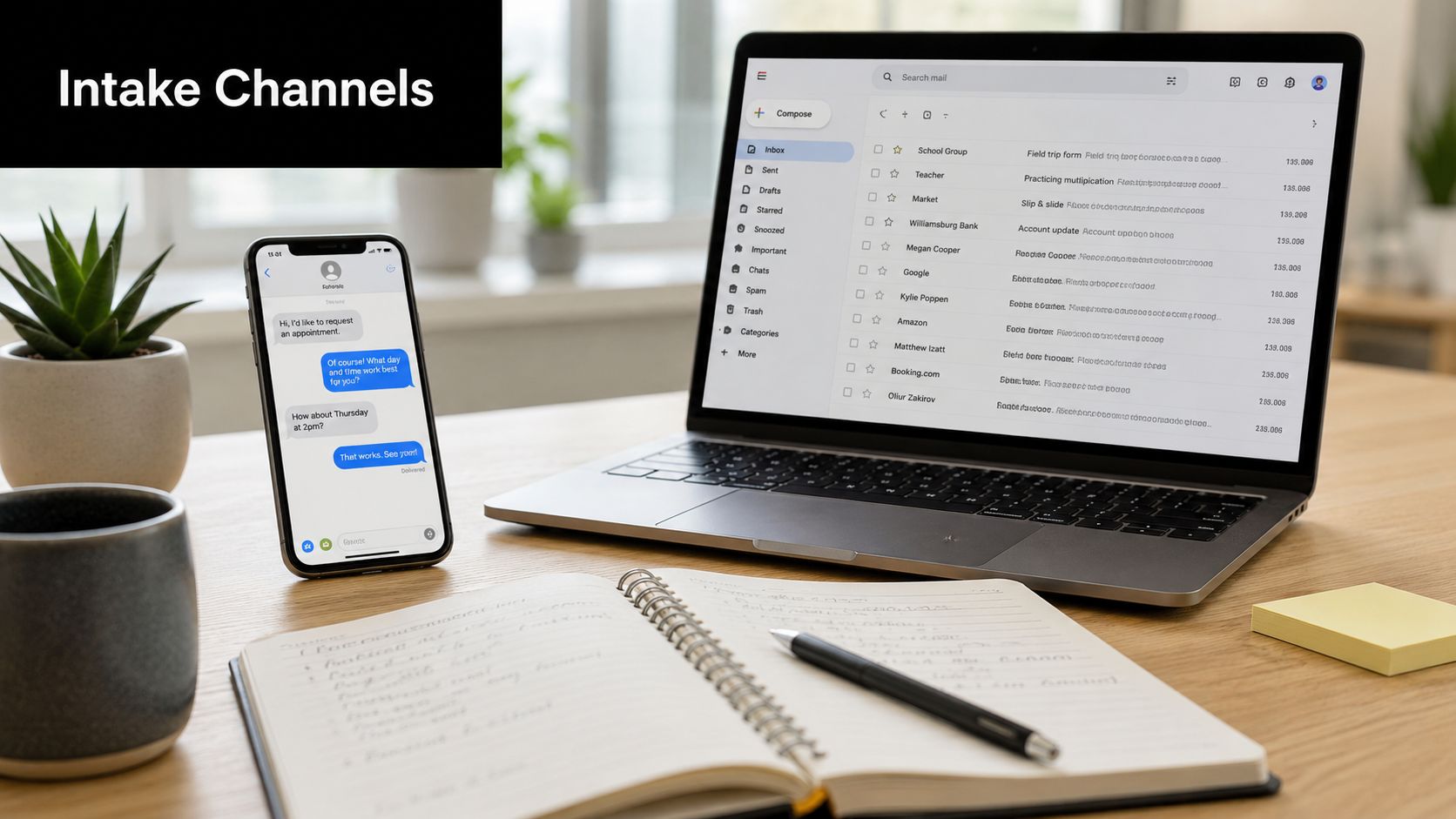
An office desk featuring a smartphone displaying a messaging conversation, a laptop showing an inbox, and a notebook.

Use multiple channels, but one record

Customers complain through whatever channel feels fastest to them. Usually that means text first, then phone, then email if they're already annoyed. Your system should accept complaints from all of them, but every complaint must end up in one internal record.

The practical setup is simple:

  • Phone: Best for urgent issues like wrong orders, missing items, or delivery confusion at the door.
  • Text message: Best for customers who want quick acknowledgment and easy photo sharing.
  • Email: Best for quality complaints, follow-up summaries, and written resolution confirmation.
  • Website form: Best for standardized intake when the customer isn't in an immediate time crunch.

The mistake is treating each channel as separate work. They aren't. They're just different entry points into the same log. If you already use a customer-facing ordering workflow, tie complaint intake as closely as possible to that system. A dedicated support ticket flow for delivery customers keeps complaints from getting buried in personal phones or scattered inboxes.

Capture only what you need to act

Don't make people fight a form just to report a bad order. Intake should gather enough information to verify the complaint and start triage, not build a legal brief.

At minimum, log these fields:

  1. Order identifier
  2. Customer name used on the order
  3. Best callback number or email
  4. Complaint type
  5. Short description in the customer's own words
  6. Time complaint was received
  7. Assigned staff owner
  8. Any supporting photo or screenshot

For cannabis delivery, verification matters. Staff should confirm identity by matching the complaint to order history and delivery details already on file. They shouldn't demand unnecessary personal data that the business doesn't need for resolution.

Acknowledge fast and sound human

The first reply does two jobs. It reassures the customer that someone is working the issue, and it preserves control of the conversation before frustration spills into repeated messages or public posts.

A strong acknowledgment script sounds like this:

“Thanks for reaching out. I've logged your complaint under your order details and I'm reviewing it now. If you have a photo of the item or bag, please send it in this thread. We'll update you after the first review.”

That works because it is clear, calm, and specific. It doesn't admit facts you haven't checked. It doesn't promise a fix you may not be able to offer. It tells the customer what happens next.

Build intake for speed, not theater

A lot of businesses over-design intake. They add too many categories, too many required fields, and too many approval layers. Staff then work around the system because it's slower than texting each other.

Keep the intake categories tight. Typical categories for weed delivery are enough:

  • Order accuracy
  • Missing item
  • Late delivery
  • Product quality concern
  • Driver conduct
  • Payment or charge issue
  • Verification or ID dispute

A complaint record should help the next person act. If it only helps management count things later, it's badly designed.

Triage and Prioritization for Fast Resolution

Once a complaint is logged, speed depends on how well your team triages it. It is at this stage that many delivery operations stall. They treat every complaint as equally urgent, or they let the loudest customer jump the queue. Neither works.

True frontline resolution should happen quickly and transparently. According to the Ethical Standards Commissioner guidance on complaint handling, true frontline resolution must be completed within five working days, and 40% of consumers abandon complaints when the process feels opaque or too slow. For a delivery business, that means customers need to know whether the issue is still at the frontline stage or has moved higher.

Sort by risk, not by emotion

I've found that a simple three-level model works best in delivery operations:

  • Normal: Inconvenient but contained. The customer is affected, but there's no immediate compliance or safety concern.
  • High: Service failure with stronger customer impact or a strong chance of repeat contact if mishandled.
  • Critical: Complaint with legal, boundary, identity, or serious conduct implications. Management should see it fast.

This model keeps frontline staff from over-escalating routine delivery friction while ensuring the dangerous issues don't sit in a queue.

Complaint Triage and Prioritization Matrix

Complaint Type Example Severity Level Initial Owner
Wrong product Customer ordered one vape cart and received another High Dispatch lead or order support
Missing item Bag arrives without one listed item High Packing lead or shift supervisor
Late delivery Driver arrives well after expected window with no update Normal Dispatch
Product quality concern Customer reports an issue with flower, edible, or concentrate condition High Manager or quality lead
Driver professionalism Customer reports rude behavior or poor communication High Delivery supervisor
ID or age verification dispute Customer challenges refusal or verification handling Critical Manager
Boundary or location issue Delivery request appears to involve movement outside the lawful service area Critical Manager or legal point person

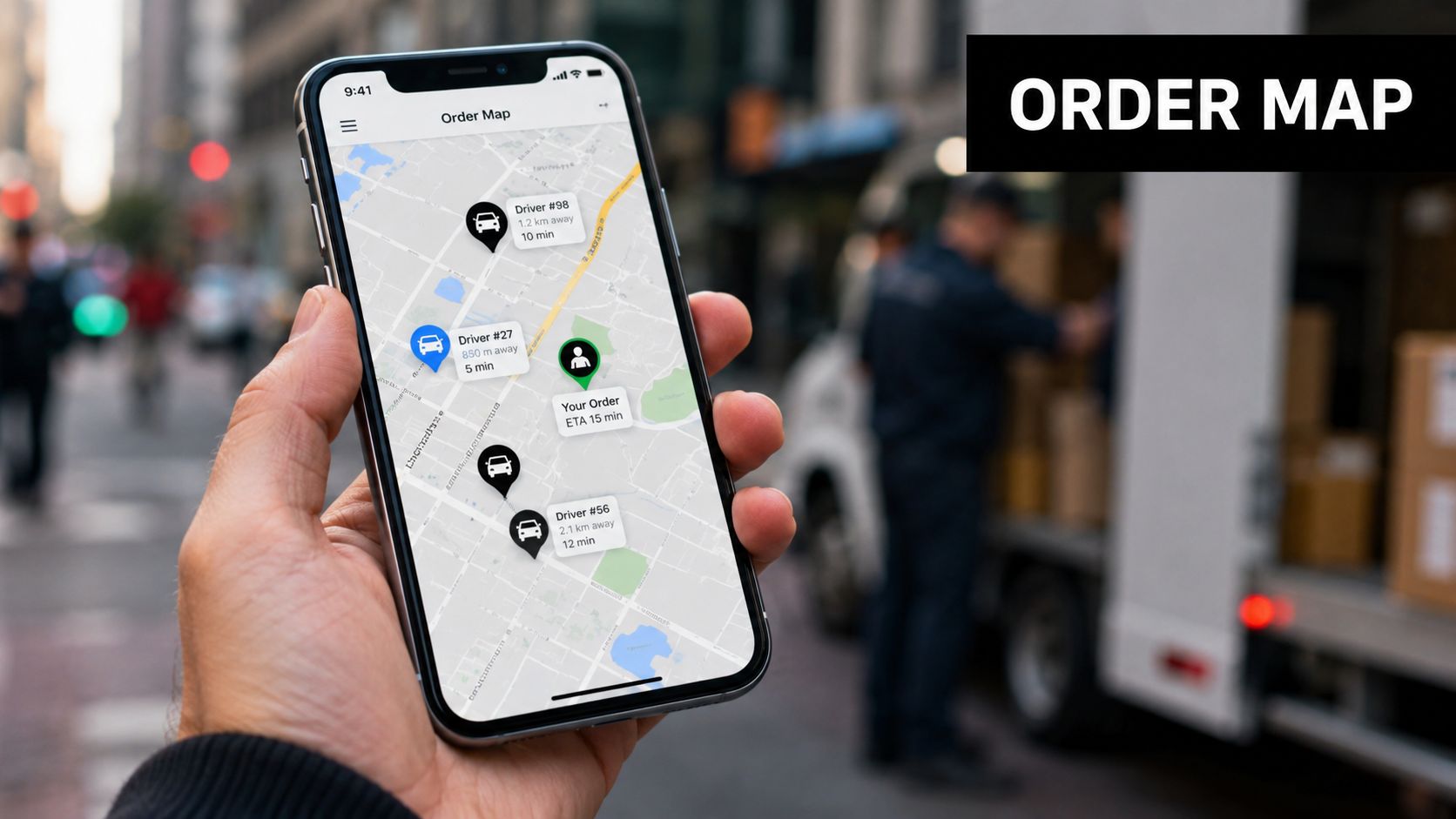
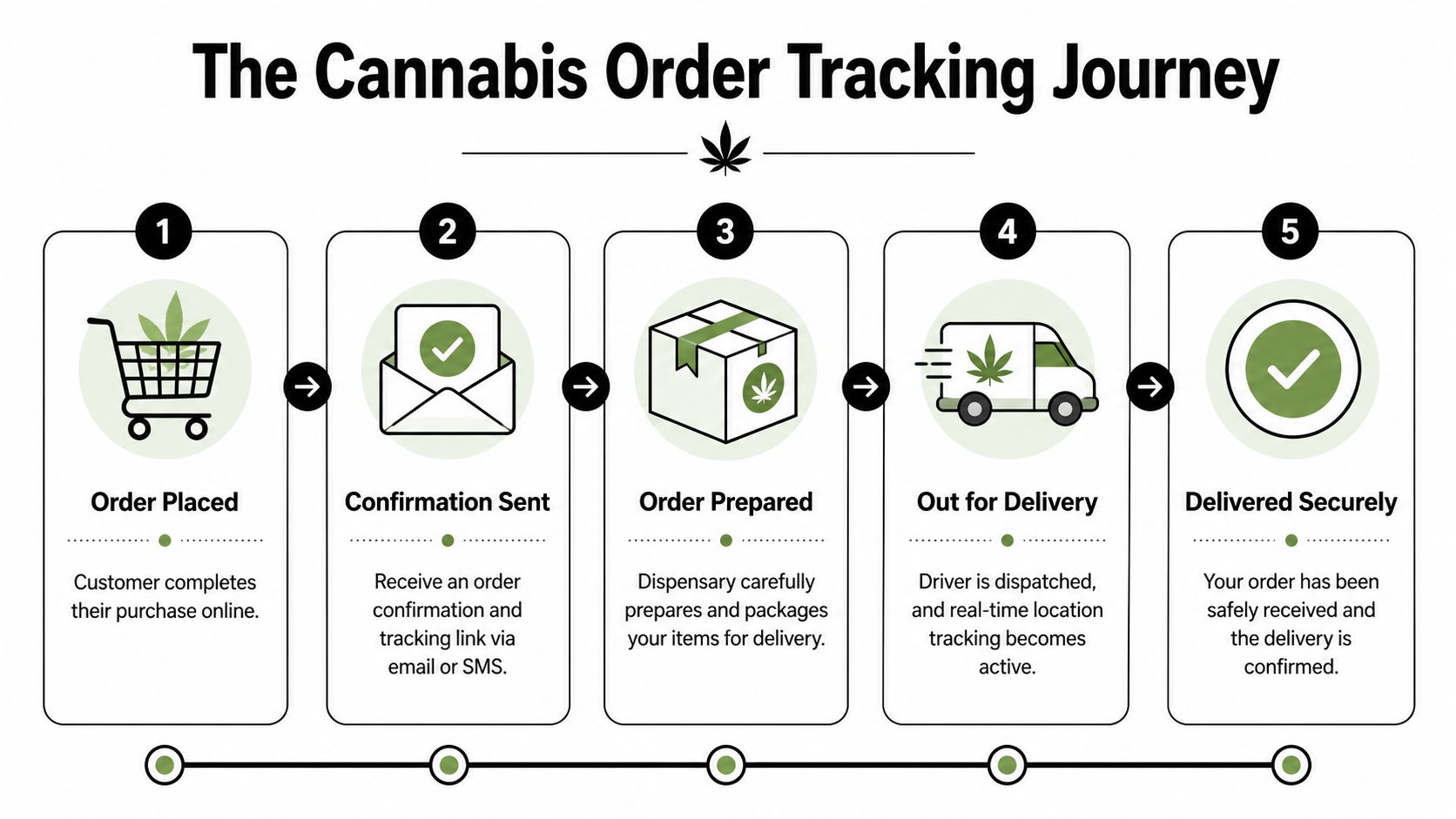
One supporting tool here is real-time visibility. If dispatch can't see where an order sits, they can't separate a late delivery from a communication failure. A tighter order tracking system for delivery operations gives staff something better than guesswork.

Assign one owner immediately

A complaint without an owner becomes a group chat topic. That's when details get lost.

Use these rules:

  • Dispatch owns timing issues first
  • Packing or fulfillment owns item accuracy questions
  • A supervisor owns conduct complaints
  • A manager owns legal or jurisdiction-sensitive complaints

The owner doesn't have to solve everything alone. They do have to move the complaint forward and keep the record current. That distinction matters. Customers don't care which team touched the issue. They care whether one person is accountable.

Tell customers the current stage plainly. “I'm reviewing this now” is better than silence. “This has been escalated to a manager for review” is better than pretending it's still in frontline handling.

Investigation Workflows and Resolution Tactics

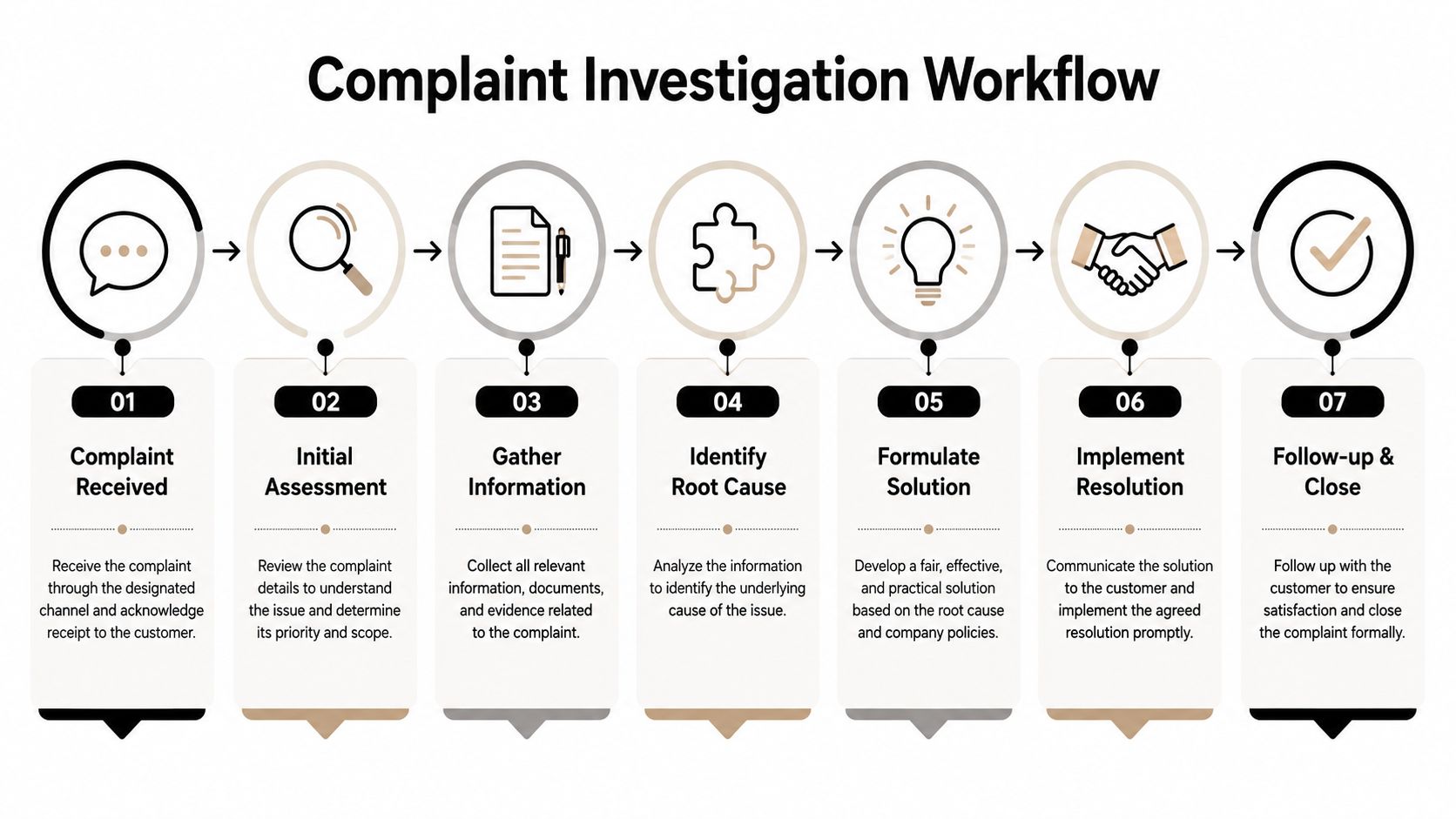
Most complaints become easier once the team stops debating and starts checking records. A missing item claim needs a different investigation path than a late delivery complaint. A quality complaint needs different evidence than a driver conduct complaint. The best complaint resolution process reflects that reality instead of pushing every issue through the same script.

A seven-step flowchart illustrating the professional complaint investigation workflow from receiving to closing a complaint.

Start with the facts that already exist

For a missing item, staff should check the original order contents, packing notes, any bagging checklist, and the driver's inventory handoff record. If the customer sent a photo of the delivered bag, compare that against the order before anyone starts arguing over memory.

For a late delivery, review dispatch timestamps, driver status updates, route notes, and any customer communication already sent. Many “late” complaints are really “nobody updated me” complaints. The fix is different.

For a wrong product, compare the order confirmation against the fulfillment record and any SKU or item label history you maintain. This is usually a pick-and-pack error, not a driver problem.

For driver professionalism, get the customer statement first, then the driver account, then dispatch notes. Don't force the customer to repeat the same story to multiple people. Log it once and investigate from there.

Match the remedy to the failure

Not every complaint deserves the same resolution. Teams get into trouble when they over-correct simple inconvenience or under-correct a clear service failure.

A practical decision path looks like this:

  • Use an apology when the issue is minor, the service was completed, and the customer mainly lacked communication.
  • Use a replacement when the wrong item or a missing item can be corrected cleanly within policy.
  • Use a refund or credit when redelivery isn't practical, the customer no longer wants the item, or the trust break is larger than the original mistake.
  • Escalate before offering anything when the complaint touches legality, jurisdiction, age verification, or a dispute over what was delivered.

Notice that this isn't about being generous or strict. It's about choosing a remedy that fits the cause and can be documented clearly afterward.

First-contact resolution changes the outcome

The reason frontline staff authority matters is simple. According to Citizens Advice research on complaint handling%20(1).pdf), when a complaint is resolved at the initial stage, 90% of customers report being extremely satisfied. That's the operational case for giving trained staff enough authority to fix ordinary problems without waiting for a manager.

Customers rarely judge you only by the original mistake. They judge how many times they had to ask for help before someone took ownership.

That doesn't mean frontline staff should freestyle. It means they should have pre-approved options for common failures, with clean limits and clear notes.

Use language that closes the issue, not inflames it

Resolution messages should be plain and specific. Good examples:

“I checked your order and confirmed the item mismatch. We can correct that with a replacement under our standard process, and I'm logging this under your order record now.”

“I reviewed the dispatch notes. Your order was delayed and you should have received an update sooner. I'm sorry about that. Here is the resolution we can offer today.”

Avoid defensive phrases like “our policy says” as the opening line. Policy matters, but customers need acknowledgment before they need citation. Staff should explain the result, the reason, and the next step in that order.

Building Escalation Paths and Training Your Team

A complaint system breaks when frontline staff either escalate everything or escalate nothing. Both patterns create cost. The first clogs management with routine work. The second leaves serious issues in the hands of people who shouldn't carry them alone.

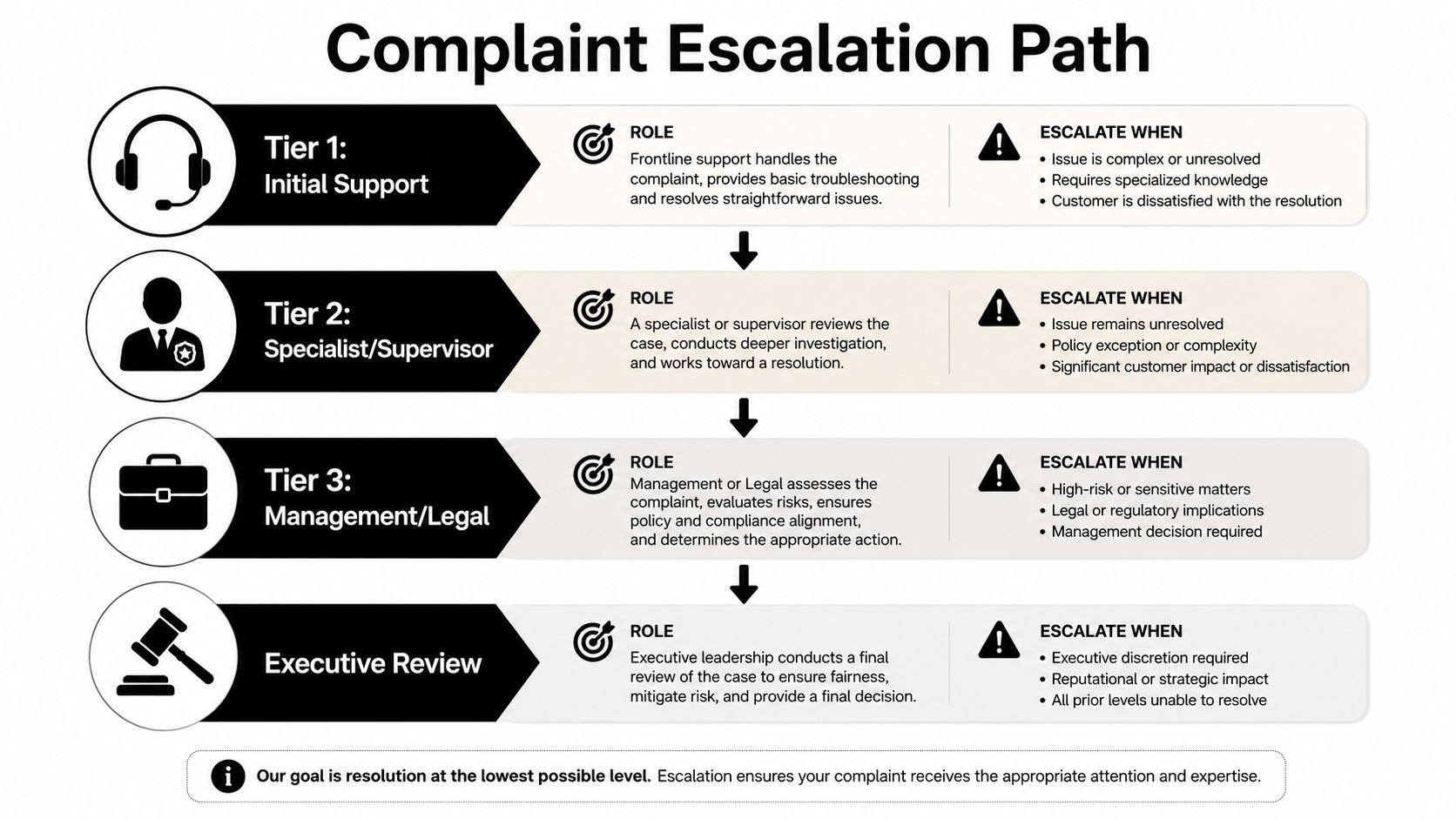
A flowchart diagram illustrating the four-step complaint escalation process from initial support through to final executive review.

Build a simple path with real authority

Most delivery teams don't need a complex org chart. They need a path that staff can remember during a busy shift.

A workable structure is:

  1. Tier 1 initial support
    This is dispatch, phone support, or the person monitoring complaint intake. They verify the order, log the issue, gather evidence, and resolve routine service failures within approved limits.

  2. Tier 2 supervisor or specialist
    This level handles disputed facts, repeat complaints, stronger customer dissatisfaction, and issues involving staff conduct or product concerns that need judgment.

  3. Tier 3 management or legal review
    This level takes anything involving jurisdiction, age verification conflict, service area boundaries, repeated policy exceptions, or language that could create regulatory exposure.

  4. Executive review
    Reserved for the rare complaints with broad business risk, repeated process failure, or major customer relationship impact.

Put the triggers in writing. “Ask for a manager” is a trigger. “Customer rejects the proposed resolution” is a trigger. “Possible delivery outside lawful boundaries” is a trigger.

The short training video below is a useful reminder that escalation works best when staff know where their authority ends.

Train for judgment, not scripts alone

Scripts help. They don't replace judgment. A strong complaint resolution process depends on staff understanding why the process exists and what a good outcome looks like.

Training sessions should include:

  • Role-play on common failures: Wrong item, missing item, late delivery, poor communication, and refusal scenarios tied to verification or location.
  • Documentation drills: Staff should practice turning a messy call into a clean complaint record.
  • Resolution authority limits: Everyone should know what they can approve on the spot and what requires review.
  • De-escalation language: Calm, neutral wording beats defensive policy recitations.
  • Jurisdiction awareness: Staff must know that DC, Maryland, and Virginia cannot be handled with the same assumptions.

Measure the frontline team on the right thing

A frontline team needs one benchmark that matters enough to shape behavior. According to Arthur D. Little guidance on resolving customer complaints, a high-performance process requires a First Contact Resolution benchmark of 80% or higher. That benchmark only works when frontline staff do have the knowledge and permission to solve ordinary complaints.

Use that insight carefully. Don't turn it into pressure to close complaints before they're resolved. The point of FCR is not to make numbers look clean. The point is to prevent unnecessary handoffs.

Manager's note: Reward staff for accurate resolution and complete documentation together. Fast but sloppy handling creates second complaints.

What training should look like in practice

Run short sessions often instead of holding one long annual lecture. Complaint handling is operational muscle memory. Teams learn faster when they review real examples from the prior week, compare how each person would classify the issue, and discuss where the handoff should have happened.

The best teams also review closed complaints for lessons. If three separate customers complain about delayed updates, that isn't a customer service coincidence. It's a dispatch communication problem wearing three different names.

Navigating Compliance in DC Maryland and Virginia

Generic complaint advice falls apart in the DMV because the legal structure is not uniform. The same customer issue can require different wording, different documentation, and a different resolution path depending on whether the order touches DC, Maryland, or Virginia.

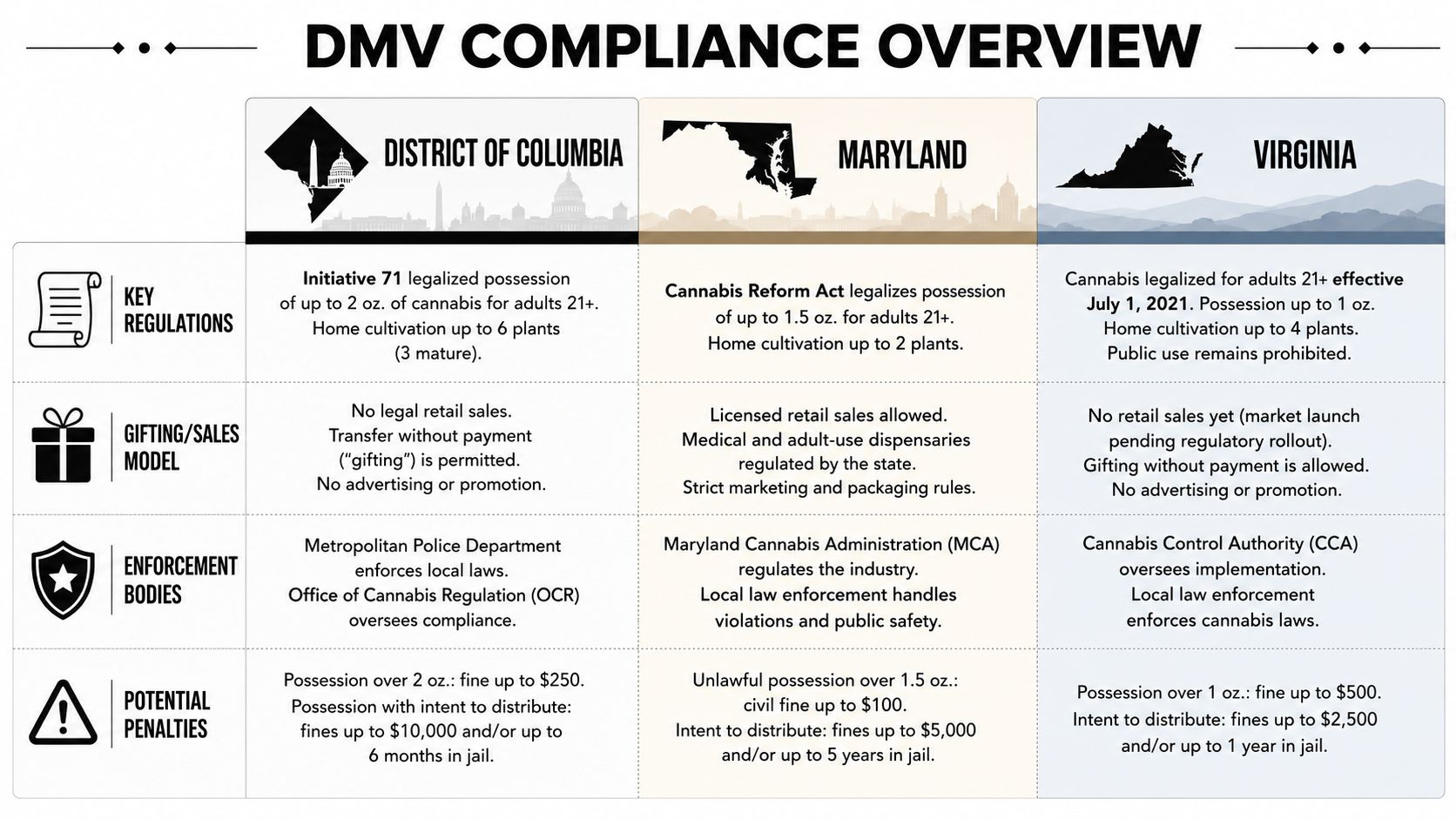
A comparison chart outlining cannabis compliance regulations in Washington DC, Maryland, and Virginia for consumers.

DC requires special care in how complaints are framed

In Washington, DC, delivery operates through Initiative 71's gifting framework, where cannabis is provided as a gift alongside a purchased non-cannabis item, and transporting cannabis across state lines, including into Maryland or Virginia, remains a federal crime, as explained in this overview of DC cannabis delivery rules.

That has direct consequences for complaint handling. In DC, staff should be trained to describe disputes with precision. Focus resolution records on the order, delivery service, fulfillment accuracy, customer communication, and the purchased non-cannabis component where applicable. Casual language can create unnecessary risk if your staff talks about the transaction the wrong way.

A second rule is geographic discipline. Delivery complaints often surface location facts. If a customer says they were trying to receive delivery outside lawful boundaries, this should move out of routine support and into management review. Staff should never improvise around cross-border requests.

Maryland allows a more conventional retail complaint model

Maryland is different. According to this summary of cannabis delivery legality in DC, Maryland, and Virginia, Maryland has fully legalized recreational cannabis sales and licensed delivery under a regulated framework. That means complaint handling there can look more like standard retail operations, with direct product-sale disputes addressed in a more familiar way.

Operationally, that usually means clearer product complaint categorization, more conventional refund or replacement logic, and less linguistic sensitivity around the underlying sale itself. Even so, teams still need strict records, because regulated markets expect traceability.

Virginia calls for a conservative posture

Virginia is where smart operators slow down. The safest approach is to use conservative escalation rules, tight documentation, and no creative interpretations by frontline staff. If a complaint touches delivery legality, product transfer assumptions, or location boundaries involving Virginia, management should handle it.

That matters because complaint records are often where off-script details appear. A text thread can reveal where the customer wanted the order moved. A phone note can reveal that staff made a promise they should never have made. In a sensitive market, the complaint file itself can become the problem if your team writes loosely.

One process, three legal overlays

The best model is one shared complaint resolution process with jurisdiction-specific rules layered on top:

  • DC: Train staff to document and communicate within the gifting framework.
  • Maryland: Use a more standard retail resolution structure, but keep full records.
  • Virginia: Escalate faster and act conservatively.

A complaint system should lower legal risk, not create fresh exposure. In the cannabis industry, that means the process has to fit the map.


If you want a DC delivery service that takes reliability, documentation, and customer care seriously, Green Express DC is built around discreet service, clear ordering, and a professional approach to getting your order right.

Posted on

Cannabis Legal Compliance Issues in DC, MD & VA

You're in DC, Maryland, or Virginia, it's late, and you want delivery. You pull up a menu, see fast drop-off, discreet packaging, maybe cash on delivery, and the only question that matters hits you right away. Is this in fact legal, or just common?

That's the wrong distinction to ignore. A lot of people assume that if a delivery service is easy to find, it must be operating safely. In the DMV, that assumption gets people into trouble. The rules for weed delivery change when you cross a state line, and in DC they change again depending on whether you're talking about medical cannabis, hemp-derived products, or an Initiative 71 gifting transaction.

Operators who treat legal compliance issues like background paperwork are making a serious mistake. Consumers who don't ask basic questions are taking unnecessary risks too. In this region, the law isn't abstract. It affects where a driver can stop, what can be handed over, how age gets verified, whether cash is handled properly, and whether a business gets shut down.

The High Stakes of Cannabis Delivery in the DMV

A common DMV delivery scenario looks simple from the outside. A customer in Northwest DC places an order from a menu, expects a same-day drop, and assumes the process works the same way it would in a regulated retail market. Then the driver shows up and asks for ID, the address turns out to be restricted, or the whole transaction is structured differently than the customer expected. That friction isn't random. It's what happens when convenience collides with a fragmented legal map.

For operators, the cost of getting this wrong is real and immediate. In 2024, regulators across 29 U.S. states, including Washington, DC, issued 2,500 violations to licensed cannabis operators, averaging nearly seven violations per day nationwide, with total fines exceeding $10 million for the year, according to this 2024 enforcement summary. That's the part many people miss. Compliance failures aren't rare edge cases. Regulators catch them every day.

What this means on the ground

Delivery creates more moving parts than a storefront. Drivers deal with addresses, IDs, timing, payment handling, packaging, and handoff rules in real time. A dispensary counter is controlled. A curbside exchange at an apartment, hotel, or office building isn't.

Practical rule: If a service can't clearly explain how its delivery model fits local law, assume the risk is being pushed onto the customer and the driver.

Consumers should care because enforcement doesn't just hit the business. Seized product, canceled deliveries, and bad handoffs all land on the customer side too. Operators should care because every sloppy process compounds risk. One weak ID check, one bad address, one employee improvising a “gift” explanation, and the whole business starts looking careless.

Why DC is especially tricky

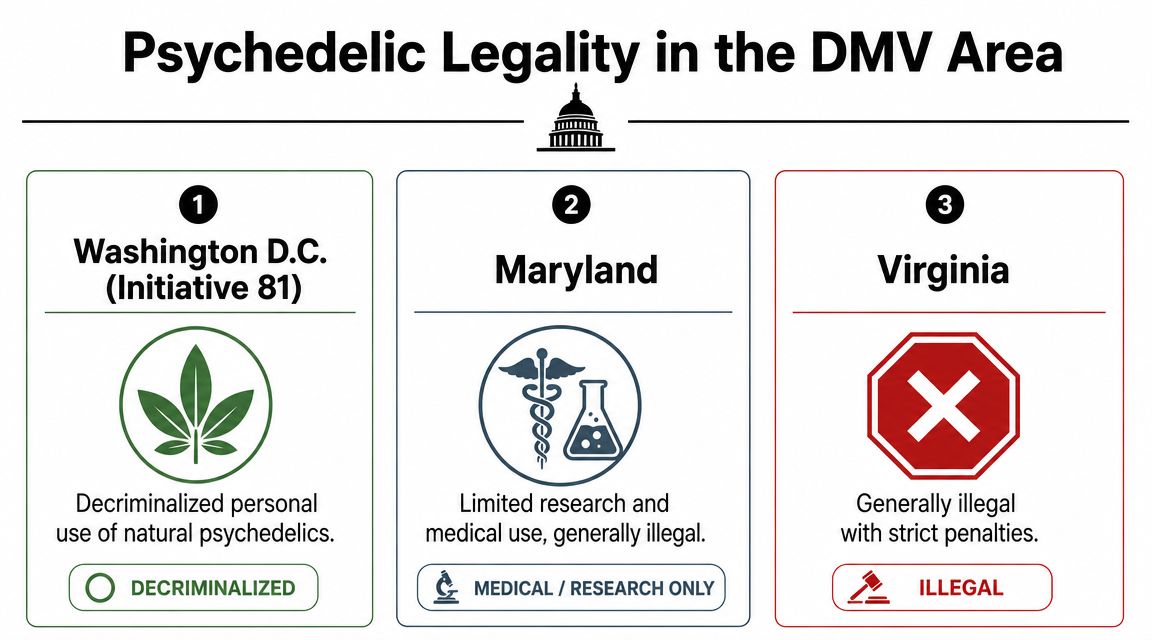
DC is the most challenging jurisdiction in the DMV because the visible market often doesn't match the legal structure. Maryland has a regulated adult-use path. Virginia has a narrower environment. DC sits in the middle with a gifting economy, strict medical rules, and active enforcement pressure.

That's why legal compliance issues matter here more than generic cannabis advice. In the DMV, details decide whether a delivery is routine or reckless.

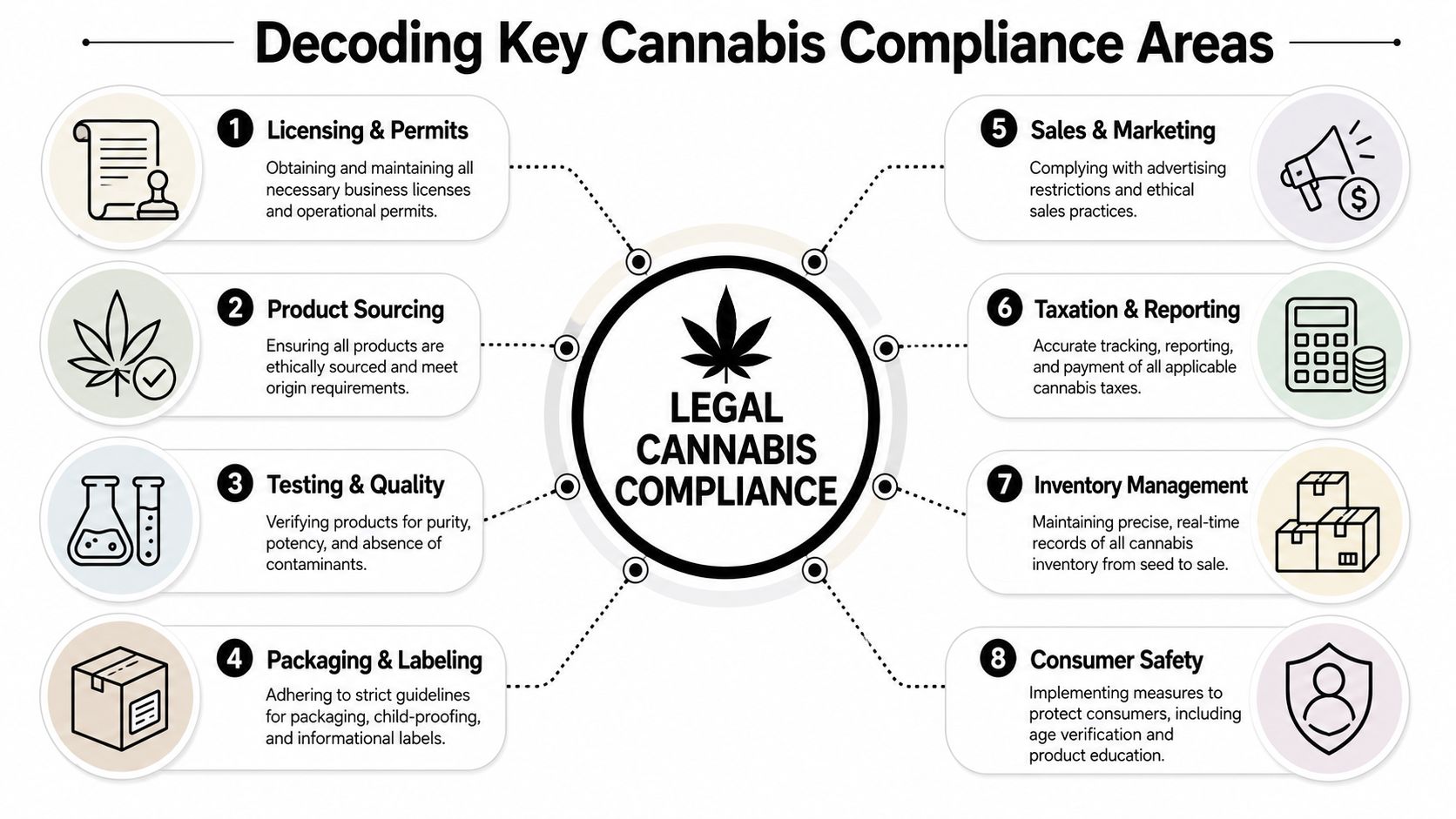
Decoding Key Cannabis Compliance Areas

The term “compliance” often brings to mind licenses on a wall. That's too narrow. Cannabis compliance works more like a mix of alcohol rules, pharmacy controls, and delivery-chain documentation. If one part breaks, the whole operation becomes vulnerable.

A diagram outlining eight key areas of legal compliance for the regulated cannabis industry business operations.

If you're evaluating a delivery business or planning one, start with a practical map. A consumer browsing a DC cannabis delivery menu usually sees products and prices. Regulators see a chain of obligations.

The eight areas that actually matter

  1. Licensing and permits
    A cannabis business needs the right approval for the exact activity it performs. Delivery, retail, courier work, and internet ordering don't all sit under the same bucket. If the business model changed but the paperwork didn't, that's a problem.

  2. Age verification
    This area often presents a lot of real-world friction. It's not enough to say “21+ only” or “medical patients only.” Someone has to verify identity at the right point in the transaction and know what to do when the ID doesn't neatly match the order.

  3. Product testing and labeling
    Testing rules are supposed to protect buyers, but they also create operational risk. As noted in this 2025 cannabis legal issues overview, product testing inconsistencies remain a major issue, and in Colorado one in every four tested products had THC content off by more than 20% from the label. If potency and labeling are off, the operator has a compliance problem and the customer has a trust problem.

  4. Packaging
    Packaging isn't cosmetic. It affects child resistance, tamper evidence, labeling, and whether the product looks like it came through a controlled channel or a random handoff.

The categories generic guides usually flatten

  • Advertising and sales practices
    A lot of businesses get sloppy here. If the legal model restricts direct sales, the marketing language matters.

  • Zoning and location rules
    Cannabis law isn't just about the product. It's also about where business activity happens and where deliveries can legally go.

  • Tax and reporting
    Cannabis operators have to track what moved, what was received, and what was paid. If records don't line up, regulators start asking harder questions.

  • Data privacy and customer records
    Delivery businesses handle names, addresses, order history, and identity data. If they collect it, they need rules for storing it and limiting access.

Compliance isn't one task. It's a chain. The handoff fails when one link fails.

The operators who survive long term treat legal compliance issues as operating discipline, not legal decoration.

Comparing Cannabis Delivery Laws in DC Maryland and Virginia

If you order in Bethesda, Arlington, and Dupont Circle, you're not dealing with one regional market. You're dealing with three separate legal realities. That's why so many consumers get confused. The app-style experience looks similar, but the law behind the transaction isn't.

DC runs on a gifting model

In Washington, DC, recreational cannabis delivery operates under the Initiative 71 gifting framework, which allows adults 21 and older to transfer up to 1 ounce (28 grams) of marijuana to another adult without payment or exchange of goods or services, according to the Metropolitan Police Department's marijuana guidance. That's the central fact every consumer and operator needs to understand.

In plain English, DC doesn't allow a straightforward recreational sale-and-deliver model the way a fully regulated adult-use market does. That's why customers see gifting language, bundles, or separate merchandise structures. If a service acts like it's selling recreational weed directly to you in DC, that should raise questions.

You can browse what local operators present as weed delivery in DC, but the legality depends on how the transaction is structured and whether the service follows the actual rules attached to that structure.

Maryland is cleaner and easier to understand

Maryland is much more straightforward. Recreational weed delivery is legal through licensed dispensaries, and the state permits licensed delivery services to make direct commercial cannabis sales to adults 21 and older within Maryland, as described in this regional delivery law overview. Consumers don't have to decode a gifting setup the way they do in DC.

That doesn't mean Maryland operators can relax. It means the legal path is clearer. A legal path still requires discipline.

Virginia stays narrower

Virginia is the awkward middle ground in many consumer conversations. People hear that possession rules have loosened in some contexts and assume delivery works the same way. It doesn't. Virginia remains more restrictive than Maryland for practical delivery purposes, and consumers shouldn't assume a service that looks normal online is operating under a broad adult-use delivery framework.

If you cross a border in the DMV, re-check the rules. Don't assume “close by” means “legally similar.”

DMV Cannabis Delivery Laws at a Glance (2026)

Jurisdiction Recreational Delivery Status Governing Model Primary Restriction
DC Not a standard direct-sale recreational model Initiative 71 gifting framework No direct commercial sale of recreational cannabis
Maryland Legal through licensed dispensaries Regulated adult-use market Delivery must run through licensed operators
Virginia Restrictive Narrower, non-broad adult-use delivery environment Consumers shouldn't assume broad recreational delivery is allowed

The practical takeaway is simple. DC requires interpretation. Maryland requires licensing. Virginia requires caution. If you operate across the DMV, you need separate procedures, not one recycled playbook.

The Real Risks of Ignoring Compliance Rules

A lot of weak operators still talk as if “hemp,” “CBD,” or “everyone does it” will buy them cover in DC. That logic is dead. District enforcement has moved in the opposite direction.

In Washington, D.C., a 2021 D.C. Attorney General memorandum explicitly confirmed that CBD is cannabis because the District doesn't have a federal-style hemp carve-out, and delivery services face search, seizure, and padlocking penalties starting April 1, 2025 after the grace period for unlicensed shops ended, according to this Axios report on DC enforcement. If your business model depends on pretending cannabinoid products sit outside DC cannabis law, you're operating on borrowed time.

Enforcement isn't theoretical

DC has made clear that unlicensed shops and delivery operations can draw multiagency attention. Businesses can also get exposed through public complaints. That matters because many operators still think enforcement only shows up after a long investigation. In practice, regulators can act much faster when the business is visible, easy to find, and obviously out of step with the rules.

For consumers, this means the cheapest or fastest option may also be the least stable one. An order can disappear when inventory is seized. A storefront can vanish. A delivery number can stop answering.

The business-ending mistakes

The worst compliance errors usually look small at first:

  • Misclassifying products so the operator claims a product is outside cannabis rules when DC says otherwise
  • Using the wrong transaction structure for the jurisdiction
  • Delivering to the wrong place because the driver doesn't understand restricted properties
  • Running weak ID checks that create avoidable disputes at the door
  • Keeping poor records so the business can't explain what was delivered, where, or why

The operators who get shut down usually didn't lose on one dramatic mistake. They lost on repeated basic mistakes.

This is why I'm blunt about legal compliance issues. They aren't side work for a lawyer to clean up later. They are front-line operating controls. If a delivery service treats compliance like branding copy, it's already behind.

How Green Express DC Prioritizes Safe and Compliant Delivery

The operators who last in DC usually do one thing well. They accept that friction is part of the job and build procedures around it instead of pretending it doesn't exist.

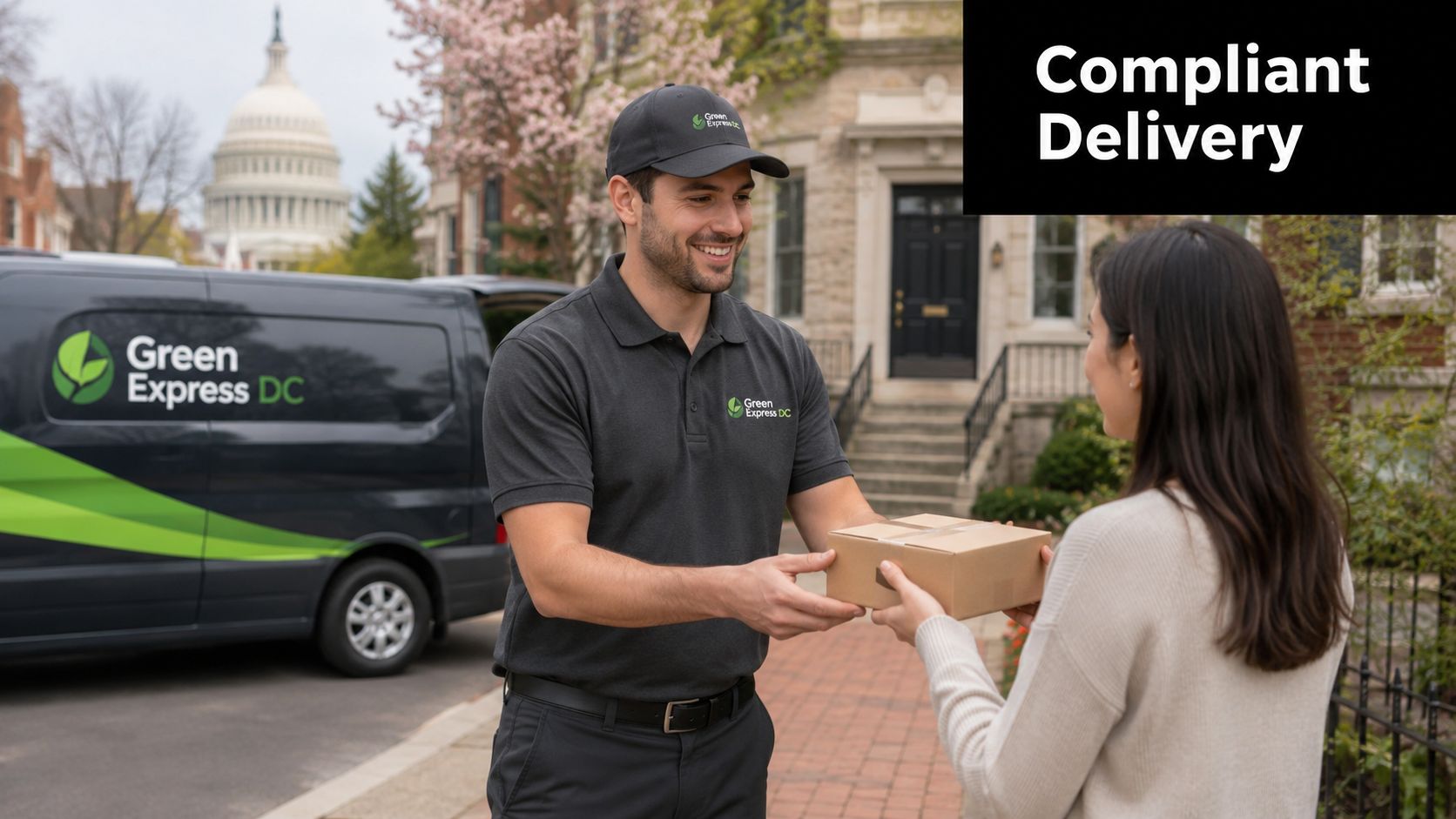
A friendly delivery driver handing a cardboard package to a customer in front of a residential home.

A good example is how serious services handle the handoff itself. The customer may think the delivery starts when the order is placed. From a compliance perspective, it starts when the service decides whether the order is even acceptable, and it ends only when the courier verifies identity and completes the drop within the rules.

The hard part is the doorstep

Most compliance guides reduce age checks to a slogan. That's useless in the field. As noted in MG Magazine's compliance discussion, many guides say “verify ID” but don't explain edge cases like expired licenses, out-of-state IDs for tourists, or biological mismatches in DC's hybrid medical-recreational environment, which leads to rejected deliveries and customer complaints.

That's exactly where professional delivery operations separate themselves from sloppy ones. The courier needs a repeatable rule set. If the ID is invalid, the handoff stops. If the recipient doesn't match the order requirements, the handoff stops. If the situation is unclear, the driver needs escalation instructions, not improvisation.

One example consumers can review is I-71 compliant shops in DC, where the focus is on how a service frames transactions and customer verification under District rules.

What responsible delivery looks like

Here's what I want to see from any DC operator:

  • Strict ID at drop-off
    Not just a checkbox online. The driver checks a valid government-issued ID in person.

  • Discreet packaging
    That lowers obvious exposure during transit and handoff.

  • Lab-tested inventory
    Customers deserve products selected with safety and consistency in mind.

  • Clear gifting structure
    If the business is operating in DC's Initiative 71 environment, it should explain that structure plainly instead of hiding it in vague language.

A short explainer helps show what this looks like in practice.

Why tourists and business travelers get tripped up

Visitors cause a lot of compliance friction without realizing it. They assume a hotel delivery works like a food app. It doesn't. ID has to be valid. The recipient has to be the right person. The address has to work for the delivery model. The driver has to be able to complete the handoff lawfully and safely.

Consumers usually experience this as inconvenience. Operators experience it as risk control. The disciplined businesses don't bend the rules to save a sale, and that's exactly what you want.

Your Consumer Checklist for Legal Cannabis Delivery

If you're ordering in the DMV, you need a checklist. Not vibes. Not assumptions. A few direct checks will tell you a lot about whether a service takes legal compliance issues seriously.

A six-point infographic titled Your Consumer Checklist for Legal Cannabis Delivery detailing safety and compliance steps.

Ask these questions before you place the order

  • How is the transaction structured in this jurisdiction
    In DC, you should understand whether the service is operating through a gifting model rather than a direct recreational sale.

  • What happens at ID verification
    If the service is vague here, that's a bad sign. Serious operators have a clear drop-off policy.

  • Are the products presented as tested and clearly labeled
    You're looking for signs of controlled sourcing, not random inventory with no paper trail.

  • Does the service explain delivery boundaries
    A company that can't explain where it will and won't deliver is telling you it may not understand its own restrictions.

The address rule too many people ignore

This one matters in DC. Third-party Medical Cannabis Courier License holders are restricted to delivering only to residential and commercial addresses in the District that are not on District government or Federal property and not on public or private school grounds, under DC Code § 7-1671.06e.

That means consumers should stop assuming any DC address is workable. Some aren't. If you're at a federal building, certain government property, or school grounds, that's a problem. If you're a traveler, ask before you order.

Consumer check: If your drop-off point is a hotel, office, dorm-adjacent location, or government-linked property, confirm delivery eligibility before you pay or schedule.

A practical pre-order screen

Use this quick filter:

Check What you want to hear Red flag
ID policy In-person valid government ID required “Just upload anything online”
Delivery location Clear explanation of restricted addresses “We deliver anywhere in DC”
Product handling Tested, labeled, discreetly packaged products No clarity on sourcing or packaging
Legal model Straight answer about gifting, medical, or licensed retail Evasive language about how the transaction works

If a service gets defensive when you ask basic compliance questions, move on. Good operators expect those questions. Bad operators hate them.

The Evolving Future of DMV Cannabis Laws

The DMV isn't one cannabis market and won't behave like one anytime soon. DC still forces consumers and operators to contend with a gifting system and tougher enforcement pressure. Maryland offers a cleaner regulated lane for adult-use delivery. Virginia remains narrower and less intuitive for consumers who assume regional consistency.
That fragmentation is why people keep stumbling into preventable legal compliance issues. The delivery experience looks modern and simple, but the legal framework underneath it is still patchwork. Cash handling, age verification, address restrictions, and product classification all stay complicated until lawmakers simplify the bigger system.

Federal changes could eventually make parts of this easier. Banking reform would help cash-heavy operations. Broader legal reform could reduce some of the strange contradictions between local and federal treatment. But nobody ordering or operating in the DMV should make decisions based on what the law might become.

Use the rules that exist today. Ask direct questions. Expect direct answers. If a service can't explain its process in plain English, don't trust it with your order.


If you want a delivery option that explains its process clearly, browse Green Express DC and review the ordering details, ID requirements, and product information before placing an order.

Posted on

Order Tracking Systems: Secure DC Cannabis Delivery

You place an order, put your phone down, then pick it back up five minutes later. No update yet. Ten minutes later, you're checking texts, email, and the front window. If you've ever waited for a delivery that matters, you know the feeling. You don't just want speed. You want to know what's happening, when it's arriving, and whether the handoff will stay private.

That feeling gets more specific with cannabis delivery in the DMV area. In DC, timing matters. Privacy matters more. And for people in Maryland or Virginia who are searching for DC delivery options, the legal boundaries matter most of all. A good tracking experience doesn't just answer “Where is my order?” It helps you plan your evening, keeps the exchange discreet, and makes the whole process feel professional instead of uncertain.

The New Standard for Cannabis Delivery

A few years ago, delivery updates often meant one message: “your order is on the way.” That was better than nothing, but it still left a lot of room for guesswork. Was the driver nearby? Was there a delay? Do you need to stay glued to the door, or do you have time to finish a call, walk the dog, or step away from the window?

For cannabis customers in DC, those details matter more than they do for a typical online purchase. Many people want a smooth drop-off without drawing attention from roommates, neighbors, hotel staff, or anyone else around them. They also want confidence that the courier is headed to the right address, that the handoff will go to the right adult, and that they won't be left wondering if they missed the delivery.
That's why order tracking systems have become part of the baseline for modern delivery. They give you a live sense of movement, not just a vague promise. A clean tracking flow can show when an order is accepted, when it's being prepared, when a driver is assigned, and when arrival is close enough that you should have your ID ready.
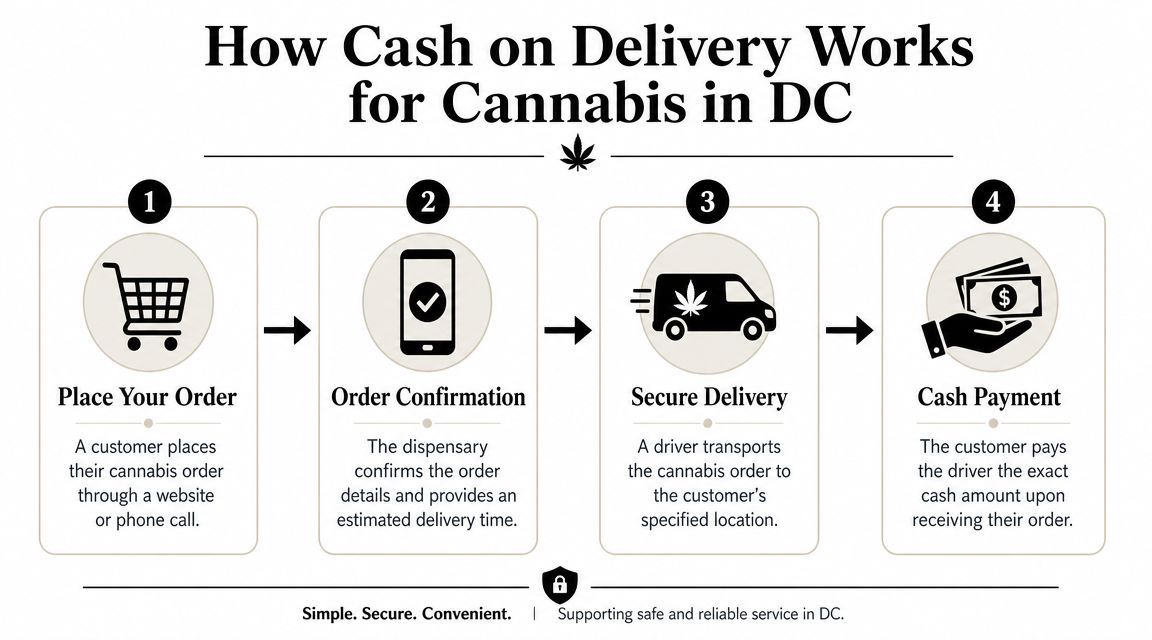
For customers browsing DC weed delivery options, this changes the experience from passive waiting to informed waiting. You stay in control of your time. You don't need to keep calling or texting for updates. You can prepare for a discreet handoff instead of reacting at the last second.

Practical rule: The best delivery experience is the one that keeps you informed without forcing you to ask for information.

In cannabis delivery, that balance matters. You want visibility, but not exposure. You want updates, but not a flood of messages with sensitive details. Strong tracking helps create exactly that middle ground.

What Exactly Is an Order Tracking System

An order tracking system is easiest to understand if you think of it as a private travel map for your delivery. Instead of watching a random car on a public road, you're seeing the progress of your specific order as it moves through a controlled series of updates.
A person holding a smartphone showing an order tracking map app with driver locations and ETA.

Static updates versus live tracking

A basic shipping email says something happened. A real tracking system shows what's happening now.

That difference matters. “Order confirmed” is a status message. “Driver assigned and approaching your area” is operational visibility. One is a snapshot. The other is a moving timeline.

At a simple level, order tracking systems connect three things:

  • Your order record so the system knows what was requested and where it should go
  • The courier's app or route feed so the business can see progress in motion
  • The customer view so you can follow the delivery without contacting support

When those pieces talk to each other well, the result feels simple on your end. You click a link, open a page, and see clear status updates.

Why this technology is growing fast

This isn't a niche tool anymore. According to Market Intelo's order tracking software market report, the global order tracking software market was valued at $4.2 billion in 2025 and is projected to reach $9.7 billion by 2034, with a 12.3% CAGR. That growth reflects demand for real-time visibility in e-commerce and logistics.

The reason is straightforward. Customers expect updates. Delivery teams need fewer manual check-ins. Businesses want one source of truth instead of scattered texts, calls, and handwritten notes.

What customers usually see

From the customer side, most order tracking systems feel familiar. You'll often see a short sequence like this:

Status What it usually means
Order received Your request entered the system
Preparing order The team is packing and organizing the delivery
Driver assigned A courier has been matched to the drop-off
Out for delivery The order is moving toward your address
Delivered The handoff is complete

That front-end simplicity sits on top of more complex logistics. The good systems hide the complexity. You shouldn't need to know the technical details to trust the process, but it helps to know that the updates aren't random. They come from a structured chain of events tied to your order.

How Cannabis Order Tracking Works Step by Step

The cannabis delivery journey feels simple when it works well. Under the hood, several systems are coordinating at once so you get timely updates without seeing the messier parts of logistics.

A five-step infographic showing the process of tracking a cannabis order from purchase to secure delivery.
Step 1 Order placed

You browse products, choose what you want, enter your delivery details, and submit the order. At that moment, the system creates a record tied to your order ID, address, and contact method.

This is the start of the tracking chain. Nothing is moving yet, but the delivery platform now has a defined job to manage.

Step 2 Confirmation sent

Once the order is accepted, you usually receive a confirmation by text or email. That message tells you the order exists in the system and may include a tracking link or a status page that becomes useful as the delivery progresses.

This stage matters because it replaces uncertainty with acknowledgment. You know the order didn't disappear into a form submission void.

A good confirmation message should answer the first anxious question immediately: “Did they get my order?”

Step 3 Order prepared

The team prepares the order for dispatch. Products are packed, the destination is checked, and the delivery gets queued for a courier.

At the system level, internal events start stacking up. A production-grade setup described by CodeSol Technologies' guide to order tracking system development uses a multi-layer architecture with tools like Node.js, SQS, and PostgreSQL to process events in real time. In plain English, that means the app can take updates from driver tools and internal systems, organize them, and turn them into a clean status feed the customer can understand.

Step 4 Driver assigned and en route

Once a driver is assigned, the order shifts from preparation to movement. This is usually the point where tracking offers its greatest utility to customers, because the estimated arrival gets more concrete.

Different services display this in different ways. Some show a live map. Others show milestone updates like “driver assigned,” “arriving soon,” or “out for delivery.” Either way, the customer starts getting practical timing information.

Step 5 Real-time tracking

This is the phase commonly associated with the term “tracking.” The driver's route updates the system, and your order page reflects that movement.

Here's the simple version of what's happening:

  1. A driver app records progress as the courier moves through the route
  2. The system matches those updates to your order
  3. Your tracking page refreshes with the latest delivery status

That constant syncing is what turns raw movement into a usable customer update.

Step 6 Arrival and discreet verification

When the driver is close, the system may trigger an “arriving soon” notice. That gives you a short window to get ready without standing outside for half an hour.

For cannabis delivery, this is also where verification becomes critical. The handoff needs to go to the intended adult, at the intended private location, using a process that doesn't create unnecessary exposure.

Step 7 Delivery complete

After the handoff, the order closes out in the system. The final status changes to delivered, and the delivery record is stored according to the service's internal process.

That final update matters because it ends the uncertainty loop. You're not left guessing whether the courier marked the order incorrectly or whether another step is still pending. The system gives both the customer and the delivery team the same ending point.

Key Features for Customer Peace of Mind

The best tracking tools don't feel flashy. They feel calming. They remove the little uncertainties that make delivery stressful, especially when you want the process to stay quiet and predictable.

The features that actually matter

Some features sound technical but matter because of what they prevent.

  • Live map visibility helps you stop guessing. You don't have to keep checking the hallway, lobby, or front step every few minutes.
  • Dynamic ETA gives you a working arrival window instead of a vague promise. That means less waiting around and fewer missed handoffs.
  • Status notifications such as “confirmed,” “out for delivery,” and “arriving soon” let you prepare at the right moment.
  • Driver contact options can reduce confusion when there's a gate code issue, building entry question, or arrival detail to confirm.

These are convenience features on paper. In practice, they're privacy features too. The less confusion there is, the less back-and-forth there is in public.

Why notifications reduce stress

A strong notification system helps in two directions. Customers know what's happening, and support teams get fewer “where is it?” messages.

According to Artsyl's overview of real-time order tracking, implementing real-time tracking with SMS or email push alerts has been shown to reduce WISMO calls by 30 to 40 percent, while improving trust through transparency.

That stat matters because it reflects a real customer experience. When people have a reliable tracking page and timely alerts, they don't need to chase updates. They can follow the order.

Privacy, convenience, and control

For a cannabis customer, the feature-benefit connection usually looks like this:

Feature Customer benefit
Live status page Fewer surprise arrivals
ETA updates Better timing and less awkward waiting
Private alerts More discretion than repeated phone calls
Delivery confirmation Confidence that the order closed properly

Key takeaway: The most useful tracking feature isn't the map itself. It's the ability to plan your own behavior around reliable information.

That's why order tracking systems matter beyond logistics. They make the customer feel prepared, not exposed. For a cannabis delivery, that difference is the whole experience.

Privacy and Discretion in DC Cannabis Delivery

Generic e-commerce articles often treat tracking as a speed tool. In cannabis delivery, it's also a discretion tool. That's especially true in the DC, Maryland, and Virginia conversation, where people often search across the whole region even though the legal delivery rules don't work the same way across state lines.

A graphic highlighting privacy and discretion features for cannabis delivery services, including secure data and packaging.

What privacy means in a tracking context

Privacy in delivery tracking isn't just about hiding the product name. It includes several practical layers:

  • Limited visibility so the tracking page shows delivery progress without exposing unnecessary personal details
  • Private links so only the customer with the message can access the status page
  • Controlled communication so updates happen through direct text or email instead of public-facing channels
  • Discreet handoff timing so the customer knows when to meet the driver without waiting visibly outside

Cannabis delivery presents a divergence from standard retail. A customer may be comfortable ordering, but still want the process to stay low-profile from checkout to drop-off.

Why verification supports discretion

In DC, cannabis delivery often operates through the gifting model. As explained in Distru's overview of DC recreational cannabis laws, businesses may sell a legal product or service and include cannabis as a gift. That setup requires strict verification that the recipient is 21+, and secure tracking and delivery protocols help enforce it.

That verification step does two jobs at once. It supports legal compliance, and it protects customer privacy by making sure the handoff goes to the correct person instead of becoming a confused doorstep situation.

For customers looking into cannabis delivery in DC, this is one of the biggest signs of a serious operation. Professional services don't treat verification as friction. They treat it as part of a secure chain of custody.

Privacy gets stronger when every handoff has a clear rule. The courier knows who should receive the order, and the customer knows what to expect.

The DC, Maryland, and Virginia reality

Often, readers misunderstand a key point. Someone may live in Maryland or Virginia, browse DC menus online, and assume a tracking system can solve the distance problem. It can't. Tracking can improve visibility within a legal service area, but it doesn't change where delivery is allowed.

That matters because the privacy conversation only makes sense inside a lawful route. If a service can't legally deliver to the address, the most polished tracking page in the world doesn't make the transaction valid.

What discreet service usually looks like

Customers often associate discretion with silence, but the better model is selective communication. You get useful updates, not loud ones. The order is packaged plainly. The courier follows a verification routine. The tracking page tells you what you need to know, and not much more.

A thoughtful system balances three priorities at once:

  1. Security through verified handoff procedures
  2. Privacy through controlled information sharing
  3. Convenience through accurate timing and status updates

That's the nuance generic shipping advice often misses. In cannabis delivery, tracking isn't only about package movement. It's about making a sensitive transaction feel orderly, lawful, and low-profile.

What to Expect When Tracking Your Green Express DC Order

If you've never used a cannabis delivery tracker before, the process is usually simpler than people expect. Most of the complexity stays behind the scenes.

A delivery driver carrying a cardboard package walks towards a house entrance next to a parked van.

The customer view from start to finish

First, you place an order through the website and provide the details needed for delivery. After that, you should watch for a confirmation message. That message is your first signal that the order has entered the system correctly.
Next, the order moves into preparation. You may not see every internal action, but you'll typically see the status update from received to a more active stage once the team starts processing it.

When the delivery is closer to dispatch, tracking becomes more useful, and customers usually click the link from their text or email to check live status. Depending on the interface, you may see a route update, a delivery stage, or a near-arrival notice.

How to use tracking without overthinking it

The easiest approach is to check for three moments:

  • Confirmation received so you know the order is active
  • Out for delivery so you know movement has started
  • Arriving soon so you can get your ID and meet the courier discreetly

That's usually enough. You don't need to refresh the page every minute. The system is there to reduce stress, not create a second hobby.

If you're ordering for the first time, it also helps to review how to prepare for delivery before your drop-off window. A little prep makes the final handoff smoother, especially if you're in an apartment, hotel, or building with access rules.

The tracking page should answer practical questions. “Did my order go through?” “Is it moving?” “Do I need to be ready now?”

That's the customer experience at its best. Not dramatic. Not confusing. Just clear enough that you know what's happening and when to be available.

FAQ on DC and Maryland Cannabis Delivery Tracking

Can a DC cannabis delivery be tracked into Maryland or Virginia

No. In Washington, D.C., licensed cannabis delivery services are legally permitted for adults 21+, but they're confined to within the District of Columbia boundaries. Services can't legally deliver to addresses in Maryland or Virginia, according to this update on DC cannabis delivery rules.

If I live in Maryland or Virginia, can I still place a DC delivery order

A tracking link doesn't change delivery law. If the address is outside DC, the delivery can't legally be completed there by a DC-only service. People in Maryland and Virginia often search DC menus because the region is close-knit, but the legal service area still matters.

What ID should I expect to show

You should expect adult age verification at delivery. For cannabis handoff in DC, the recipient needs to be the correct adult. Professional delivery protocols are built around that final verification step.
Does tracking make cannabis delivery less private

Not when it's done well. A good system shares only the information needed for timing and verification. It helps avoid missed handoffs, unnecessary calls, and public waiting. In that sense, tracking usually improves discretion rather than weakening it.

How is cash-on-delivery handled in a tracked order

The order system can mark the delivery stages and confirm the handoff, while the courier follows the payment process used by the service. From the customer side, the important part is simple: have the correct payment method ready and follow the instructions provided with the order.

Will my tracking information stay public

A reputable service should use private tracking links and controlled notifications rather than public pages that anyone can browse. Customers should only see the details necessary to follow their own order.


If you want a smoother, more private delivery experience in Washington, DC, Green Express DC makes the process simple with discreet service, clear communication, and reliable order updates for adults 21+ across the District.

Posted on

One Up Mushroom: A DC Guide to Risks & Safe Alternatives

You're probably here because you saw a One Up Mushroom bar online, in a group chat, or passed around by someone who swears it's the genuine article. The packaging looks playful, familiar, and low-risk. That's exactly why people let their guard down.

I don't think curiosity is the problem. The problem is treating a grey-market psychedelic candy like it's a normal retail product. It isn't. If you live in DC, Maryland, or Virginia, that distinction matters for both your safety and your legal exposure.

If what you want is a mood lift, a more creative headspace, or a different kind of evening than alcohol, there's a safer route. In the DMV, that usually means skipping mystery mushroom bars and choosing legal, lab-tested cannabis products that you can buy through a system with age checks, delivery rules, and at least some accountability.
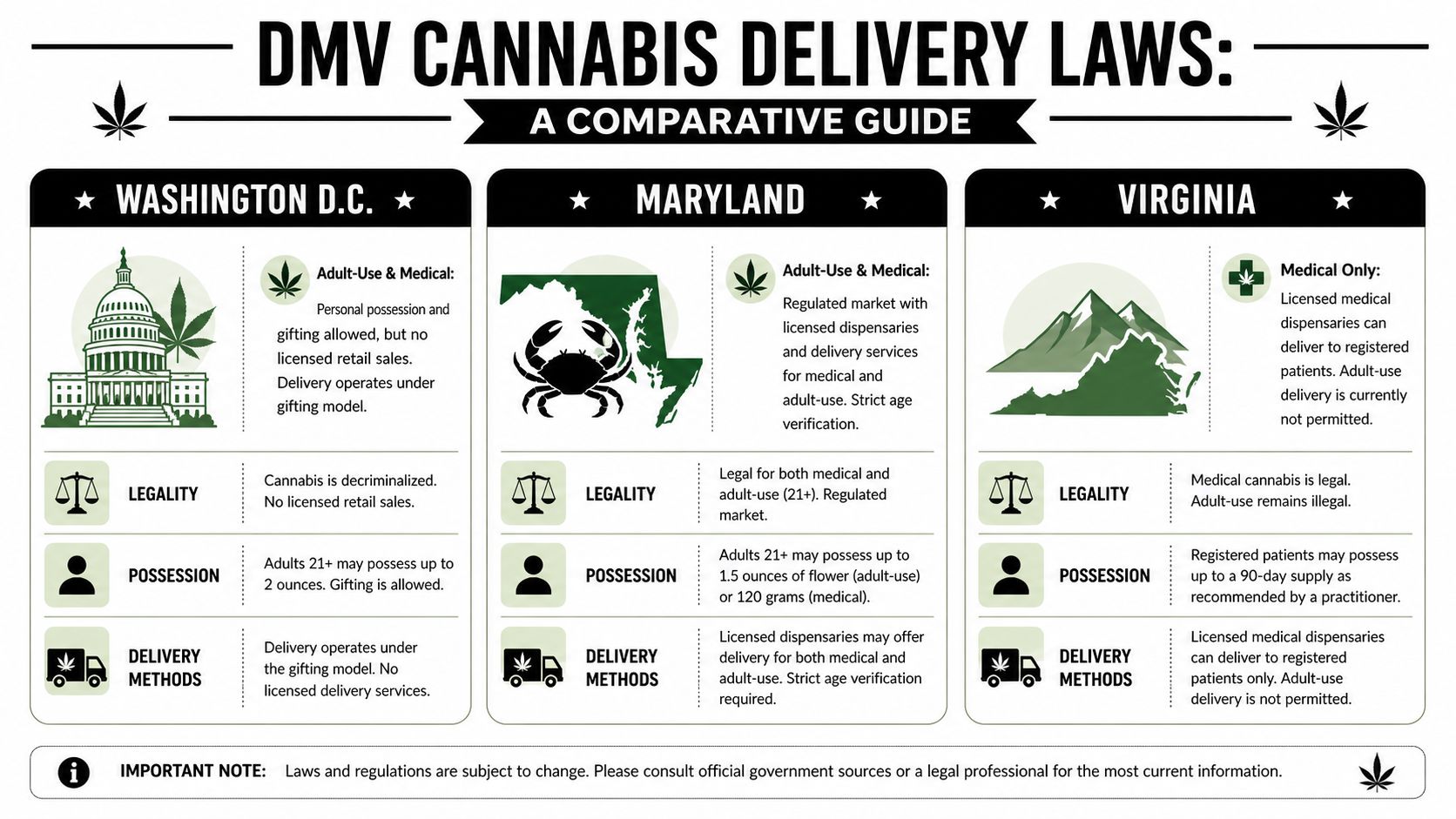
The Allure of the One Up Mushroom Bar

The appeal is obvious. A One Up Mushroom bar doesn't look threatening. It looks like a novelty snack with a wink.
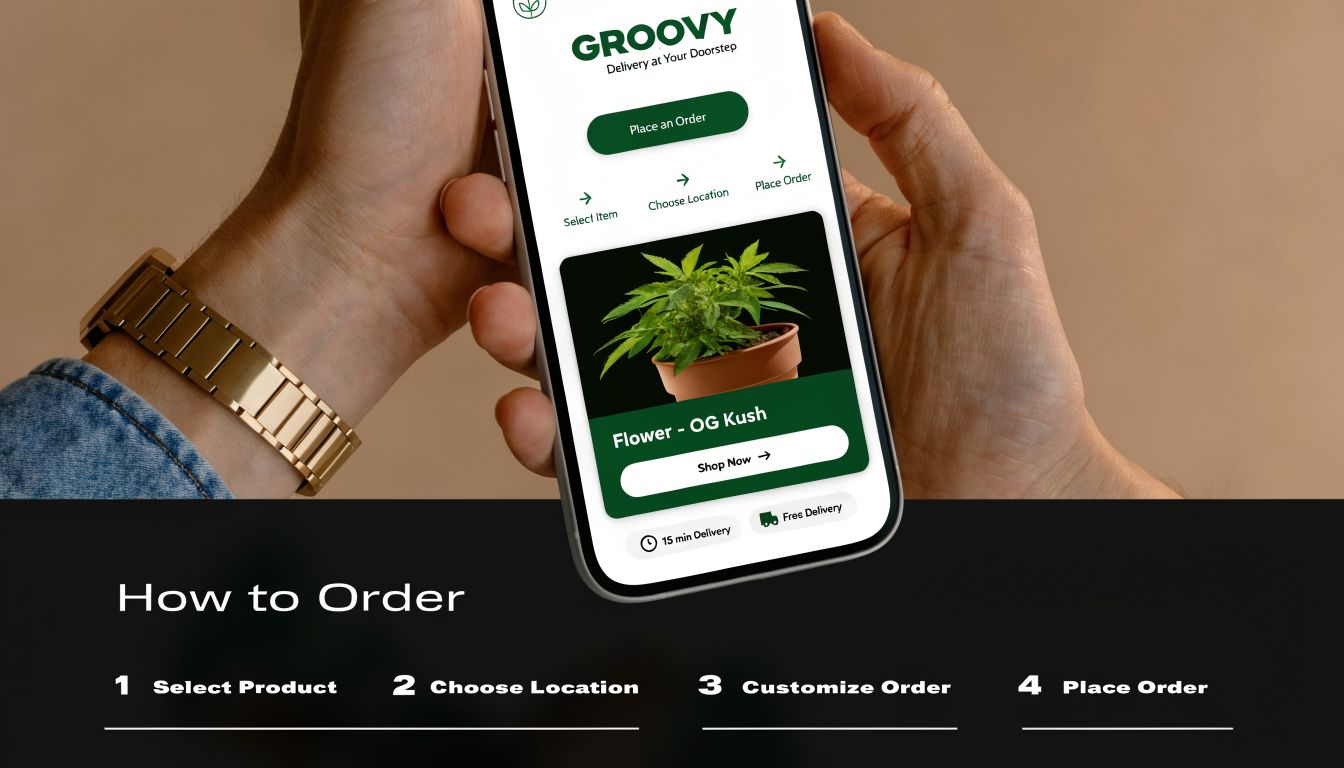
That branding matters. People associate colorful chocolate packaging with candy, not with an unregulated psychoactive product. Add a familiar video game reference and the whole thing feels more playful than serious. That's a mistake.

Those searching for a one up mushroom product aren't looking for chaos. They want something specific. Usually it's one of these:

  • A mood shift: a break from stress, boredom, or routine
  • A creative push: music, art, conversation, or a more interesting night in
  • A softer alternative to drinking: less hangover, less sloppiness
  • A curated experience: something that feels intentional rather than random

Those goals are understandable. What isn't understandable is pretending a mystery bar from a grey market source is a smart way to get there.

Practical rule: If you can't verify what's in it, who made it, and how it was handled, don't eat it.

That's the tension behind the one up mushroom trend. It sells the feeling of discovery and the vibe of insider access. But when you strip away the packaging, you're left with a basic question: are you comfortable taking a psychoactive product with no meaningful oversight?

You shouldn't be.

If you're in DC, that question gets even more important because local cannabis access gives you a realistic alternative. If you're in Maryland or Virginia, it matters for another reason. Crossing jurisdictions with the wrong product can turn a casual decision into a legal problem fast.

What Are One Up Mushroom Bars Really

A One Up Mushroom bar is not a mushroom species. It's a branded, game-themed edible product usually marketed as containing psilocybin or some other psychoactive mushroom blend. The key point is simple: this is branding, not a recognized licensed category.

The name comes from the 1-Up Mushroom in the Super Mario franchise. That item grants the player an extra life, and in some titles it stops helping once you've already reached the maximum of 99 lives, according to MarioWiki's reference on the 1-Up Mushroom. That same reference also notes that the icon has been adapted into formal rule systems outside the platform games, including Nintendo Monopoly, where a 1-Up Mushroom can trigger payment rules of 10% of total assets or $200 in the 2006 version, and $200 in the 2010 version.

A single rectangular dark chocolate bar wrapped in plain brown packaging resting on a grey surface.

It's nostalgia packaging, not official licensing

The Mario connection is a marketing shortcut. It taps into nostalgia and instantly communicates the idea of a “power-up.” That doesn't mean the product has any official connection to Nintendo.

It doesn't.

That matters because people often read polished packaging as proof of legitimacy. They assume that if the wrapper looks professional, someone credible must be behind it. Grey-market sellers know that. Clean graphics and familiar symbols do a lot of heavy lifting.

What you should call it

If you want the most accurate description, call it this:

  • An unlicensed branded chocolate bar
  • A grey-market psychoactive edible
  • A product with no standard retail oversight

That framing is less fun, but it's more honest.

The one up mushroom name is doing the emotional work. It makes the product feel familiar before you've verified anything important.

That's why I'd treat every One Up Mushroom bar with skepticism first and curiosity second. The name is clever. The packaging is intentional. Neither tells you what's inside.

Sourcing and Safety The Problem with Unregulated Products

The issue with One Up Mushroom bars comes down to three unknowns. Unknown ingredients. Unknown dose. Unknown producer.

Any one of those is enough to pause. All three together should be a hard no.

Unknown ingredients

When a product comes through a grey market channel, you don't get meaningful transparency. You're relying on packaging claims and seller assurances. That's not quality control.

Some people assume “mushroom” means natural, and natural means safe. That logic falls apart fast. A psychoactive edible can be poorly made, contaminated, mislabeled, or inconsistent from piece to piece. You also don't know how it was stored, who handled it, or whether the wrapper matches the contents.

Unknown dose

Many find themselves caught off guard. One square can feel underwhelming. The next can feel overwhelming.

That's the problem with unregulated psychoactive edibles. You can't reliably plan the experience. If you're trying to have a relaxed evening, unpredictability is the opposite of what you want.

A lot of bad nights start with a simple assumption: “I've had edibles before, so this will probably be manageable.” That assumption doesn't hold when the product itself is a question mark.

Unknown producer

There's a huge difference between a real agricultural market and an anonymous grey-market product. The legitimate U.S. mushroom crop in 2023 to 2024 totaled 659 million pounds, had a sales value of $1.09 billion, and an average reported price of $1.65 per pound, while the broader global mushroom industry has grown to more than 40 million metric tons, according to market data summarized here. That's a transparent commodity market.

A One Up Mushroom bar is the opposite. No production oversight. No traceable chain. No safety data.

Here's my advice. If your goal is a controlled, enjoyable psychoactive effect, stop shopping in categories where uncertainty is built into the product. If you prefer inhaled products because they're easier to titrate than mystery edibles, look at regulated-style cannabis options such as Pure One carts instead of taking chances on copycat mushroom packaging.

Quick risk check

Question If the answer is no
Do you know exactly what the active ingredient is? Don't take it
Do you know who produced it? Don't take it
Do you have a credible way to verify consistency? Don't take it

That's not paranoia. That's basic self-protection.

Psychedelic Legality in DC Maryland and Virginia

The DMV is small on a map and messy in real life. A product that feels casually available in one place can create immediate legal risk when you cross into another.

An infographic showing the legality of psychedelics in Washington D.C., Maryland, and Virginia.

Washington DC

DC is the part that confuses people most. Personal-use enforcement around certain natural psychedelics is widely understood to be deprioritized under local policy, but that is not the same as a normal legal retail market. Deprioritized enforcement doesn't create clean rules for commercial mushroom sales.

That gap matters. People hear “decriminalized” and mentally translate it to “legal enough.” I wouldn't do that.

For cannabis, DC has a more developed framework that adults can learn and use. If you need a practical overview, start with this guide on how to buy weed in DC.

A quick legal explainer helps:

Maryland and Virginia

Maryland and Virginia are where casual assumptions become expensive assumptions. Psilocybin products are not something I'd treat as casually portable across state lines. That includes bars, capsules, and anything else sold through vague channels.

If you live in Maryland or Virginia and you're browsing one up mushroom products online, the practical answer is simple. Don't buy a legally murky psychedelic item and then convince yourself the regional proximity to DC makes it fine. It doesn't.

Crossing from DC into Maryland or Virginia with the wrong product can turn a low-stakes purchase into a much higher-stakes problem.

What to do instead

If you want an altered mood, creative lift, or a more enjoyable night, stay inside the legal lane that has structure. In this region, that usually means DC-only cannabis access for adults, not improvised mushroom shopping and definitely not interstate carry.

Legal Alternatives for Your Desired Effects

Many looking for a one up mushroom bar aren't committed to mushrooms as such. They're committed to the effect they hope to get.

That's good news, because effects are often easier to pursue safely than brands are.

An infographic showing legal alternatives for desired effects like creativity, focus, and mood elevation through various natural products.

The old Mario logic fits here. The 1-Up Mushroom is a rare, hidden pickup used to reward exploration and precision, according to the Mario fandom reference on the item. That's a better way to think about cannabis, too. The power-up isn't a flashy bar. It's knowing which legal product matches the experience you want.

If you want creativity and energy

Start with sativa-leaning cannabis. Many adults choose sativa flower, prerolls, or lower-dose THC edibles when they want a more upbeat headspace for music, conversation, or a daytime reset.

Keep your expectations realistic. Cannabis is not a mushroom substitute in a strict pharmacological sense. But for plenty of people, it can scratch the same itch that sent them searching in the first place: novelty, perspective shift, and enhanced sensory enjoyment.

If you want calm without feeling flat

Use indica-leaning products or balanced options with a gentler pace. These make more sense when the goal is stress relief, body relaxation, or a slow evening at home.

For a lot of adults, this is the better trade. You get a predictable, familiar effect pattern without gambling on a mystery edible.

If you want control

Pick formats that are easier to manage:

  • Vapes: faster onset, easier to stop once you've reached the effect you want
  • Gummies: slower onset, but familiar and easy to portion if you're patient
  • Flower: flexible and easier for some people to dose gradually

If edibles are your lane, browse products like THC gummies in DC rather than trying to decode mushroom-bar packaging from social media.

A simple effect map

Desired effect Better legal match
Creative, talkative, uplifted Sativa-leaning cannabis
Relaxed, cozy, slower evening Indica-leaning cannabis
Balanced mood and flexibility Hybrid cannabis
Careful, incremental dosing Vape or low-dose edible approach

You don't need the exact same substance to get closer to the exact experience you want.

That's the smarter way to shop. Start with the effect. Match the format. Keep it legal and testable.

Your Guide to Ordering from Green Express DC

If you've decided to skip one up mushroom bars and stick with cannabis in DC, the ordering process is straightforward.

A person holding a smartphone displaying a food delivery application with a menu of featured items.

Step one, shop by effect

Don't start with the strongest thing on the menu. Start with the outcome you want.

If you want a bright, social headspace, look at sativa flower, prerolls, or a manageable edible. If you want to unwind after work, check indica flower or a slower evening edible. If you want flexibility, hybrids usually make more sense than chasing extremes.

Step two, choose a format that fits your habits

Some people like smoking flower because the feedback is immediate. Others want gummies because they're familiar and discreet. Others prefer vapes because they're compact and easier to use in short sessions.

Your format matters as much as the strain category. A person who wants control usually does better with inhaled cannabis than with any edible they can't easily undo.

Step three, place the order and be ready for delivery

Green Express DC offers cannabis delivery for adults 21+ in Washington, DC, with a $50 minimum, cash on delivery, age verification at drop-off, and same-day service based on availability and timing. That setup is much closer to normal consumer behavior than buying a random mushroom bar from an unknown source.

Here's the short version:

  1. Browse the menu and filter by flower, edibles, vapes, concentrates, or tinctures.
  2. Pick for effect first, not hype.
  3. Place your order online or by phone.
  4. Have a valid government ID ready when the courier arrives.
  5. Pay in cash at delivery.

That's a cleaner process than gambling on Telegram messages, pop-up sellers, or repackaged candy bars. It also gives you a practical ceiling on risk because you know what category you're buying, what jurisdiction you're in, and what the delivery rules are.

Common Questions About Cannabis Gifting in DC

Is cannabis delivery actually legal in DC

Adults in DC can access cannabis through the local gifting-style system rather than a standard retail dispensary model. The rules are specific, and the practical takeaway is that you should stay within DC processes instead of improvising your own.

What ID do you need

Bring a valid government-issued ID showing you're 21 or older. Don't treat this as optional. Delivery only works cleanly when age verification is handled at the door.

Do deliveries go to Maryland or Virginia

For practical and legal reasons, keep delivery expectations inside Washington, DC. If you live in Maryland or Virginia, don't assume a DC cannabis process extends across borders just because the drive is short.

How discreet is delivery

People usually want two things: privacy and simplicity. Discreet packaging and routine drop-off procedures matter because most adults aren't trying to make a scene out of a cannabis order. They just want the process to be smooth, private, and boring in the best way.

If you want low drama, choose products and delivery systems built for ordinary adult use, not grey-market items built around ambiguity.

Is cannabis a perfect replacement for mushrooms

No. It's a safer practical alternative for many adults in the DC area who mainly want uplift, relaxation, sensory enhancement, or a more interesting night than alcohol offers. That's the standard I'd use. Not “identical,” but “safer, legal, and easier to manage.”


If you want a simpler route than chasing a One Up Mushroom bar, Green Express DC offers a practical option for adults in Washington, DC who prefer lab-tested cannabis, clear delivery rules, and a menu that lets you choose by effect instead of gambling on mystery packaging.

Posted on

What Is THC Tincture? Your 2026 DC, VA & MD Guide

A THC tincture is a liquid cannabis concentrate that offers precise, smoke-free dosing. It's taken under the tongue or swallowed, and when used sublingually it can start working in about 15 to 30 minutes.

If you're in DC, Maryland, or Virginia and you want cannabis without the smell of flower or the wait that can come with gummies, tinctures usually come up fast once you start asking the right questions. A lot of cautious shoppers want the same thing: something discreet, simple to measure, and easier to control than “take a puff and see.”

That's where tinctures fit. They're one of the oldest cannabis formats, but they still feel modern because they solve a very current problem. You can carry a small bottle, use a dropper, and know much more clearly what you're taking than you can with smoking.

For people ordering through delivery in the DMV area, that matters. You want something that works with apartment living, shared spaces, travel between neighborhoods, and a normal evening routine. You also want to understand what you're buying before you put anything under your tongue.

Your Discreet Smoke-Free Cannabis Solution

A lot of new customers don't start by asking for a tincture. They start by saying what they don't want.

They don't want to smoke. They don't want their place to smell like cannabis. They don't want to eat a whole edible and wait around wondering when it will hit. And they definitely don't want to overdo it on a weeknight in Adams Morgan, Arlington, Bethesda, or anywhere else in the DC metro area.

A tincture answers that set of concerns better than many people realize. It's a measured liquid cannabis extract that's usually sold in a small bottle with a dropper. You use the dropper to take a specific amount, which makes it a strong option for adults who care about control.

Why people gravitate to tinctures: they give you a smoke-free option that feels more precise than inhaling and more flexible than taking a full edible.

For a DMV resident using delivery, that convenience is practical. You can keep a bottle in a drawer, use it discreetly, and adjust your dose in smaller steps than you can with many other product types. That's especially helpful if you're trying cannabis for the first time, returning after a long break, or looking for a low-key evening format that won't dominate your night.

Three situations where tinctures make immediate sense:

  • You want discretion: There's no smoke cloud and no need to step outside.
  • You want control: A dropper lets you work in smaller, repeatable amounts.
  • You want flexibility: You can use it under the tongue for a quicker feel or swallow it if you prefer an edible-style experience.

That combination is why tinctures keep showing up in serious conversations about practical cannabis use. They aren't flashy. They're just useful.

What Exactly Is a THC Tincture

You get home after a long day in DC, Arlington, or Bethesda and want something more measured than a vape but less committing than a gummy. A THC tincture fits that middle ground. It is a liquid cannabis extract sold in a small bottle, usually with a marked dropper so you can measure a specific amount.

Traditionally, tinctures were made by soaking cannabis in high-proof alcohol to pull cannabinoids from the plant. Many modern versions use MCT oil or glycerin as the base instead. The format stays the same. You are getting cannabis in liquid form, designed for measured use rather than guesswork.

An educational infographic titled Anatomy of a Herbal Tincture displaying five components and methods of administration.

What's inside the bottle

A tincture works like a recipe with three main parts.

  • Cannabinoids such as THC: This is the active cannabis component that shapes the effects.
  • A liquid base: Alcohol was the classic base. Today, oil-based tinctures are common because many people prefer the taste and feel.
  • A dropper: This lets you measure by the milliliter instead of estimating by puff, bite, or sip.

That last part is why tinctures stand out in the DMV delivery market. If you order flower, your dose depends on how much you inhale and how you draw. If you order a gummy, you often have to split pieces and wait. A tincture label usually tells you how much THC is in each milliliter, which makes it easier to repeat the same amount another night.

What makes a tincture different from other cannabis products

The simplest way to understand a tincture is to compare it to products people already know.

Flower is the raw plant. Vapes heat cannabis oil for inhalation. Edibles go through digestion like food. A tincture is a prepared liquid extract that gives you more than one route of use, depending on how you take it.

That flexibility matters for cautious adults in DC, Maryland, and Virginia. Some want a smoke-free option for an apartment building, a shared home, or a quiet evening without the smell of flower. Some want more control than a standard 10 mg edible. Some want a product that stores neatly, travels discreetly within local rules, and feels easier to track.

If you have ever read about how edible timing can vary, that same concern often pushes people toward tinctures. They like having a format that can feel more intentional and easier to measure from the start.

Why cautious users often start here

A tincture does not remove every variable, but it does reduce a few common ones. You can see the bottle size. You can read the THC per serving. You can use the same dropper amount again if it felt right the first time.

For a new or returning consumer, that can feel more manageable than smoking or taking a full edible and waiting to see what happens. It is closer to using a measuring spoon than pouring freehand.

One more practical point for local shoppers. In the DC delivery space, tinctures are often chosen by people who want a low-profile product that is easy to order responsibly from a service such as Green Express DC, store at home, and use in smaller increments. In plain English, a THC tincture is a measured cannabis liquid built for control.

How to Use and Dose Tinctures for Predictable Results

A lot of first-time tincture experiences go sideways for one simple reason. The person takes the right amount, but uses the wrong route for the result they expected.

A person using a dropper to administer a herbal tincture directly into their open mouth.

If you live in DC, Maryland, or Virginia and want a smoke-free option that feels easier to control than a vape or a full edible, this part matters more than the bottle itself. A tincture can act more like a faster oral product or more like an edible, depending on how you take it.

Two ways to take it

Under the tongue

Put your measured dose under your tongue and hold it there before swallowing. Sunmed's guide to tincture timing notes that sublingual tinctures can begin to take effect in about 15 to 30 minutes. That is why many cautious shoppers choose this method first. It gives a more gradual, trackable start without inhaling anything.

Swallowed

You can also swallow the tincture right away or add it to a drink or snack. Once you do that, it behaves much more like an edible because digestion does the work. Mission Dispensaries' tincture guide explains that tinctures held under the tongue may feel faster, while swallowed tinctures follow a slower edible-style timeline and can take about 45 to 90 minutes to kick in.

That difference clears up a common point of confusion. One customer says tinctures work quickly. Another says the same product felt like a gummy. Both can be right.

Start with a dose you can repeat

A tincture works best when you treat it like measuring ingredients, not pouring sauce. Small, deliberate amounts are easier to learn from.

Leafwell's THC dosage guide describes a low-dose range of about 1 to 5 mg THC for beginners, with higher ranges better suited to people who already know their tolerance. For many new or returning adults, especially those ordering delivery in the DC market and using tinctures for evening relaxation, staying near the low end is the safer place to begin.

A practical approach looks like this:

  • New or cautious user: start low, often around the low-dose range
  • Wait before taking more: your route determines how long that means
  • Change one variable at a time: dose or method, not both
  • Write down what you took: amount, time, and whether you held it under the tongue or swallowed it

That last point sounds simple, but it helps a lot. If you use 0.25 mL under the tongue on Friday and mix 0.5 mL into tea on Sunday, those are not really the same test.

How to read the label without getting lost

The label usually becomes much easier once you reduce it to one question. How many milligrams of THC are in each milliliter?

Example:

  • Bottle says 300 mg THC / 30 mL
  • Divide 300 by 30
  • That gives you 10 mg THC per 1 mL

So if you want a 5 mg dose, you'd take 0.5 mL.

That is the practical advantage of tinctures in a delivery menu. With a gummy, you are often breaking pieces apart and hoping the split is close enough. With a tincture, the dropper gives you a more exact way to repeat the same dose. A beginner-friendly explanation of this label math appears in Kentucky Cannabis Clinic's guide to tinctures for beginners.

A few habits make results more consistent:

  • Use the marked dropper
  • Hold the tincture the same way each time if using it sublingually
  • Store the bottle upright and read the serving size carefully
  • Give it time before redosing, especially if you swallowed it

If you are comparing tinctures to gummies because you want a more predictable evening, it helps to review when edibles kick in and why timing can vary. That comparison is especially useful for DMV shoppers deciding what to order for home use, where patience matters as much as product type.

Here's a quick visual if you want to see the basic administration method in action.

Tinctures vs Edibles vs Vapes Which Is Right for You

When people shop delivery menus in DC and nearby areas, they usually compare three categories first: tinctures, edibles, and vapes. The right choice depends less on trend and more on how you want the experience to unfold.

Where tinctures sit in the middle

Sublingual tinctures can start working in about 15 to 30 minutes and may last roughly 4 to 8 hours, according to Sunmed's explanation of tincture timing and duration. When swallowed, they act more like an edible, which is why route matters so much.

That puts tinctures in an interesting middle ground. They're typically faster than edibles, but they don't involve inhalation. For adults who want a smoke-free option with a more controllable start than a gummy, that tradeoff is often the whole appeal.

A comparison chart showing onset time, duration, dosing, discretion, and lung impact for tinctures, edibles, and vapes.

A simple comparison

Method How fast it feels How long it tends to stay with you Dose control Best fit
Tincture under the tongue Faster than an edible Medium to longer Strong, because of the dropper Adults who want discretion and control
Edible Slowest to begin Often longer-lasting Mixed, depending on serving size People who don't mind waiting
Vape Quickest feel Shorter experience Harder to keep consistent for some users People comfortable with inhalation

Shopper confusion frequently arises. People often lump tinctures and edibles together because both are oral products. But that misses the key distinction. As discussed in this tinctures-versus-edibles comparison, route of administration changes the experience, and tinctures can be the better choice when someone wants discretion plus more predictable timing than a standard edible.

Questions to ask yourself

  • Need a smoke-free format for home or apartment living? Tinctures and edibles both fit.
  • Need something that may start sooner than a gummy? Tinctures make more sense.
  • Want the ritual and fast feel of inhalation? A vape may still be your preference. If that's what you're comparing against, this look at a THC vape cartridge helps clarify the format.

Tinctures often appeal to the person who wants cannabis to fit into life quietly, not take over the whole schedule.

Ordering Safe and Legal Tinctures in the DMV

Buying a tincture is easy. Buying one you can trust takes more attention.

Why lab testing matters

A tincture is only as useful as its label is honest. If you're choosing a product because you want measured dosing, you need confidence that the bottle reflects the stated potency and that the product has been screened for unwanted contaminants. That's why many careful consumers look for a certificate of analysis and clear product information before they order.

A bottle of Nature's Wellness hemp extract tincture placed in front of its laboratory cannabinoid analysis certificate.

If you're using tinctures because they're more controllable than edibles, then consistency isn't a luxury. It's the entire point.

What DMV residents should keep in mind

The legal side varies across DC, Maryland, and Virginia, so residents should check current local rules before ordering or traveling with any cannabis product. In practical terms, shoppers in the region should pay attention to:

  • Where the order is being fulfilled: Rules differ by jurisdiction.
  • How age verification happens: Reputable services verify valid government ID at delivery.
  • Whether the menu clearly identifies product type and potency format: That matters more with tinctures than with many other categories.

For adults ordering in Washington, DC, one local option is Green Express DC's weed delivery service, which states that it serves adults 21+ in the District, uses discreet packaging, and verifies ID at drop-off.

A cautious buyer's checklist

Before you order any tincture in the DMV, check for these basics:

  • Clear labeling: You should be able to find THC per mL or enough information to calculate it.
  • Product testing: Look for lab documentation when available.
  • Delivery professionalism: ID verification and discreet handling matter.
  • Fit for your needs: Tinctures are often a better pick than edibles when you want a more controllable onset without waiting as long, as noted in the earlier comparison.

That kind of shopping approach keeps the process boring in the best way. You know what you ordered, you know how to measure it, and you're less likely to end up with a product that doesn't match your expectations.

Your Next Steps With THC Tinctures

If you came in wondering what is THC tincture, the practical answer is simple. It's one of the most controlled ways to use cannabis without smoking.

The format works because it solves several beginner problems at once. It's discreet. It's easy to store. And it gives you a better shot at repeating the same dose instead of guessing.

For adults in the DC area, that makes tinctures a strong fit for everyday realities. Shared housing, low-smell preferences, careful evening use, and delivery convenience all point toward a product that can be measured and used discreetly.

Keep your first few experiences simple:

  • Start low: Stay in a cautious range.
  • Choose one method: Under the tongue or swallowed, not randomly both.
  • Be patient: Let the expected timing play out before adding more.
  • Track what you did: Dose, method, and how it felt.

Small, repeatable doses teach you more than one oversized experiment ever will.

That's a key value of tinctures. They let you learn your own response with less chaos.


If you're ready to try a smoke-free cannabis option with measured dosing, Green Express DC offers lab-tested cannabis delivery in Washington, DC, with discreet drop-off and age verification for adults 21+.

Posted on

How to Prepare for Delivery: A DC, MD & VA Weed Guide

You're probably here because the idea sounds simple. Open a menu, pick a few products, wait at home, and skip the drive. Then the questions start. Is delivery handled the same way in DC, Maryland, and Virginia? What do you need ready? What slows the process down?

For first-time customers in the DMV, smooth delivery usually comes down to basic prep, not luck. The people who have the easiest experience tend to do the same few things well. They confirm the rules where they are, use a real delivery-ready address, keep their ID handy, and answer the phone when the courier is close.

That's the practical version of how to prepare for delivery. Not theory. Not cannabis culture talk. Just the steps that make your first order feel normal, quick, and low-stress.

Your First Cannabis Delivery in the DMV

A first delivery often looks the same at the start. Someone in DC, Bethesda, Silver Spring, Arlington, or Alexandria opens a menu late in the day, sees a few flower strains, a vape, maybe some edibles, and thinks, “This would be easier than going out.” Then uncertainty kicks in. They don't want to place the order wrong, miss the driver, or find out too late that their building setup makes handoff awkward.

That anxiety is reasonable. The DMV isn't one market with one set of expectations. DC, Maryland, and Virginia each have different legal realities, and that affects how customers should prepare before they order. A resident in the District may be used to one type of transaction, while someone crossing over from Maryland or Virginia may assume the process works the same everywhere. It doesn't.

The easiest first deliveries usually feel boring in the best way. The customer has already checked the rules, picked a private residential address, kept their phone close, and set out what they need before the courier arrives. The exchange is brief, professional, and discreet.

If you're ordering in the District and want to see what a standard menu-and-checkout flow looks like, browsing a dedicated DC weed delivery page helps set expectations before you commit to anything.

Practical rule: Treat cannabis delivery like any other age-verified delivery. The more complete your details are before checkout, the less friction you'll have at the door.

What doesn't work is waiting until the courier is nearby to figure out whether your ID is current, whether your apartment call box works, or whether the address you entered sends drivers to the wrong entrance. Those are the little mistakes that create delays.

A clean first experience starts before the menu. It starts with eligibility, location, and logistics.

Getting Ready Before You Even Browse the Menu

The strongest move is to pause before shopping and confirm the basics. New customers often jump straight to product selection, but pre-order prep matters more than strain names if you want a smooth handoff.

Start with the legal reality where you live

In the DMV, the first question isn't “What do I want?” It's “What rules apply where I am receiving this delivery?” DC, Maryland, and Virginia don't operate under one simple framework, so don't assume advice from one area carries cleanly into another.

That matters most for people who move around the region for work or spend time in more than one jurisdiction. A delivery that makes sense at a private address in one place may not be appropriate somewhere else. Keep your prep tied to the location of the handoff, not just where you usually live.

If you're unsure, the safest approach is practical, not complicated:

  • Check local rules first: Make sure delivery is appropriate for your exact location before you build a cart.
  • Use a private residential address: Public handoffs create confusion and can put both you and the courier in a bad spot.
  • Stay off federal property: In and around DC, this is especially important.
  • Don't assume cross-border convenience: The DMV feels connected, but cannabis rules still change by jurisdiction.

This quick visual covers the basics worth confirming before you browse:

A checklist infographic detailing four steps to prepare for a successful delivery, including ID, address, payment, and regulations.

Have your ID and order basics sorted

Your valid, unexpired government-issued ID is not a minor detail. It's the first thing to sort out because age verification is a core part of the process. If you're 21 or older, make sure the physical ID is available and current before you browse. A dead phone battery, a photo of your license, or an expired card can turn a simple drop-off into a failed one.

Then think about your cart like a practical purchase, not a casual scroll. Some services have minimums. A common real-world example is a $50 minimum with Green Express DC, so it helps to know your budget before you start adding items.

Know enough about products to choose calmly

You don't need expert-level cannabis knowledge to place a good first order. You just need enough to avoid buying the wrong type of experience.

A simple way to think about menu basics:

Product type Best for What to keep in mind
Indica Evening use, winding down Often chosen by customers looking for a heavier feel
Sativa Daytime or social use Often picked for a more upbeat experience
Hybrid Balanced middle ground Useful if you don't want to lean too far either way
Edibles Smoke-free use Slower onset, so patience matters
Vapes Fast, convenient use Effects tend to arrive faster than edibles

Don't overcomplicate the first order. Pick one format you understand, one effect profile you want, and a quantity that fits the minimum without pushing you into impulse buys.

Placing Your Order for a Flawless Drop-Off

Once the basics are handled, the order itself should be simple. At this stage, customers either make the handoff easy or accidentally create a scavenger hunt for the courier.

A young woman smiling while working on a laptop at a desk with a coffee mug.

Your address needs to work in real life

A correct address isn't always a useful address. That's the difference many first-time customers miss.

If you live in a rowhouse, things are usually straightforward. If you live in a large apartment building, condo tower, or gated property, the courier may need more than the street number and unit. The best orders include the information someone would need if they had never visited the building before.

Use the delivery notes field for details like:

  • Entry instructions: Gate code, call box name, lobby access details.
  • Best entrance: Front desk entrance, side entrance, loading-side entrance if that's where guests are admitted.
  • Parking or pickup note: If your street is hard to stop on, give a short practical note.
  • Contact preference: If calling upon arrival works better than buzzing, say so clearly.

A missed delivery often starts as a communication problem, not a driving problem.

That fits a broader delivery lesson from logistics tracking. Modern operations usually monitor a small set of core KPIs instead of one single measure, with on-time delivery rate, first-attempt success rate, and cost per delivery commonly treated as the first metrics to watch because they reflect reliability, repeat-visit waste, and unit economics in a simple framework. Industry guidance also recommends reviewing fast-moving metrics weekly and using standardized definitions so comparisons stay fair, and notes that failed deliveries waste resources and frustrate customers (delivery KPI guidance from Locus).

You don't need to run a logistics team to use that lesson. For a customer, the takeaway is simple: good notes improve first-attempt success.

Choose the ordering method that fits your confidence level

Some people prefer ordering online because they can read slowly, compare options, and check the cart before submitting. Others do better by phone because they can ask one or two direct questions and confirm details in real time.

If payment happens at the door, it helps to understand the process before you place the order. Reviewing how cash on delivery works can remove a lot of uncertainty for first-time customers.

Here's what works best during checkout:

  1. Keep your phone number current: If the courier needs to reach you, they need the right number.
  2. Use your full legal first and last name if requested: Don't create ID confusion with nicknames.
  3. Double-check the address line: Typos in apartment numbers are more common than people think.
  4. Read your order once before submitting: Most preventable mistakes happen in the last ten seconds.

What doesn't help is writing vague notes like “text me when here” without saying how to enter the building, or using a friend's address without confirming that they'll be present and available.

Preparing for the Courier's Arrival

This part should feel easy. By the time the courier is close, your only job is to be reachable and ready.

A young woman looks out of a window while waiting for a delivery truck to arrive.

Keep three things within arm's reach

First-time customers often overthink the moment of arrival. In practice, the cleanest handoffs are quick because the customer already has what matters.

Keep these ready:

  • Your physical ID: Not a screenshot. Not a photo in your camera roll. The actual card.
  • Your payment: If the service uses cash on delivery, have it ready before the driver arrives.
  • Your phone: Keep the ringer on during the delivery window in case the courier calls or texts.

If you're in a building with poor cell service, stand somewhere you can receive a call. That sounds obvious, but it causes more problems than people expect.

Make the handoff easy, not theatrical

You don't need to wait at the curb unless your building setup requires it. You do need to stay available. If you know your lobby is confusing, go downstairs a few minutes early when the courier is close. If your front gate sticks, have it open ahead of time if that's possible.

A useful mindset is to reduce every avoidable pause. That means shoes on, ID visible, payment counted, and no last-minute search through drawers while the courier waits.

What works: a responsive customer who's ready when contacted.
What fails: a silent phone, unclear apartment access, and an ID that “should be somewhere.”

There's another operations lesson that applies here. Delivery prep isn't just about speed. It increasingly depends on completion and accuracy rates, too. In delivery analytics, order completion rate is calculated as completed deliveries divided by total orders received, multiplied by 100, and one industry example shows that if 100 orders are confirmed and 97 are delivered, the completion rate is 97%. Guidance in the same area also treats order accuracy rate as a core indicator because on time but wrong still fails the experience (food delivery metrics overview from FulFllld).

For customers, that translates into a practical rule. Be present, verify promptly, and keep the exchange simple so the order can be completed accurately on the first try.

After the Drop-Off Safety and First Use

The actual exchange is usually brief. The courier arrives, verifies what needs to be verified, hands off the order, and leaves. If you prepared well, the entire interaction feels routine.

After that, the important part starts. Delivery success isn't only about getting the package. It's also about what you do once it's in your hands.

A safety infographic showing four steps for post-delivery care, including inspection, secure storage, instructions, and responsible use.

Check, store, then slow down

Do a quick visual check of the package. You're not looking for drama. You're making sure the order appears intact and matches what you expected.

Then store products with intention:

  • Keep them secure: Away from children, pets, and casual access.
  • Choose a stable spot: Cool, dark, and dry is better than a sunny windowsill or hot car.
  • Use proper containers when needed: Airtight storage helps preserve flower quality.
  • Separate products clearly: Don't toss edibles, vapes, and flower together and hope you remember what's what later.

A lot of first-time regret has nothing to do with delivery. It comes from poor storage or rushing into use without reading the label.

Start low and go slow

This is the advice I'd give any new customer, especially one who's anxious. Don't judge a product by how friendly the packaging looks. Judge it by how cautiously you approach your first session.

Different product types behave differently:

Product General experience pattern Best first-time approach
Flower Easier to pace gradually Take a small amount and wait before more
Vape Faster onset One small pull can be enough to assess
Edible Delayed onset, longer-lasting feel Be patient and don't stack more too soon
Tincture Controlled, measured use Read directions carefully and track your response

If you're trying edibles for the first time, don't treat the delay as proof that nothing is happening. That's how people overshoot. If you want a better sense of the timing differences, this guide on when edibles kick in is a useful starting point.

New users usually have the best experience when they leave room to adjust. The worst first sessions usually start with impatience.

If you're sharing with friends, keep your own pace. Don't let someone with a higher tolerance set the tempo for your first use. Comfortable and controlled is a better outcome than impressive.

DMV Cannabis Delivery Frequently Asked Questions

Is cannabis delivery the same in DC, Maryland, and Virginia

No. The DMV is a patchwork, not a single cannabis market. DC, Maryland, and Virginia each sit in their own legal context, so always prepare based on the exact place where delivery will happen. Don't assume that because something feels common in one area, it carries over cleanly into the next.

Can I receive a delivery anywhere I happen to be

Stick to a private residential location. Public handoffs create problems. So does trying to receive delivery at or near federal property. In the District especially, customers should be careful about where a handoff is arranged.

Should I tip the driver

Tipping is generally treated as normal delivery etiquette when the experience is smooth, professional, and on time. There isn't one universal rule, so use judgment. If the courier handled a difficult building, found you quickly, and kept the process easy, many customers choose to tip.

What happens if I miss the delivery

That depends on the service, but the usual result is delay, failed handoff, or the need to reschedule. The easiest way to avoid that is to stay reachable during the delivery window and respond quickly if the courier contacts you.

What is the biggest mistake first-time customers make

They focus on products and ignore logistics. A first order usually goes smoothly when the customer has four things lined up: a legal delivery location, a valid physical ID, accurate entry instructions, and payment ready at the door.

Is discreet delivery actually discreet

Usually, yes, when you use a professional service and do your part. Discretion works best when you don't force the courier to wait outside, call repeatedly, or search a building for you.


If you want a reliable option in the District, Green Express DC makes the process straightforward for adults 21+ with discreet delivery, a clear menu, cash-on-delivery convenience, and professional ID verification at drop-off. If it's your first time ordering, start simple, prepare well, and let the delivery feel as easy as it should.

Posted on

What Is Cash on Delivery? Your DC Cannabis Guide

Cash on delivery is a mainstream payment model, not an odd exception. In online food delivery alone, the global COD segment was valued at US$93,264.7 million in 2024 and is projected to reach US$122,998.5 million by 2030, a projected 4.2% CAGR from 2025 to 2030.

If you're ordering cannabis delivery in Washington, DC, that checkout option usually means something simple and normal. You place your order, the courier arrives, your ID is verified, and you pay at handoff. In the District's cannabis gifting environment, that's the practical way to complete a transaction without forcing customers into payment systems that often don't fit market conditions.

A lot of people run into this for the first time when they're ready to check out and see "Cash on Delivery" instead of Apple Pay or a card form. That can feel old-fashioned if you're used to paying online for everything else. In cannabis delivery around DC, Maryland, and nearby Virginia customers meeting in the District, it's usually the opposite. COD is the cleaner, more transparent option.

Understanding Payments in the DC Cannabis Scene

A typical first order goes like this. You browse a menu, find the flower or vape you want, add it to cart, and then pause when checkout asks for cash on delivery. The first instinct is often to wonder whether something is off.

Usually, nothing is off at all.

In the DC cannabis space, COD is a familiar handoff process. You arrange the order, the courier brings it, and payment happens when the order is physically delivered. That's easy to understand, and for many customers, it feels more comfortable than prepaying for a regulated product through a payment flow they don't fully trust.

Why this feels unusual at first

Most online shopping trained people to expect instant card payments. Cannabis delivery in DC works differently because the transaction has to fit a very specific operating environment. That changes how checkout is built and how the final exchange happens.

For new customers, the useful takeaway is this:

  • You're not paying into a vague system online. You pay when the courier arrives.
  • You can keep the exchange straightforward. Order, confirm, verify ID, pay, receive.
  • You can treat it like a normal local delivery process. The main difference is the timing of payment.

COD remains a major global payment method. It represented about 15% of global eCommerce payment transactions in 2023, and in some markets it can account for up to 70% of online sales, with preference reaching 90% in some tier 2 and tier 3 cities, according to this cash on delivery market overview.

That broader context matters. COD isn't a workaround invented for one corner of retail. It's a payment model people keep using when trust, convenience, and payment access matter. If you're looking at weed delivery in DC, seeing COD at checkout should read as standard operating practice, not a red flag.

What customers usually care about most

Those asking "what is cash on delivery" aren't looking for a finance definition. They want to know whether the process is safe, simple, and normal. In DC cannabis delivery, the answer is yes when you're dealing with an established service and following the usual age-verification process.

How Cash on Delivery for Weed Works Step-by-Step

The easiest way to understand COD is to walk through the handoff from start to finish.

How Cash on Delivery for Weed Works Step-by-Step

The order starts online, but payment doesn't

You browse the menu, choose your products, and submit the order. At checkout, you select cash on delivery instead of prepaying. After that, you receive a confirmation and an estimated arrival window.

That timing matters because COD is a deferred settlement model. The payment isn't completed at checkout. It happens when the courier reaches you, and the courier acts as a collection agent before funds are remitted back to the seller, as explained by the U.S. Chamber overview of cash on delivery.

What happens at the door

When the courier arrives, the exchange is usually quick and routine:

  1. The courier confirms the delivery details. This keeps the handoff orderly and avoids confusion.
  2. You present a valid government-issued ID showing you're 21+. Age verification is part of the process, not an optional extra.
  3. You hand over the cash payment. In DC cannabis delivery, customers should expect literal cash unless the service clearly says otherwise.
  4. You receive the order. Payment and possession happen at the point of handoff.

That structure is why COD feels familiar once you've done it once. It's not very different from other delivered goods except that ID verification is central and payment happens at the end.

For a visual walkthrough, this short explainer helps:

What works and what doesn't

A smooth COD delivery usually comes down to a few practical habits:

  • Have your phone nearby. Drivers may need to confirm arrival or clarify the meeting point.
  • Keep your ID ready before the courier gets there. That avoids awkward delays at the door.
  • Have your payment prepared. Counting bills after the courier arrives slows down the exchange.
  • Use a clear, reachable delivery location. Complicated handoffs create unnecessary friction.

Practical rule: COD works best when the customer treats the delivery like a scheduled handoff, not a loose arrival window they can half-ignore.

What doesn't work is placing the order and then becoming hard to reach, forgetting ID, or assuming the courier can wait around while you find cash. COD is simple, but it rewards being prepared.

The Legal Reasons COD Dominates the DMV Market

COD makes the most sense in the DMV once you look at the legal and banking reality around cannabis. Customers often think cash-only delivery is a preference. In practice, it's often the clearest operational answer to a complicated setup.

The Legal Reasons COD Dominates the DMV Market

Why online cannabis payments are harder than they look

In Washington, DC, adult-use cannabis operates under rules that don't line up neatly with standard eCommerce payment rails. That matters for local delivery. Card processors and major payment platforms are built for conventional retail sales. Cannabis businesses often can't rely on those systems the same way a restaurant or clothing store can.

That's why cash remains so common. COD lets the order be arranged ahead of time while keeping the actual payment at the point of physical transfer. In the DC gifting environment, that structure is easier to manage than trying to force everything through a standard online payment stack.

COD is bigger than cannabis

It's also important not to treat COD like a fringe practice. According to Grand View Research's cash on delivery data for online food delivery, the global COD segment in that category was valued at US$93,264.7 million in 2024 and is projected to reach US$122,998.5 million by 2030, with Asia Pacific as the largest revenue-generating region in 2024 and India projected to post the highest CAGR through 2030.

That doesn't prove anything specific about DC law by itself. What it does show is that COD is an established logistics and payment system used at scale. For cannabis delivery in the District, it's a practical fit for a market where compliance and payment processing don't work like ordinary retail.

The right way to read COD in the DMV is not "Why can't I just pay online?" It's "What payment method actually fits the rules, the banking limits, and the handoff process?"

Customers in Virginia and Maryland run into this too when they're shopping DC options. The key point is that DC's rules drive the payment method. If you're researching I-71 compliant shops in DC, COD is part of how the local market stays operational without pretending cannabis checkout works like standard national eCommerce.

Customer Benefits and Practical Considerations of COD

Customers usually judge COD on one question. Is it better for me than paying online? In the DC cannabis context, it often is, but it's not perfect.

Why many customers prefer it

The biggest customer-side advantage is control. You don't have to push money through a questionable payment flow before the courier arrives. The handoff happens first, then the payment.

Logistics guidance also notes that COD reduces buyer anxiety because payment is made only after the product is in hand. That inspection-before-payment model is one reason it remains popular with cautious buyers, as described in CEVA's explanation of cash on delivery.

A second advantage is privacy. Cash doesn't create the same kind of visible digital payment trail that card transactions do. For many cannabis customers, that's not a small detail.

The part customers need to plan for

The trade-off is convenience. Cash is simple, but only if you have it ready. If you need to find an ATM at the last minute or you're short on the total, the delivery gets harder than it needs to be.

Here's the practical comparison:

Feature Cash on Delivery (COD) Digital/Card Payments (Hypothetical)
Payment timing Paid at handoff Paid before delivery
Privacy More private at the payment stage Leaves a clearer digital payment trail
Order confidence You pay when receiving the order You pay before the handoff
Checkout ease Requires cash preparation Familiar for most online shoppers
Fit for DC cannabis delivery Aligns with current market realities Often harder to support cleanly

Bottom line: COD is usually better for privacy and reassurance. It is less convenient if you aren't prepared with cash before the courier arrives.

How to Prepare for Your Green Express DC Delivery

Preparation makes COD feel easy. Lack of preparation is what makes people think the system is awkward.

How to Prepare for Your Green Express DC Delivery

Keep these four things ready

If you're using a local option such as Green Express DC's delivery service, the handoff goes more smoothly when you set everything up before the driver arrives.

  • Your valid ID. Have a current government-issued ID ready for the age check.
  • Your cash total. Review your order total and set the payment aside in advance.
  • Your phone. Keep it on and nearby in case the driver needs to reach you.
  • Your location. Be at the agreed delivery spot and ready to receive the order.

Clarify what "cash on delivery" means before arrival

One area that confuses customers is the word "cash." In some industries, COD can include card-on-delivery or mobile payment at the door. But that isn't something you should assume. As Billtrust's COD explainer notes, the term has broadened, but the key question is still what payment instruments are accepted at handoff.

For DC cannabis delivery, assume literal cash unless the service clearly states otherwise.

A short checklist that avoids most problems

  • Check the order total before the driver leaves for your stop
  • Set aside exact cash if possible
  • Don't send someone else to accept the order unless they meet the ID requirement
  • Stay reachable until the handoff is complete

This is also the place to remember the basics of the service you're using. Green Express DC operates with a $50 minimum and a cash-on-delivery process, so it helps to confirm the total and have that amount ready before the courier arrives.

Frequently Asked Questions About COD Cannabis Delivery

Can I live in Virginia or Maryland and still use cash on delivery for a DC weed order?

Customers from Virginia and Maryland often shop DC menus, but the actual handoff still needs to fit DC rules and delivery practices. If you're outside the District, don't assume a courier can complete the transaction across state lines. Confirm the delivery area and meeting requirements before placing the order.

Do I need exact change?

Exact cash isn't always mandatory, but it's strongly recommended. It speeds up the exchange, keeps the handoff discreet, and avoids putting the courier in a position where making change becomes a problem.

Is cash on delivery actually safe?

Yes, when you're dealing with a legitimate delivery service and following normal verification steps. COD is designed to move payment to the final handoff, which gives customers a clear, direct transaction instead of an uncertain online payment attempt.

Is it legal to hand a driver cash in the DC cannabis market?

In DC, the payment process has to be understood within the local gifting framework and the operating realities around cannabis transactions. That's one reason COD is so common. It gives customers and delivery services a straightforward handoff structure that fits the market better than standard online card processing.

What if I thought COD meant card at the door?

Don't assume that. Ask before delivery if anything other than cash is accepted. In cannabis delivery, many services stick to literal cash to avoid processing complications.


If you're ordering in the District and want a straightforward handoff process, Green Express DC offers a DC cannabis delivery model built around ID verification, discreet drop-off, and cash on delivery so customers know exactly what to expect before the courier arrives.

Posted on

Weed Delivery Guide for DC, MD & VA

You’re in the DMV, it’s been a long day, traffic has already taken enough from you, and the last thing you want is to sit in another line just to buy cannabis. Maybe you live in DC, work in Maryland, and have friends in Virginia. Maybe you’re visiting for a conference and trying to figure out what’s legal without stumbling into a gray-market mistake.

That’s where weed delivery gets useful, and also where people get confused fast.

The tricky part isn’t understanding why delivery appeals to people. That part is simple. It’s private, convenient, and easier to fit into real life. The hard part is that DC, Maryland, and Virginia do not follow the same rules. A service that sounds normal in one part of the DMV may be restricted, medical-only, or not legally structured the same way in another.

This guide walks through weed delivery the way a careful local would explain it to a friend. We’ll keep it practical. We’ll focus on safety, legality, and how to choose wisely.

The Modern Convenience of Cannabis at Your Doorstep

A lot of people come to weed delivery for ordinary reasons. They’ve got work, kids, errands, roommates, neighbors, or just a strong preference not to turn a simple purchase into a public outing. Delivery solves a basic problem. It lets adults shop from home, read a menu at their own pace, and receive products without adding another stop to the day.

That convenience didn’t become popular by accident. During the pandemic, cannabis delivery moved from a niche option to a mainstream one. Delivery and curbside pickup surged to 40% of all US weed sales in spring 2020, according to this cannabis delivery market whitepaper. That change was tied to lockdowns, safety concerns, and the appeal of contactless service.

A delivery person wearing a flat cap holds a large black bag with a green logo.

Why delivery feels normal now

For many adults, delivery now fits cannabis into the same mental category as food delivery, grocery drop-off, or pharmacy pickup. You browse, compare, order, verify your identity, and wait at home. That rhythm feels familiar.

A few things make weed delivery especially appealing:

  • Privacy at home: You can browse flower, edibles, vapes, or concentrates without standing at a counter while other people listen.
  • More time to choose: Delivery menus let you slow down and read product details instead of making a rushed decision.
  • Less friction: You don’t have to plan parking, store hours, or a trip across town.
  • Better for newcomers: People who feel unsure in a dispensary often find online browsing less intimidating.

Practical rule: Convenience matters, but with cannabis, convenience only counts if the service is operating legally where you are.

Why the DMV needs a closer look

In the DMV, weed delivery isn’t one single thing. A person in Washington, DC may have access to options that don’t work the same way in Arlington or Bethesda. A Maryland resident can’t assume DC rules apply at home. A Virginia consumer can’t assume adult-use delivery exists just because adult possession gets discussed so often.

That mismatch causes most of the confusion. People hear “weed delivery” and picture one standard model. The actual situation differs. The legal path depends on the jurisdiction, whether the order is medical or adult-use, and how the business is licensed.

If you remember only one thing from this section, remember this: weed delivery is now a common part of the cannabis market, but in the DMV, the legality depends on your side of the border. Border lines matter here more than is commonly understood.

Navigating Weed Delivery Laws in DC Maryland and Virginia

The fastest way to understand weed delivery in the DMV is to compare the three jurisdictions directly. DC, Maryland, and Virginia sit close together on the map, but they don’t handle cannabis delivery the same way.

A comparative infographic outlining cannabis delivery laws and possession limits in Washington D.C., Maryland, and Virginia.

The core difference at a glance

Jurisdiction Recreational Delivery Status Medical Delivery Status Key Consideration
Washington, DC Adult-use access exists in a unique local environment, but it does not work like a standard licensed retail system Licensed medical delivery is allowed DC has separate realities for medical delivery and adult-use access
Maryland Adult-use cannabis is regulated through the state market Medical access also exists Buyers should expect a more traditional regulated retail framework
Virginia Adult-use delivery is not currently permitted Medical delivery is allowed for registered patients Virginia is the most restrictive of the three for delivery

Washington, DC

DC is the jurisdiction that confuses people most.

Many people have heard about Initiative 71 and the long-running “gifting” model. That history matters, but it often gets mixed up with the District’s licensed medical cannabis delivery system. Those are not the same thing. If you’re trying to stay on solid legal ground, it’s important to separate informal assumptions from licensed operations.

For licensed medical delivery in DC, the rules are strict. Under ABCA regulations, courier vehicles must stay within District boundaries and cannot transit through Virginia or Maryland, as stated on the ABCA medical cannabis courier license page. That sounds like a small detail, but it tells you a lot about how seriously the District treats chain of custody and compliance.

Here’s what that means in plain language:

  • The delivery starts and ends inside DC: A licensed courier can’t cut through Maryland or Virginia to save time.
  • The route is part of compliance: The trip itself has rules, not just the product.
  • Tracking matters: The product must stay tied to a licensed source and a documented delivery process.

In DC, legal delivery is less about speed claims and more about whether the service can document where the product came from and how it reached the customer.

If you’re trying to understand adult-use shops and the local gray areas, it helps to read a focused breakdown of I-71 compliant shops in DC. That kind of context is useful because many consumers use the phrase “weed delivery” to describe systems that don’t all operate under the same license structure.

Maryland

Maryland is easier for many readers to understand because it looks more like a standard regulated market. The state has adult-use and medical cannabis within a formal framework, and consumers generally expect licensed dispensaries, age checks, and clearer retail boundaries.

That doesn’t mean every business model is identical, and it doesn’t mean you should assume all services deliver to all addresses. But Maryland consumers are typically dealing with a more conventional setup than DC’s mix of local policy, medical delivery rules, and broader public confusion around gifting versus licensed activity.

A practical way to think about Maryland is this:

  • Expect a regulated purchasing experience
  • Expect identity and age verification
  • Expect service areas and operating policies to vary by provider

Virginia

Virginia is the most limited of the three if you’re talking specifically about delivery. The key point is simple. Adult-use delivery is not currently permitted, while medical delivery is tied to registered patients through licensed medical channels.

That distinction matters because many people hear “Virginia has cannabis laws” and assume that means delivery is broadly available. It doesn’t. If you’re in Northern Virginia, the legal analysis is different from DC and different from Maryland.

People often get tripped up by geography. You may be only minutes from the District, but cannabis rules don’t travel with you just because the Beltway does.

A few DMV rules people often misunderstand

Some mistakes show up again and again:

  • Thinking a DC service can just cross into Maryland or Virginia: It can’t if the licensed framework says the delivery must remain in DC.
  • Assuming “adult-use legal” means “adult-use delivery legal”: Those are separate questions.
  • Believing proximity changes the law: Living near a border doesn’t blend legal systems together.
  • Treating every online menu as equally compliant: A professional website doesn’t prove a legal operating model.

For DMV residents, the safest habit is to start with location. Ask one question first: Where will the order be delivered? Once you answer that, the legal options narrow quickly.

Your First Weed Delivery Order A Step by Step Guide

If you’ve never used weed delivery before, the process is usually simpler than people expect. The anxiety mostly comes from not knowing what happens after you place the order. Once you understand the sequence, it feels much more routine.

A smartphone held in hand displaying a cannabis delivery app interface with an ordering guide below.

Step one is checking that the service fits your location

Before you browse products, confirm that the service delivers to your address and does so under the rules that apply there. This matters a lot in the DMV because crossing from one jurisdiction to another changes the legal picture.

Look for basics first:

  • Delivery area: Does the service clearly name where it operates?
  • Eligibility: Is it medical-only, adult-use, or tied to a specific local structure?
  • Hours: Delivery windows can be narrower than people expect.
  • ID requirements: A serious service explains this up front.

If the site is vague about where it delivers or how verification works, that’s a reason to pause.

Step two is reading the menu like a calm shopper, not a rushed one

A delivery menu can feel overwhelming at first. You may see flower, prerolls, vape carts, disposables, shatter, wax, live resin, gummies, tinctures, and more. Don’t try to understand everything in one pass.

Start with three simple choices:

  1. Product type
    Ask whether you want something inhaled, eaten, or used more gradually, such as a tincture.

  2. Desired experience
    Are you looking for something light, relaxing, social, or more potent?

  3. Comfort level
    If you’re new, choose the most straightforward format, not the most intense one.

Order the product you understand best, not the one with the flashiest description.

Step three is placing the order

Most services let you order online, and some also accept phone orders. During checkout, you’ll usually enter your name, delivery address, and contact details. Some services may ask for identification details before dispatch. Others verify mainly at drop-off.

The main thing to know is that ID checks are normal. They’re not a nuisance. They’re a sign that the courier is following procedure.

A short visual walkthrough can help if you like seeing the process before trying it yourself.

Step four is preparing for delivery

Once your order is accepted, stay reachable. Keep your phone nearby. Delivery windows can shift with traffic, order volume, and route planning.

Have these ready:

  • A valid government ID: Don’t wait until the driver arrives to start looking for it.
  • Access instructions: If you live in an apartment, condo, or building with a front desk, be clear.
  • Payment method: Some services use cash on delivery, so confirm before arrival.

Many first-time customers ask about packaging. In a legitimate delivery setup, packaging is usually designed for privacy and professionalism. That generally means sealed products and a low-key handoff, not a flashy branded exchange.

Step five is the handoff

When the courier arrives, the interaction is usually brief. They verify identity, confirm the order, complete the transaction, and hand off the package. If you were expecting a long or awkward exchange, it usually isn’t.

A few smart habits make the experience smoother:

  • Be on time: Drivers are working a route, not making open-ended social calls.
  • Use your legal name if required by the service: Matching records reduces confusion.
  • Meet at an appropriate location: Follow the service’s rules for where handoff can happen.
  • Check the order promptly: Make sure what you received matches what you ordered.

For most adults, the first weed delivery order feels unfamiliar only once. After that, it’s just another service you know how to use.

How to Verify Quality and Safety in Cannabis Products

When people talk about cannabis delivery, they often focus on speed. That’s understandable, but speed is not the most important question. Quality control is. If a service can’t clearly explain where its products come from, how they’re tracked, and whether they’re tested, convenience stops being a benefit.

The strongest safety concept to understand is seed-to-sale tracking. In DC’s licensed delivery ecosystem, products are logged through a METRC-integrated system so they can be tracked from source to final handoff. According to this DC delivery compliance update, that system enables recalls if contaminants exceed ABCA limits, including pesticides below 0.1 ppm, and it has been associated with a 30 to 40% reduction in adulterated product incidents compared with unregulated markets.

What lab-tested should mean

“Lab-tested” gets used a lot, and some consumers treat it like a decorative phrase. It shouldn’t be decorative. It should signal that the product has gone through a controlled testing process tied to a regulated supply chain.

A careful buyer looks for signs that the service takes testing seriously:

  • Clear product labeling: The menu should identify what the item is, not hide behind vague names.
  • Consistency across listings: Random, uneven descriptions can signal weak inventory controls.
  • Traceability language: A reputable service should be able to explain where products come from and how they’re handled.
  • Compliance mindset: If the service talks openly about ID checks, sourcing, and packaging, that’s usually a better sign than a site focused only on hype.

If you want to see how a delivery menu can present products in a more organized way, browsing a structured DC cannabis delivery menu can help you understand what transparent product categories and descriptions look like.

What to watch for when claims sound too loose

“Organic,” “top shelf,” “gas,” and “exotic” can all sound appealing. They’re not useless terms, but they don’t replace evidence of safe handling. A product can be marketed beautifully and still leave important questions unanswered.

Here’s a simple filter that works well:

Question Why it matters
Is the product clearly categorized? You should know whether you’re buying flower, concentrate, vape, or edible
Does the service explain verification? Strong compliance often reflects stronger overall operations
Does the business sound professional about sourcing? Safety starts long before delivery day
Are the claims specific or just flashy? Specific information is usually more trustworthy than pure hype

Safety starts before the driver leaves the shop. It begins with sourcing, testing, recordkeeping, and a business that acts like those details matter.

For beginners, this is the easiest rule to remember: buy from services that make quality boring in a good way. The safer operation is often the one that sounds calm, clear, and procedural.

Choosing the Right Product From Flower to Edibles

A weed delivery menu can look huge, but most products fall into a few familiar groups. Once you understand those groups, shopping gets easier. You stop scrolling aimlessly and start matching a product to the kind of experience you want.

A display of various Botanix brand cannabis products including flower jars, pouches, gummies, and pre-rolls.

Flower for the classic experience

Flower is still where many people start. It’s the dried cannabis bud sold in jars, bags, or as prerolls. If you’ve heard terms like indica, sativa, and hybrid, that language usually appears here first.

A simple way to think about them:

  • Indica-leaning options: Often chosen by people who want a slower, more settled vibe
  • Sativa-leaning options: Often chosen for daytime, conversation, or a more lifted feel
  • Hybrid options: A middle ground for people who want a blend of effects

Those labels can guide you, but they aren’t magic formulas. Strain details, terpene profiles, and potency all matter too. For a newer user, flower is often easier to understand than concentrates because the experience is usually more familiar and easier to pace.

Vapes for convenience and lower odor

Vapes appeal to people who want portability and a more discreet format. On a menu, you’ll usually see disposables and cartridges.

Disposables are simple. You buy the device ready to use. Cartridges usually attach to a compatible battery. If you don’t already own the hardware, a disposable is often the easier first purchase.

People often choose vapes because they’re convenient, but there’s a tradeoff. They can feel so easy to use that some beginners consume more than intended. Short pulls and patience matter.

If you’re new to vaping cannabis, wait before taking another hit. Ease of use can make it feel milder than it is.

Concentrates for experienced users

Concentrates include products like shatter, wax, live resin, and rosin. These products are more potent and usually better suited to people who already know how cannabis affects them.

The texture and format vary:

  • Shatter: Glass-like and brittle
  • Wax: Softer and easier to handle
  • Live resin: Known for strong aroma and flavor
  • Rosin: Popular with buyers who pay attention to extraction style

If you’re brand new, concentrates usually aren’t the best first stop. They can be excellent products, but they reward experience and careful dosing.

Edibles for people who don’t want to inhale

Edibles include gummies, chocolates, baked items, and infused drinks where available. Many adults prefer them because there’s no smoke or vapor involved.

The part that trips people up is timing. Edibles take longer to kick in than inhaled products. That delay causes many bad first experiences, because someone feels nothing, takes more, and then gets far more intoxicated than planned.

A smart beginner approach looks like this:

  1. Choose a clearly labeled edible
  2. Start with a modest amount
  3. Wait patiently before taking more
  4. Don’t mix impatience with extra dosing

A quick match guide

If you want Start with
Familiar, traditional cannabis use Flower or prerolls
Convenience and portability Disposable vape
Stronger, more advanced options Concentrates
No inhalation Edibles or tinctures

The best product isn’t the one another person recommends with the most enthusiasm. It’s the one that fits your experience level, your setting, and your willingness to go slow.

Spotlight on Green Express DC Services and Deals

In DC, people often care about three things at once. They want convenience, they want discretion, and they want products that feel worth the money. A service stands out when it can handle all three without making the process confusing.

That’s where Green Express DC is a useful example. The service focuses on same-day cannabis delivery in Washington, DC, with a menu that includes flower, concentrates, vapes, edibles, and tinctures. The setup is simple for customers. Browse, order, verify, and receive the package with a professional handoff. You can see the service details on the Green Express DC delivery page.

Why this model fits DC especially well

DC has a lot of people who don’t want a drawn-out retail experience. Some are locals with packed schedules. Others are travelers, conference attendees, or people staying in short-term accommodations who want a low-key process.

That preference is reflected in visitor behavior. According to this contactless cannabis delivery article focused on traveler preferences, up to 40% of urban cannabis-using visitors prefer delivery for privacy, especially when services use unmarked vehicles and vacuum-sealed packaging.

Green Express DC also highlights details many customers look for right away:

  • A $50 minimum, which keeps ordering accessible
  • Cash on delivery, which keeps payment simple for many buyers
  • Rotating specials, including deals like $150 for 10g of shatter or crumble
  • Lab-tested, organic products, which matters to buyers who care about safety, not just speed

The practical takeaway

A good delivery service doesn’t just move products from point A to point B. It reduces hassle without making the experience feel sketchy. In DC, that means clear menus, discreet packaging, reliable communication, and a process that respects both privacy and compliance.

For locals, that’s convenience. For visitors, it can also mean avoiding the uncertainty that comes from trying to decode unfamiliar local cannabis norms on the fly.

Frequently Asked Questions About Weed Delivery

Can you get weed delivery to a hotel or Airbnb in DC

Sometimes, but you should never assume. The key issue is whether the service allows that destination and whether the location itself permits a handoff. Hotels, apartment buildings, and short-term rentals may have their own policies, and delivery services may also set rules about where they can complete an order.

The safest move is to ask before ordering. Be clear about whether you’re at a hotel front desk, in a lobby-access building, or at a private rental.

Do you need to show ID every time

You should expect to. That’s a normal part of a professional cannabis delivery process. Even if you’ve ordered before, the courier may still need to verify that the person receiving the order is the correct, eligible customer.

If a service acts casual about ID, that’s not reassuring. It’s a warning sign.

Is packaging actually discreet

Usually, yes, if you’re dealing with a serious service. Discreet packaging generally means the products are sealed, the exterior isn’t screaming for attention, and the handoff is handled professionally.

People sometimes imagine something theatrical. In reality, the best delivery experience is usually uneventful.

The ideal delivery is the one your neighbors never notice and you barely have to think about.

What happens if you miss the driver

That depends on the service. Some will contact you and try to coordinate. Others may need to move on and reschedule. Drivers usually operate on routes, so being unavailable can affect more than just your own order.

If you think you’ll be delayed, communicate early. A quick reply is much better than silence.

Should you tip the delivery driver

Tipping practices vary, and not everyone follows the same standard. If the service is prompt, professional, and helpful, many customers choose to tip the courier the same way they would tip for other delivery services. Check the service’s policy if you’re unsure.

Can a DC delivery service bring cannabis into Maryland or Virginia

Don’t assume that it can. Jurisdiction lines matter. Delivery legality depends on where the order is going and how the business is licensed to operate. A service that can legally deliver in DC is not automatically cleared to deliver across the border.

That’s one of the biggest misconceptions in the DMV, and one of the easiest ways to make a bad decision.


If you want a dependable option in Washington, DC, Green Express DC offers same-day cannabis delivery, discreet packaging, a curated menu of lab-tested products, and a straightforward ordering process for adults 21+ across the District.