
A customer orders a vape cart for the evening. The driver arrives late, the bag has the wrong item, and nobody answers the first text. In most delivery businesses, that's a customer service problem. In cannabis delivery across DC, Maryland, and Virginia, it can also become a documentation problem, a compliance problem, and a reputation problem within a few minutes.
That's why a real complaint resolution process matters. Not a loose habit of “we'll make it right,” and not a shared inbox that only gets checked when someone remembers. If you run or support a weed delivery operation in the DMV, complaints need structure, ownership, and rules. The legal environment is too uneven, the customer expectations are too high, and the margin for sloppy handling is too small.
Why a Formal Complaint Process Is Non-Negotiable
The common failures are predictable. A customer says the order is missing an item. The dispatcher asks the driver. The driver says the bag left complete. Nobody checks the packing notes. Nobody timestamps the callback. The customer gets three different answers from three different people. By the end of the night, the original issue is smaller than the confusion your team created.
That's what a formal complaint resolution process prevents. It gives staff one place to log the issue, one owner for the next action, and one standard for what “resolved” means.
What goes wrong without a system
In cannabis delivery, bad complaint handling creates extra risk because the transaction is already more sensitive than ordinary retail. You're dealing with age verification, delivery timing, product handling, and jurisdiction-specific rules. A loose process makes small mistakes harder to prove or disprove.
A formal process protects the business in three ways:
- It preserves facts early: Order number, delivery time, driver notes, customer contact, and the exact complaint are captured before memories shift.
- It limits inconsistent promises: Staff stop improvising refunds, redeliveries, and apologies that don't match policy.
- It creates a record for compliance review: If a dispute later touches delivery boundaries, order verification, or customer eligibility, your team has documentation.
For operators working in the District, this is tied directly to legal discipline. DC delivery sits inside a narrow framework, and if your team handles disputes casually, they can say the wrong thing, refund the wrong part of a transaction, or describe the order in a way that creates avoidable exposure. Businesses that need a clearer view of those risks should understand the legal compliance issues for DC cannabis delivery before they build their response policies.
Practical rule: If a complaint can't be reconstructed from your system the next day by someone who wasn't on shift, you don't have a process. You have memory.
Complaints are also a retention system
Customers don't expect perfection from delivery. They expect honesty, speed, and a reasonable fix. That's especially true in a market where many buyers are still figuring out what's normal, what's legal, and how to judge a trustworthy operator.
A structured complaint resolution process does more than calm people down. It signals that the business is organized. The customer sees that the team logs issues, checks facts, follows up, and closes the loop. That's what turns a bad order from a churn event into a service recovery moment.
The strongest operators treat complaints as operational input. Wrong item complaints expose packing weaknesses. Late delivery complaints expose routing or dispatch problems. “No update” complaints usually reveal communication gaps, not transportation problems.
The cost of staying informal
An informal approach feels fast at first. It usually becomes slow later. Staff repeat questions, managers get dragged into avoidable disputes, and customers escalate because nobody gave them a clean answer the first time.
That's unsustainable in the DMV. DC has one model. Maryland has another. Virginia requires caution. If your complaint handling doesn't match that reality, growth only multiplies confusion.
Designing Your Complaint Intake System
If intake is messy, the rest of the complaint resolution process will stay messy. Good teams don't wait for the perfect software stack. They build a reliable intake lane that captures the right facts on the first touch.

Use multiple channels, but one record
Customers complain through whatever channel feels fastest to them. Usually that means text first, then phone, then email if they're already annoyed. Your system should accept complaints from all of them, but every complaint must end up in one internal record.
The practical setup is simple:
- Phone: Best for urgent issues like wrong orders, missing items, or delivery confusion at the door.
- Text message: Best for customers who want quick acknowledgment and easy photo sharing.
- Email: Best for quality complaints, follow-up summaries, and written resolution confirmation.
- Website form: Best for standardized intake when the customer isn't in an immediate time crunch.
The mistake is treating each channel as separate work. They aren't. They're just different entry points into the same log. If you already use a customer-facing ordering workflow, tie complaint intake as closely as possible to that system. A dedicated support ticket flow for delivery customers keeps complaints from getting buried in personal phones or scattered inboxes.
Capture only what you need to act
Don't make people fight a form just to report a bad order. Intake should gather enough information to verify the complaint and start triage, not build a legal brief.
At minimum, log these fields:
- Order identifier
- Customer name used on the order
- Best callback number or email
- Complaint type
- Short description in the customer's own words
- Time complaint was received
- Assigned staff owner
- Any supporting photo or screenshot
For cannabis delivery, verification matters. Staff should confirm identity by matching the complaint to order history and delivery details already on file. They shouldn't demand unnecessary personal data that the business doesn't need for resolution.
Acknowledge fast and sound human
The first reply does two jobs. It reassures the customer that someone is working the issue, and it preserves control of the conversation before frustration spills into repeated messages or public posts.
A strong acknowledgment script sounds like this:
“Thanks for reaching out. I've logged your complaint under your order details and I'm reviewing it now. If you have a photo of the item or bag, please send it in this thread. We'll update you after the first review.”
That works because it is clear, calm, and specific. It doesn't admit facts you haven't checked. It doesn't promise a fix you may not be able to offer. It tells the customer what happens next.
Build intake for speed, not theater
A lot of businesses over-design intake. They add too many categories, too many required fields, and too many approval layers. Staff then work around the system because it's slower than texting each other.
Keep the intake categories tight. Typical categories for weed delivery are enough:
- Order accuracy
- Missing item
- Late delivery
- Product quality concern
- Driver conduct
- Payment or charge issue
- Verification or ID dispute
A complaint record should help the next person act. If it only helps management count things later, it's badly designed.
Triage and Prioritization for Fast Resolution
Once a complaint is logged, speed depends on how well your team triages it. It is at this stage that many delivery operations stall. They treat every complaint as equally urgent, or they let the loudest customer jump the queue. Neither works.
True frontline resolution should happen quickly and transparently. According to the Ethical Standards Commissioner guidance on complaint handling, true frontline resolution must be completed within five working days, and 40% of consumers abandon complaints when the process feels opaque or too slow. For a delivery business, that means customers need to know whether the issue is still at the frontline stage or has moved higher.
Sort by risk, not by emotion
I've found that a simple three-level model works best in delivery operations:
- Normal: Inconvenient but contained. The customer is affected, but there's no immediate compliance or safety concern.
- High: Service failure with stronger customer impact or a strong chance of repeat contact if mishandled.
- Critical: Complaint with legal, boundary, identity, or serious conduct implications. Management should see it fast.
This model keeps frontline staff from over-escalating routine delivery friction while ensuring the dangerous issues don't sit in a queue.
Complaint Triage and Prioritization Matrix
| Complaint Type | Example | Severity Level | Initial Owner |
|---|---|---|---|
| Wrong product | Customer ordered one vape cart and received another | High | Dispatch lead or order support |
| Missing item | Bag arrives without one listed item | High | Packing lead or shift supervisor |
| Late delivery | Driver arrives well after expected window with no update | Normal | Dispatch |
| Product quality concern | Customer reports an issue with flower, edible, or concentrate condition | High | Manager or quality lead |
| Driver professionalism | Customer reports rude behavior or poor communication | High | Delivery supervisor |
| ID or age verification dispute | Customer challenges refusal or verification handling | Critical | Manager |
| Boundary or location issue | Delivery request appears to involve movement outside the lawful service area | Critical | Manager or legal point person |
One supporting tool here is real-time visibility. If dispatch can't see where an order sits, they can't separate a late delivery from a communication failure. A tighter order tracking system for delivery operations gives staff something better than guesswork.
Assign one owner immediately
A complaint without an owner becomes a group chat topic. That's when details get lost.
Use these rules:
- Dispatch owns timing issues first
- Packing or fulfillment owns item accuracy questions
- A supervisor owns conduct complaints
- A manager owns legal or jurisdiction-sensitive complaints
The owner doesn't have to solve everything alone. They do have to move the complaint forward and keep the record current. That distinction matters. Customers don't care which team touched the issue. They care whether one person is accountable.
Tell customers the current stage plainly. “I'm reviewing this now” is better than silence. “This has been escalated to a manager for review” is better than pretending it's still in frontline handling.
Investigation Workflows and Resolution Tactics
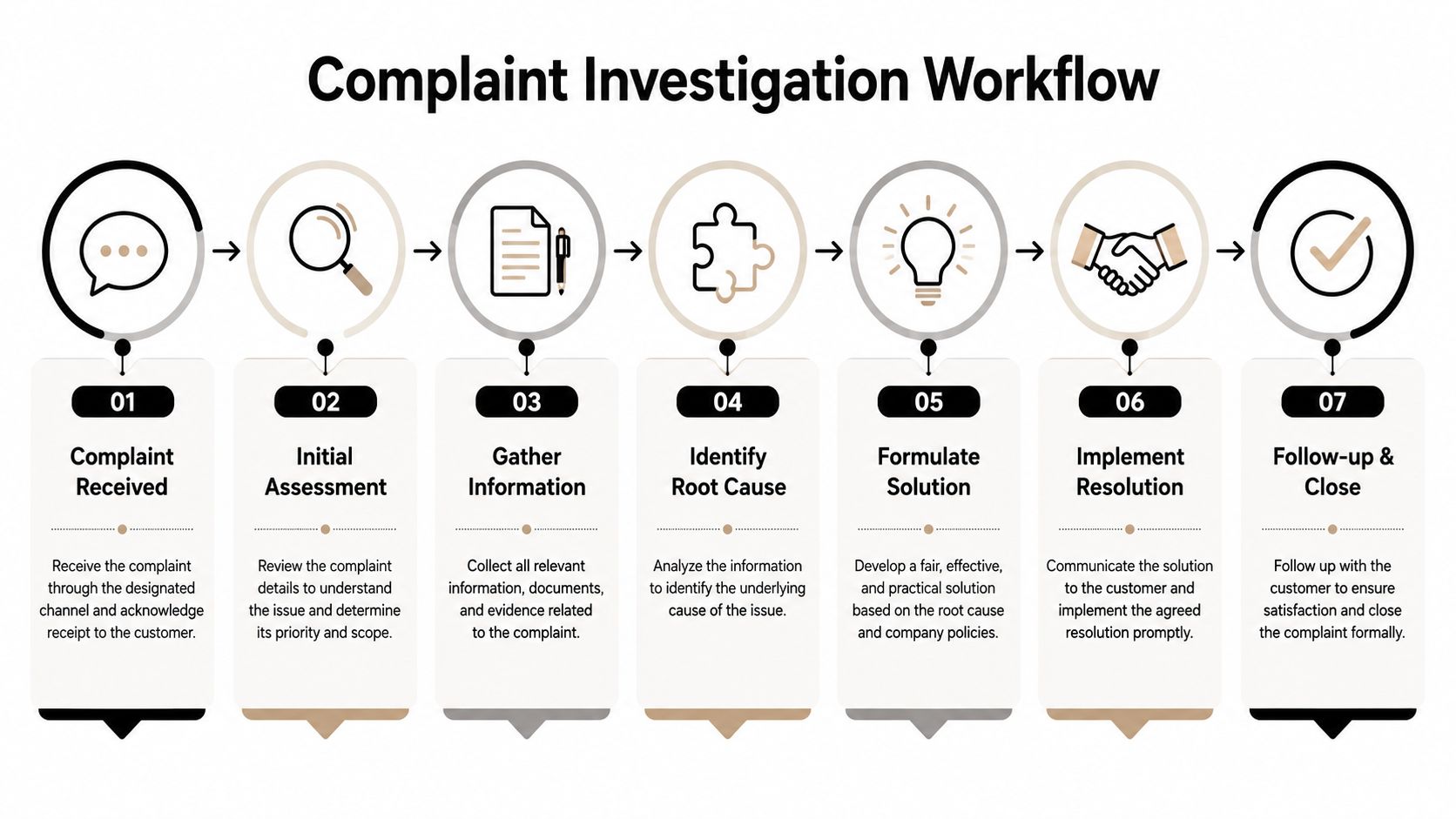
Most complaints become easier once the team stops debating and starts checking records. A missing item claim needs a different investigation path than a late delivery complaint. A quality complaint needs different evidence than a driver conduct complaint. The best complaint resolution process reflects that reality instead of pushing every issue through the same script.
Start with the facts that already exist
For a missing item, staff should check the original order contents, packing notes, any bagging checklist, and the driver's inventory handoff record. If the customer sent a photo of the delivered bag, compare that against the order before anyone starts arguing over memory.
For a late delivery, review dispatch timestamps, driver status updates, route notes, and any customer communication already sent. Many “late” complaints are really “nobody updated me” complaints. The fix is different.
For a wrong product, compare the order confirmation against the fulfillment record and any SKU or item label history you maintain. This is usually a pick-and-pack error, not a driver problem.
For driver professionalism, get the customer statement first, then the driver account, then dispatch notes. Don't force the customer to repeat the same story to multiple people. Log it once and investigate from there.
Match the remedy to the failure
Not every complaint deserves the same resolution. Teams get into trouble when they over-correct simple inconvenience or under-correct a clear service failure.
A practical decision path looks like this:
- Use an apology when the issue is minor, the service was completed, and the customer mainly lacked communication.
- Use a replacement when the wrong item or a missing item can be corrected cleanly within policy.
- Use a refund or credit when redelivery isn't practical, the customer no longer wants the item, or the trust break is larger than the original mistake.
- Escalate before offering anything when the complaint touches legality, jurisdiction, age verification, or a dispute over what was delivered.
Notice that this isn't about being generous or strict. It's about choosing a remedy that fits the cause and can be documented clearly afterward.
First-contact resolution changes the outcome
The reason frontline staff authority matters is simple. According to Citizens Advice research on complaint handling%20(1).pdf), when a complaint is resolved at the initial stage, 90% of customers report being extremely satisfied. That's the operational case for giving trained staff enough authority to fix ordinary problems without waiting for a manager.
Customers rarely judge you only by the original mistake. They judge how many times they had to ask for help before someone took ownership.
That doesn't mean frontline staff should freestyle. It means they should have pre-approved options for common failures, with clean limits and clear notes.
Use language that closes the issue, not inflames it
Resolution messages should be plain and specific. Good examples:
“I checked your order and confirmed the item mismatch. We can correct that with a replacement under our standard process, and I'm logging this under your order record now.”
“I reviewed the dispatch notes. Your order was delayed and you should have received an update sooner. I'm sorry about that. Here is the resolution we can offer today.”
Avoid defensive phrases like “our policy says” as the opening line. Policy matters, but customers need acknowledgment before they need citation. Staff should explain the result, the reason, and the next step in that order.
Building Escalation Paths and Training Your Team
A complaint system breaks when frontline staff either escalate everything or escalate nothing. Both patterns create cost. The first clogs management with routine work. The second leaves serious issues in the hands of people who shouldn't carry them alone.
Build a simple path with real authority
Most delivery teams don't need a complex org chart. They need a path that staff can remember during a busy shift.
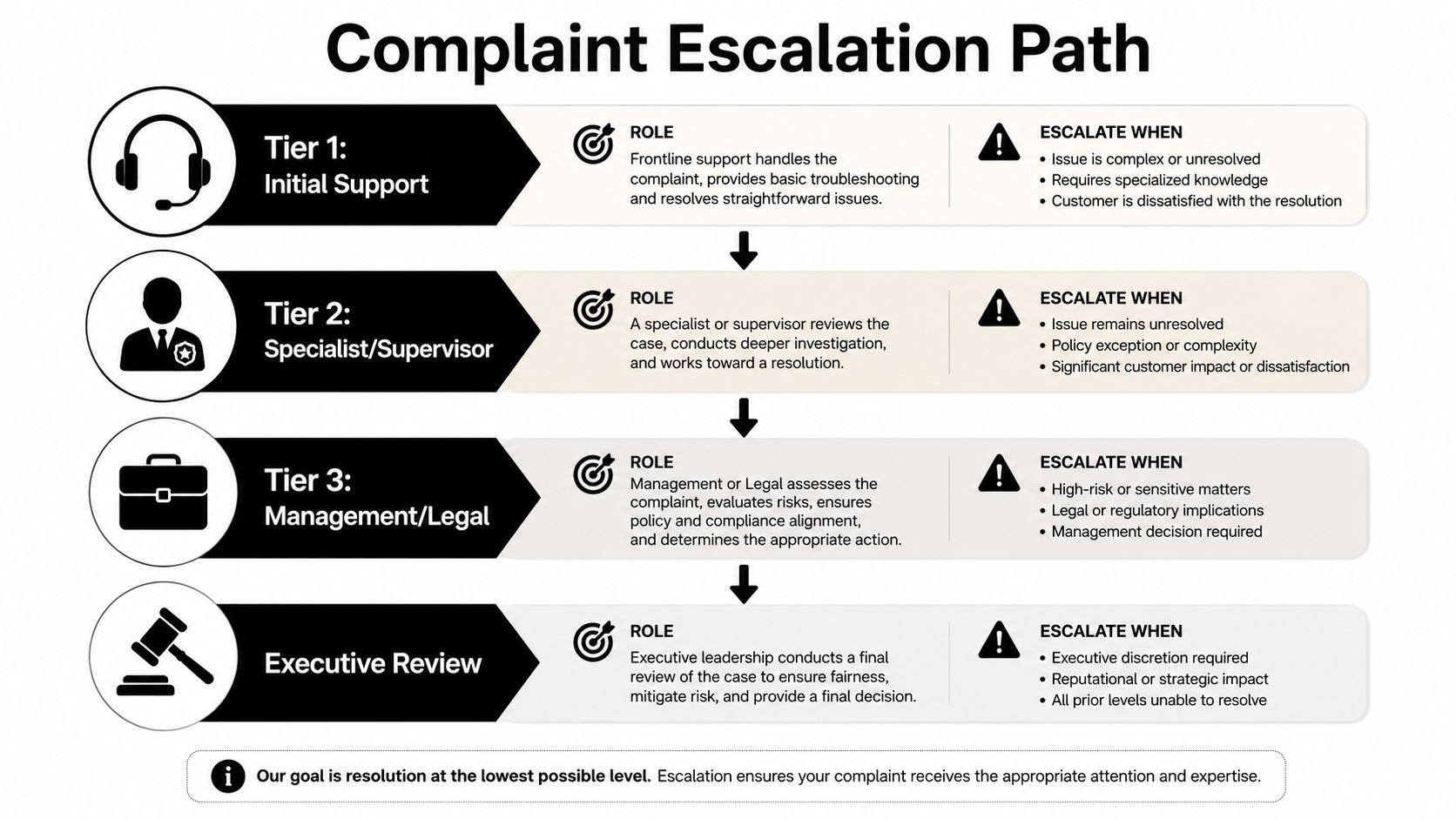
A workable structure is:
Tier 1 initial support
This is dispatch, phone support, or the person monitoring complaint intake. They verify the order, log the issue, gather evidence, and resolve routine service failures within approved limits.Tier 2 supervisor or specialist
This level handles disputed facts, repeat complaints, stronger customer dissatisfaction, and issues involving staff conduct or product concerns that need judgment.Tier 3 management or legal review
This level takes anything involving jurisdiction, age verification conflict, service area boundaries, repeated policy exceptions, or language that could create regulatory exposure.Executive review
Reserved for the rare complaints with broad business risk, repeated process failure, or major customer relationship impact.
Put the triggers in writing. “Ask for a manager” is a trigger. “Customer rejects the proposed resolution” is a trigger. “Possible delivery outside lawful boundaries” is a trigger.
The short training video below is a useful reminder that escalation works best when staff know where their authority ends.
Train for judgment, not scripts alone
Scripts help. They don't replace judgment. A strong complaint resolution process depends on staff understanding why the process exists and what a good outcome looks like.
Training sessions should include:
- Role-play on common failures: Wrong item, missing item, late delivery, poor communication, and refusal scenarios tied to verification or location.
- Documentation drills: Staff should practice turning a messy call into a clean complaint record.
- Resolution authority limits: Everyone should know what they can approve on the spot and what requires review.
- De-escalation language: Calm, neutral wording beats defensive policy recitations.
- Jurisdiction awareness: Staff must know that DC, Maryland, and Virginia cannot be handled with the same assumptions.
Measure the frontline team on the right thing
A frontline team needs one benchmark that matters enough to shape behavior. According to Arthur D. Little guidance on resolving customer complaints, a high-performance process requires a First Contact Resolution benchmark of 80% or higher. That benchmark only works when frontline staff do have the knowledge and permission to solve ordinary complaints.
Use that insight carefully. Don't turn it into pressure to close complaints before they're resolved. The point of FCR is not to make numbers look clean. The point is to prevent unnecessary handoffs.
Manager's note: Reward staff for accurate resolution and complete documentation together. Fast but sloppy handling creates second complaints.
What training should look like in practice
Run short sessions often instead of holding one long annual lecture. Complaint handling is operational muscle memory. Teams learn faster when they review real examples from the prior week, compare how each person would classify the issue, and discuss where the handoff should have happened.
The best teams also review closed complaints for lessons. If three separate customers complain about delayed updates, that isn't a customer service coincidence. It's a dispatch communication problem wearing three different names.
Navigating Compliance in DC Maryland and Virginia
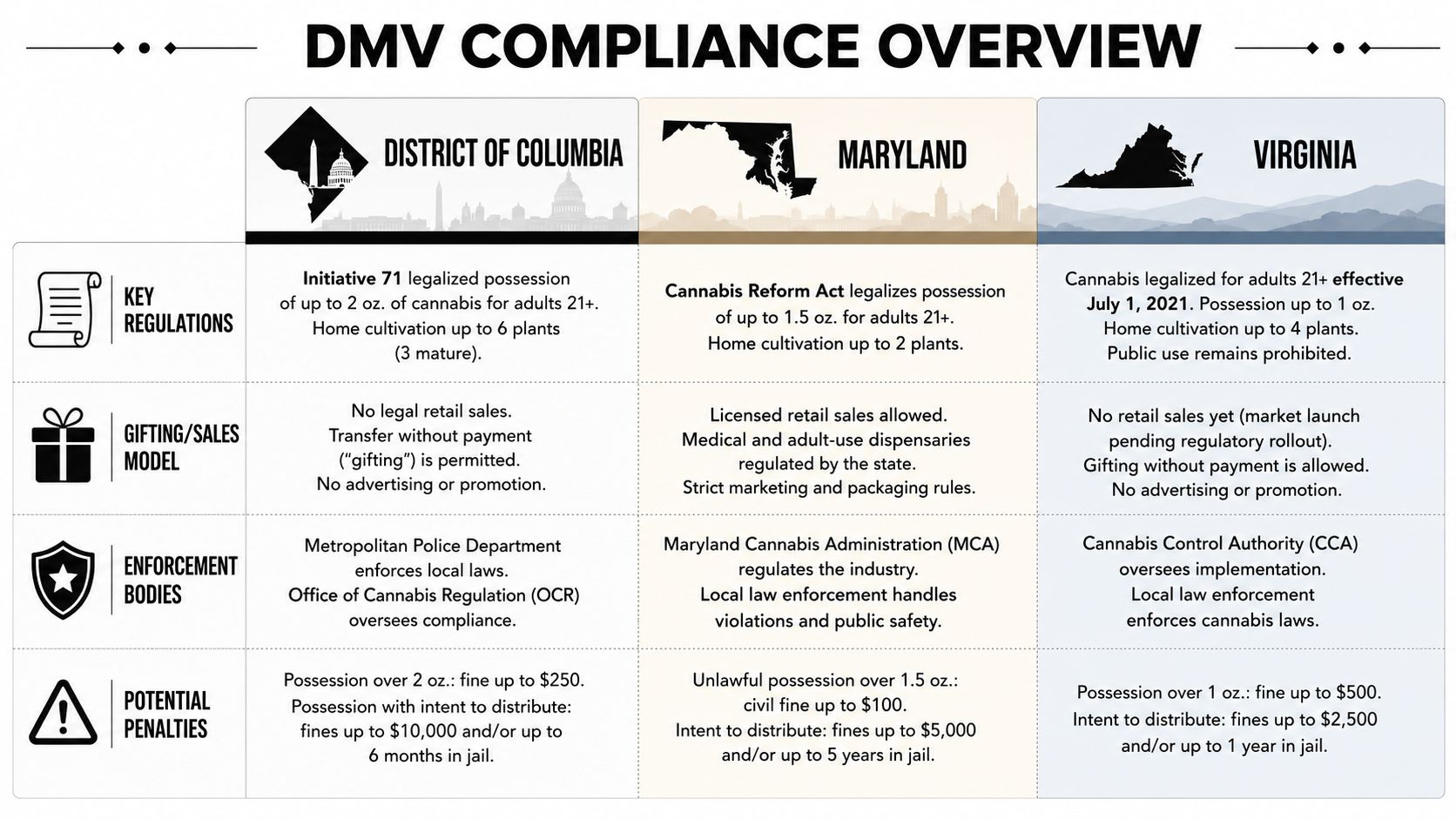
Generic complaint advice falls apart in the DMV because the legal structure is not uniform. The same customer issue can require different wording, different documentation, and a different resolution path depending on whether the order touches DC, Maryland, or Virginia.
DC requires special care in how complaints are framed
In Washington, DC, delivery operates through Initiative 71's gifting framework, where cannabis is provided as a gift alongside a purchased non-cannabis item, and transporting cannabis across state lines, including into Maryland or Virginia, remains a federal crime, as explained in this overview of DC cannabis delivery rules.
That has direct consequences for complaint handling. In DC, staff should be trained to describe disputes with precision. Focus resolution records on the order, delivery service, fulfillment accuracy, customer communication, and the purchased non-cannabis component where applicable. Casual language can create unnecessary risk if your staff talks about the transaction the wrong way.
A second rule is geographic discipline. Delivery complaints often surface location facts. If a customer says they were trying to receive delivery outside lawful boundaries, this should move out of routine support and into management review. Staff should never improvise around cross-border requests.
Maryland allows a more conventional retail complaint model
Maryland is different. According to this summary of cannabis delivery legality in DC, Maryland, and Virginia, Maryland has fully legalized recreational cannabis sales and licensed delivery under a regulated framework. That means complaint handling there can look more like standard retail operations, with direct product-sale disputes addressed in a more familiar way.
Operationally, that usually means clearer product complaint categorization, more conventional refund or replacement logic, and less linguistic sensitivity around the underlying sale itself. Even so, teams still need strict records, because regulated markets expect traceability.
Virginia calls for a conservative posture
Virginia is where smart operators slow down. The safest approach is to use conservative escalation rules, tight documentation, and no creative interpretations by frontline staff. If a complaint touches delivery legality, product transfer assumptions, or location boundaries involving Virginia, management should handle it.
That matters because complaint records are often where off-script details appear. A text thread can reveal where the customer wanted the order moved. A phone note can reveal that staff made a promise they should never have made. In a sensitive market, the complaint file itself can become the problem if your team writes loosely.
One process, three legal overlays
The best model is one shared complaint resolution process with jurisdiction-specific rules layered on top:
- DC: Train staff to document and communicate within the gifting framework.
- Maryland: Use a more standard retail resolution structure, but keep full records.
- Virginia: Escalate faster and act conservatively.
A complaint system should lower legal risk, not create fresh exposure. In the cannabis industry, that means the process has to fit the map.
If you want a DC delivery service that takes reliability, documentation, and customer care seriously, Green Express DC is built around discreet service, clear ordering, and a professional approach to getting your order right.