You're in DC, Maryland, or Virginia, it's late, and you want delivery. You pull up a menu, see fast drop-off, discreet packaging, maybe cash on delivery, and the only question that matters hits you right away. Is this in fact legal, or just common?
That's the wrong distinction to ignore. A lot of people assume that if a delivery service is easy to find, it must be operating safely. In the DMV, that assumption gets people into trouble. The rules for weed delivery change when you cross a state line, and in DC they change again depending on whether you're talking about medical cannabis, hemp-derived products, or an Initiative 71 gifting transaction.
Operators who treat legal compliance issues like background paperwork are making a serious mistake. Consumers who don't ask basic questions are taking unnecessary risks too. In this region, the law isn't abstract. It affects where a driver can stop, what can be handed over, how age gets verified, whether cash is handled properly, and whether a business gets shut down.
The High Stakes of Cannabis Delivery in the DMV
A common DMV delivery scenario looks simple from the outside. A customer in Northwest DC places an order from a menu, expects a same-day drop, and assumes the process works the same way it would in a regulated retail market. Then the driver shows up and asks for ID, the address turns out to be restricted, or the whole transaction is structured differently than the customer expected. That friction isn't random. It's what happens when convenience collides with a fragmented legal map.
For operators, the cost of getting this wrong is real and immediate. In 2024, regulators across 29 U.S. states, including Washington, DC, issued 2,500 violations to licensed cannabis operators, averaging nearly seven violations per day nationwide, with total fines exceeding $10 million for the year, according to this 2024 enforcement summary. That's the part many people miss. Compliance failures aren't rare edge cases. Regulators catch them every day.
What this means on the ground
Delivery creates more moving parts than a storefront. Drivers deal with addresses, IDs, timing, payment handling, packaging, and handoff rules in real time. A dispensary counter is controlled. A curbside exchange at an apartment, hotel, or office building isn't.
Practical rule: If a service can't clearly explain how its delivery model fits local law, assume the risk is being pushed onto the customer and the driver.
Consumers should care because enforcement doesn't just hit the business. Seized product, canceled deliveries, and bad handoffs all land on the customer side too. Operators should care because every sloppy process compounds risk. One weak ID check, one bad address, one employee improvising a “gift” explanation, and the whole business starts looking careless.
Why DC is especially tricky
DC is the most challenging jurisdiction in the DMV because the visible market often doesn't match the legal structure. Maryland has a regulated adult-use path. Virginia has a narrower environment. DC sits in the middle with a gifting economy, strict medical rules, and active enforcement pressure.
That's why legal compliance issues matter here more than generic cannabis advice. In the DMV, details decide whether a delivery is routine or reckless.
Decoding Key Cannabis Compliance Areas
The term “compliance” often brings to mind licenses on a wall. That's too narrow. Cannabis compliance works more like a mix of alcohol rules, pharmacy controls, and delivery-chain documentation. If one part breaks, the whole operation becomes vulnerable.
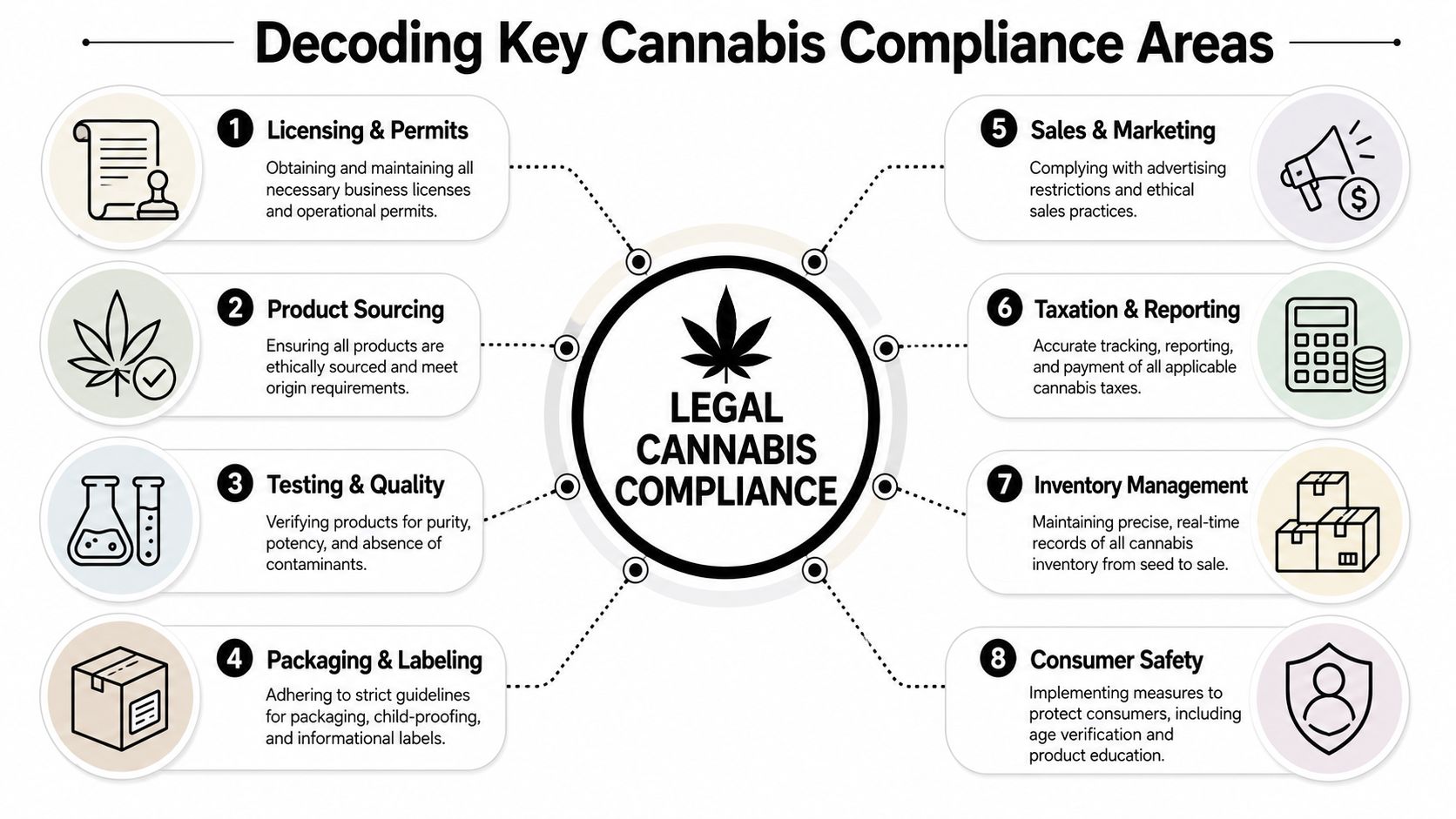
If you're evaluating a delivery business or planning one, start with a practical map. A consumer browsing a DC cannabis delivery menu usually sees products and prices. Regulators see a chain of obligations.
The eight areas that actually matter
Licensing and permits
A cannabis business needs the right approval for the exact activity it performs. Delivery, retail, courier work, and internet ordering don't all sit under the same bucket. If the business model changed but the paperwork didn't, that's a problem.Age verification
This area often presents a lot of real-world friction. It's not enough to say “21+ only” or “medical patients only.” Someone has to verify identity at the right point in the transaction and know what to do when the ID doesn't neatly match the order.Product testing and labeling
Testing rules are supposed to protect buyers, but they also create operational risk. As noted in this 2025 cannabis legal issues overview, product testing inconsistencies remain a major issue, and in Colorado one in every four tested products had THC content off by more than 20% from the label. If potency and labeling are off, the operator has a compliance problem and the customer has a trust problem.Packaging
Packaging isn't cosmetic. It affects child resistance, tamper evidence, labeling, and whether the product looks like it came through a controlled channel or a random handoff.
The categories generic guides usually flatten
Advertising and sales practices
A lot of businesses get sloppy here. If the legal model restricts direct sales, the marketing language matters.Zoning and location rules
Cannabis law isn't just about the product. It's also about where business activity happens and where deliveries can legally go.Tax and reporting
Cannabis operators have to track what moved, what was received, and what was paid. If records don't line up, regulators start asking harder questions.Data privacy and customer records
Delivery businesses handle names, addresses, order history, and identity data. If they collect it, they need rules for storing it and limiting access.
Compliance isn't one task. It's a chain. The handoff fails when one link fails.
The operators who survive long term treat legal compliance issues as operating discipline, not legal decoration.
Comparing Cannabis Delivery Laws in DC Maryland and Virginia
If you order in Bethesda, Arlington, and Dupont Circle, you're not dealing with one regional market. You're dealing with three separate legal realities. That's why so many consumers get confused. The app-style experience looks similar, but the law behind the transaction isn't.
DC runs on a gifting model
In Washington, DC, recreational cannabis delivery operates under the Initiative 71 gifting framework, which allows adults 21 and older to transfer up to 1 ounce (28 grams) of marijuana to another adult without payment or exchange of goods or services, according to the Metropolitan Police Department's marijuana guidance. That's the central fact every consumer and operator needs to understand.
In plain English, DC doesn't allow a straightforward recreational sale-and-deliver model the way a fully regulated adult-use market does. That's why customers see gifting language, bundles, or separate merchandise structures. If a service acts like it's selling recreational weed directly to you in DC, that should raise questions.
You can browse what local operators present as weed delivery in DC, but the legality depends on how the transaction is structured and whether the service follows the actual rules attached to that structure.
Maryland is cleaner and easier to understand
Maryland is much more straightforward. Recreational weed delivery is legal through licensed dispensaries, and the state permits licensed delivery services to make direct commercial cannabis sales to adults 21 and older within Maryland, as described in this regional delivery law overview. Consumers don't have to decode a gifting setup the way they do in DC.
That doesn't mean Maryland operators can relax. It means the legal path is clearer. A legal path still requires discipline.
Virginia stays narrower
Virginia is the awkward middle ground in many consumer conversations. People hear that possession rules have loosened in some contexts and assume delivery works the same way. It doesn't. Virginia remains more restrictive than Maryland for practical delivery purposes, and consumers shouldn't assume a service that looks normal online is operating under a broad adult-use delivery framework.
If you cross a border in the DMV, re-check the rules. Don't assume “close by” means “legally similar.”
DMV Cannabis Delivery Laws at a Glance (2026)
| Jurisdiction | Recreational Delivery Status | Governing Model | Primary Restriction |
|---|---|---|---|
| DC | Not a standard direct-sale recreational model | Initiative 71 gifting framework | No direct commercial sale of recreational cannabis |
| Maryland | Legal through licensed dispensaries | Regulated adult-use market | Delivery must run through licensed operators |
| Virginia | Restrictive | Narrower, non-broad adult-use delivery environment | Consumers shouldn't assume broad recreational delivery is allowed |
The practical takeaway is simple. DC requires interpretation. Maryland requires licensing. Virginia requires caution. If you operate across the DMV, you need separate procedures, not one recycled playbook.
The Real Risks of Ignoring Compliance Rules
A lot of weak operators still talk as if “hemp,” “CBD,” or “everyone does it” will buy them cover in DC. That logic is dead. District enforcement has moved in the opposite direction.
In Washington, D.C., a 2021 D.C. Attorney General memorandum explicitly confirmed that CBD is cannabis because the District doesn't have a federal-style hemp carve-out, and delivery services face search, seizure, and padlocking penalties starting April 1, 2025 after the grace period for unlicensed shops ended, according to this Axios report on DC enforcement. If your business model depends on pretending cannabinoid products sit outside DC cannabis law, you're operating on borrowed time.
Enforcement isn't theoretical
DC has made clear that unlicensed shops and delivery operations can draw multiagency attention. Businesses can also get exposed through public complaints. That matters because many operators still think enforcement only shows up after a long investigation. In practice, regulators can act much faster when the business is visible, easy to find, and obviously out of step with the rules.
For consumers, this means the cheapest or fastest option may also be the least stable one. An order can disappear when inventory is seized. A storefront can vanish. A delivery number can stop answering.
The business-ending mistakes
The worst compliance errors usually look small at first:
- Misclassifying products so the operator claims a product is outside cannabis rules when DC says otherwise
- Using the wrong transaction structure for the jurisdiction
- Delivering to the wrong place because the driver doesn't understand restricted properties
- Running weak ID checks that create avoidable disputes at the door
- Keeping poor records so the business can't explain what was delivered, where, or why
The operators who get shut down usually didn't lose on one dramatic mistake. They lost on repeated basic mistakes.
This is why I'm blunt about legal compliance issues. They aren't side work for a lawyer to clean up later. They are front-line operating controls. If a delivery service treats compliance like branding copy, it's already behind.
How Green Express DC Prioritizes Safe and Compliant Delivery
The operators who last in DC usually do one thing well. They accept that friction is part of the job and build procedures around it instead of pretending it doesn't exist.
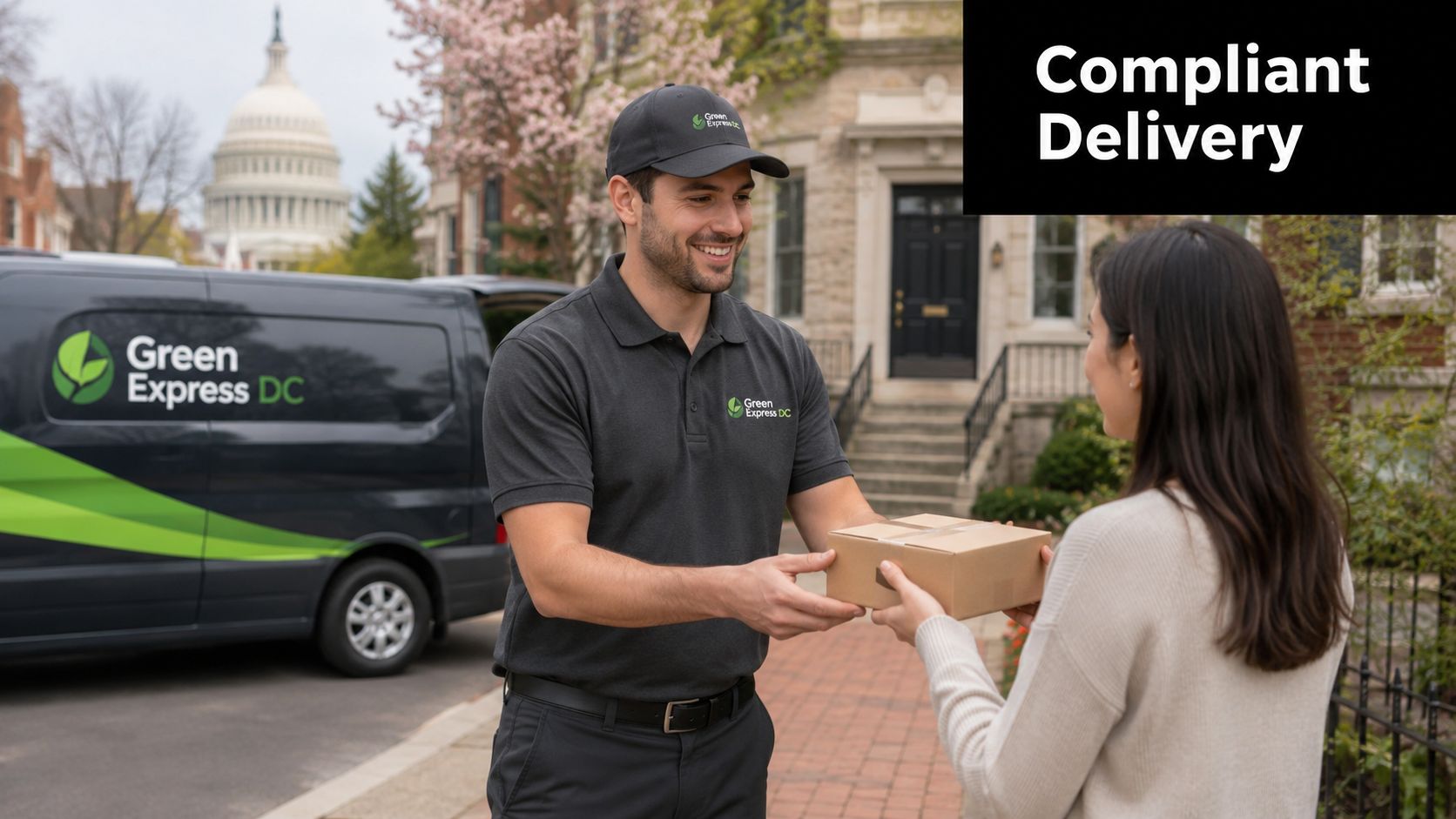
A good example is how serious services handle the handoff itself. The customer may think the delivery starts when the order is placed. From a compliance perspective, it starts when the service decides whether the order is even acceptable, and it ends only when the courier verifies identity and completes the drop within the rules.
The hard part is the doorstep
Most compliance guides reduce age checks to a slogan. That's useless in the field. As noted in MG Magazine's compliance discussion, many guides say “verify ID” but don't explain edge cases like expired licenses, out-of-state IDs for tourists, or biological mismatches in DC's hybrid medical-recreational environment, which leads to rejected deliveries and customer complaints.
That's exactly where professional delivery operations separate themselves from sloppy ones. The courier needs a repeatable rule set. If the ID is invalid, the handoff stops. If the recipient doesn't match the order requirements, the handoff stops. If the situation is unclear, the driver needs escalation instructions, not improvisation.
One example consumers can review is I-71 compliant shops in DC, where the focus is on how a service frames transactions and customer verification under District rules.
What responsible delivery looks like
Here's what I want to see from any DC operator:
Strict ID at drop-off
Not just a checkbox online. The driver checks a valid government-issued ID in person.Discreet packaging
That lowers obvious exposure during transit and handoff.Lab-tested inventory
Customers deserve products selected with safety and consistency in mind.Clear gifting structure
If the business is operating in DC's Initiative 71 environment, it should explain that structure plainly instead of hiding it in vague language.
A short explainer helps show what this looks like in practice.
Why tourists and business travelers get tripped up
Visitors cause a lot of compliance friction without realizing it. They assume a hotel delivery works like a food app. It doesn't. ID has to be valid. The recipient has to be the right person. The address has to work for the delivery model. The driver has to be able to complete the handoff lawfully and safely.
Consumers usually experience this as inconvenience. Operators experience it as risk control. The disciplined businesses don't bend the rules to save a sale, and that's exactly what you want.
Your Consumer Checklist for Legal Cannabis Delivery
If you're ordering in the DMV, you need a checklist. Not vibes. Not assumptions. A few direct checks will tell you a lot about whether a service takes legal compliance issues seriously.
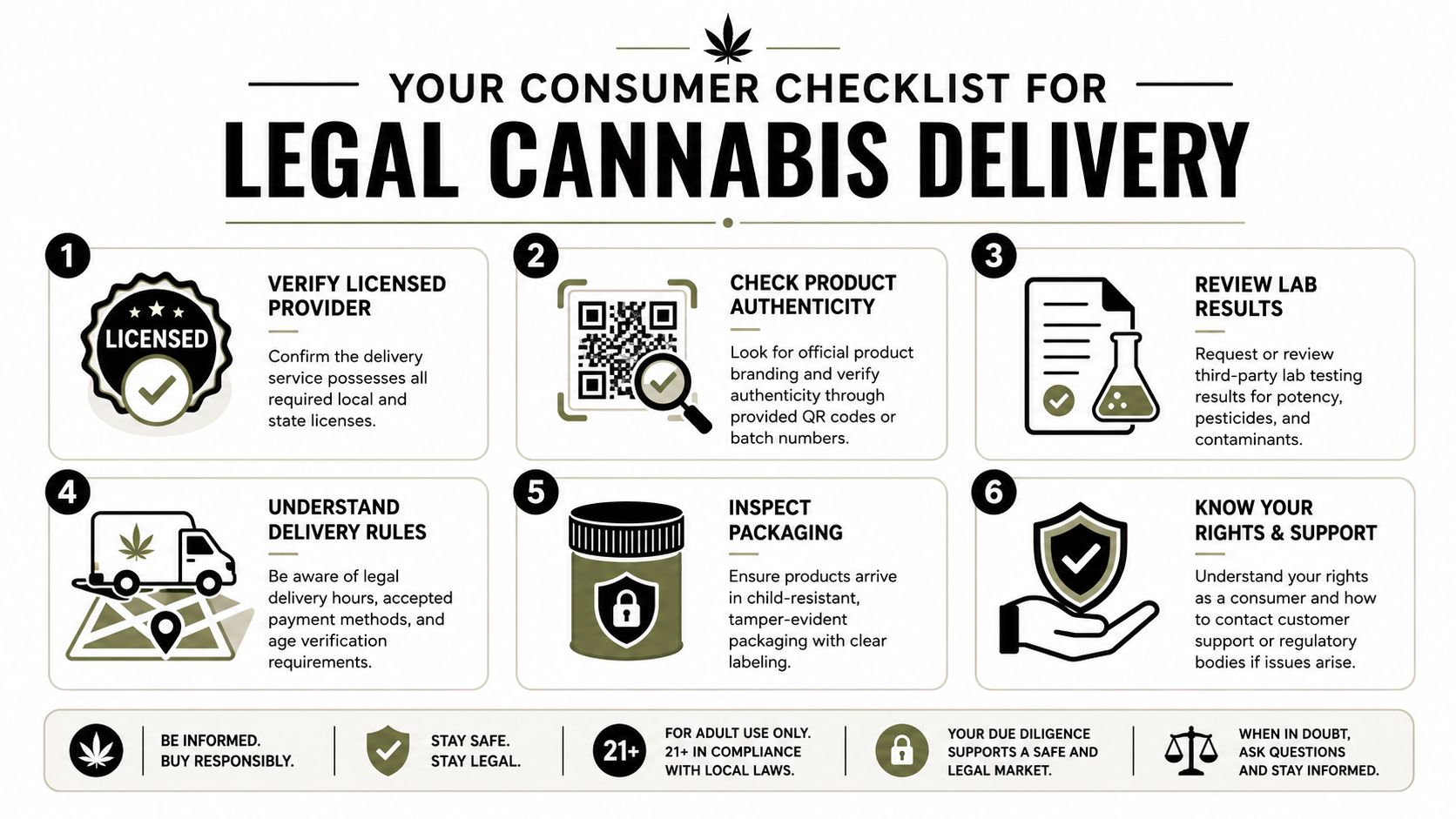
Ask these questions before you place the order
How is the transaction structured in this jurisdiction
In DC, you should understand whether the service is operating through a gifting model rather than a direct recreational sale.What happens at ID verification
If the service is vague here, that's a bad sign. Serious operators have a clear drop-off policy.Are the products presented as tested and clearly labeled
You're looking for signs of controlled sourcing, not random inventory with no paper trail.Does the service explain delivery boundaries
A company that can't explain where it will and won't deliver is telling you it may not understand its own restrictions.
The address rule too many people ignore
This one matters in DC. Third-party Medical Cannabis Courier License holders are restricted to delivering only to residential and commercial addresses in the District that are not on District government or Federal property and not on public or private school grounds, under DC Code § 7-1671.06e.
That means consumers should stop assuming any DC address is workable. Some aren't. If you're at a federal building, certain government property, or school grounds, that's a problem. If you're a traveler, ask before you order.
Consumer check: If your drop-off point is a hotel, office, dorm-adjacent location, or government-linked property, confirm delivery eligibility before you pay or schedule.
A practical pre-order screen
Use this quick filter:
| Check | What you want to hear | Red flag |
|---|---|---|
| ID policy | In-person valid government ID required | “Just upload anything online” |
| Delivery location | Clear explanation of restricted addresses | “We deliver anywhere in DC” |
| Product handling | Tested, labeled, discreetly packaged products | No clarity on sourcing or packaging |
| Legal model | Straight answer about gifting, medical, or licensed retail | Evasive language about how the transaction works |
If a service gets defensive when you ask basic compliance questions, move on. Good operators expect those questions. Bad operators hate them.
The Evolving Future of DMV Cannabis Laws
The DMV isn't one cannabis market and won't behave like one anytime soon. DC still forces consumers and operators to contend with a gifting system and tougher enforcement pressure. Maryland offers a cleaner regulated lane for adult-use delivery. Virginia remains narrower and less intuitive for consumers who assume regional consistency.
That fragmentation is why people keep stumbling into preventable legal compliance issues. The delivery experience looks modern and simple, but the legal framework underneath it is still patchwork. Cash handling, age verification, address restrictions, and product classification all stay complicated until lawmakers simplify the bigger system.
Federal changes could eventually make parts of this easier. Banking reform would help cash-heavy operations. Broader legal reform could reduce some of the strange contradictions between local and federal treatment. But nobody ordering or operating in the DMV should make decisions based on what the law might become.
Use the rules that exist today. Ask direct questions. Expect direct answers. If a service can't explain its process in plain English, don't trust it with your order.
If you want a delivery option that explains its process clearly, browse Green Express DC and review the ordering details, ID requirements, and product information before placing an order.