
You get home after a long day in DC, kick off your shoes, and want something lighter than a brownie and more fun than a plain gummy. A colorful rope candy sounds familiar and playful, but if it's THC-infused, the questions pile up fast. How strong is it? Is it legal to have it delivered? Can a service bring it to Virginia or Maryland?
That confusion is common because gummy rope candy sits at the intersection of candy nostalgia, edible dosing, and local cannabis rules. If you live in the District, or you're just comparing options across DC, Virginia, and Maryland, it helps to understand both the candy itself and the legal framework around delivery.
Why Gummy Rope Candy Is Trending in DC
A lot of adults in the District are looking for edibles that feel less clinical and more familiar. Gummy rope candy fits that mood. It looks like a playful candy-store treat, but in THC form it also offers a slower, more discreet edible experience than smoking.
DC's legal setup adds another layer. Recreational cannabis delivery in the District operates through a gifting model rather than direct retail sales, so consumers often spend more time comparing product forms and deciding what feels easiest to use at home. For many, rope-style edibles stand out because they're recognizable, easy to portion visually, and less intimidating than some concentrates. If you're weighing edible options, this overview of the benefits of edibles helps explain why so many adults choose them for convenience and discretion.
Understanding Gummy Rope Candy Concepts
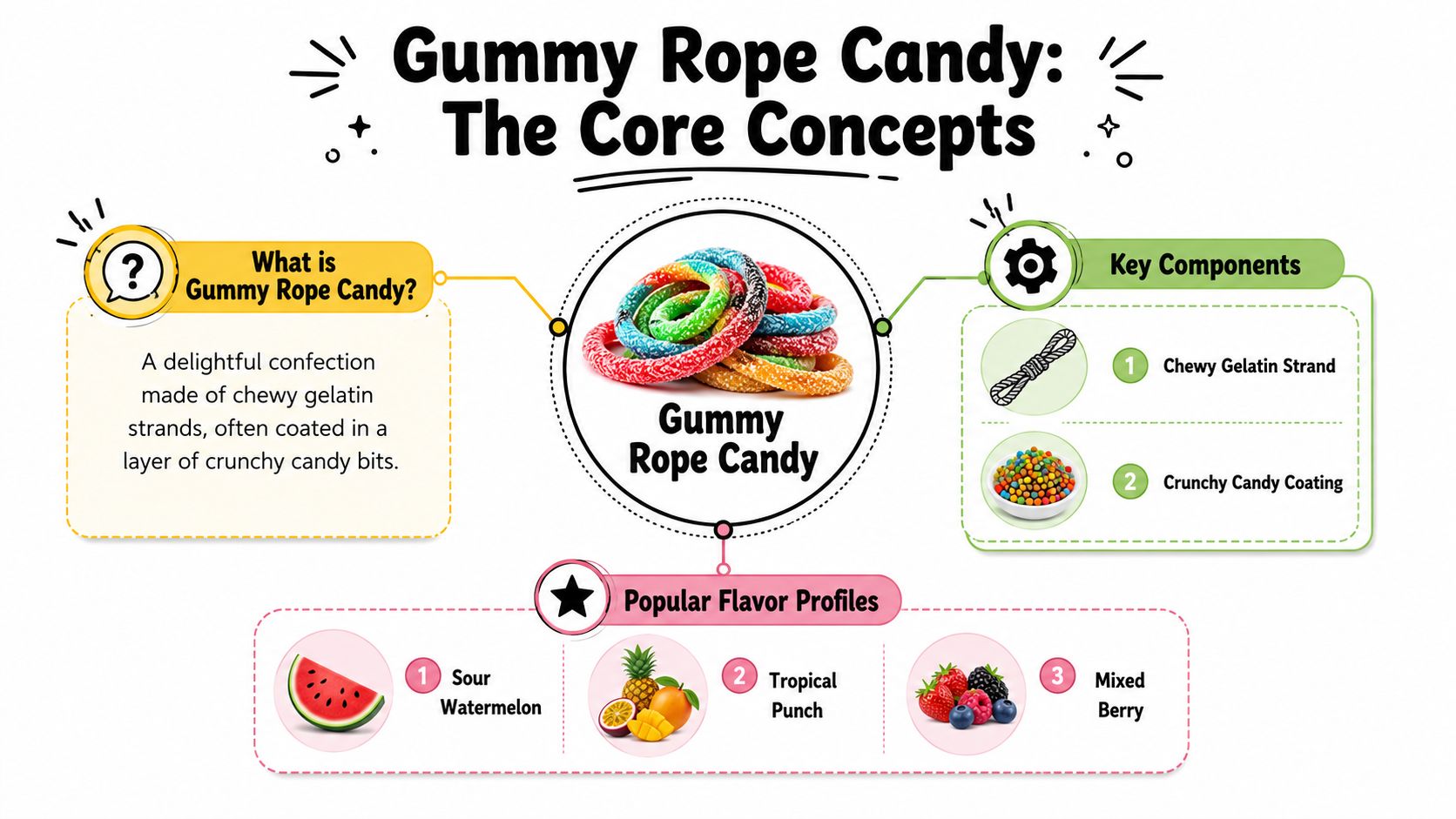
At its simplest, gummy rope candy is a chewy strand built around a gelatin base, often finished with a crunchy outer coating. Think of it as two candies working together. The center stretches and resists your bite, while the outside cracks, pops, or crunches first.
That contrast is the whole appeal. If a plain gummy is one-note, a rope candy feels more like a tug-of-war between textures.
The anatomy of a rope
Most rope candies have two main parts:
- Chewy core. This is the gelatin-based center that gives the candy its bend and pull.
- Crunchy shell. This outer layer adds texture and often boosts the sour or fruity impact.
Popular flavor profiles usually lean bright and punchy. Sour watermelon, tropical punch, and mixed berry all make sense in this format because the chewy center carries the fruit flavor while the coating sharpens the first bite.
Why the texture feels so different
The core behaves the way it does because gelatin forms a protein network. In practical terms, that network helps the candy stretch instead of snapping right away. Manufacturing matters too. The gummy mixture is simmered with continuous stirring until fully dissolved, then poured into molds. After that, the filled mold must cool for at least 15 minutes so the mixture changes from a viscous liquid to a semi-solid gel that can be removed without deforming, as shown in this gummy rope production walkthrough.
A good rope candy should feel elastic when you pull it and distinct when you bite it. If it's just sticky and flat, the texture balance is off.
Where readers often get confused
People sometimes assume the crunchy coating is structural, like a shell holding everything together. It really isn't the main support. The center does most of that work. The coating mostly contributes sensation, flavor, and appearance.
That matters later when you start comparing standard candy ropes with THC-infused versions. The edible effect doesn't change the fact that texture starts with the gummy core.
Comparing Conventional and Cannabis Infused Ropes
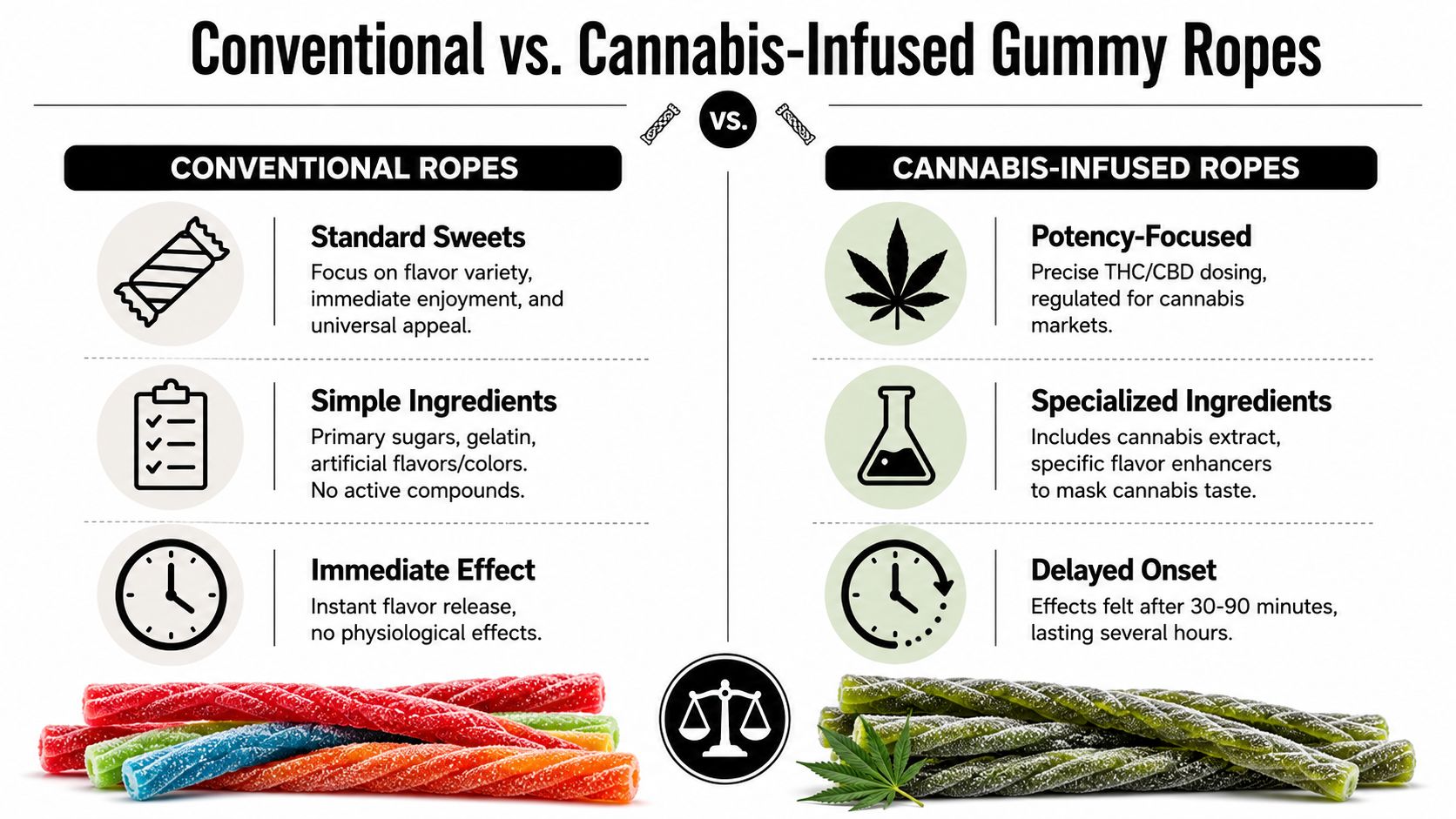
A standard rope candy and a THC rope can look almost identical on the outside. That's where mistakes start. One is just candy. The other is an edible that may produce delayed effects and needs much more careful labeling and handling.
Side by side differences
| Type | What you notice first | What matters most |
|---|---|---|
| Conventional rope | Flavor and texture | Candy ingredients, freshness, sweetness |
| Cannabis-infused rope | Flavor may be similar | THC labeling, consistency, storage, testing |
A conventional rope is designed for immediate enjoyment as candy. A cannabis-infused rope has a second job. It needs to deliver a predictable edible experience, which raises the stakes on formulation and labeling.
The biggest practical difference is uncertainty. With a regular rope, no one worries about psychoactive effects. With an infused rope, consumers need to know what's in the full rope and how easily it can be portioned.
Why infused ropes deserve more scrutiny
There's a major knowledge gap around homemade and even loosely described infused rope products. One especially overlooked issue is this: there's no consolidated, data-backed guidance on how high sugar and acidic crunchy coatings affect THC bioavailability or gummy stability during melting and cooling, as noted in this discussion of DIY Nerds Rope-style recipes.
That doesn't mean infused ropes are unsafe by default. It means consumers should be careful with products that make broad potency claims without clear testing or labeling.
Consumer rule: If an infused rope looks homemade, unevenly coated, or poorly labeled, assume the dose may not be evenly distributed.
A simple way to think about it
A regular rope is a snack. A THC rope is a snack plus a dosing system. Once you frame it that way, the buying criteria change fast. Texture still matters, but accuracy matters more.
Safety and Dosing Guidelines for THC Rope Candies
The safest way to approach THC rope candies is to stop thinking like a candy eater and start thinking like an edible user. The same product shape that makes rope candy fun can also tempt people to keep chewing before the first dose has had time to fully kick in.
That's why patience matters more than enthusiasm.
Start lower than you think
For a new or occasional consumer, the smartest move is to begin with a small portion of the rope, then wait and see how your body responds. Tolerance, whether you've eaten recently, and the product's consistency all affect the experience.
If the rope isn't clearly marked by portion, be extra cautious. A long candy shape can make it easy to assume one bite equals one serving, but that isn't always true.
- Check the label first. Look for total THC and whether the rope is divided into servings.
- Cut before you chew. A clean cut is easier to track than a rough bite.
- Wait before taking more. Edibles can take longer to show full effects than many people expect.
- Skip alcohol the first time. Mixing variables makes it harder to judge your response.
Why homemade dosing is tricky
THC rope candy looks simple, but infusion raises questions that candy recipes don't answer well. As noted earlier, there isn't consolidated, data-backed guidance on how sugary, acidic coatings affect THC behavior during melting and cooling. That's one reason buyers often prefer tested products over improvised kitchen versions. If you want to see how these products are commonly presented in the market, this page on edible Nerds Rope options shows the style of product many consumers are curious about.
Build a repeatable routine
Keep it boring the first time. That's the best edible advice I know.
Write down what you took, when you took it, whether you had food beforehand, and how you felt later. A simple note in your phone works. Over time, that gives you a personal pattern you can trust more than guesswork.
Edibles often feel strongest to people who assume nothing is happening, then take more too soon.
Common mistakes to avoid
- Eating more because the candy tastes good. Rope candies are easy to overconsume because they don't feel medicinal.
- Sharing without explanation. A product that resembles regular candy can confuse other adults in the room.
- Leaving pieces out. An unfinished segment on a table can be mistaken for ordinary candy.
Legal and Labeling Rules in Washington DC
Washington, DC has one of the more misunderstood cannabis systems in the region. Many consumers talk about “buying weed delivery,” but recreational cannabis in the District doesn't operate like standard retail sales in a licensed storefront model.
Under Initiative 71, recreational cannabis delivery works through a gifting framework. Cannabis, up to 1 ounce, may be transferred as a true gift alongside the purchase of a non-cannabis item because direct sales of recreational weed and licensed recreational storefront dispensaries are prohibited, according to the DC Metropolitan Police Department marijuana guidance.
What that means in plain English
You aren't walking into a typical adult-use retail environment like some people expect in other jurisdictions. The legal structure matters because the transaction has to fit the gifting model.
For consumers, that means legality isn't just about the product itself. It's also about how the delivery is structured.
How to read labels carefully
When you're looking at a THC gummy rope in DC, labeling should answer basic questions clearly:
- What's the total THC content?
- Is the rope divided into servings or pieces?
- Does the package distinguish THC from CBD?
- Is there any batch or test information?
If a package leaves those questions fuzzy, move on. Rope candies can be long, sticky, and irregular in shape, so clear labeling matters even more than it does with evenly molded gummies.
Recreational gifting versus medical delivery
There's also a difference between the recreational gifting model and medical cannabis delivery. In DC, medical cannabis delivery may be handled under a specific courier licensing structure for eligible patients and caregivers, while recreational delivery stays tied to Initiative 71 gifting rules. Consumers sometimes blur those categories, but the legal pathways aren't the same.
Legal shortcut: In DC, focus on whether the transaction follows the gifting framework and whether the package gives you enough information to dose responsibly.
Choosing Quality THC Gummy Ropes and Storage Tips
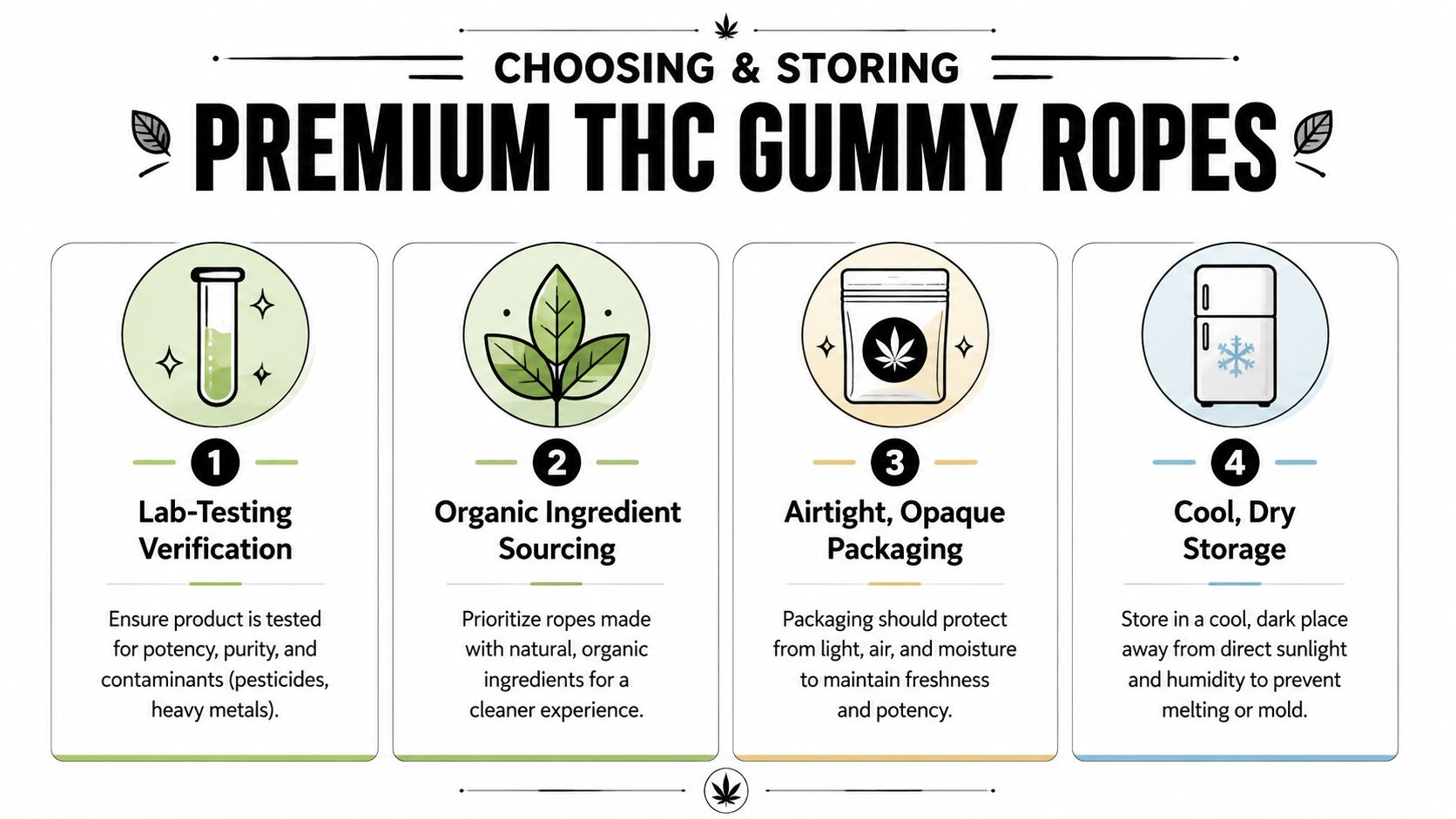
The fastest way to judge a THC rope is to ask two questions. Was it tested, and was it packaged like the seller expected it to sit on a shelf safely? If the answer to either is unclear, treat that as a warning sign.
What quality looks like
A strong buying checklist includes:
- Lab-tested potency. You want confirmation that the THC content matches the package.
- Contaminant screening. Cannabis edibles should be checked for unwanted residues and impurities.
- Protective packaging. Opaque, sealed packaging helps reduce light, air, and moisture exposure.
- Clean ingredient choices. Many consumers prefer simpler formulas, especially with fruit-flavored edibles.
Why texture tells you something useful
Gummy ropes are surprisingly durable because gelatin forms a resilient protein network. One reported mechanical measure puts gelatin-based gummy rope candy at about 15 kPa in tensile strength, with a breaking force of roughly 300 Newtons, or about 30 kilograms (66 pounds) before the material stretches or tears, according to this explanation of gummy rope mechanical strength.
You don't need a lab to use that information. The practical takeaway is simple. A good rope should feel springy and cohesive, not wet, mushy, or brittle.
Best ways to store them
Storage changes both texture and reliability. Rope candies don't like heat, humidity, or constant air exposure.
Here's a practical comparison:
| Storage option | Best use | Watch out for |
|---|---|---|
| Original sealed package | Best for short-term freshness | Reseal carefully after opening |
| Airtight container | Good after opening | Keep away from light and humidity |
| Refrigerator | Useful if your space runs warm | Condensation can affect the coating |
Smart storage habits
- Keep it cool and dry. Heat can soften the rope too much and make the coating messy.
- Store it out of sight. These products can look like ordinary candy.
- Label opened portions. If you cut a rope into pieces, note what you know about the serving size.
- Don't mix loose edibles together. Different candies can pick up each other's flavors and become hard to identify later.
A well-stored THC rope keeps its chew, coating, and clarity. A poorly stored one becomes a guessing game.
Ordering Discreet Delivery from Green Express DC
If you're ordering in the District, the process is fairly straightforward, but it only works inside DC. Delivery services are restricted to District boundaries because cannabis can't legally be transported across state lines, and customers must be verified as DC residents aged 21 or older. Deliveries can't legally go into Virginia or Maryland, as explained in this overview of DC cannabis delivery boundaries.
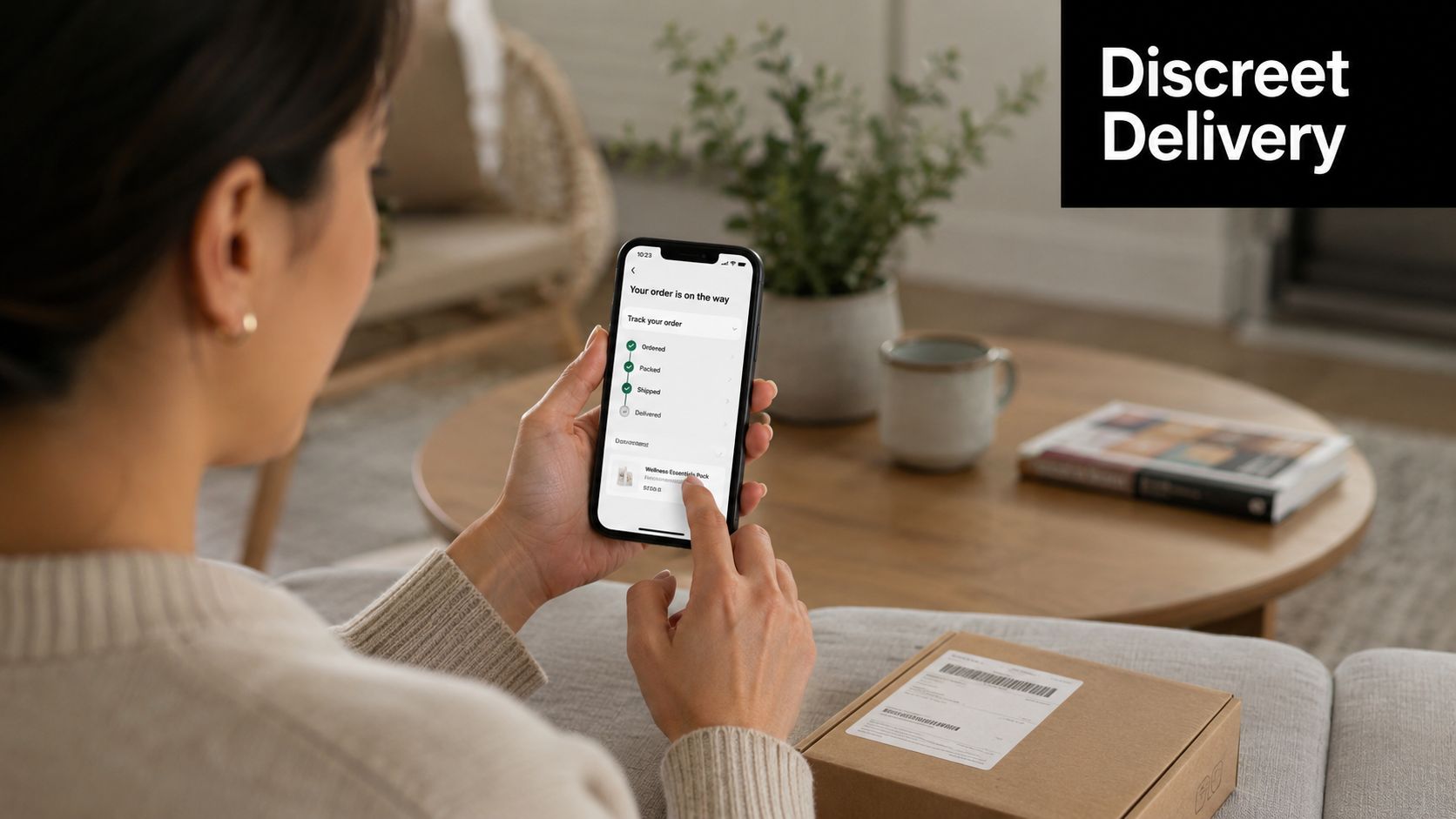
How the process usually works
In DC, a customer typically:
- Registers or submits order details.
- Verifies age and identity.
- Selects products available through the gifting-style framework.
- Confirms a District delivery address.
- Shows valid ID again at drop-off.
That final check matters. Discreet delivery doesn't mean anonymous delivery. It means the package and handoff are handled with privacy, while the courier still confirms identity.
What Virginia and Maryland residents should know
People often stumble on this point. Being close to DC doesn't make a Virginia or Maryland address eligible for DC cannabis delivery. Even if you're just across the border, the order can't legally cross into those states.
So if you live in Arlington, Alexandria, Bethesda, Silver Spring, or elsewhere outside the District, you'll need to use legal local channels in your own jurisdiction rather than a DC service. If you're comparing District options before ordering, this guide on where to buy cannabis edibles in DC gives a useful overview of how the local market is commonly approached.
Delivery boundaries matter as much as product choice. A legal DC order still has to stay in DC.
Next Steps for Enjoying Gummy Rope Candy Safely
The safest approach to gummy rope candy is simple. Learn what the product is, confirm how it's labeled, choose tested options, and store it like an edible rather than a snack. If you're in DC, keep the gifting framework in mind. If you're in Virginia or Maryland, remember that DC delivery can't cross the border.
Start low, wait patiently, and keep notes on what works for you. A rope candy can be fun, flavorful, and manageable when you treat it with the same care you'd give any THC edible.
If you want a reliable place to order premium, lab-tested cannabis products in the District, Green Express DC offers fast, discreet delivery for adults 21+ in Washington, DC, with a curated menu, clear ordering, and professional ID-verified drop-off.