
Cash on delivery is a mainstream payment model, not an odd exception. In online food delivery alone, the global COD segment was valued at US$93,264.7 million in 2024 and is projected to reach US$122,998.5 million by 2030, a projected 4.2% CAGR from 2025 to 2030.
If you're ordering cannabis delivery in Washington, DC, that checkout option usually means something simple and normal. You place your order, the courier arrives, your ID is verified, and you pay at handoff. In the District's cannabis gifting environment, that's the practical way to complete a transaction without forcing customers into payment systems that often don't fit market conditions.
A lot of people run into this for the first time when they're ready to check out and see "Cash on Delivery" instead of Apple Pay or a card form. That can feel old-fashioned if you're used to paying online for everything else. In cannabis delivery around DC, Maryland, and nearby Virginia customers meeting in the District, it's usually the opposite. COD is the cleaner, more transparent option.
Understanding Payments in the DC Cannabis Scene
A typical first order goes like this. You browse a menu, find the flower or vape you want, add it to cart, and then pause when checkout asks for cash on delivery. The first instinct is often to wonder whether something is off.
Usually, nothing is off at all.
In the DC cannabis space, COD is a familiar handoff process. You arrange the order, the courier brings it, and payment happens when the order is physically delivered. That's easy to understand, and for many customers, it feels more comfortable than prepaying for a regulated product through a payment flow they don't fully trust.
Why this feels unusual at first
Most online shopping trained people to expect instant card payments. Cannabis delivery in DC works differently because the transaction has to fit a very specific operating environment. That changes how checkout is built and how the final exchange happens.
For new customers, the useful takeaway is this:
- You're not paying into a vague system online. You pay when the courier arrives.
- You can keep the exchange straightforward. Order, confirm, verify ID, pay, receive.
- You can treat it like a normal local delivery process. The main difference is the timing of payment.
COD remains a major global payment method. It represented about 15% of global eCommerce payment transactions in 2023, and in some markets it can account for up to 70% of online sales, with preference reaching 90% in some tier 2 and tier 3 cities, according to this cash on delivery market overview.
That broader context matters. COD isn't a workaround invented for one corner of retail. It's a payment model people keep using when trust, convenience, and payment access matter. If you're looking at weed delivery in DC, seeing COD at checkout should read as standard operating practice, not a red flag.
What customers usually care about most
Those asking "what is cash on delivery" aren't looking for a finance definition. They want to know whether the process is safe, simple, and normal. In DC cannabis delivery, the answer is yes when you're dealing with an established service and following the usual age-verification process.
How Cash on Delivery for Weed Works Step-by-Step
The easiest way to understand COD is to walk through the handoff from start to finish.
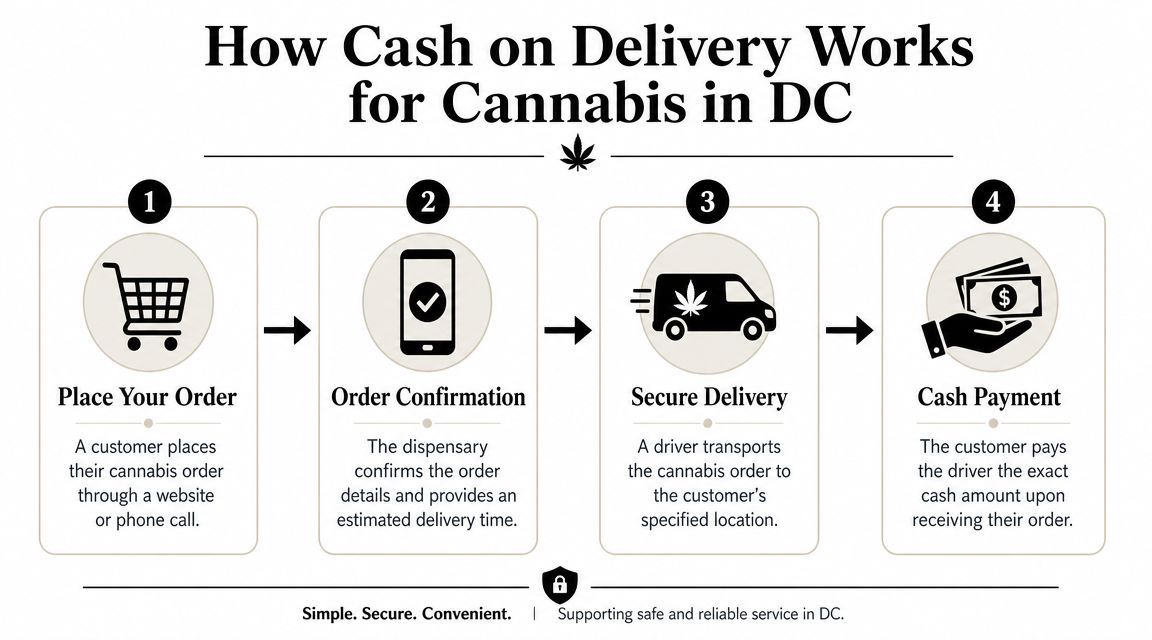
The order starts online, but payment doesn't
You browse the menu, choose your products, and submit the order. At checkout, you select cash on delivery instead of prepaying. After that, you receive a confirmation and an estimated arrival window.
That timing matters because COD is a deferred settlement model. The payment isn't completed at checkout. It happens when the courier reaches you, and the courier acts as a collection agent before funds are remitted back to the seller, as explained by the U.S. Chamber overview of cash on delivery.
What happens at the door
When the courier arrives, the exchange is usually quick and routine:
- The courier confirms the delivery details. This keeps the handoff orderly and avoids confusion.
- You present a valid government-issued ID showing you're 21+. Age verification is part of the process, not an optional extra.
- You hand over the cash payment. In DC cannabis delivery, customers should expect literal cash unless the service clearly says otherwise.
- You receive the order. Payment and possession happen at the point of handoff.
That structure is why COD feels familiar once you've done it once. It's not very different from other delivered goods except that ID verification is central and payment happens at the end.
For a visual walkthrough, this short explainer helps:
What works and what doesn't
A smooth COD delivery usually comes down to a few practical habits:
- Have your phone nearby. Drivers may need to confirm arrival or clarify the meeting point.
- Keep your ID ready before the courier gets there. That avoids awkward delays at the door.
- Have your payment prepared. Counting bills after the courier arrives slows down the exchange.
- Use a clear, reachable delivery location. Complicated handoffs create unnecessary friction.
Practical rule: COD works best when the customer treats the delivery like a scheduled handoff, not a loose arrival window they can half-ignore.
What doesn't work is placing the order and then becoming hard to reach, forgetting ID, or assuming the courier can wait around while you find cash. COD is simple, but it rewards being prepared.
The Legal Reasons COD Dominates the DMV Market
COD makes the most sense in the DMV once you look at the legal and banking reality around cannabis. Customers often think cash-only delivery is a preference. In practice, it's often the clearest operational answer to a complicated setup.
Why online cannabis payments are harder than they look
In Washington, DC, adult-use cannabis operates under rules that don't line up neatly with standard eCommerce payment rails. That matters for local delivery. Card processors and major payment platforms are built for conventional retail sales. Cannabis businesses often can't rely on those systems the same way a restaurant or clothing store can.
That's why cash remains so common. COD lets the order be arranged ahead of time while keeping the actual payment at the point of physical transfer. In the DC gifting environment, that structure is easier to manage than trying to force everything through a standard online payment stack.
COD is bigger than cannabis
It's also important not to treat COD like a fringe practice. According to Grand View Research's cash on delivery data for online food delivery, the global COD segment in that category was valued at US$93,264.7 million in 2024 and is projected to reach US$122,998.5 million by 2030, with Asia Pacific as the largest revenue-generating region in 2024 and India projected to post the highest CAGR through 2030.
That doesn't prove anything specific about DC law by itself. What it does show is that COD is an established logistics and payment system used at scale. For cannabis delivery in the District, it's a practical fit for a market where compliance and payment processing don't work like ordinary retail.
The right way to read COD in the DMV is not "Why can't I just pay online?" It's "What payment method actually fits the rules, the banking limits, and the handoff process?"
Customers in Virginia and Maryland run into this too when they're shopping DC options. The key point is that DC's rules drive the payment method. If you're researching I-71 compliant shops in DC, COD is part of how the local market stays operational without pretending cannabis checkout works like standard national eCommerce.
Customer Benefits and Practical Considerations of COD
Customers usually judge COD on one question. Is it better for me than paying online? In the DC cannabis context, it often is, but it's not perfect.
Why many customers prefer it
The biggest customer-side advantage is control. You don't have to push money through a questionable payment flow before the courier arrives. The handoff happens first, then the payment.
Logistics guidance also notes that COD reduces buyer anxiety because payment is made only after the product is in hand. That inspection-before-payment model is one reason it remains popular with cautious buyers, as described in CEVA's explanation of cash on delivery.
A second advantage is privacy. Cash doesn't create the same kind of visible digital payment trail that card transactions do. For many cannabis customers, that's not a small detail.
The part customers need to plan for
The trade-off is convenience. Cash is simple, but only if you have it ready. If you need to find an ATM at the last minute or you're short on the total, the delivery gets harder than it needs to be.
Here's the practical comparison:
| Feature | Cash on Delivery (COD) | Digital/Card Payments (Hypothetical) |
|---|---|---|
| Payment timing | Paid at handoff | Paid before delivery |
| Privacy | More private at the payment stage | Leaves a clearer digital payment trail |
| Order confidence | You pay when receiving the order | You pay before the handoff |
| Checkout ease | Requires cash preparation | Familiar for most online shoppers |
| Fit for DC cannabis delivery | Aligns with current market realities | Often harder to support cleanly |
Bottom line: COD is usually better for privacy and reassurance. It is less convenient if you aren't prepared with cash before the courier arrives.
How to Prepare for Your Green Express DC Delivery
Preparation makes COD feel easy. Lack of preparation is what makes people think the system is awkward.
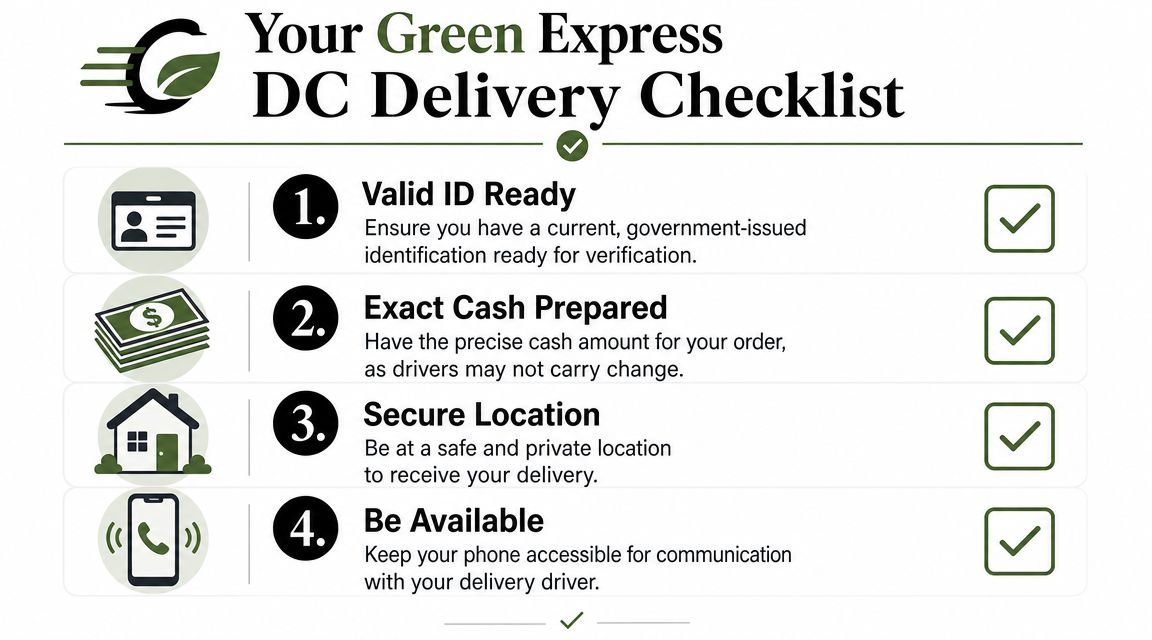
Keep these four things ready
If you're using a local option such as Green Express DC's delivery service, the handoff goes more smoothly when you set everything up before the driver arrives.
- Your valid ID. Have a current government-issued ID ready for the age check.
- Your cash total. Review your order total and set the payment aside in advance.
- Your phone. Keep it on and nearby in case the driver needs to reach you.
- Your location. Be at the agreed delivery spot and ready to receive the order.
Clarify what "cash on delivery" means before arrival
One area that confuses customers is the word "cash." In some industries, COD can include card-on-delivery or mobile payment at the door. But that isn't something you should assume. As Billtrust's COD explainer notes, the term has broadened, but the key question is still what payment instruments are accepted at handoff.
For DC cannabis delivery, assume literal cash unless the service clearly states otherwise.
A short checklist that avoids most problems
- Check the order total before the driver leaves for your stop
- Set aside exact cash if possible
- Don't send someone else to accept the order unless they meet the ID requirement
- Stay reachable until the handoff is complete
This is also the place to remember the basics of the service you're using. Green Express DC operates with a $50 minimum and a cash-on-delivery process, so it helps to confirm the total and have that amount ready before the courier arrives.
Frequently Asked Questions About COD Cannabis Delivery
Can I live in Virginia or Maryland and still use cash on delivery for a DC weed order?
Customers from Virginia and Maryland often shop DC menus, but the actual handoff still needs to fit DC rules and delivery practices. If you're outside the District, don't assume a courier can complete the transaction across state lines. Confirm the delivery area and meeting requirements before placing the order.
Do I need exact change?
Exact cash isn't always mandatory, but it's strongly recommended. It speeds up the exchange, keeps the handoff discreet, and avoids putting the courier in a position where making change becomes a problem.
Is cash on delivery actually safe?
Yes, when you're dealing with a legitimate delivery service and following normal verification steps. COD is designed to move payment to the final handoff, which gives customers a clear, direct transaction instead of an uncertain online payment attempt.
Is it legal to hand a driver cash in the DC cannabis market?
In DC, the payment process has to be understood within the local gifting framework and the operating realities around cannabis transactions. That's one reason COD is so common. It gives customers and delivery services a straightforward handoff structure that fits the market better than standard online card processing.
What if I thought COD meant card at the door?
Don't assume that. Ask before delivery if anything other than cash is accepted. In cannabis delivery, many services stick to literal cash to avoid processing complications.
If you're ordering in the District and want a straightforward handoff process, Green Express DC offers a DC cannabis delivery model built around ID verification, discreet drop-off, and cash on delivery so customers know exactly what to expect before the courier arrives.