
You're about to tap a DC delivery menu, scan a few flower and concentrate options, and decide whether the lab paperwork matters enough to open it. That pause is smart. The shiny part of the listing tells you strain names, flavors, and potency, but the quieter part of the paperwork, the heavy metal analysis section of the COA, is where you find out whether the batch was checked for contaminants you'd never see or smell.
That matters more in the District than a lot of buyers realize. Under DC's Initiative 71 framework, adult possession and gifting exist alongside a delivery culture, which means buyers often have to verify quality themselves instead of relying on a conventional retail shelf experience. If you want a simple rule, start with the metals page, not the marketing copy, and treat it like the safety panel on a car. The product can look perfect and still need scrutiny where it counts.
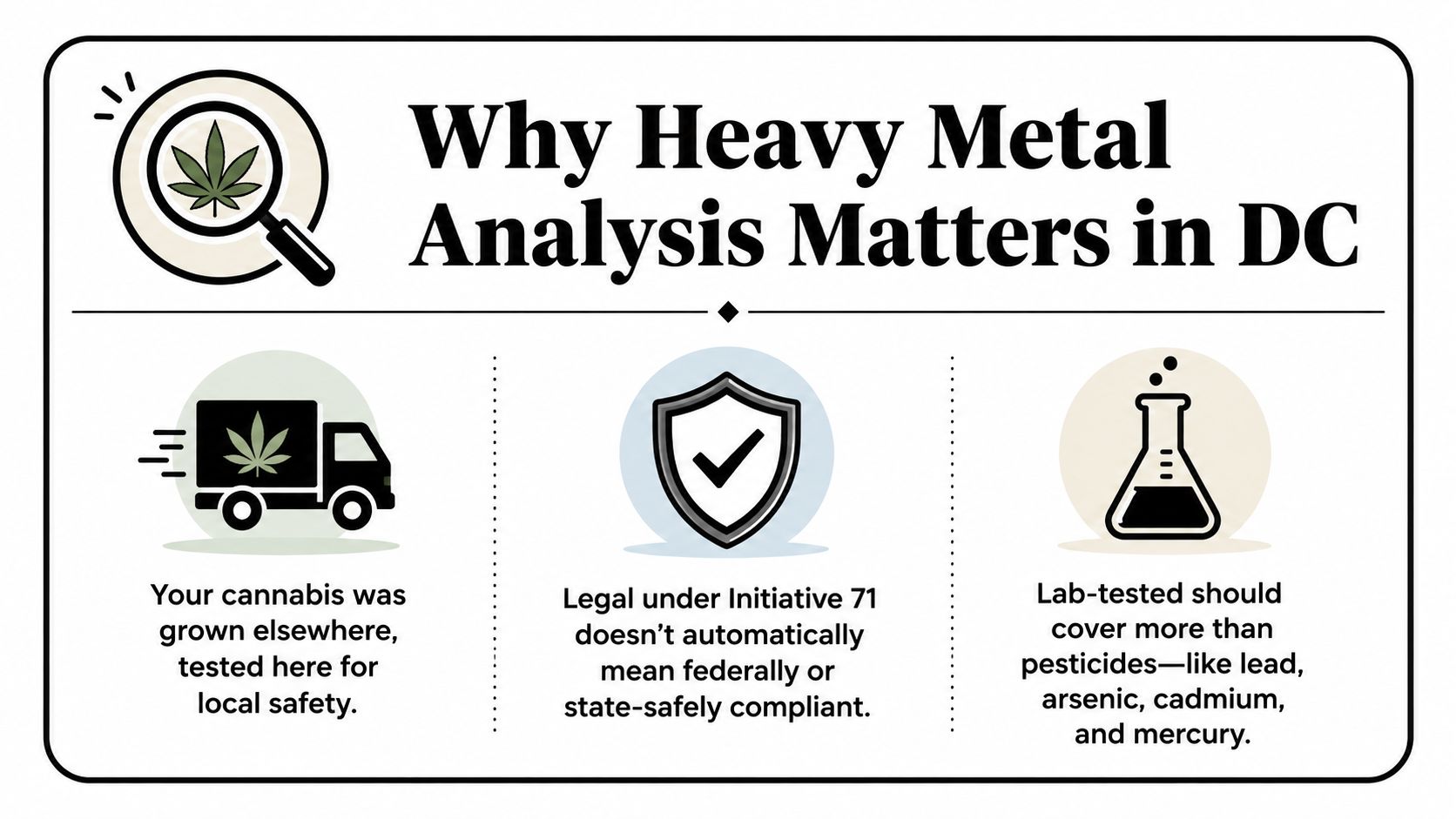
Why Heavy Metal Analysis Matters When You Order in DC
The first thing most DC buyers notice is convenience. You browse a menu, pick a product, and expect the delivery to arrive discreetly, but the chemistry behind that product doesn't care how smooth the ordering flow feels. Cannabis is a bioaccumulator, which means it can pull metals from soil, water, and fertilizers into the plant tissue, so a good-looking bud isn't automatically a clean one.
Why the COA deserves your attention
A Certificate of Analysis is the closest thing cannabis has to a lab report card. People often scan for THC first, maybe terpenes if they're more experienced, and then stop there. The heavy metal section is where you learn whether the batch was checked for lead, cadmium, arsenic, and mercury, the contaminants that matter because they can ride along from cultivation into the finished product.
DC's delivery and gifting scene makes that paperwork more important, not less. Since the legal structure doesn't work like a standard retail dispensary model, you're often depending on the seller's transparency and the lab's credibility at the same time. If a service can't clearly show what was tested, when it was tested, and what the batch matched, that's a warning sign, not a minor omission. For more on contamination controls, the practical guide at Green Express DC's contamination prevention page is a useful place to compare what a serious seller should disclose.
Practical rule: If the menu is polished but the COA is missing, vague, or hard to match to the product, assume the verification is incomplete.
What you should expect before checkout
A buyer doesn't need to become a chemist to make a better choice. You just need to know that lab-tested should mean more than potency. It should cover the contaminants most likely to travel through soil, dust, fertilizer, or water into the batch you're buying, and the report should be recent enough to describe the product in your hand, not some older lot from a different run.
The end goal is simple. By the time you finish reading a COA, you should know which line lists the heavy metals, which result is acceptable, and which one means keep shopping. DC buyers who learn that habit tend to ask better questions and avoid trusting a nice menu photo as a substitute for a real test panel.
What Heavy Metal Analysis Actually Tests For
Think of heavy metal analysis like a smoke detector for cannabis, except it listens for specific hazards instead of heat. The panel doesn't tell you everything about a plant, but it does flag the contaminants that can matter even when the flower looks, smells, and tastes fine. In most cannabis testing setups, the core targets are lead, cadmium, arsenic, and mercury, with chromium included in some state panels.
The four metals most buyers should know
Lead is the one people recognize fastest, and for good reason. It's a legacy contaminant, often tied to older soil, dust, pipes, or industrial residue. If a grow site sits on contaminated ground, or if dust settles during cultivation and handling, lead can show up in the final sample.
Cadmium often traces back to phosphate fertilizers. That means a plant can pick it up without any obvious sign that something went wrong at harvest. Arsenic is associated with soil and water sources, and it can also appear through certain historical pesticide inputs. Mercury is less common in everyday grow conversations, but it matters because atmospheric deposition can carry it into broader environmental cycles.
A result isn't “heavy metals” in the abstract, it's a snapshot of a specific contaminant behaving in a specific way.
Why tiny thresholds still matter
Cannabis is consumed in small amounts, but the body can retain metals over time. That's why labs report these analytes in very small units, often micrograms per kilogram or parts per billion. The numbers look tiny because the chemistry is tiny, and because a low concentration can still be meaningful when the exposure repeats.
The important takeaway is that one metal doesn't stand in for the rest. A batch can be fine on one analyte and weak on another, just as a car can pass one safety check and fail a different one. The consumer job is to read the full panel, not stop at the first green mark.
How Labs Measure Metals in Cannabis
The instrument matters, but the instrument alone doesn't decide whether a result is trustworthy. In practice, ICP-MS is the high-sensitivity workhorse for multi-element heavy metal analysis because its detection limits are typically far lower than atomic absorption methods. One comparative source reports limits below 0.01 ng/mL for As, Cd, Cr, Cu, and Pb by ICP-MS, while graphite or flame AAS can range from 0.0014 to 10 ng/mL depending on the element (EMEP/CCC-NILU analytical methods manual).
ICP-MS and AAS, side by side
A simple way to think about it is this. ICP-MS is like a high-resolution microphone that can pick up a single quiet instrument in an orchestra, while AAS hears the louder sections more easily than the faint ones. That difference matters because a lower detection limit reduces false negatives in trace screening and makes it easier to measure metals at very low levels without preconcentration.
The same source stresses the quality controls that keep the method honest, including blank analysis, at least three standards across the linear range, and replicate agreement to confirm calibration quality. Those aren't bureaucratic extras. They're what keep a contaminated blank, a sloppy calibration, or a drifting instrument from producing a misleading pass.
Why a better machine still needs better validation
Even the best analyzer can only read what the lab prepared correctly. That's why the detection limit on a brochure is only part of the story. If the workflow isn't clean, stable, and reproducible, the result can still be hard to trust.
Bottom line: a sensitive instrument helps, but only when the calibration, blanks, and replicates are tight enough to support the claim.
For buyers, this means one practical question beats a dozen buzzwords. Ask whether the lab used ICP-MS for the metals panel and whether the method was controlled tightly enough to avoid contamination-driven bias. If the answer is vague, the report deserves a second look.
From Plant to Petal on the Instrument
A heavy metal result starts before any vial reaches the analyzer. The plant has to be turned into a clean, measurable solution first, and that prep stage is where many readers misunderstand what the instrument is reporting. A validated food-style ICP-MS workflow uses a 0.5 g sample, microwave acid digestion in nitric acid, an internal standard such as indium, at least four calibration standards, and a rinse blank before data collection. That preparation step converts the plant material into something the instrument can read, much like turning a whole fruit into juice before testing what is inside it.
Why digestion controls the result
If you brew coffee, grind size, water temperature, and dose all change the cup. Lab prep works the same way. A digestion that does not fully break the matrix apart can suppress the signal, inflate it, or leave metals trapped in plant tissue that the instrument never sees.
That is why the validation criteria matter as much as the analyzer model. The workflow above uses recovery of 75 to 125%, repeatability below 15% RSD, and a quantification limit of 0.05 mg/kg as acceptance criteria. Those checks show whether the lab can pull a believable result out of a messy biological sample, the same way a careful recipe tells you whether the final drink matches the ingredients that went in.
A lab also has to show that the method works on the sample type itself, not just on a clean standard in water. In sample digestion and method validation, analysts look for evidence that the extraction is complete, the blank stays quiet, and the calibration behaves across the range they expect to report. The US EPA Method 3051A guidance on microwave-assisted acid digestion is one widely used reference for that kind of preparation step.
The question that exposes weak testing
A buyer rarely sees digestion quality on a product page, but it is one of the few details that separates a real test from a decorative one. If a lab cannot demonstrate recovery and quantification limits, the result is harder to trust no matter how modern the instrument sounds.
Ask this directly, “What is your lab's reported recovery and LOQ for the metals panel?”
That question cuts through the brochure language fast. It tells you whether the lab knows its own method performance or just its instrument brand.
Video helps here because the sample-prep sequence is easier to follow when the workflow is laid out visually.
Reading the Heavy Metal Section of a COA
A COA can look intimidating until you know what the columns mean. The heavy metal section usually lists the analyte name, the result, the limit of quantification, the action level or pass threshold, and the lab's accreditation. If the batch number on the report doesn't match the product in the bag, stop there. The report is only useful when it belongs to what you bought.
A quick way to scan the page
Use a traffic-light mindset. Green means the result sits comfortably under the limit. Yellow means it's close enough that you should ask questions. Red means walk away.
| Metal | Result (ppb) | Action Level (ppb) | Status |
|---|---|---|---|
| Arsenic | 80 | 200 | Pass |
| Lead | 300 | 500 | Pass |
| Cadmium | 40 | 100 | Pass |
| Mercury | 20 | 50 | Pass |
This mock table shows a clean reading, but the exact numbers on a real COA can vary by jurisdiction and product type. What matters is the relationship between the result and the action level, plus whether the lab is ISO 17025-accredited and the report is recent enough to describe the current batch.
What to check beyond the numbers
A strong COA makes the details easy to verify. A weak one hides them in footnotes, missing page numbers, or a summary that never shows the actual analyte results. The best habit is to compare the batch ID, the lab name, the method, and the date before you decide the product is safe enough for you.
If the page makes you guess, it's not doing its job.
That's why a buyer can learn a lot in less than a minute. Open the report, locate the heavy metal block, match the batch, and see whether the results are clearly below the stated limit. Once you can do that consistently, the rest of the menu gets easier to judge.
How Thresholds Differ Across DC, Maryland, and Virginia
The same flower can be treated very differently depending on where it's sold and under what framework it moves. In DC, adult-use possession and home cultivation are legal under Initiative 71, but commercial recreational sales are not legalized by that measure, so delivery and gifting models fill the gap. In Maryland, the adult-use market opened on July 1, 2023, after legalization in 2022, and licensed retail sales for adults 21+ are now regulated by the state (Maryland legalization framework). In Virginia, there still isn't a licensed adult-use retail market, and unlicensed sale remains prohibited (Virginia framework summary).
Why the legal map changes the buying question
This patchwork changes what “compliant” means in practice. Maryland's licensed retail environment is built around state rules, while DC buyers often rely on seller transparency because the delivery model isn't the same as walking into a standard dispensary. Virginia, by contrast, has a different legal posture altogether, so buyers need to be careful about what kind of product channel they're using and what proof of testing they can inspect.
That's why the best delivery services publish their own COA standards, not just a strain description. If a menu item came from a different sourcing environment, the consumer still needs a batch-specific report that shows the actual metals results, not a generic claim that testing happened somewhere upstream. The internal buyer guide at Green Express DC's weed delivery page is a good example of the kind of disclosure-focused approach shoppers should expect from any service.
What to ask before you buy
Ask who ran the panel, which matrix was tested, and whether the COA matches the exact product format you're ordering. Flower, concentrates, and infused products don't all behave the same way, so a test report that covers one lot doesn't automatically prove the next format is equivalent.
The legal framework doesn't replace testing, it raises the value of testing. In a region where the sale channel can differ across DC, Maryland, and Virginia, the cleanest buying decision is the one backed by a report you can inspect.
What This Means for Your Next Delivery Order
A delivery order is the moment to connect the COA to the exact product in your cart. A flower jar, a concentrate, and a vape cartridge can all come from the same brand, yet the metal profile may differ because the input material and processing steps are not the same. That is why the label alone is never enough.
Some formats deserve more scrutiny than others. Trim and biomass extracts can carry more soil-bound contamination risk because they start from plant material that is closer to the cultivation substrate, while isolates and distillates tend to be cleaner from a metals perspective because more of the non-target material has been stripped away. That does not make any one format automatically safer, but it does change what you should ask about.
Use the format to guide your question
Flower and pre-rolls still deserve a full metals panel because they're the least processed products on the menu. Concentrates like shatter, live resin, wax, and rosin need batch-specific documentation too, especially if the input material came from a mix of plant fractions. Vape cartridges, edibles, and tinctures should be checked with the same discipline, because the processing route does not erase a weak upstream testing story.
A transparent seller like Green Express DC makes that paperwork easy to find before you pay, as seen in their cannabis delivery process. That kind of access matters because a shopper should be able to compare the report with the product before money changes hands, not after a problem shows up.
The smartest buyer move is simple. Ask three questions before checkout, and do not accept a dodge:
- Which lab ran the panel?
- Is the COA batch-specific?
- Are the heavy metal results under the strictest published action level you can find?
Why newer screening tools aren't the whole answer
Faster methods like XRF are moving quickly, but they do not replace full confirmation by default. The recent literature emphasizes that matrix effects, calibration quality, and reference-material commutability still matter, so confirmatory ICP-MS or AAS remains the defensible route for reporting many cannabis-heavy metal results (Heliyon review on newer screening methods00093-3)). That is the kind of detail a serious delivery service should be willing to discuss.
A transparent seller makes that paperwork easy to find before you pay. A weak one treats it like an optional extra.
Sorting Hype from Reality When You Shop
“Organic,” “natural,” and “clean green” sound reassuring, but they don't make metals disappear. Soil still contains background elements, and industrial-era contamination changed that background in ways you can't see from a menu badge alone. In alpine snow and ice records, post-1970 atmospheric contamination was much higher than pre-1700 ice, with increase factors reaching 36x for cadmium, 19x for zinc, 15x for bismuth, 11x for copper, and 9x for nickel (Alpine ice core study).
The practical lesson is straightforward. Organic cultivation can reduce some inputs, but it can't erase geogenic background or historical contamination already present in the environment. That's why testing beats branding when you're deciding what to order.
Before your next delivery, use this checklist:
- Confirm a recent ISO-accredited COA
- Verify the heavy metal section is complete
- Check that the batch number matches the product
- Prioritize services that publish the lab name and detection limits
Before the next delivery, pull up the COA and read the metal line yourself.
If you want a cleaner buying experience in DC, choose a delivery service that treats lab paperwork like part of the product, not an afterthought. Green Express DC offers the kind of transparent, delivery-first experience that makes it easier to compare products, verify documentation, and order with more confidence.