
You're staring at a cart that's sitting at $43 and the site says $50 minimum. Maybe you only wanted one preroll, maybe you're trying to stretch tonight's budget, maybe you're halfway to checkout and wondering whether it's worth adding anything at all. In DC delivery, that little number decides whether the order moves or stalls, and it's usually the difference between a clean same-night drop and another round of browsing.
Minimum order requirements aren't filler text on a menu. They're the line a delivery service draws so the trip, the packaging, the ID check, and the order itself still make sense on the back end. If you understand that floor, you stop treating it like a nuisance and start using it like a buying rule that can save you money.
Why the Minimum Exists Before You Even Add an Item
The first mistake people make is assuming the minimum is there to be annoying. It isn't. A seller sets a floor because every order has real work attached to it, and a small order can eat up the margin fast. Delivery services have to cover handling, packaging, labor, and the trip itself, so minimums are set to keep those costs from swallowing the order.
The stop matters more than the item count
For delivery, the courier still has to take a route, verify the customer, and complete the drop. That work does not shrink just because the cart is tiny. If the basket is too small, the service is paying for the run without enough room to cover labor, packaging, and the profit it needs to stay open.
Practical rule: if the cart looks cheap but the minimum is still sitting there, the service is telling you the trip itself costs more than your current basket can support.
Why a small cart is the wrong place for bargain hunting
Low order floors can look friendly until you add the hidden pieces. Packaging still happens. Compliance still happens. The courier still has to get to you and back. A minimum order requirement is a business rule, not a friendly suggestion tacked onto the menu.
The smarter move is simple. Ask what combination gets you over the line without wasting money. In DC, that matters because delivery already sits in the convenience lane, and you are paying for the stop whether you load the cart well or not. If you are paying for the stop, make the stop count.
What a Minimum Order Requirement Means
A minimum order requirement is the lowest order value or smallest order size a seller will accept in a single transaction. In practice, that rule can show up as a spend floor, a unit floor, or both. Some menus care about how much you buy. Others care about how many items are in the cart. The idea is simple, the order has to reach the seller's cutoff before it moves.
Quantity and value are not the same rule
That distinction matters at checkout. A cart that is one preroll short is a quantity problem. A cart that is four dollars short is a value problem. If you read the message wrong, you can add the wrong item and still miss the threshold.
Buyers run into this because minimums are not one fixed format. They can be based on units, order value, a specific product group, or the whole cart, and clearing one rule does not always clear another (Intuendi).
Read the checkout message like a buyer, not a browser
If the cart is short on value, add a low-cost item that lifts the total past the line. If the cart is short on units, one more product can fix it even if the dollar change is small. The fix depends on what the site is measuring.
A blocked cart usually does not need a bigger theory, it needs the right add-on.
So when a menu throws a minimum at you, read the wording closely. In DC delivery, the smart move is usually one more item that fits the cart, not a random add-on that pushes you over by a lot.
How Green Express DC Sets Its $50 Minimum
Green Express DC uses a $50 minimum order for delivery, and the cleanest way to think about it is that a $50 cart moves, a $49 cart doesn't. The service also uses cash on delivery at drop-off, after the courier verifies a valid government ID. That means the order has to be valid on both the menu side and the door side.
What the floor looks like in real checkout flow
At checkout, the minimum acts like a gate. If your cart lands below $50, the order doesn't qualify yet. If it clears $50, the system accepts it and the run gets scheduled. The threshold isn't about making you buy more for the sake of it. It's about making the trip worth dispatching.
SAP's pricing example shows how a minimum-order-value system can work in practice, with a USD 200 floor applied to a USD 190.08 order and a USD 9.92 surcharge used to bring the net order value up to the minimum before taxes (SAP). The point is simple. The threshold is informational until the system enforces it.
Build around the number, not around one category
The best carts at this level mix categories instead of overbuying one thing. Flower, prerolls, disposables, concentrates, edibles, and tinctures all make sense when you're trying to land near the line without wasting spend. That's especially true if you want a balanced bag instead of three duplicates you didn't need.
For cart planning, Green Express DC's menu also gives you room to use a cartridge option if that's your preference, and this THC cartridge selection is one place shoppers can start when they're building a cart to hit the minimum. The courier still has to travel, verify ID, and complete the handoff, so the minimum also protects delivery windows from getting clogged with tiny runs.
Real Carts That Hit the Minimum Without Overbuying
The fastest way to understand a minimum is to build carts the way real DC buyers do. Don't think in theory. Think in combinations that clear the floor with the least waste. A quarter-ounce flower plus a preroll feels normal. Two mid-range disposables feels normal. A gram of concentrate plus an edible feels normal too.
| Sample DC Delivery Carts That Clear the $50 Minimum | ||
|---|---|---|
| Cart | Items | Approx. Total |
| Flower + preroll | One flower option plus one preroll | Clears the minimum |
| Two disposables | Two vape disposables | Clears the minimum |
| Concentrate + edible | One gram of shatter or similar concentrate plus one edible | Clears the minimum |
| Mixed basket | One flower item, one edible, one small add-on | Clears the minimum |
The bundle move beats the impulse add-on
A shopper who just throws in the cheapest extra item usually leaves value on the table. A bundle does more. It clears the minimum and can lower the effective cost of the basket by turning a weak order into a better-priced one. That's why a cart built around one category is usually less efficient than a cart built around a deal structure.
Green Express DC's menu also rotates bundle-style pricing, including $150 for 10g of shatter or crumble, along with multi-gram disposable bundles and seasonal 420 deals. Those are the kinds of offers that turn a minimum into a smarter spend, because you're not just crossing the threshold, you're crossing it with a better ratio of value to product.
If two carts both clear the minimum, the one with the bundle usually wins on real value.
Use the minimum like a planning tool
The cleanest approach is to decide your target before you open checkout. Pick your main category, then add one supporting item that gets you across the line. If your cart is already close, use the smallest gap to guide the final add. If you're farther away, pivot to a bundle instead of stacking random extras.
The goal isn't to spend the least possible. The goal is to spend intelligently, with a cart that feels complete when it lands at the door.
DC, Maryland, and Virginia Rules That Change How You Order
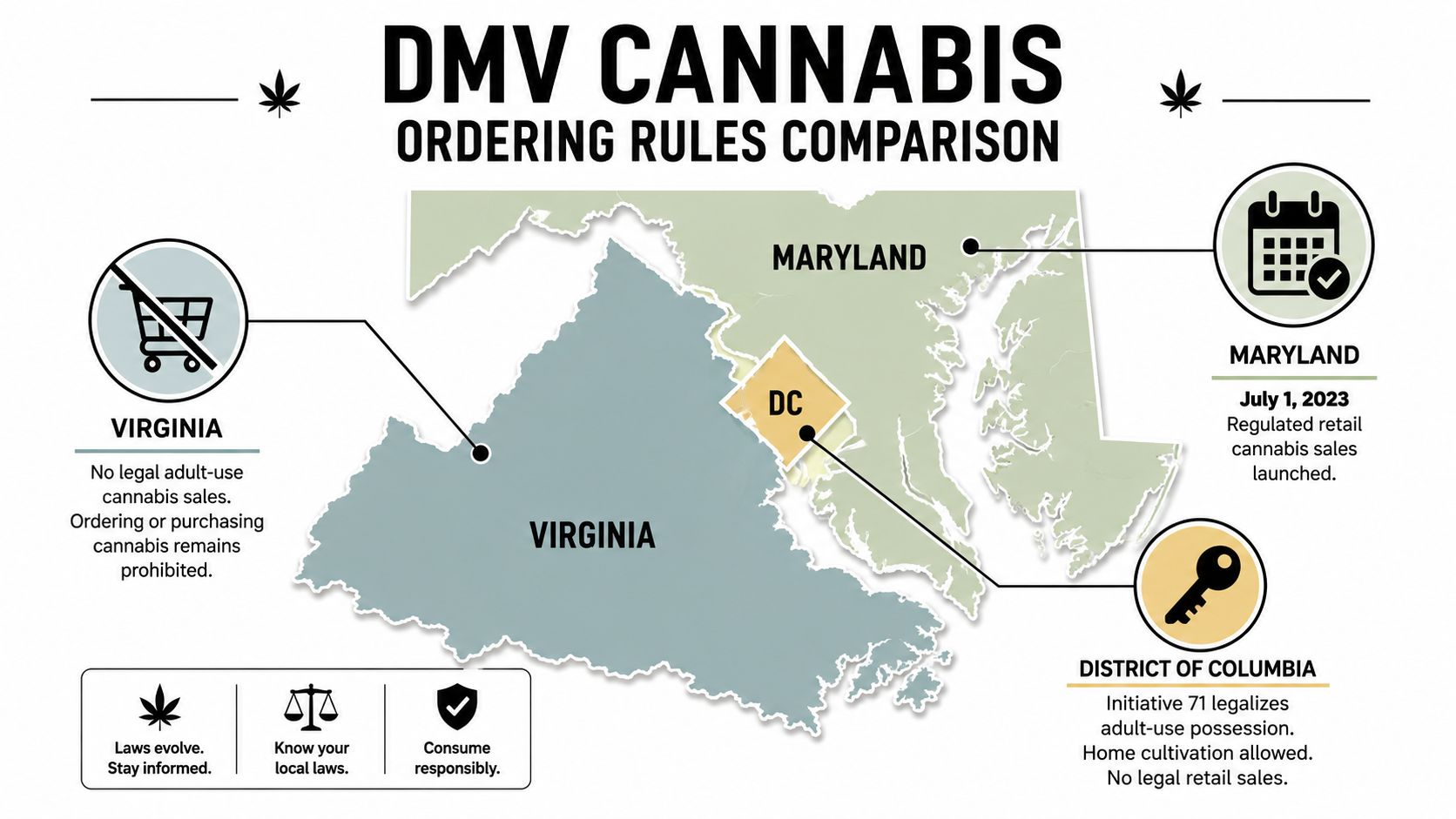
The DMV is three different rulebooks, and that changes how a delivery cart gets handled. DC, Maryland, and Virginia all sit in separate legal lanes, so the same menu can mean different things depending on where the order starts and where it lands. Maryland opened regulated adult-use sales on July 1, 2023, and adults 21+ can legally buy and possess up to 1.5 ounces of cannabis flower or its equivalent under that framework (Finale Inventory). Virginia works differently, because it has not set up a licensed recreational retail market in the same way, even though adults 21+ may possess up to 1 ounce, grow up to four plants per household, and transfer up to 1 ounce without payment (Cogsy).
A DC delivery order still runs through DC-side compliance at the door. If you want the cleanest path, start with the service rules, then check the local possession rules for the place tied to the order. For a direct look at how the delivery side is handled, see Green Express DC weed delivery.
The law under the cart matters
A minimum order requirement sits on top of the legal framework, not in place of it. The checkout total decides whether the cart qualifies. The local legal layer decides whether the handoff makes sense at all.
That is why people get tripped up. They assume state lines behave the same way once the cart is full. They do not. A Maryland buyer using a DC delivery service is still dealing with a DC delivery process, not a Maryland storefront.
Don't mix possession rules with delivery rules
Possession rules tell you what an adult can hold under state law. Delivery rules tell you whether a specific service will accept the order and complete the route. Those ideas connect, but they are not the same. If you are in the District, keep the order aligned with DC delivery expectations. If you are coming from Maryland or Virginia, do not assume the rules at home change the way a DC delivery service processes the cart.
The clean way to avoid problems is simple. Treat the minimum as a service rule and the cannabis law as the legal rule. Both have to line up before the order makes sense.
Smart Ways to Use the Minimum to Your Advantage
The best move is to stop treating the $50 minimum like a penalty and start treating it like a trigger for better pricing. If you're already spending, use that spend to reach a bundle or a rotating special instead of buying a filler item you don't really want. That's how you make the minimum work for you.
Bundle first, then top off
A good basket starts with the item you want, then fills the gap with something that improves value. A multi-gram disposable bundle does that better than a random low-dollar add-on. So does a seasonal deal if the menu is already leaning that way. If you're building close to the floor, the best extra isn't the cheapest extra, it's the one that improves the total cart.
Green Express DC also runs 24/7 availability and same-day delivery, which gives you room to wait for the menu to line up with what you want instead of forcing a weak order. That flexibility matters when you're trying to hit a minimum without overspending on an item you'll barely use.
Practical rule: if your cart is under the minimum, use a bundle or special to close the gap, not a throwaway add-on.
Compare the basket, not the sticker price
A single item can look cheap and still be the wrong choice if it doesn't help the basket. Two bundle options can look more expensive at first glance and still save money because the math works better across the whole order. That's why the $150 for 10g of shatter or crumble rotation matters. It changes the per-gram logic of the order instead of just padding the cart.
The same thinking applies to disposable bundles and seasonal specials. If the cart is already near the floor, the service is basically inviting you to turn the minimum into a smarter purchase. Take it.
Ordering Tips, Cash on Delivery, and Common Questions
If you're ordering from DC and want the handoff to go fast, have your government ID ready before the courier gets there, and keep your cash on delivery ready too. Build the cart before you place the order. Browsing first keeps you from scrambling when the delivery window is already in motion. Green Express DC accepts orders by phone or email, and the clearest breakdown of the payment setup is in this cash-on-delivery guide.
Quick ordering habits that help
- Check the total early: Make sure you clear the $50 minimum before you finish.
- Use the menu first: Pick the main item, then add a supporting item that gets you over the line.
- Keep cash ready: Delivery is smoother when you do not have to fumble at the door.
- Match the order to the rule: If the minimum is value-based, do not try to solve it with the wrong kind of add-on.
Short answers to the questions people ask most
Is the minimum per order or per delivery window?
For DC delivery, treat it as a per-order threshold. If the cart does not clear, it does not qualify.
What counts toward the minimum, taxes, fees, or delivery?
The minimum is about the qualifying order itself. Do not assume extra charges are the thing pushing you over the line.
Do bundle deals count toward the same minimum?
Yes, and that is usually the smarter way to shop. Bundles are often the cleanest path to crossing the floor without wasting money.
The bottom line is simple. Minimum order requirements keep fast, discreet DC delivery workable. Use them as a bundle trigger, not a barrier, and you will usually get better value from the menu.
If you want a simple way to work around the minimum without overbuying, browse Green Express DC and build your cart around the deals, bundles, and same-day delivery options that fit your budget. Their $50 floor, cash on delivery setup, and ID check at the door make this topic practical, not theoretical, so you can order with a clear plan instead of guessing at checkout.