

Edibles usually hit in 30 minutes to 2 hours because they have to be digested and processed by the liver before THC enters the bloodstream. For many people, the first effects show up in 30 to 90 minutes, the experience builds for a while, and the full ride can last much longer than smoking.
If you're reading this after taking a gummy, chocolate, or drink and staring at the clock, you're in very familiar territory. A lot of people in DC, Virginia, and Maryland get tripped up not because they took a wild amount, but because they expected edible timing to work like a vape or joint.
The good news is that edible timing isn't random. Your body, your stomach, and the kind of product you took all change the experience in ways that are pretty understandable once you know what to look for.
I Just Ate an Edible Now What
You take half a gummy at 8:00. By 8:30, you feel normal. By 8:45, the package starts to look suspicious, and taking more begins to sound reasonable.
That waiting window is where a lot of first edible experiences go sideways.

The safest assumption is simple. If you do not feel much yet, the edible may still be on its way. Edibles usually take longer than people expect, and the effects often build in layers instead of arriving all at once. That is why someone in Adams Morgan, Crystal City, or Silver Spring can mistake a normal delay for a weak product and accidentally stack doses too early.
Treat the first couple of hours like waiting for bread to bake. Opening the oven every few minutes does not speed it up, and adding more dough halfway through only makes the result harder to predict. With edibles, your main control levers are timing, dose, and setting. Those are the parts you can manage.
Practical rule: If you are not sure whether it is working, wait longer before taking more.
A better first move is to set yourself up for an easy, low-stress wait:
- Set a timer: Pick a clear check-in point so you are not guessing every 10 minutes.
- Stay where you are: Do not start driving, taking Metro, or running errands during the maybe-it's-starting phase.
- Keep water nearby: It will not speed anything up, but it can make the wait more comfortable.
- Save the package: If the effects feel stronger later, you will want the serving size and milligram information.
- Avoid mixing substances: Alcohol and extra cannabis can make the experience harder to read and harder to control.
Many first-time users expect one dramatic moment. More often, it starts subtly. You may notice your body feels heavier, your thoughts feel slower, or music suddenly grabs more of your attention.
That slow ramp can be frustrating, but it is also useful. If you stay patient, you give yourself time to notice how your body responds to that specific product, whether it is a gummy, chocolate, or drink bought in DC, Virginia, or Maryland. That is how you build confidence with edibles instead of guessing your way through them.
The Digestive Journey vs The Direct Route
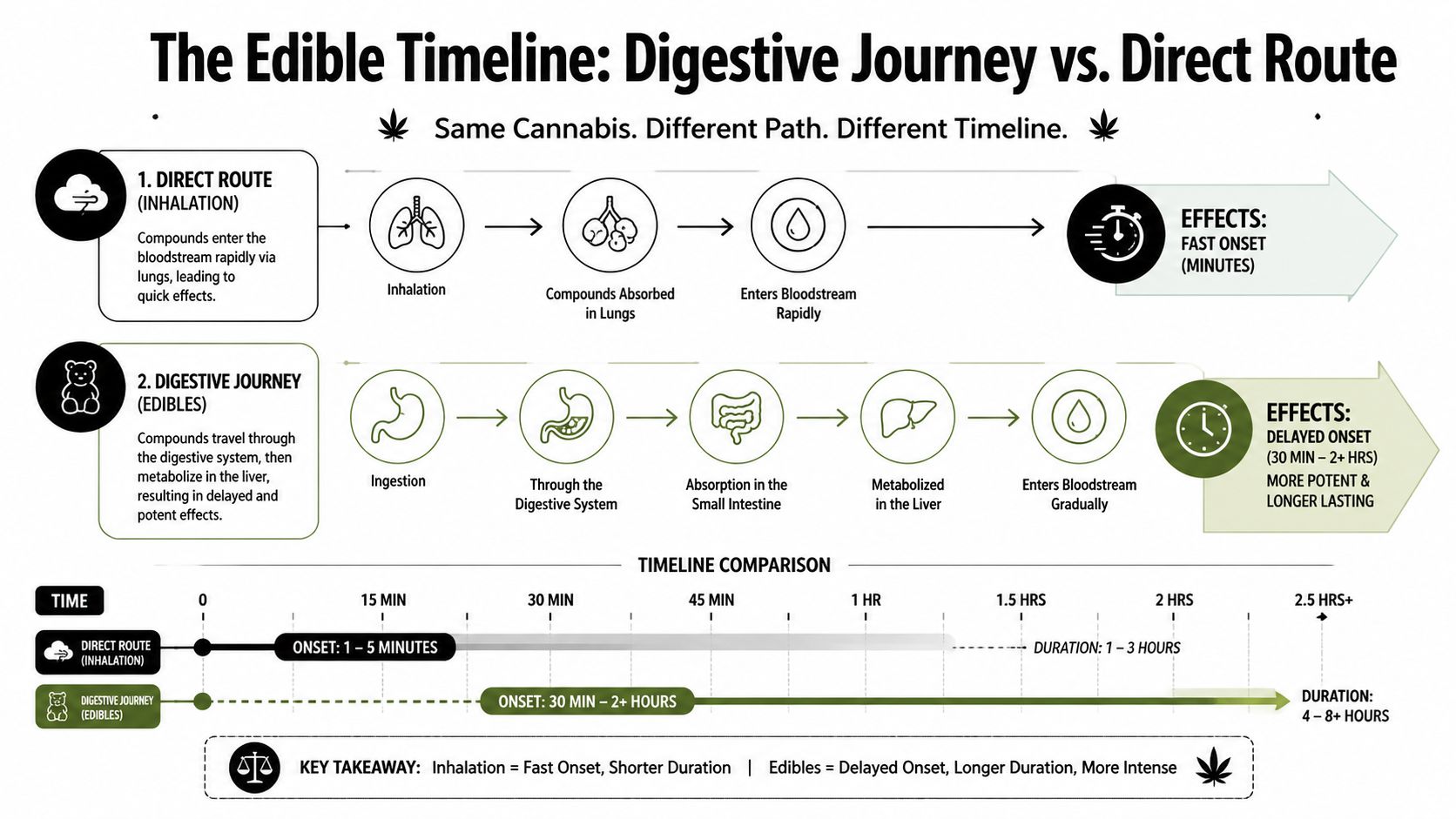
Smoking is like a direct flight. Edibles are like a scenic train ride with a layover.
When you inhale cannabis, compounds move through the lungs and into the bloodstream fast. That's why smoking or vaping tends to feel quick and easier to dose in the moment. Edibles take the longer route.
What your body is doing
With an edible, THC goes through your digestive system first. Then the liver gets involved. During that process, delta-9-THC is converted into 11-hydroxy-THC, which is a major reason edible highs often feel different from smoked highs.
According to Healthline's explanation of edible timing, this first-pass metabolism in the liver creates the usual onset delay of 30 to 90 minutes, with peak levels around 2 to 3 hours after eating it.
That sounds technical, but the practical takeaway is simple. Smoking is fast because it skips digestion. Edibles are slower because your body has more steps to complete before you feel the effects.
Why edible highs can feel stronger
A lot of first-time users ask, "Why does a gummy feel so different from a few puffs?" This is usually the reason.
Edibles often feel:
- More body-heavy: You may notice more couch-lock, warmth, or physical relaxation.
- Longer lasting: The experience doesn't come and go quickly.
- More layered: Instead of one quick rise, the effects can build in stages.
Here's a useful visual if you want the science broken down in a simple way:
Think of inhalation as flipping a light switch. Edibles are more like turning a dimmer knob that keeps rising for a while.
Why people misread the timeline
The confusing part is that the edible may already be "working" before it feels obvious. During that slow build, people often assume nothing is happening and redose too early.
That's why when people ask when do edibles hit, the full answer isn't just a number. It's also a process. Your body is digesting, absorbing, converting, and circulating THC before the experience becomes clear.
Once you understand that route, the waiting period stops feeling mysterious. It starts feeling predictable.
Factors That Change Your Edible Timeline
Two people can take the same gummy from the same package and have very different nights. That's normal. It doesn't mean one product is good and the other is bad. It means edible timing is shaped by a handful of variables you can pay attention to.

Your body matters
Some of the biggest differences come from your own physiology. This guide to edible dosing and timing factors notes that genetics and liver enzymes such as CYP2C9 and CYP3A4 can strongly affect onset time, and slow CYP2C9 metabolizers can have delayed onset up to 4 hours with more intense peaks.
That helps explain why one friend says, "I always feel it in under an hour," while another says, "Mine don't really kick in until much later." Both can be telling the truth.
Age, body composition, and your general metabolism also matter. You don't need a lab test to use that information. You just need to stop assuming your body will react exactly like someone else's.
If edibles always seem slow or unusually strong for you, trust your own pattern more than your friend's advice.
Food changes the schedule
What's already in your stomach can shift the experience a lot.
A few common patterns:
- Empty stomach: Effects may show up sooner, but they can also feel sharper.
- Full meal: Onset may take longer and feel more gradual.
- Heavy meal: The edible can seem delayed enough that people get impatient.
This is one reason "when do edibles hit" is such a frustrating question. The clock starts at the same time, but digestion doesn't move at the same speed every day.
If you want a broader look at edible timing basics, this Green Express DC guide on how long edibles take gives a useful overview.
Product type changes absorption
Not every edible behaves the same way.
Gummies and chews often feel different from a dense brownie. Drinks can feel different from candy. Some products are designed to absorb more quickly, while others move through the classic slower path. Texture, fat content, and formulation all play a role in how quickly your body starts processing the THC.
A practical example helps. A lightly dosed beverage may feel more "clean and early" for some people, while a baked edible can feel like nothing is happening until it suddenly becomes very obvious.
Tolerance changes what you notice
Tolerance doesn't just affect strength. It also changes how easy it is to notice the early signs.
For someone who uses cannabis regularly, the first wave might feel subtle enough to ignore. For someone newer, that same amount can feel very noticeable. That's why copying another person's dose is a bad strategy, even if you're similar in size.
A better approach is to track your own patterns:
- Write down what you took
- Note whether you had eaten
- Record when you first noticed a shift
- Notice what type of product it was
After a few sessions, your own notes become more useful than generic advice.
The Start Low and Go Slow Method in Practice
Most edible mistakes come from one decision: taking more before the first dose has had time to fully show itself. The fix is simple, but it only works if you follow through.
Start low. Wait. Then decide.
A practical dosing table
Here is a simple framework you can use.
| Tolerance Level | Recommended Starting Dose | Potential Effects |
|---|---|---|
| New or very low tolerance | 2.5-5 mg THC | Mild to noticeable effects, easier to assess your reaction |
| Some prior experience | 5-10 mg THC | More obvious psychoactive and body effects |
| Higher regular tolerance | 10-20 mg THC | Stronger effects that may still build slowly |
The low-end starting guidance comes from verified edible safety guidance that recommends 2.5-5 mg THC for lower-tolerance users, while broader consumer guidance often points to 5-10 mg THC as a common starting range and 10-20 mg THC for people with higher tolerance. In practice, the safest move is to begin at the lower end if you're unsure.
The two-hour rule
The most reliable habit is to wait a full 2 hours before even thinking about another dose. That's especially important if you're trying a new brand, a drink instead of a gummy, or anything homemade.
"Start low, go slow" works because edibles keep building after the moment most people get impatient.
This matters for a few familiar situations:
- First timer on a Friday night: Take a small amount, settle in, and don't treat silence at minute 45 as failure.
- Regular smoker trying edibles: Don't assume smoking tolerance maps neatly onto edible tolerance.
- Trying a new product type: Drinks, gummies, chocolates, and baked goods can feel different enough that caution still matters.
A simple routine that works
Use this checklist instead of winging it:
- Choose one serving size and stick to it
- Take it in a comfortable place
- Set a timer for 2 hours
- Avoid alcohol and extra THC while waiting
- Judge the dose only after enough time has passed
If you're curious about making your own products later, this Green Express DC article on how to make edibles is helpful. Homemade edibles can be enjoyable, but they're also one of the easiest ways to end up with uneven dosing if you're not careful.
What patience looks like in real life
Patience doesn't mean staring at yourself and asking every five minutes if you feel different. It means setting things up so the waiting period is easy.
Put on a movie. Queue a playlist. Keep water nearby. Have a snack ready. Let the edible arrive without chasing it.
That's the version of "responsible use" that works in real life. It's less about discipline and more about not forcing the experience.
What to Do If the Ride Is Too Intense
Sometimes the edible hits harder than expected. Maybe you took more because you thought it wasn't working. Maybe you tried a new product after a long break. Maybe your stomach, mood, and environment all lined up in the worst way.
First, remind yourself of one important fact. The intense part will pass.
According to this dosing guide on edible peaks and duration, peak effects typically happen around 2 to 4 hours after consumption, and the total experience can last 6 to 12+ hours. That long arc is exactly why impatience causes problems, and it's also why your best move is usually to settle in rather than fight it.
What helps right away
If you're too high, focus on comfort and simplicity:
- Change rooms: A quieter, calmer space can make a big difference.
- Sit or lie down: Stop trying to power through errands or social plans.
- Sip water: Small sips are better than chugging.
- Eat a light snack: Something plain can help you feel more grounded.
- Reduce stimulation: Dim lights, lower the volume, put the phone down.
What to tell yourself
Your inner monologue matters here. A rough edible experience often gets worse because people start narrating it as danger instead of discomfort.
Try this instead:
You took cannabis. It's stronger than you wanted. That feels unpleasant, but it is temporary.
If you have a trusted friend nearby, tell them plainly what you need. Something as simple as "Can you sit with me for a bit?" is often enough.
When to get help
If someone has severe distress, trouble staying responsive, or you feel unsafe, seek medical help. There's no prize for toughing it out. Being responsible includes knowing when to ask for support.
Most too-strong edible experiences improve with time, hydration, rest, and a calmer setting. The main job is to stop making it worse by adding more THC, adding alcohol, or putting yourself in a chaotic environment.
Ordering with Confidence in DC VA and MD
You are standing on your porch in DC, or sitting in your apartment in Arlington or Bethesda, scrolling through edible options and wondering which one will give you a calm, manageable night instead of a six-hour lesson in patience. This is the point where a lot of edible outcomes are shaped. Before the first bite.
A common edible mistake starts at checkout. Someone picks the product that looks fun, ignores the serving size, and assumes all gummies work about the same. They do not. If you want more control over when an edible may start to hit and how intense it may feel, the product itself matters almost as much as your dose.
For shoppers in DC, Virginia, and Maryland, confidence starts with clear information. You want to know how much THC is in one piece, how many pieces are in the package, and what format you are buying. A gummy, chocolate, drink, and fast-acting product can behave differently, even if the package numbers look similar.
What to check before you order
Use a short pre-order checklist:
- Per-piece THC is easy to read: You should be able to tell what one serving is in seconds.
- Total THC is listed separately: This helps you avoid eating a full package by accident.
- Product type matches your goal: A low-dose gummy for a quiet evening is a different tool than a higher-dose edible meant for someone with more experience.
- Instructions are plain: Good labeling should not make you do math while high.
- The seller handles the basics clearly: Age checks, delivery details, and product descriptions should feel straightforward, not vague.
That last point matters more in this region than many first-time buyers expect. DC, VA, and MD consumers are not all shopping under the same rules, and the local market can feel a little patchwork. That makes it even smarter to buy from services that explain what you are getting instead of forcing you to guess.
If you want a place to compare formats, strengths, and availability in the area, Green Express DC cannabis delivery options give local shoppers a practical starting point.
The goal is simple. Reduce surprises before you order.
Clear labeling will not make edibles perfectly predictable. Your stomach, metabolism, tolerance, and timing still play a role. But a well-labeled product gives you better control over the levers you can pull, and that is the difference between hoping for a good experience and setting one up carefully.
Frequently Asked Questions About Edibles
Can I make an edible hit faster
Only a little, and not in a guaranteed way. Product type, whether you've eaten, and your own metabolism all matter. Some people notice a faster onset with drinks or sublingual-style products, while dense foods can feel slower. But once you've swallowed a standard edible, patience matters more than hacks.
What if I fall asleep before it hits
That can happen. In many cases, you may wake up feeling the effects or feel groggy later. The practical concern isn't that sleep itself is harmful. It's that you should be in a safe place and shouldn't take more before bed just because you think it never arrived.
Why do edibles hit my friend faster than me
Because your bodies aren't identical. Digestion, liver enzyme activity, genetics, stomach contents, and tolerance all change the timeline. Edibles are one of the least copy-and-paste cannabis experiences.
How do I know it's starting
The first signs are often subtle. You might notice physical heaviness, a shift in mood, dry mouth, a stronger interest in music or food, or that time feels a little different. The early phase can be quiet.
What's the safest beginner mindset
Treat your first few edible experiences like information-gathering. You're not trying to prove anything. You're learning how your body responds.
If you want a dependable place to browse lab-tested options and order discreetly in Washington, DC, take a look at Green Express DC. For adults 21+, it's a straightforward way to explore edibles, flower, vapes, concentrates, and tinctures with clear menu information, delivery convenience, and the kind of consistency that makes dosing easier to manage responsibly.