
You’re ready to launch or tighten up a delivery operation in the DMV. You’ve got demand, a menu concept, maybe even a route plan. Then you hit a significant bottleneck. Wholesale weed supplies are never just about finding flower, carts, or concentrates. In DC, Maryland, and Virginia, sourcing is tied to licensing, transport risk, packaging rules, lab paperwork, and the practical question every operator eventually asks: who can deliver consistent product without creating headaches two weeks later?
That’s where most generic wholesale guides fall apart. They talk like the whole market works under one clean statewide system. The DMV doesn’t. DC has its own compliance reality. Maryland has a licensed adult-use structure. Virginia has its own limits and unresolved friction around sales. If you’re serving customers near state lines, or sourcing with one eye on compliance and the other on same-day fulfillment, those differences decide whether your operation stays smooth or starts bleeding time and money.
The upside is real. The global cannabis wholesale market is projected at USD 137.67 billion in 2026, North America held 83.82% of global market share in 2025, and the US market is projected to reach USD 428.22 billion by 2032, according to Fortune Business Insights cannabis market projections. Opportunity isn’t the problem. Execution is.
Navigating the DMV Wholesale Cannabis Market
In the DMV, sourcing isn’t just a purchasing task. It’s an operating system. The supplier you choose affects menu stability, courier workflows, customer complaints, returns, packaging, and how exposed you are if a regulator starts asking questions.
A lot of new operators focus on price first. That’s understandable, especially when customers compare menus fast and expect bundles, bulk options, and reliable same-day drops. But the cheapest supply is often the most expensive inventory you’ll ever buy. Product arrives late, labels don’t match, test paperwork is incomplete, units vary lot to lot, and your team spends the week patching problems instead of selling.
Why the DMV is harder than it looks
DC, Maryland, and Virginia sit close enough that people talk about the region as one market. It isn’t one market from a sourcing standpoint. Each jurisdiction has a different regulatory posture, a different enforcement reality, and a different level of maturity around licensed supply.
That creates a few real-world trade-offs:
- Speed versus traceability. Fast supply is useful, but if paperwork is weak, you inherit the risk.
- Menu breadth versus consistency. A supplier with endless SKUs can still fail on repeatability.
- Price versus survivability. If products don’t move, low buy-in pricing doesn’t save you.
- Regional access versus transport exposure. Close geography tempts bad decisions around movement across jurisdictions.
Practical rule: In the DMV, a “good supplier” isn’t the one with the biggest menu. It’s the one whose product, paperwork, and handoff process still look clean when an order goes wrong.
What experienced operators watch first
Before looking at flavor names or margin, smart buyers look at four basics:
| Priority | What to check | Why it matters |
|---|---|---|
| Legal fit | Whether the source actually fits the jurisdiction you operate in | A product can be fine in one place and a liability in another |
| Lab discipline | Whether every batch comes with usable, recent documentation | Missing paperwork slows delivery and creates exposure |
| Packaging readiness | Whether units are already prepared for compliant sale and handoff | Repackaging creates mistakes |
| Reorder reliability | Whether the same SKU can be supplied again in similar quality | Customers hate menu churn |
If you get those four right, you can build around them. If you get them wrong, no amount of branding or route efficiency fixes the problem.
Understanding the Legal Framework for Sourcing in DC VA and MD
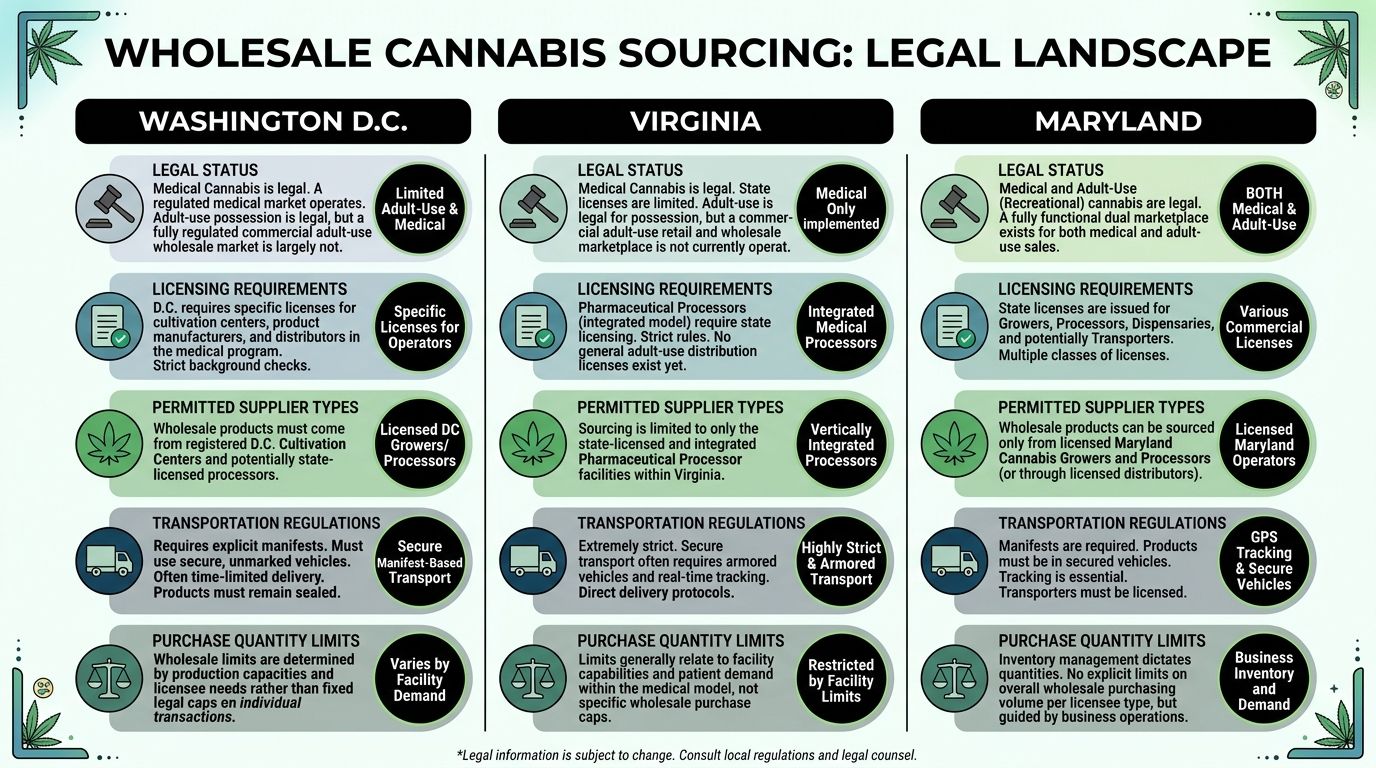
The first mistake people make is treating the DMV like a single operating zone. It’s not. Sourcing rules change when you cross from the District into Maryland, and they change again when Virginia enters the picture. If you’re buying, storing, packaging, or moving cannabis for delivery, the legal model in each jurisdiction matters more than your business plan.
DC operates on a different logic
In Washington, DC, sourcing conversations always have to account for the District’s unusual market structure. Operators and buyers often use the same words that licensed adult-use markets use, but the practical environment is different. That difference affects how products are described, how business relationships are formed, and how carefully you need to evaluate supply claims.
If you’re trying to understand the District’s compliance culture before you source, reviewing established I-71 compliant shops in DC gives useful context for how operators present products, gifting relationships, and customer-facing practices. It won’t replace legal advice, but it does show you the language and boundaries serious operators pay attention to.
Maryland is the cleanest wholesale environment in the region
Maryland gives buyers the most straightforward sourcing path in the DMV because the market is structured around licensed cultivation, processing, and retail. That doesn’t mean it’s simple. It means the chain of custody is more legible.
For buyers, that usually means:
- You can evaluate suppliers through formal business records and product documentation.
- Inventory tends to be easier to compare lot to lot.
- Packaging and labeling expectations are more operationally standardized.
- Wholesale discussions feel more like regulated CPG than informal cannabis networking.
That structure makes Maryland attractive for operators who want predictable procurement, especially for repeat SKUs like flower, prerolls, vapes, and concentrates.
Virginia remains the most restrictive practical environment
Virginia creates confusion because possession and market conversation often move faster than actual legal commercial options. From a sourcing perspective, that means buyers need to be especially careful about assumptions. Just because product is discussed openly in the region doesn’t mean there’s a straightforward legal wholesale path for a delivery business model.
The danger in Virginia isn’t just obvious noncompliance. It’s false confidence. Buyers hear “regional,” “DMV,” or “local” and assume supply can move smoothly. It can’t, unless the legal structure supports that specific movement and transaction.
Most costly sourcing mistakes in this region happen when someone assumes proximity equals permission.
DMV Cannabis Sourcing Regulations at a Glance 2026
| Jurisdiction | Governing Model | Wholesale Source | Key Restriction for Delivery |
|---|---|---|---|
| Washington, DC | District-specific cannabis framework with unique compliance realities | Source legitimacy and documentation must align with local rules and enforcement posture | Delivery operators must be careful about how products are sourced, presented, and transferred |
| Maryland | Licensed adult-use and medical market | Licensed cultivators and processors are the clearest wholesale path | Delivery activity must stay inside Maryland’s legal and licensing boundaries |
| Virginia | Evolving and limited commercial landscape | Sourcing options are constrained by a narrower legal structure | Assumptions about retail-style delivery can create immediate legal exposure |
What this means on the ground
For a DMV operator, the practical answer is simple. Don’t build one supply plan for three jurisdictions. Build separate sourcing logic for each place you touch.
That means:
- Identify where the product originates.
- Confirm whether that source is lawful for that jurisdiction.
- Match packaging, labeling, and transfer practices to the place where the customer receives the product.
- Never assume regional convenience overrides jurisdictional rules.
The operators who stay standing are usually the ones who get boring about this. They document everything, avoid cute shortcuts, and say no to supply that creates legal ambiguity.
How to Source and Vet Wholesale Cannabis Suppliers
A Friday restock can look fine at noon and turn into a mess by 6 p.m. if your supplier sends flower with mismatched batch tags, carts with weak hardware, or packaging that works in one jurisdiction and creates questions in another. For a delivery operator in DC, Maryland, and Virginia, supplier vetting is not a back-office task. It decides whether your menu stays stable, whether your drivers get put in bad positions, and whether a quick buy turns into a long cleanup.

Good sourcing starts with one question. Can this supplier hold up when you ask for specifics?
A nice logo, loud strain names, and polished jars do not answer that question. In the DMV, I want to know who controls the inventory, how batches are tracked, who packed the units, and what happens when a product issue shows up after delivery. Maryland usually gives buyers a cleaner path because licensed operators are easier to identify and verify. In DC and around the broader DMV, buyers have to work harder.
Start with legitimacy, not product hype
The first screen is simple and practical. Who are they, what do they sell in volume, and what paperwork do they send before you start chasing them?
I look for a few signals right away:
- Clear operating identity. The supplier should be able to explain who owns the product and who handles the transfer.
- Consistent paperwork habits. COAs, batch references, and packaging details should come over fast and match each other.
- Stable communication. Slow replies happen. Vague replies are the problem.
- Repeatable inventory. A hot sample matters a lot less than a reliable reorder.
That last point gets missed by newer buyers. One dialed-in batch can hide a sloppy operation. Consistency is revealed when lot two and lot three show the same care as the sample bag.
Ask questions that force specifics
Suppliers who know their operation can answer direct questions without turning the call into a pitch. Ask narrow questions and stay quiet long enough to hear where they get slippery.
Use questions like these:
- What lab tests come with each batch?
- Do the batch numbers on the COA match the batch numbers on the units?
- Who packaged these items, and where?
- What is your process for leaking carts, broken seals, or disputed concentrate weight?
- Are these units ready for compliant sale, or will I need to relabel or rework them?
- Can you provide samples from the same lot you plan to deliver on the first real order?
The answer quality matters as much as the answer itself. Clear operators speak in process. Weak ones speak in vibes.
For vape inventory, customer tolerance is low. A menu page like these Pure One carts shows why consistency matters so much. People notice hardware failure, burnt taste, oil color, and fill level right away. If a supplier cannot explain their cart hardware, oil source, and replacement policy, I treat that as a warning.
Watch behavior during the sample stage
The sample stage gives you free information if you pay attention. I learn more from the handoff than from the sales talk.
Did the sample arrive labeled in a way that makes sense? Was it tied to a real batch? Did the supplier mention storage conditions, production date, or shelf age without being prompted twice? If a seller gets loose with details on a tiny sample order, they usually get worse once larger invoices start going out.
This is also where regional friction shows up. A supplier may be solid on Maryland flower but careless about how products are packed for a DC-facing delivery workflow. Another may have attractive pricing on carts but no disciplined process for replacing defective hardware. Those are different risks, and they hit your operation in different ways.
That’s also a good point to watch a broader discussion on cannabis wholesale mechanics and supplier evaluation:
Treat testing habits like an operating signal
Strong suppliers do not make testing feel theatrical. They send clean paperwork, keep batch records straight, and answer questions without acting offended.
If testing only appears when you push hard, I assume the process is weak. If every batch seems to have a different explanation, I assume quality control is drifting. And if a supplier treats failed units as a normal cost of doing business, I price in the risk or walk.
A clean COA should arrive before you ask for it the second time.
Build a shortlist, not a dependency
A delivery business in the DMV should not lean on one source for everything. Keep a short bench and know what each supplier is good at.
One may be dependable on flower. Another may hold steadier on concentrates. A third may be worth using only for carts or pre-rolls because their packaging and replacement process are tighter. That mix gives you options when supply dries up, quality slips, or a product line stops moving.
The goal is not to collect supplier contacts. The goal is to know which suppliers stay organized when the week gets messy.
Decoding Lab Tests and Organic Claims for Quality Assurance
Friday night in DC, your menu is live, drivers are already asking what is ready to go, and a supplier drops off flower that looks great in the jar. Then you check the paperwork and the batch code on the label does not match the COA they texted over. In a DMV delivery operation, that is not a small admin problem. That is the kind of mistake that turns into refunds, pulled listings, and a long weekend of customer service.
A Certificate of Analysis, or COA, is the first quality screen I trust. Bag appeal matters once the product reaches the customer. Before that, paperwork has to carry the weight, especially if you are sourcing across a region where DC, Maryland, and Virginia all create different expectations around packaging, labeling, and how closely anyone may inspect your supply chain if something goes wrong.

What a usable COA should tell you
A usable COA ties to the exact lot in hand. Same batch number, same product form, same basic timing. If the supplier hands you paperwork for a similar run or says the current batch is “testing the same,” treat that as missing documentation.
Check five things first:
- Potency data that fits the product being sold
- Cannabinoid detail beyond one headline THC number
- Contaminant screening for the product category
- Batch identifiers that match the package and invoice
- Testing dates that make sense for inventory age
For flower, I also compare the COA to the sales story. If a vendor is pitching top-shelf indoor with a loud terp profile, the lab sheet should support that. If they are pitching carts, I want to know whether the oil profile and hardware quality line up with what customers expect from that segment. Counterfeit-heavy categories deserve extra scrutiny, which is why it helps to know the real market range for Big Chief carts before you buy wholesale.
Red flags inside the paperwork
Weak COAs usually fail on small details. That is how bad product gets through.
A few problems show up over and over in the DMV:
- Batch numbers that do not match the jar, pouch, or case
- Missing contaminant results
- Old testing dates on supposedly fresh inventory
- Potency-only reports with no safety panel
- Blurry screenshots instead of full lab PDFs
- Sample names so generic they could apply to anything
Suppliers working clean rarely struggle to send complete paperwork. Suppliers cutting corners often turn every document request into a debate.
If a seller cannot connect the product in your hand to the report on your screen, do not list it.
Organic claims need records, not branding
“Organic” in cannabis is still loose language. In one room it means living soil. In another it means no synthetic sprays late in flower. In a third, it means somebody printed earth tones on the bag.
That creates a real sourcing problem in the DC, Maryland, and Virginia corridor, because buyers often move product through mixed consumer expectations and mixed regulatory pressure. A customer in DC may care about clean cultivation and flavor. A Maryland buyer may ask sharper questions about licensed production and testing discipline. A Virginia customer may be reading labels differently because the retail environment around them is still uneven. If you are delivering across that region, vague organic claims create more risk than value.
Ask direct questions and listen for specific answers:
- What cultivation method was used?
- Were synthetic pesticides or fungicides used at any stage?
- Is there batch-level grow documentation?
- Can the supplier explain nutrient inputs clearly?
- Does the label language match the test results and production story?
As noted earlier, serious labeling standards are a useful benchmark even outside the state where they were written. I use that standard in practice. If a supplier wants premium pricing for “organic” flower but cannot show clear cultivation records, pesticide discipline, and batch consistency, I treat the claim as marketing.
Quality is broader than THC
Delivery customers do not reorder because a number on the sticker looked impressive. They reorder because the flower burned clean, the cart pulled right, the edible hit on time, and the second unit matched the first.
That is why I put more weight on repeatable quality than on flashy potency. In this business, consistency protects margin. It cuts returns, reduces menu churn, and keeps your team from explaining the same product problem to ten different customers in one day.
The best wholesale weed supplies usually come from suppliers who stay boring in the right ways:
- same lot tracking
- same test format
- same labeling discipline
- same handling standards
- same answer when you ask for support documents twice
That kind of consistency matters more in the DMV than generic wholesale guides admit. One paperwork gap might be ignored by a casual buyer. For a delivery operator working across DC, Maryland, and Virginia, it can spill into compliance problems, customer disputes, and inventory you cannot move with confidence.
Negotiating Wholesale Prices and Purchase Terms
Friday at 4:30 p.m., a supplier sends over a "can’t miss" price sheet. The flower looks cheap, the carts are priced to move, and the rep wants an answer before close. In the DMV, that is exactly when buyers get trapped. By Monday, you may be holding too much of the wrong SKU, tied to terms that make no sense for a delivery operation serving customers with different expectations and legal exposure across DC, Maryland, and Virginia.
Price matters. Terms decide whether the buy works.

Cheap inventory can become expensive fast
A low per-unit quote means very little if the supplier forces a large opening order, limits returns, or pushes a product mix that does not fit your menu. Delivery businesses need margin, but they also need flexibility. A SKU that sits for two extra weeks can wipe out the savings you thought you won on the invoice.
That problem gets sharper in the DMV because demand is not uniform across the region. A product that moves easily with a DC customer base may stall in a Virginia-facing menu strategy. Maryland buyers can be different again. If you are sourcing with one blunt price target instead of location-specific sell-through expectations, you are negotiating half blind.
Wholesale pricing also moves. Product cycles are short. New drops get hype, then flatten out. So the right question is not "How cheap can I buy this?" It is "What happens if this slows down after the first push?"
Terms that protect the buyer
The best negotiations focus on risk allocation. If the supplier wants you to absorb all of the downside, the deal is weak even if the headline price looks good.
Push on these points:
- Opening MOQ that matches real demand. First orders should test movement, not fill a closet.
- Tiered pricing based on reorder volume. Earn the better price after the product proves itself.
- Defect and replacement language in writing. This matters with carts, disposables, and concentrates, where leaks, clogs, hardware failures, and seal issues show up after delivery starts.
- Clear payment timing. Net terms, split payments, or partial deposits can help if your cash flow comes in waves.
- Batch consistency. If a product works, ask whether the next order will match closely enough to keep the menu stable.
- Stale inventory options. Even limited swap support can save a buyer from getting stuck.
Get specific. "We stand behind our product" is not a term. "Any visibly leaking cartridge from the same batch gets credited within seven days with photo proof" is a term.
Use retail pressure in the negotiation
Suppliers sometimes price as if the customer will never compare menus. That is not how this business works. Retail pricing is visible, especially on recognizable brands and vape products. If the street-facing number is already tight, your wholesale buy has to leave room for promotions, customer service headaches, and the occasional replacement.
That is easy to see on consumer-facing pages tracking Big Chief carts price. Buyers should read that kind of pricing pressure as a warning. If your landed cost is too high, you will either compress your own margin or post menu prices that slow conversions.
Neither outcome helps a delivery operation.
Negotiate around product life, not sales talk
Suppliers know every SKU is not a long-term winner. Experienced buyers use that reality instead of arguing over pennies.
Ask for introductory pricing on new items. Ask for mixed cases instead of a full-case commitment on unproven products. Ask what support exists if the first round underperforms. If the answer is vague, assume you will own the whole problem.
I also want a straight answer on reorder timing. If something catches, can the supplier refill it fast enough to keep momentum? A sharp first week followed by no replenishment creates a different problem. Now your menu trained customers to want an item you cannot replace.
Match the deal to your menu plan
Procurement decisions hit the customer-facing side faster than many buyers expect. If you plan to run bundles, entry-price flower, premium eighths, or vape specials, those offers need to be built into your buy price and reorder terms from the start.
A practical review looks like this:
- Which SKU is supposed to anchor daily sales?
- Which item is there to bring in trial orders?
- Which product can support bundles without killing margin?
- Which category creates the most service issues if quality slips?
- Which supplier can refill winning SKUs without changing the product every two weeks?
In the DMV, the smartest buyers negotiate for optionality. Laws differ. Customer behavior differs. Product risk differs by category. A deal that only works under perfect conditions is not a good wholesale deal.
Managing Logistics Packaging and Regional Compliance
Once inventory is purchased, the important work starts. At this stage, operators either become disciplined or become sloppy. Logistics, storage, packaging, and local compliance aren’t glamorous, but they decide whether a delivery business stays stable.
In the DMV, post-purchase handling gets complicated fast because the standards around labeling, packaging language, and product presentation don’t feel identical across DC, Maryland, and Virginia. Even when the product itself is fine, the package can still create exposure.
Start with MOQ discipline and storage reality
A lot of buyers over-order because they negotiated hard and don’t want to “miss the deal.” That mindset creates dead stock. Wholesale weed supplies should fit your turnover rate, your storage conditions, and your menu strategy.
Before saying yes to a larger buy, ask:
- Can this product move while still fresh?
- Do we have enough secure storage for the actual unit count?
- Will we need to repackage or relabel anything?
- Is this item a staple, a test, or a promotional piece?
Concentrates, prerolls, flower, and vapes all age differently in practical terms. Even when they remain saleable, they don’t all present the same after sitting. Aroma changes. hardware issues show up. seals weaken. customer perception shifts.
Packaging is part of compliance, not an accessory
Newer operators lose money because they focus on compliant cannabis and forget compliant packaging. In delivery, the package is part of the transaction record. It affects customer trust, transport handling, and regulator attention.
According to the verified data tied to MJ Wholesale’s packaging compliance content, 68% of DC dispensaries faced packaging compliance audits last year, and 22% incurred fines averaging $5,200. That should get every delivery operator’s attention.
The lesson is simple. You are not just sourcing product. You are sourcing:
- the product,
- the immediate container,
- the outer packaging,
- the printed label,
- and the evidence that all of it belongs together.
What packaging needs to do in practice
Even before looking at specific local rules, packaging has to perform three jobs at once.
| Packaging function | What it means operationally | Why buyers should care |
|---|---|---|
| Product protection | Keeps flower, concentrates, carts, and edibles stable in transit | Poor packaging creates leakage, odor issues, and damage |
| Consumer information | Communicates potency, batch identity, and warnings clearly | Weak labeling creates complaints and compliance risk |
| Controlled handoff | Supports child-resistant and tamper-evident handling where required | Delivery adds extra scrutiny at the point of transfer |
Common mistakes that create avoidable trouble
The mistakes are rarely complex. They’re usually rushed.
- Buying generic bags in bulk before checking local requirements
- Using labels that don’t match the exact product lot
- Relying on supplier claims about child resistance without verification
- Splitting bulk units into smaller retail-ready packs without a compliance workflow
- Treating outer delivery packaging as separate from regulated packaging concerns
In delivery, packaging is the last compliance step before the product touches a customer. That makes it one of the first things you should standardize.
Regional handling requires separate playbooks
DC, Maryland, and Virginia shouldn’t share one packaging SOP just because they share roads. The safer approach is to create separate internal checklists for each jurisdiction you operate in or near. Keep them short enough for staff to use.
A practical packaging and logistics checklist should cover:
- approved package type,
- required label elements,
- batch-to-package match check,
- seal check,
- storage condition check,
- courier handoff protocol,
- issue escalation if a unit is damaged or mislabeled.
Keep logistics boring
That sounds simple, but it’s one of the best operating principles in this business. Boring means standardized bins, repeatable intake, clean batch records, predictable package types, and no last-minute relabeling at dispatch.
The more improvisation your team does at the fulfillment stage, the more likely mistakes become. A smooth delivery operation usually looks quiet behind the scenes. Product comes in. It’s logged. It’s checked. It’s stored correctly. It leaves in the right package with the right label. No drama.
That kind of discipline doesn’t just reduce risk. It makes service faster and customer experience cleaner.
Your Essential Wholesale Weed Buyer Checklist
When you’re evaluating wholesale weed supplies in the DMV, the easiest way to stay sharp is to walk into every supplier conversation with the same checklist. That prevents you from getting distracted by hype strains, glossy packaging, or one attractive number on a quote.
Questions to ask every potential supplier
Use these in calls, visits, and sample reviews.
Who exactly is the legal business behind this inventory
Ask for the operating entity, not just the brand front.Can you provide batch-specific COAs that match the units being offered
You want current, readable documentation tied to the actual lot.How do you package product for sale and transfer
This reveals whether you’ll inherit repackaging work or compliance exposure.What happens when a batch arrives with damage, leaks, or mismatched labels
Their answer tells you whether post-sale support exists at all.Can you maintain consistency on reorders
A one-time strong batch doesn’t help if the next one is a different product wearing the same name.What are your MOQ and reorder expectations
This shows whether the relationship can scale sensibly.Do you support mixed orders or only single-product volume buys
Mixed orders help delivery menus test and rotate more intelligently.
Critical red flags to watch for
Some issues should end the conversation quickly.
They won’t send COAs until after payment
That’s backwards.Their batch numbers, labels, and test reports don’t line up
Sloppiness at intake becomes your problem later.They answer legal sourcing questions with attitude instead of clarity
Confidence is not documentation.They push huge opening orders
That often means they want to offload inventory risk onto you.Their pricing is weirdly low without an explanation
Cheap can mean old, inconsistent, or hard to move.They describe everything as top shelf
Serious suppliers can tell the difference between premium, mid-tier, and value inventory.
Good buyers don’t just ask whether the product is good. They ask whether the relationship is manageable.
A simple pass fail filter
If you need a fast internal standard, use this:
| Category | Pass signal | Fail signal |
|---|---|---|
| Documentation | Batch-specific paperwork is ready and clear | Documents are delayed, partial, or mismatched |
| Communication | Answers are direct and operational | Answers are vague, defensive, or overhyped |
| Packaging | Units appear sale-ready and consistent | Rework or relabeling looks likely |
| Terms | MOQ and support fit your menu reality | Supplier pushes one-sided risk |
A supplier doesn’t need to be perfect. They do need to be usable. That’s a different standard, and in this market it matters more.
Building a Compliant and Profitable Supply Chain
A strong DMV delivery operation is built long before the customer places an order. It starts with sourcing discipline. You need supply that fits the jurisdiction, paperwork that holds up under scrutiny, packaging that won’t create avoidable trouble, and terms that leave room for real retail execution.
The operators who last in DC, Maryland, and Virginia usually aren’t the flashiest. They’re the most consistent. They know which supplier can restock. They know how to read a COA without guessing. They know when a “deal” is just old inventory in disguise. They know that regional convenience doesn’t erase legal boundaries.
That’s what turns wholesale weed supplies from a constant headache into a working system.
If you stay strict on legal fit, quality verification, packaging readiness, and purchase terms, you give yourself a real shot at building a menu customers trust. In delivery, trust compounds faster than hype. People remember clean product, accurate labels, reliable drops, and a menu that doesn’t feel random every week.
That’s the game in the DMV. Not just getting product. Getting product you can stand behind.
If you want a dependable option for premium cannabis delivery in the District, Green Express DC offers fast, discreet service with lab-tested, carefully selected products for adults 21+ across Washington, DC. From flower and prerolls to concentrates, vapes, edibles, and tinctures, the menu is built for customers who care about freshness, consistency, and a smooth same-day ordering experience.