Shipping marijuana is illegal under federal law because it remains a Schedule I controlled substance, and any interstate shipment is treated as a federal offense. That's true even if both states involved have legalized cannabis, which is why a package that seems harmless in local conversation can still create serious legal risk.
That answer is the part many want first, especially if they're sitting in Washington, DC with legal cannabis and thinking about a friend in Maryland or Virginia. The confusion is real because local rules often make possession, gifting, or delivery feel normal inside one jurisdiction, while federal law draws a hard line the moment cannabis crosses a state border or enters the mail system.
Why Sending Weed Across State Lines Confuses Everyone
A lot of people in DC hit the same mental snag. You've got legal cannabis in front of you, your friend in Maryland wants a package, and the whole thing feels no more complicated than mailing snacks or headphones. Then you hear that shipping weed is illegal, and the question becomes, legal where, exactly?
That confusion makes sense because cannabis law in this region works like two different rulebooks sitting on top of each other. One rulebook is local, so DC, Maryland, and Virginia each have their own limits and delivery realities. The other rulebook is federal, and it doesn't bend just because the sender and recipient live in places that allow some cannabis use.
The mailbox is not the same as a local handoff
If you hand cannabis to another adult in a place where local law allows that kind of transfer, you're dealing with one set of rules. If you put the same item in the mail, you've crossed into a very different legal lane. The federal system treats that as shipment, not casual sharing.
Practical rule: if the package is marijuana, the mail is the wrong vehicle, even when both ends of the trip are in legal-cannabis states.
That's the part people miss. They assume state legalization travels with the product, but federal shipping law doesn't work that way. The result is a legal maze where a lawful local purchase can still become an unlawful interstate shipment the moment someone tries to “send it over.”
For DC residents, that difference matters even more because the District's cannabis culture is built around local access, not interstate transport. Maryland and Virginia add their own twists, so readers often mix up possession rights with shipping rights. Those are not the same thing, and treating them like they are is where most mistakes start.
Federal Law Clashes With State Cannabis Rules
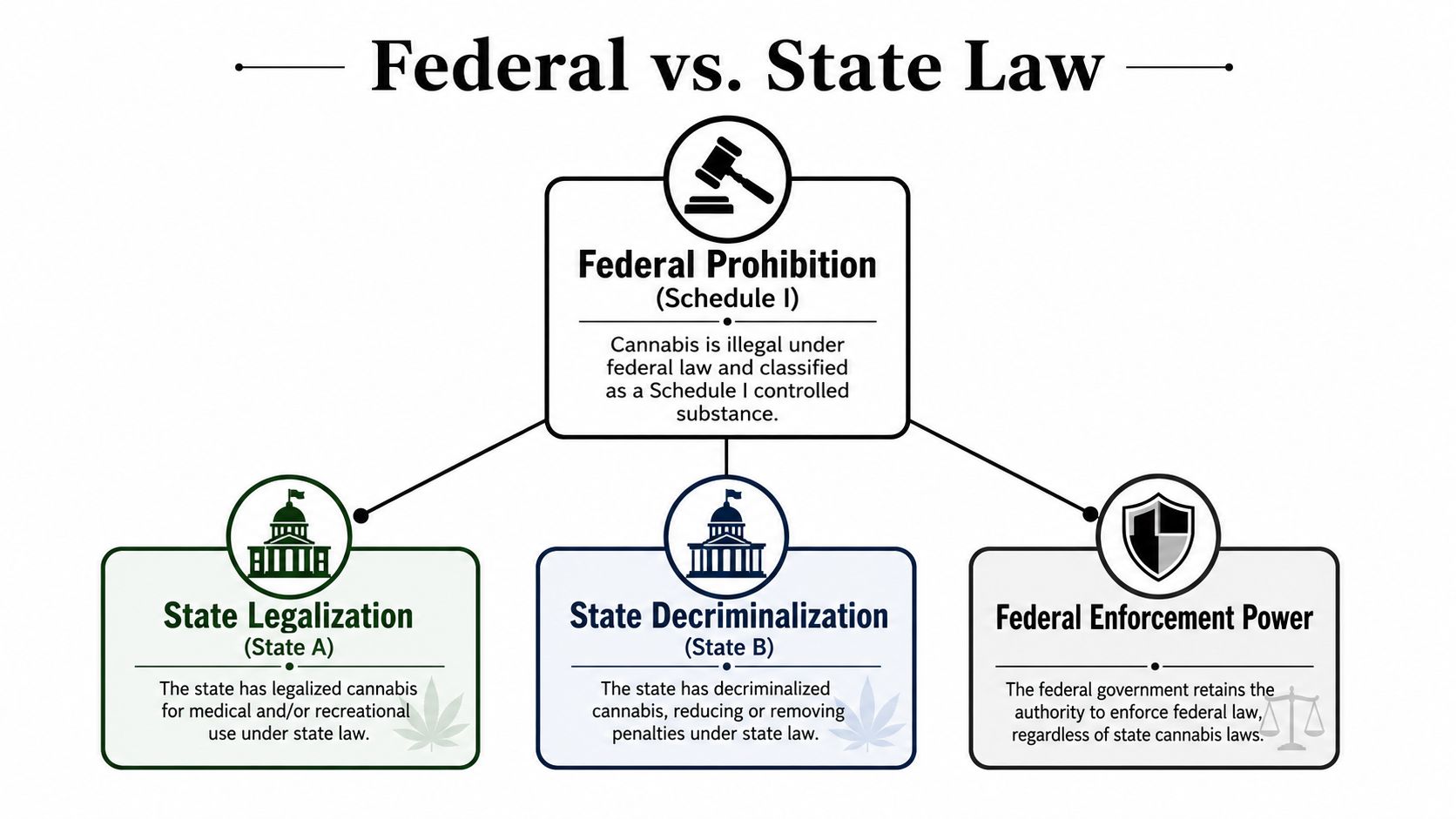
The federal government still treats marijuana as Schedule I under the Controlled Substances Act. That status is the backbone of the shipping ban, because federal law controls the mail and interstate transport, even when a state has created its own legal cannabis system. In plain English, a state can relax local possession or retail rules, but it can't rewrite federal shipping law.
A building with different floors of authority illustrates the situation. State law may open a door on one floor, but federal law sits above it with the master key when the issue is mail or interstate commerce. That's why legal state possession doesn't automatically create legal shipping.
Why USPS cannot treat cannabis like ordinary mail
USPS is a federal agency, so it has to follow federal law. Multiple legal summaries state that any amount of marijuana is illegal to mail under federal lawRossen Law Firm. That means the question isn't whether the sender is careful, discreet, or sending a tiny amount. The core issue is what the item legally is.
The distinction matters because federal law doesn't ask whether the product is “for personal use” or “for a friend.” If it's marijuana, it's still marijuana in the eyes of federal shipping rules. That's why the interstate part is so important. Once a package moves across state lines, the federal interest is no longer theoretical.
A state can legalize possession within its borders. It can't make the postal system ignore federal drug law.
For DC readers, that hierarchy explains why local convenience doesn't equal shipping permission. It also explains why people often get tripped up by legal language that sounds broad at the local level but collapses when shipping enters the picture. The safest way to think about it is simple. If federal law controls the channel, state legalization alone won't save the shipment.
Carrier Policies Block Cannabis Shipments
Carrier policies follow federal law, not local approval, so the shipping rules stay strict even when a product is legal somewhere else. The dividing line is the 0.3% delta-9 THC threshold in the hemp framework. Products at or below that level can move only under specific conditions, while marijuana-derived products above it are not mailable. That is why the first question is usually about classification, not packaging, labels, or how discreet the parcel looks.
UPS makes the point plainly. It prohibits shipment of marijuana under any circumstances, including medicinal use and use that is legal under state law. A different carrier does not solve the problem. The issue follows the federal classification of the product, so a private shipping company cannot turn marijuana into a lawful parcel just by accepting it.
Carrier and THC Threshold Rules
Product Type
Carrier Stance
Federal Classification
Marijuana flower or edibles
Not mailable through USPS or private carriers for interstate shipment
Prohibited marijuana
Marijuana-derived THC products
Not lawfully shippable across state lines
Prohibited marijuana
Hemp-derived products at or below 0.3% delta-9 THC
Can be shipped under specific conditions
Federally marketable hemp
The table shows the practical test in plain form. If the product is marijuana, no carrier choice makes it legal. If the product is hemp and stays within the federal THC line, the shipping analysis changes because it falls into a different category.
For readers comparing logistics providers or trying to track package movement, the same rule still applies. A carrier can only move what the law already permits. A shipping platform may give the appearance of order and control, but it does not change federal drug classification. Some DC businesses separate compliance and logistics discussions for that reason, as in their order tracking systems guidance, because tracking a package is not the same thing as making its contents legal.
Cannabis Delivery Rules Across DC Maryland Virginia
Washington, DC, Maryland, and Virginia sit next to each other, but their delivery rules do not work the same way. A person can live near all three and still face three different legal systems, like three houses on the same street with different front-door rules. DC has a local cannabis gifting and delivery culture inside the District's own framework. Maryland opened its adult-use market after voters approved legalization, and adults 21 and over there may possess up to 1.5 ounces of cannabis flower and, in many circumstances, cultivate up to two plants per householdFindLaw. Virginia is different again, because adults 21+ may possess up to 1 ounce in public and each household may cultivate up to four plants, but it does not operate a full adult-use retail sales system cannabisregulations.ai.
Why local delivery and interstate shipping are different things
A DC resident might legally receive cannabis through a District-based service, then assume the same product can be mailed to a friend in Maryland. That assumption breaks the moment the package crosses a state line. Local delivery happens inside a licensed or tolerated local system, while interstate shipment runs into federal prohibition.
Maryland's adult-use market shows the difference clearly. Its legal access is tied to licensed in-state commerce and age verification, not cross-border shipping FindLaw. Virginia gives another example. Adults can possess and grow limited amounts, but possession rights do not create a lawful shipping lane or a retail delivery market. A person can have a legal amount at home and still have no legal way to mail it.
A simple regional reality check
Washington, DC: local gifting and delivery operate inside the District's own rules.
Maryland: adults can buy through licensed in-state channels, not through interstate shipment.
Virginia: adults can possess and grow limited amounts, but retail adult-use delivery is not the same thing as possession rights.
That regional split is the part people miss. They see cannabis allowed in more than one nearby place and assume one rule set carries across all of them. It does not. A lawful District delivery, a Maryland dispensary order, and a Virginia possession rule each sit in separate legal boxes.
For DC consumers comparing local options, the right question is not whether cannabis can move. It is which jurisdiction allows the move, and by what channel. That distinction keeps lawful local access separate from illegal shipping. For one DC-focused service model, see weed delivery in the District, which operates inside local rules rather than across state lines.
Legal Local Delivery and Compliance Tips
The safest path is boring, and boring is good here. If you live in DC, Maryland, or Virginia, use the channel that matches the law in your jurisdiction, and don't try to force a mail solution onto a product that federal law still treats as marijuana. Virginia's possession-and-home-cultivation model makes this especially important, because legal possession there does not create a retail delivery market the way people sometimes assume cannabisregulations.ai.
Compliance habits that actually matter
Verify ID at delivery: adult-use access depends on age checks, not casual drop-off.
Use in-state licensed channels: local rules govern local delivery, not the postal system.
Never package cannabis for mail: the mailbox does not become legal just because the product is personal-use.
Separate gifting from shipping: an in-person exchange is one thing, mailing is another.
Best practice: if you wouldn't explain the package contents to a federal postal inspector without flinching, don't ship it.
DC residents often ask whether a licensed local courier is a safer alternative. In a District context, local delivery is the lawful path when it stays inside the local framework, and some services, including Green Express DC, publish compliance guidance around that model. That doesn't change the federal rule on shipping, but it does show the difference between a local delivery system and an illegal interstate mailing attempt.
For Maryland and Virginia readers, the key is not to borrow DC assumptions. Maryland's market is tied to its own licensed retail structure, and Virginia's current setup doesn't turn possession into a shipping license. If the product is moving across borders, it has left the safe lane.
Key Takeaways on Weed Shipping Legality
The answer to is it legal to ship weed is still no when the product is marijuana and the route crosses state lines. Federal law controls the mail, marijuana remains Schedule I, and state legalization does not override that rule. That's the part that shuts down the common “but it's legal here” argument.
DC, Maryland, and Virginia show the difference between possession rights and shipping rights more clearly than most places. DC supports local delivery inside its own framework. Maryland's adult-use market is licensed and in-state. Virginia allows limited possession and cultivation, but not a full retail delivery system.
If you want to stay on the right side of the line, think local, not postal. Think licensed, not improvised. And think jurisdiction first, because cannabis law in the Mid-Atlantic is really a map of separate rules that only look similar from the outside.
Common Questions About Shipping Cannabis
Does DC gifting count as shipping weed
No. In-person gifting and mailing are different legal acts. If two adults exchange cannabis within a local framework, that's not the same as putting it in a box and sending it through the mail.
The confusion usually comes from the word “gift.” People hear it and assume any transfer is fine. The legal risk appears when the transfer crosses into shipping, especially across state lines, because federal law treats that as the transportation problem, not a casual handoff.
Can tourists in DC use local delivery
Tourists often assume local delivery is off-limits because they're not residents. In practice, what matters is whether the service follows DC's local rules, including age verification, and whether the transaction stays inside the District's permitted framework. The key point is that local delivery is not interstate shipping.
A visitor should still treat the process as a jurisdiction-specific service, not a general right to move cannabis anywhere. If you're staying in DC, the local rules matter while you're there. Once you try to carry that same expectation into Maryland or Virginia, the legal picture changes.
How do hemp-derived THC vapes differ from marijuana products
Hemp-derived products sit under the 0.3% delta-9 THC line, so they can be shipped under specific conditions 23state.com. Marijuana-derived products above that line are not mailable. That's the classification divide that drives the whole shipping analysis.
The mistake people make is assuming that any cannabis vape is treated the same way. It isn't. Federal law cares about how the product is legally classified, not just how it looks on the shelf or in an online catalog. If the product is marijuana, the shipping route is blocked.
For DC readers, that means you should separate local cannabis delivery from hemp shipping and from marijuana mailing. They can look similar in casual conversation, but the law treats them differently. If you want a clean rule to remember, keep it simple, hemp may travel under specific conditions, marijuana cannot be mailed across state lines.
If you live in DC and want cannabis delivered inside the District, use a service that works within local rules instead of risking a federal shipping problem. Green Express DC offers a DC delivery model built around adult ID verification, discreet local drop-off, and in-District service, which is the kind of setup this topic calls for. Visit their site, compare the menu, and choose the legal route that fits where you are.
You find an old vape cart in a drawer, or a half-forgotten edible bag in the back of the pantry, and the first question is always the same, is this still good, or am I about to waste money on something that's already gone flat? In cannabis, expiration date tracking isn't just about avoiding a stale product. It's about protecting potency, reducing waste, and keeping your inventory honest whether you're buying for personal use or moving product through a delivery workflow in the DMV.
Businesses managing perishable goods, including cannabis, can lose an estimated 2% to 5% of inventory value each year because products expire before they're sold or used, which is why tracking is a real financial control, not a housekeeping chore Zenventory. In a market where some operators are juggling flower, concentrates, vapes, edibles, and tinctures, a bad date doesn't just mean a weaker experience. It means stock that should've been rotated, discounted, returned, or removed got left sitting until it became dead weight.
Why Tracking Cannabis Expiration Dates Matters
A product that's been sitting around too long usually doesn't announce itself. Flower dries out, concentrates lose their texture, vape oil can drift in quality, and edibles can become less appealing long before anyone throws the package away. For consumers, that means disappointment and inconsistent effects. For operators, it means a quiet leak in margin that shows up as spoilage, missed rotation, and avoidable write-offs.
The real cost is bigger than freshness
The point of expiration date tracking is not to obsess over a label for its own sake. It's to build a routine that catches aging product early enough to do something about it. That matters even more in cannabis delivery, where inventory may sit in a back room, travel between locations, or move through multiple hands before it reaches a customer.
Practical rule: if a product is close enough to worry you at home, it's close enough to need a decision at the business level.
For individual users, that decision is simple. Use the older item first, store it properly, or toss it if it's clearly degraded. For operators, the decision has compliance, customer experience, and cash-flow consequences. A delivery service can't afford to discover too late that a batch should've been pulled from active stock weeks ago.
What a tracking mindset changes
Good tracking shifts the habit from guessing to knowing. You stop asking whether a jar or carton is “probably fine,” and start recording what it is, when it arrived, where it's stored, and how close it is to the end of its useful life. That's the difference between a stash and a system.
A complete worksheet should include the product name or SKU, batch or lot number, manufacturing date, expiration date, quantity, location, and statusLaceUp Solutions. That same logic works for a home shelf, just on a smaller scale. The details matter because the date alone doesn't tell you enough. The batch, location, and status tell you whether the product is still usable, needs rotation, or should be removed.
Understanding Cannabis Product Shelf Life
Shelf life is not a single clock for every product, and that is where casual tracking breaks down. Flower, concentrates, vape cartridges, edibles, and tinctures each fail in different ways because air, heat, light, moisture, and handling affect them differently. Treat everything as if it ages on the same schedule, and you will either toss usable product too early or keep weak product in rotation too long.
What changes shelf life by product type
Flower usually loses quality through air exposure, light exposure, and moisture swings that leave it too dry or make mold more likely. Concentrates are less fragile in one sense, but they still suffer when heat is high or the container does not seal tightly. Vape cartridges are especially sensitive to heat and oxidation, and the oil can separate or darken as time passes.
Edibles and tinctures depend more on packaging integrity and steady storage. If they stay sealed and sit in stable conditions, they often hold up better than people expect. If they end up in hot cars, near windows, or in a kitchen drawer that warms up and cools down all day, they age faster than the label suggests.
Storage rule: the best date on earth will not save a product that has been stored badly.
Cannabis Product Estimated Shelf Life
Product Type
Estimated Shelf Life
Key Storage Factors
Flower
Shorter when exposed to light, air, and humidity swings
Original packaging, cool storage, moisture control
Tinctures
Often more stable when sealed properly
Dark bottle, cool area, cap kept tight
That table is a working reference, not a guarantee. It helps set expectations so you do not treat every item as if it follows the same aging curve.
The intake log only works if the first entry is accurate. Log the product name, lot or batch, manufacturing date, expiration date, quantity, location, and status as soon as the product arrives, the same way a delivery team in the DMV would document incoming stock for compliance and rotation control. Sloppy data on day one creates cleanup work later, and no spreadsheet fixes that after the fact.
For a product-specific reference on edibles, use this guide on how long weed edibles last to compare your own storage expectations with the item in front of you.
A Simple Tracking System for Home Use
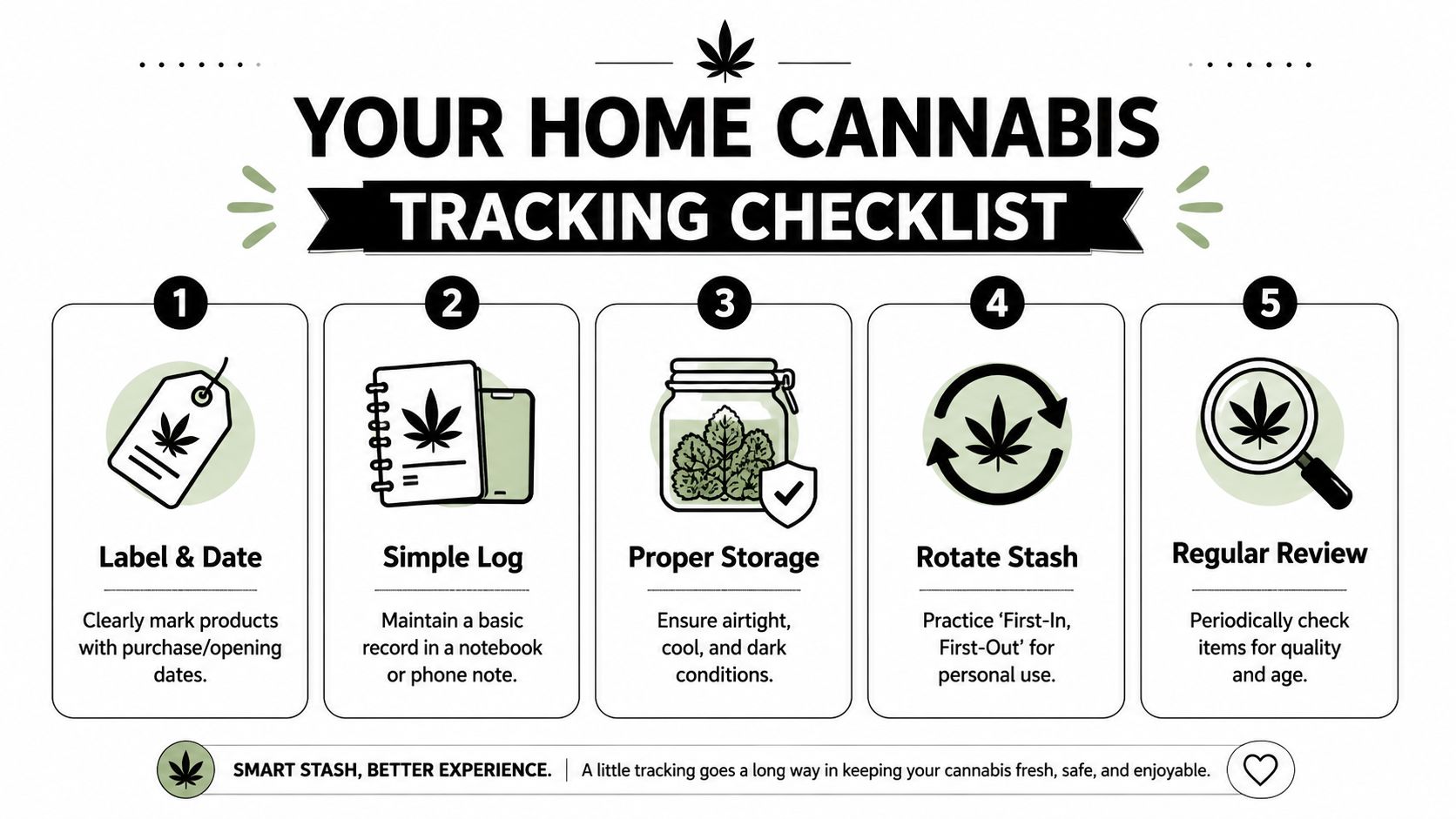
Home tracking doesn't need software that feels built for a warehouse. A small stash can stay organized with a label, a reminder, and a note app if you're disciplined about using them. The trick is to make the process so easy that you'll keep doing it after the first week.
The setup I'd use for a personal stash
Start with a simple label convention. Put the purchase date, or the opening date if that's more useful for you, on the package with a small sticker or marker dot. If you keep several types of product together, color-coding helps too, one color for flower, one for edibles, one for concentrates, so you can spot older items fast.
Then build a basic log in your phone notes app or a spreadsheet. You don't need fancy fields. Product name, date bought, estimated use window, and storage location are enough for home use. The goal is to know what you own and what should be used first.
Here's a simple habit that works:
Label every new item immediately. Don't wait until later, because “later” is when the receipt disappears.
Put older product in front. That's personal FIFO, and it keeps you from always reaching for the newest jar.
Set a calendar reminder. A recurring monthly check keeps old items from hiding in the back.
Note anything that changes quality. Dryness, smell, separation, or packaging damage are worth logging.
Review before restocking. Don't buy more until you know what's already sitting there.
What a good home routine catches
A simple system helps you notice what would otherwise get ignored. If an eighth of flower has been open for a while, you'll use it before the fresher jar. If a multi-pack of edibles is already old, you'll stop shoving it behind the new stuff. That's not complicated, but it prevents waste.
A practical tracking system should use a staged alert model, with an early-warning alert, a critical warning to trigger removal, and routine audits to make sure expired items don't stay in stock Resgrid. At home, that can be as low-tech as a phone reminder and a monthly drawer check. The principle is the same whether you keep three items or thirty.
The rule that matters most is consistency. If you label one product and forget the next five, the system falls apart. If you check your stash regularly, you'll always know what's getting old before it becomes useless.
Inventory Control for Delivery and Retail Operators
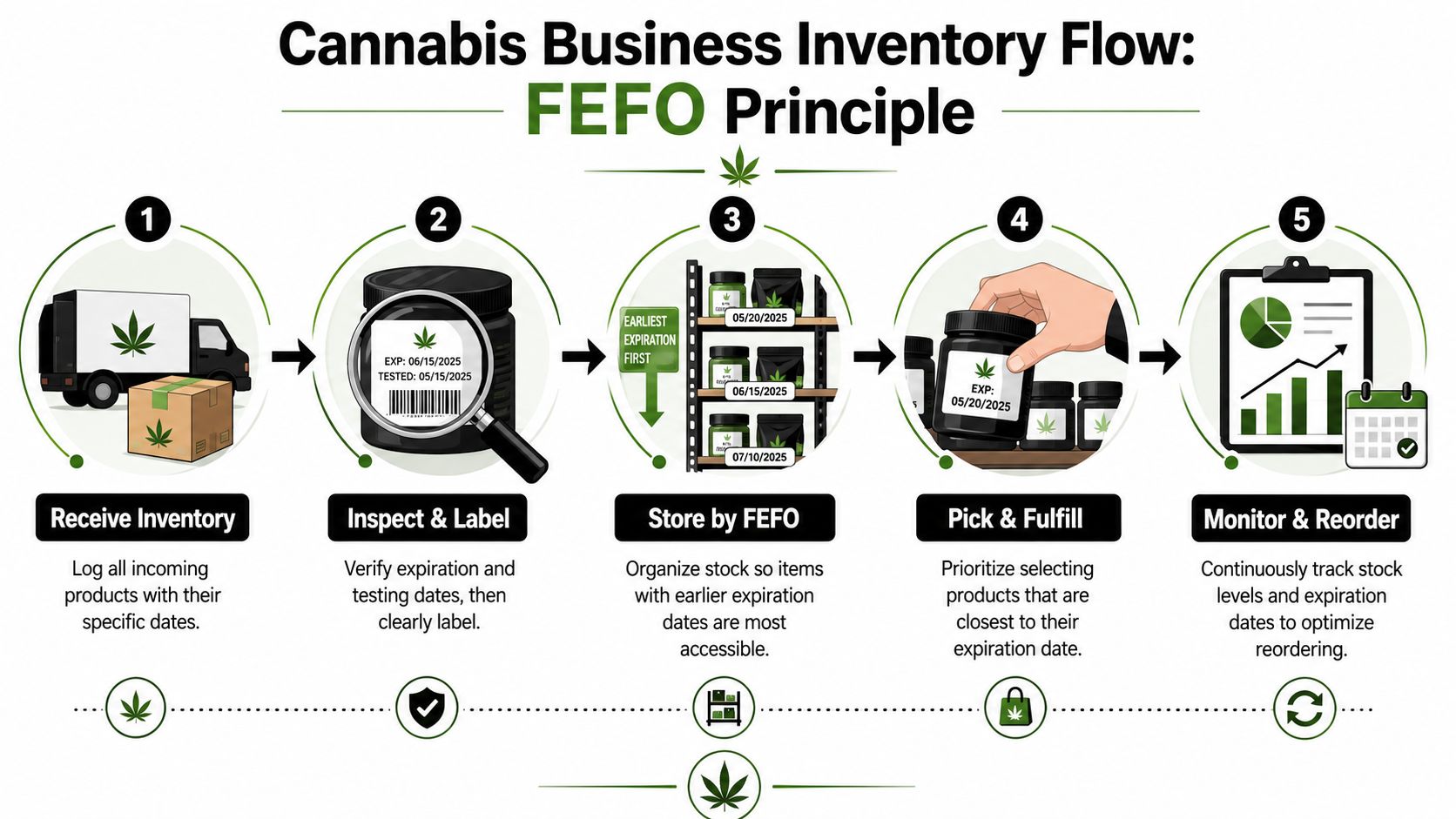
A delivery operation cannot run on memory. Once you are handling multiple SKUs, multiple batches, and multiple customer orders, FEFO, First-Expired, First-Out, has to replace guesswork. The oldest-dated stock moves first, even if the newest inventory is easier to reach on the shelf.
Build the workflow at receiving
The process starts at intake. Every item should be logged with its batch or lot number, expiration date, and storage location the moment it arrives. Skip that step, and everything downstream gets harder because you are trying to manage stock without reliable identity data.
For real expiry risk, batch-level tracking is the standard. Expert guidance recommends FEFO picking, tiered 30, 60, and 90-day alerts, and a weekly review of near-expiry stockStockPilot. In practice, that means the team checks the oldest-dated items first, watches the warning windows, and uses weekly review time to decide what needs promotion, movement, or removal.
Operational truth: if the picker cannot see the date clearly, the system is already failing.
Keep the data aligned with the shelf
Inventory control only works when the digital record matches the physical product. Barcode scanning, clear shelf labels, and routine exception checks keep that alignment from drifting. If the batch says one thing and the shelf says another, the record needs correction before the order goes out.
A useful worksheet for operators should include product name or SKU, batch or lot number, manufacturing date, expiration date, quantity, location, and status. That gives the delivery team enough visibility to fulfill correctly and enough proof to spot problems before they become waste. It also creates a clean trail for audits and internal reviews.
For operators who already use order tracking systems, expiration control fits into the same workflow. Once an order is matched to the right item, batch integrity matters all the way through packing and handoff.
What actually prevents loss
The biggest mistake is relying on SKU-only pick lists. That is how a fresh batch gets shipped while an older one sits untouched. Another mistake is not training staff to put new stock behind older stock. That sounds small, but it is where a lot of avoidable shrink starts.
Use a staggered alert structure, then tie the alerts to action. Early warnings should trigger review, critical warnings should trigger removal or transfer, and weekly audits should confirm the retired items are verified as gone. That rhythm keeps inventory moving instead of aging in place.
Navigating DMV Cannabis Regulations
DC, Maryland, and Virginia don't behave like one market, even when the customer lives only a few miles apart. That's why expiration tracking has to follow the actual operating environment, not a generic cannabis playbook. What counts as enough control in one place may be too loose, or not even relevant, in another.
Why DC needs stricter self-discipline
Washington, DC's adult-use cannabis market runs under a unique gifting model legalized by Initiative 71, and it doesn't have the same retail licensing structure used in neighboring states DIVA portal. That makes internal controls especially important, because operators can't lean on a standard dispensary framework to organize inventory for them. Date logging, batch control, and rotation discipline become part of the brand's credibility.
For delivery services working in this environment, tracking isn't a back-office bonus. It's part of how product quality stays consistent when the legal structure is less formal than a fully licensed retail market. A sloppy intake process in DC doesn't just risk waste. It risks reputation.
Maryland and Virginia require different thinking
Maryland's adult-use market is fully regulated, with licensed retail and cultivation structures and seed-to-sale tracking built into the system. That means batch identification and product traceability sit inside a formal compliance environment. For an operator serving Maryland consumers, expiration tracking has to fit into that more structured workflow.
Virginia is different again. Adults 21 and over can possess and privately grow cannabis, but the state still lacks a fully functioning legal recreational retail market for standard adult-use sales. That means delivery operators there can't assume the same retail model exists, so inventory handling has to stay aligned with whatever legal sourcing pathway is in use.
The result is simple, even if the rules aren't. DC delivery, Maryland retail, and Virginia-adjacent logistics each demand a different level of control, and expiration tracking has to match that reality.
For operators sorting through the legal edge cases, the internal page on legal compliance issues fits the broader compliance picture. Once legality gets complicated, date control becomes one of the few parts of the process you can tighten immediately.
What one-size-fits-all misses
A flat spreadsheet might work in a tiny stash, but not across a mixed DMV operation. In DC, the key is internal discipline. In Maryland, the key is systemized traceability. In Virginia, the key is making sure the product flow itself matches the legal structure before you worry about the shelf-life logic.
That's why the same date field can mean different things in different places. In one market, it's a rotation trigger. In another, it's a compliance checkpoint. In all three, though, it's the difference between a product that gets used on time and one that turns into a loss.
Proper Storage and Disposal Practices
Tracking only pays off if storage supports it. A product can have a clean date in the system and still go bad early because it was left in the wrong environment. Good storage doesn't make cannabis immortal, but it does help it stay closer to its intended condition for longer.
Store each format the right way
Flower should stay in an airtight container, out of direct light, and away from heat swings. Concentrates do better when sealed tightly and kept cool, because excess heat and air exposure change their consistency and quality. Edibles and tinctures need stable, dark, and dry conditions, preferably in their original packaging until use.
Humidity control matters for flower, but so does consistency. A shelf that's always cool is better than one that swings from warm to cold every day. The same goes for cabinets near ovens, windows, or places where the air conditioner blasts directly onto the product.
Keep the product where you'd want a fragile item stored, cool, dark, and out of the way of daily temperature swings.
Dispose of expired product safely
Once a product is clearly expired or badly degraded, don't keep negotiating with it. For personal users, the safest move is to make it unusable before disposal, then follow local disposal rules for household waste. For operators, expired stock should be removed from active inventory immediately, documented, and handled through the company's waste process so it doesn't drift back into circulation.
Don't mix expired product back into sellable stock, even if the package still looks fine. Don't rely on smell alone. Don't assume a sealed package is automatically safe forever. The whole point of tracking is to remove doubt before the product becomes a problem.
If you want fresher product, fewer surprises, and less waste in the DMV, make expiration date tracking part of your weekly routine instead of something you only think about after you find an old jar. Check what you own, label it the day it arrives, and rotate it before it turns into a loss. For reliable same-day delivery in Washington, DC, shop with Green Express DC and build your stash around product you can use on time.
You’re probably here because a vape feels simpler than rolling flower, less conspicuous than lighting up, and easier to fit into a DC night out, a Maryland weekend, or a Virginia drive home after work. A lot of adults in the DMV land in the same spot. They want something discreet, fast, and clean-tasting, but they don’t want to guess what they’re inhaling.
That caution is smart.
The phrase vape cartridge thc sounds straightforward, but the product category is full of small details that matter. Oil type matters. Hardware matters. Lab testing matters even more. Local law matters a lot in this region because DC, Maryland, and Virginia don’t operate under one simple set of rules.
A good cart should feel easy to use, not mysterious. You screw it onto a battery, inhale, and get a quick effect. That part is simple. The confusing part is everything around it: distillate versus live resin, ceramic versus cheap hardware, QR code lab reports, delivery rules, and whether the cart you’re holding is from a regulated channel or an iffy one.
That’s where a little patient explanation goes a long way. Think of this like a conversation at the counter with a budtender who’s seen every beginner mistake and would rather help you avoid it than fix it later.
Your Introduction to THC Vape Cartridges
A THC vape cartridge is a small container filled with cannabis oil that connects to a battery. The battery heats the oil just enough to turn it into vapor. You inhale the vapor through the mouthpiece. No grinder, no lighter, no rolling tray.
For a lot of adults, that’s the appeal. A cart is tidy. It travels well. It usually smells less than smoking flower, and the flavor can be much more pronounced because many carts preserve or reintroduce the plant’s aromatic compounds, called terpenes.
The modern cart also fits how people use cannabis now. Some want one measured puff after dinner. Some want a low-profile option in a city apartment. Some are visiting DC and want something they can use without turning the evening into a whole production.
What trips people up is potency. A cart can deliver a very different experience from flower. The effect can come on quickly, and because it feels smooth, new users sometimes take several pulls before they’ve given the first one time to land.
Practical rule: Treat your first cart like espresso, not like herbal tea. Small amount, then wait.
That’s also why shopping by label alone isn’t enough. Two carts can look almost identical and produce very different experiences depending on the oil, the additives, the hardware, and whether the product came through a tested channel.
In the DMV, there’s one more layer. The local market is a patchwork. DC has its own system. Maryland has an adult-use market. Virginia remains more restrictive in practical terms. If you’re buying or arranging delivery, you need to understand both the product and the route it took to reach you.
The Anatomy of a Modern THC Vape Cartridge
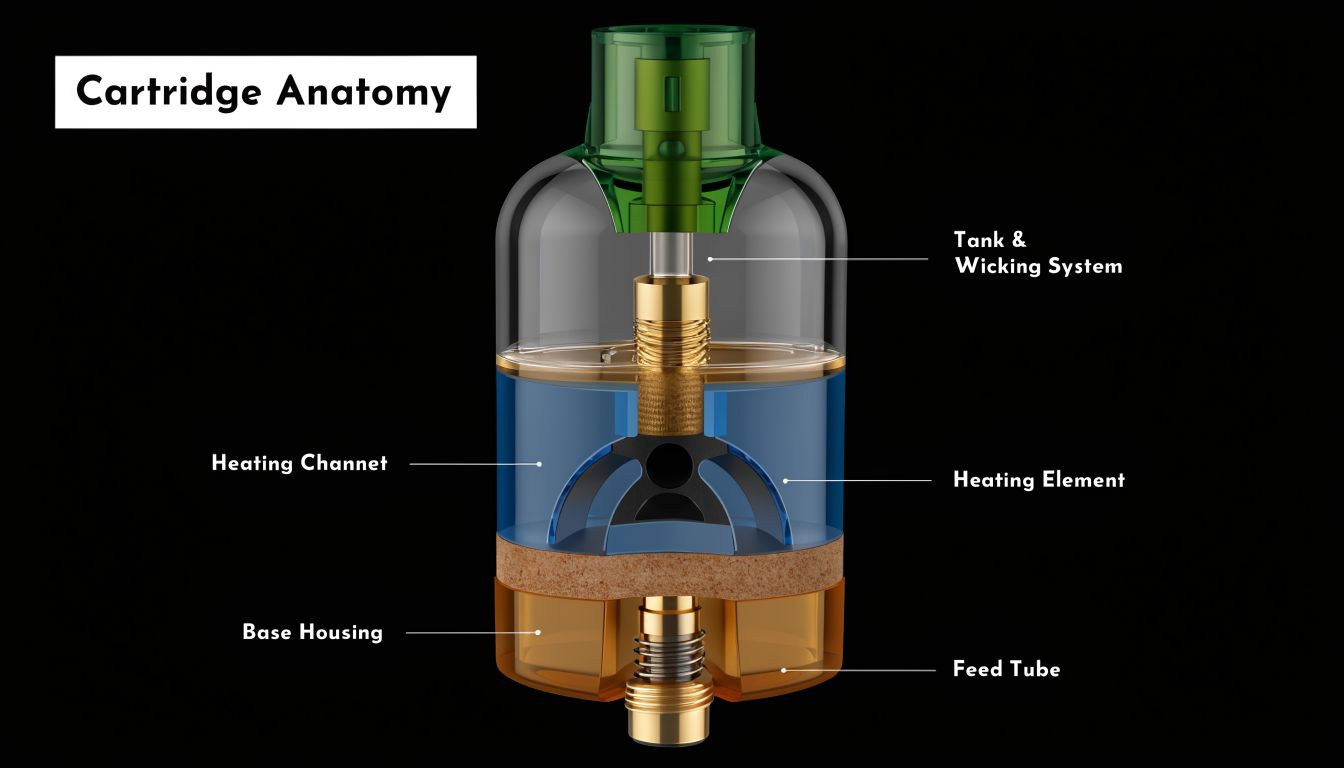
A vape cartridge has four parts that determine how it performs: the tank, the atomizer, the mouthpiece, and the base connection. If you are shopping in DC, Maryland, or Virginia, knowing these parts helps you do more than sound informed. It helps you spot cheap hardware, ask better questions, and avoid carts that look polished online but cut corners where it counts.
The four parts that matter most
Start with the tank, sometimes called the reservoir. This is the chamber that holds the oil. Glass tanks usually inspire more confidence than thin plastic because they hold flavor better and tend to feel sturdier in the hand. If the oil looks unusually dark, watery, or full of bubbles that move too fast, the issue may be the oil itself, the hardware, or both.
Next is the atomizer. This is the heating core inside the cart. It includes the coil and the wick or porous material that pulls oil toward the heat. Many modern cartridges use ceramic components because ceramic can heat oil evenly and help preserve flavor, a design trend described in the CCELL guide to vape cartridge technology. That matters more than it may seem at first. A poor atomizer can scorch oil, clog early, or produce weak pulls even when the cart is full.
The mouthpiece is the part you interact with, so small design flaws show up quickly. A good mouthpiece gives a steady draw and stays comfortable during use. A bad one can trap condensed oil, spit droplets, or feel so restrictive that people pull too hard and flood the heating chamber.
Then there is the base connection. Most THC carts in the DMV use a 510 thread, which is the common screw-in format for standard batteries. If you are ordering from a DC delivery menu or comparing products across Maryland dispensaries, this is one of the first compatibility details to confirm. It is also why shoppers often ask whether a cart will fit the battery they already own.
What the battery actually does
The battery is not just an on and off switch. It sets the temperature range the oil will experience, and that changes flavor, vapor density, and comfort.
A simple comparison helps here. Juice tastes different straight from the fridge than it does after being warmed up on a stove. Cannabis oil responds the same way to heat. Gentle heat tends to preserve more aroma. Excess heat can flatten the flavor and make the vapor feel sharp.
That is why variable-voltage batteries are useful, especially if you switch between oil types. Thick distillate may need a little more heat to move well. Terpene-rich options often taste better at lower settings. If you want a clearer explanation of how those oils differ, this breakdown of distillate vs live resin vape carts is a helpful next read.
Here is the practical version:
Lower voltage: better flavor, lighter vapor, easier to control
Higher voltage: larger clouds, faster oil use, more chance of harshness
The hardware plays a role, but concentration is the bigger story. A cartridge contains highly concentrated cannabis oil, so a small puff can deliver more THC than a new consumer expects from something so compact. The National Institute on Drug Abuse notes that cannabis concentrates can contain much higher THC levels than flower, which helps explain why vape effects can feel intense even after only a short inhale (NIDA overview of cannabis concentrates).
Customers in the DMV sometimes get tripped up: a discreet cart bought through a legal Maryland dispensary, a DC gifting-style transaction under Initiative 71, or a delivery service menu may all look similar on a screen. The inside can be very different. Good hardware paired with clean oil usually feels smoother and more predictable. Cheap hardware can make even decent oil taste burnt or hit harder than intended because the heat is poorly controlled.
A cart gets much easier to judge once you know the parts. The battery provides power. The atomizer heats the oil. The tank and mouthpiece affect consistency. The oil itself shapes most of the experience.
Choosing Your Experience Distillate Live Resin and Rosin
The biggest difference between one cart and another usually isn’t the battery. It’s the oil.
When customers ask, “Which one hits best?” I usually slow the question down. “Best” might mean strongest. It might mean tastiest. It might mean closest to the original plant. Those are not always the same thing.
The easiest analogy is orange juice.
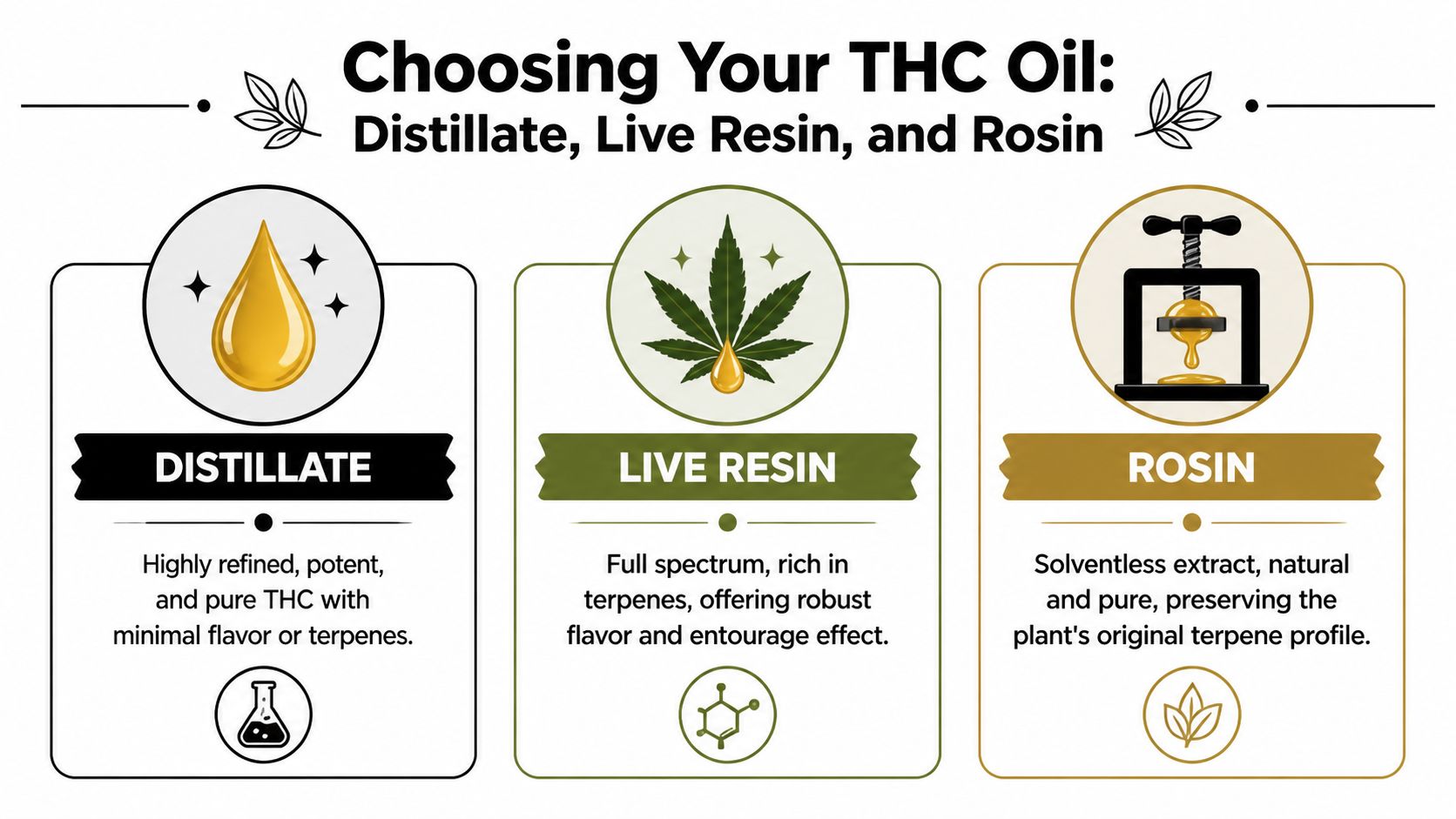
Distillate is like juice from concentrate. It’s refined, stripped down, and built for a straightforward result.
Live resin is like fresh-squeezed juice with lots of aroma still intact.
Rosin is like the small-batch, hand-pressed version. Less industrial. More natural. Usually more expensive.
Distillate
Distillate is highly refined cannabis oil. Producers isolate cannabinoids, especially THC, and remove much of the plant’s original material. The result is a very clean, potent oil with a lighter natural flavor unless terpenes are added back in later.
This is often the easiest starting point for people who want a simple, consistent effect. Distillate carts can be fruit-forward, candy-like, or strain-inspired depending on the terpene blend used.
What some people love about distillate:
Clean profile: It feels straightforward and predictable.
Strong potency: Many shoppers choose it when they want intensity over nuance.
Broad availability: It’s usually the easiest format to find.
What some people don’t love:
Less plant character: It may feel less expressive than a full-spectrum extract.
Flavor can feel designed: Some terpene blends taste polished rather than naturally “cannabis-forward.”
Live resin
Live resin starts with cannabis that’s preserved fresh rather than dried in the traditional way. That helps retain more of the volatile aromatic compounds that can get lost during standard processing.
The result is often richer in aroma and more “true to strain.” If you’ve ever smelled a cart and thought, “This smells like the flower did,” there’s a good chance it was a live resin product.
Live resin tends to attract people who care about flavor and the broader feel of the plant, not just raw THC. If you want more context on how these two categories differ, this breakdown of distillate and live resin differences gives a useful side-by-side look.
If distillate is a spotlight on THC, live resin is more like stage lighting. You notice the whole performance, not just the lead actor.
Rosin
Rosin is the category many connoisseurs chase. It’s generally made without hydrocarbon solvents, using heat and pressure to extract oil from the plant material. That “solventless” point is why many shoppers see it as the most natural-style extract in the cart world.
Rosin often offers the deepest plant expression of the three. It can be earthy, bright, funky, floral, or gassy depending on the cultivar. It also tends to cost more and can be a little less forgiving in cheap hardware, because premium oils deserve a decent battery and careful heat settings.
Quick comparison table
Attribute
THC Distillate
Live Resin
Live Rosin
Main style
Refined and THC-forward
Fuller-spectrum extract
Solventless full-spectrum extract
Flavor
Usually lighter or terpene-added
Rich, strain-expressive
Deep, natural, often most nuanced
Typical shopper
Wants potency and consistency
Wants flavor plus strong effects
Wants purity and terpene character
Production approach
Highly refined extraction and distillation
Extracted to preserve more original compounds
Heat-and-pressure extraction without added solvents in the final process
Cost
Usually lower
Mid to premium
Usually premium
Best fit
Everyday convenience
Flavor-driven sessions
Enthusiast or quality-first use
How to choose without overthinking it
If you’re new and want a simple answer, use this filter:
If you care most about clarity and consistency, start with distillate.
If you care most about flavor and a broader plant feel, try live resin.
If you care most about solventless extraction and top-shelf expression, choose rosin.
None of these is automatically “better.” They’re just different tools for different moods.
A Smart Consumer's Guide to Vaping Safety and Lab Reports
A customer in DC orders a cartridge from a delivery menu, sees a strain name they recognize, and assumes that means the product is safe. That is the mistake I try to stop first.
A THC cart should be judged like food from a good kitchen. The label matters a little. The ingredients, handling, and testing matter much more. In the DMV, that distinction is especially important because legal access works differently in DC, Maryland, and Virginia, and products can move through very different supply chains before they reach your hand.
Why unverified carts deserve extra caution
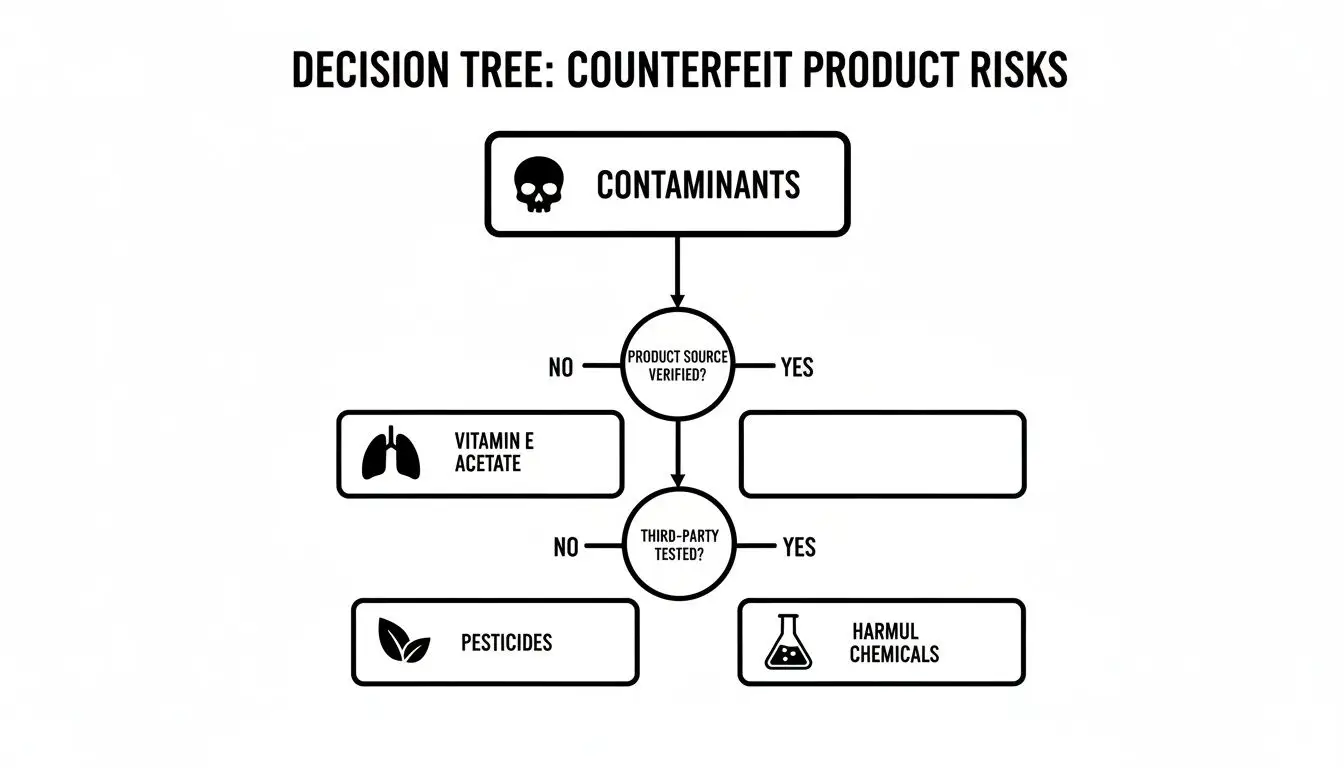
The clearest warning came during the 2019 EVALI outbreak. The CDC reported a national outbreak of serious lung injuries linked to e-cigarette or vaping products, with vitamin E acetate strongly associated with many cases involving THC products, especially those obtained from informal sources, according to the CDC's overview of the EVALI outbreak and product findings.
That history still matters. It showed buyers a hard truth. A cartridge can look polished, taste fine at first, and still come from a chain of production that cuts corners.
Heavy metals are another reason to care about the hardware itself, not just the oil. Researchers summarized by Johns Hopkins Bloomberg School of Public Health on toxic metals in vaping products have pointed out that device components can contribute metals such as lead, chromium, and nickel to the aerosol. For a shopper, the practical takeaway is simple. Safe vaping starts before the first puff, with verified sourcing and real testing.
What a COA should actually tell you
A Certificate of Analysis, or COA, is the batch-specific lab report for the product. If a shop, delivery service, or brand cannot show one clearly, you are being asked to trust packaging instead of proof.
Read a COA like a receipt plus a safety inspection. You are checking that the cart is what it claims to be, and that it passed the screens that matter.
A useful COA answers four questions:
Does the batch match the package? Product name, lot number, and test date should line up.
Is the potency realistic? You want measured cannabinoid content, not marketing language.
What else is in the oil? Terpenes and minor cannabinoids can help explain flavor and effect.
Did it pass contamination testing? That includes pesticides, heavy metals, residual solvents, and microbial screening where required.
How to read one without getting lost
Start with the identity section.
If the package in your hand says one batch and the report shows another, stop there. In a regulated market, batch matching is basic housekeeping. In a mixed market like the DMV, where shoppers may see everything from licensed products to gray-market offerings, it is one of the fastest trust checks you have.
Next, look at potency. A real lab report lists measured results. Numbers can vary by batch, and that is normal. What should make you suspicious is a product with huge claims and no report, or a report that looks generic enough to fit any cart on the shelf.
Then check the contaminant panel. This is the part that keeps you out of trouble.
Look for pass results for:
Heavy metals
Residual solvents
Pesticides
Microbials or related contamination screens
If those sections are missing, blurred, outdated, or impossible to verify by QR code or batch number, treat that as a warning, not a minor inconvenience.
Red flags DMV shoppers should take seriously
The local market can confuse newer buyers because "available" does not always mean "well sourced." DC's setup under Initiative 71 has made many shoppers comfortable with delivery-style access, but convenience should never replace verification.
Watch for these problems:
No accessible COA
Brand-heavy packaging with little batch detail
Anonymous source information
Oil with particles, separation, or an odd color for the extract type
A widely copied street brand with no clear manufacturer
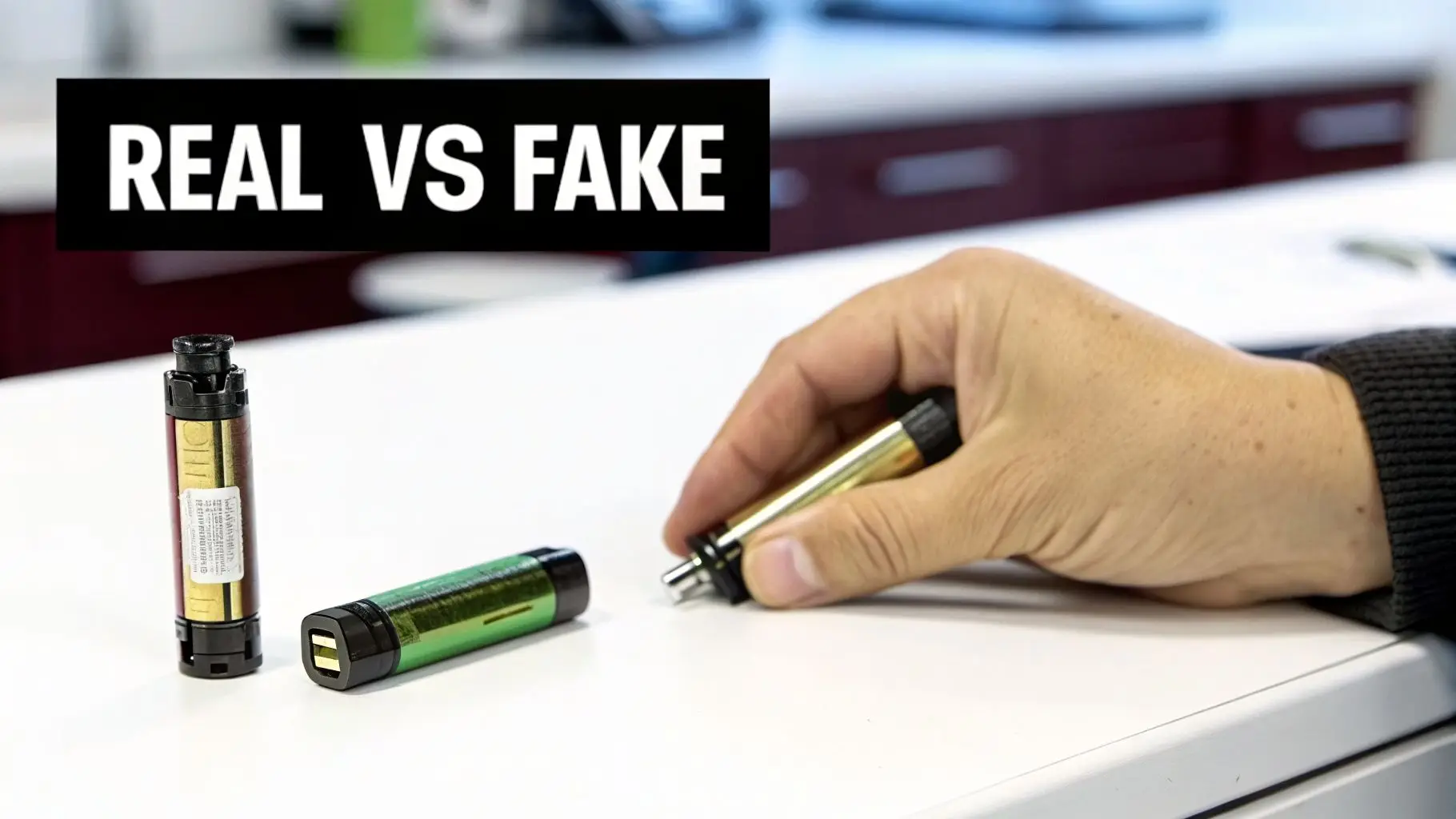
If you want a real-world example of how counterfeit or unverified brands circulate, this guide on how to tell whether Glo carts are real is worth reading.
The standard to keep in your head
A good cart should be traceable, tested, and sold by someone who can answer plain questions without getting slippery.
That does not make vaping risk-free. It does help you avoid the avoidable problems. Mystery oil, mystery hardware, and mystery sourcing are where customers get burned.
If you remember one rule, use this one. Read the lab report before you fall for the flavor name.
Getting Started Right Batteries Dosing and Maintenance
Once you’ve chosen a cart, the next job is using it in a way that gives you control. Most bad first experiences come from one of three things: too much heat, too many puffs, or poor storage.
Pick the right battery
If your cart uses a 510 thread, you need a compatible 510 battery. That part is simple. The better question is whether your battery lets you adjust voltage.
Variable voltage matters because different oils behave differently. Thick live resin or rosin may need a little patience and the right setting. A lower setting usually protects flavor better and reduces the chance of a burnt taste.
A simple beginner approach:
Charge the battery fully
Start on the lowest setting
Increase only if the cart isn’t drawing well
Avoid “hot and hard” pulls
Dose like you mean it
Verified data from a 2023 analysis found that two-thirds of tested hemp delta-9 THC vapes deviated from their stated potency by over 10%, and some cartridges can reach up to 95% THC, which is why this potency-labeling analysis in PMC supports a careful, self-moderated approach.
That’s the academic version of what budtenders say all day: one small puff can be plenty.
First-use checklist
Take one short inhale.
Wait 15 to 20 minutes before deciding whether you need more.
Notice your body. Dry mouth, warmth behind the eyes, and a mood shift often arrive before the full peak.
Only then consider a second puff.
If you’re used to flower, don’t assume the same rhythm applies. Carts can feel smoother than they are strong.
Beginner move: inhale less than you think you need, then give the cart time to speak.
A quick visual can help if you’re brand new to assembling and using the hardware:
Keep the cart working properly
Maintenance is boring until it saves your cart.
Store cartridges upright when you can. That helps the oil settle around the intake points correctly and lowers the chance of leaks. Keep them out of direct heat and don’t leave them in a hot car.
If a cart clogs, don’t immediately yank on it like a milkshake straw. Warm it gently in your hands, make sure the battery contact is clean, and try a softer draw. Sometimes a cotton swab around the connection point solves what looks like a hardware failure.
A cart is usually spent when the visible oil is nearly gone and repeated normal draws no longer produce satisfying vapor. Don’t keep blasting an almost-empty cart at high heat. That’s how you get burnt flavor and wasted residue.
Navigating Cannabis Laws in DC Maryland and Virginia
You can live ten minutes from the District line, cross into Maryland for dinner, then head into Virginia the next day. Your route is simple. The cannabis rules are not.
For THC cartridge shoppers in the DMV, that difference matters more than people expect. A cart that is easy to buy in one jurisdiction may be harder to access in another, and the legal path behind the sale can look completely different even within the same metro area.
Washington DC
DC runs on its own logic. Adults can possess and gift cannabis under Initiative 71, but Congress has blocked the District from creating a standard adult-use retail sales system. The DC Council's overview of Initiative 71 explains the basic rule set and why the local market developed in such a distinct way.
That history shaped the buying experience adults still see today. In practice, you need to pay attention to how a business describes ordering, identity checks, delivery, and what is being provided. Clear explanations are a good sign. Vague wording is not.
Maryland is easier for many customers to understand because the adult-use system looks more like a standard retail model. You walk into a licensed dispensary, review the menu, and purchase through a regulated channel.
That does not mean every cart on the shelf is the same. One may be made with distillate and botanical terpenes. Another may use live resin and different hardware. The legal structure is cleaner, but you still need to read the label the way you would read the label on two different juices at the grocery store. Both are legal products. They can still taste, feel, and perform very differently.
Virginia
Virginia creates the most confusion in the DMV. Adults often hear that cannabis is legal there, then assume buying a THC cartridge will be straightforward. Possession rules and retail access are separate questions, and that gap trips people up.
The practical lesson is simple. Do not treat legal possession as proof that a local, lawful purchase option exists for the product you want at that moment.
Safety research adds another reason to slow down. A published review in Tobacco Control on cannabis vaping and aerosol toxicants describes how chemical exposure can vary based on product composition, device design, and heating conditions. In a patchwork market, transparent third-party testing matters even more because the law only tells you what may be allowed. It does not confirm oil quality, additives, or hardware reliability.
Local law answers one question. Product quality answers another.
The practical DMV takeaway
Treat DC, Maryland, and Virginia as three separate systems every time you shop for a cartridge. Ask yourself:
Is there a lawful local path for this product where I am?
Can I verify testing and product details before I buy?
Do I understand the rules for possession, delivery, and use in that jurisdiction?
That habit saves time, reduces risk, and helps you shop with the same care you would use for any product going straight into your lungs.
Your Trusted Source Green Express DC for Premium THC Cartridges
You are in DC for the evening, your battery is charged, and you want a cartridge that feels predictable from the first puff. That usually means more than finding any cart for sale. It means finding oil with clear sourcing, hardware that performs properly, and a delivery process that follows District rules instead of asking you to guess.
For adults shopping in Washington, DC, trust is built through details. You should know what kind of oil you are buying, whether the product has been lab tested, and how the service handles age verification and delivery. After the vaping safety concerns discussed earlier in this guide, careful sourcing is not a bonus. It is part of buying wisely.
That is the role Green Express DC aims to fill.
Green Express DC offers premium cannabis delivery for adults 21+ in Washington, DC, with a focus on lab-tested products, discreet service, and a curated menu that includes THC cartridges for different experience levels. For a new customer, that can remove a lot of friction. Instead of sorting through vague listings or questionable products, you can start with a menu built around clear options and a local process.
Value shows up in everyday situations. A newer user may want a cart that is simple, authentic, and less likely to create an uncomfortable first session. A regular consumer may care more about whether a cartridge is distillate, live resin, or rosin, and whether the flavor matches the cultivar on the label. Someone visiting the District often wants one thing above all else. A process that feels legitimate, organized, and respectful of privacy.
Green Express DC speaks to those practical concerns. The service covers more than carts, but its cartridge selection fits what careful DMV shoppers usually look for. Clear product categories. Delivery within the District. ID verification at drop-off. Those are basic signals of a business that takes compliance and customer safety seriously.
A good cartridge purchase should feel boring in the best way.
You know what you ordered. You understand how it should feel. You can verify the basics before it arrives. Then the product shows up discreetly, and your evening goes according to plan.
For adults in DC searching for vape cartridge thc, that is often the goal. A reliable local option that respects the legal realities of the District, cuts down on gray-market uncertainty, and makes it easier to choose a product you can feel comfortable using.
You’re ready to launch or tighten up a delivery operation in the DMV. You’ve got demand, a menu concept, maybe even a route plan. Then you hit a significant bottleneck. Wholesale weed supplies are never just about finding flower, carts, or concentrates. In DC, Maryland, and Virginia, sourcing is tied to licensing, transport risk, packaging rules, lab paperwork, and the practical question every operator eventually asks: who can deliver consistent product without creating headaches two weeks later?
That’s where most generic wholesale guides fall apart. They talk like the whole market works under one clean statewide system. The DMV doesn’t. DC has its own compliance reality. Maryland has a licensed adult-use structure. Virginia has its own limits and unresolved friction around sales. If you’re serving customers near state lines, or sourcing with one eye on compliance and the other on same-day fulfillment, those differences decide whether your operation stays smooth or starts bleeding time and money.
The upside is real. The global cannabis wholesale market is projected at USD 137.67 billion in 2026, North America held 83.82% of global market share in 2025, and the US market is projected to reach USD 428.22 billion by 2032, according to Fortune Business Insights cannabis market projections. Opportunity isn’t the problem. Execution is.
Navigating the DMV Wholesale Cannabis Market
In the DMV, sourcing isn’t just a purchasing task. It’s an operating system. The supplier you choose affects menu stability, courier workflows, customer complaints, returns, packaging, and how exposed you are if a regulator starts asking questions.
A lot of new operators focus on price first. That’s understandable, especially when customers compare menus fast and expect bundles, bulk options, and reliable same-day drops. But the cheapest supply is often the most expensive inventory you’ll ever buy. Product arrives late, labels don’t match, test paperwork is incomplete, units vary lot to lot, and your team spends the week patching problems instead of selling.
Why the DMV is harder than it looks
DC, Maryland, and Virginia sit close enough that people talk about the region as one market. It isn’t one market from a sourcing standpoint. Each jurisdiction has a different regulatory posture, a different enforcement reality, and a different level of maturity around licensed supply.
That creates a few real-world trade-offs:
Speed versus traceability. Fast supply is useful, but if paperwork is weak, you inherit the risk.
Menu breadth versus consistency. A supplier with endless SKUs can still fail on repeatability.
Price versus survivability. If products don’t move, low buy-in pricing doesn’t save you.
Regional access versus transport exposure. Close geography tempts bad decisions around movement across jurisdictions.
Practical rule: In the DMV, a “good supplier” isn’t the one with the biggest menu. It’s the one whose product, paperwork, and handoff process still look clean when an order goes wrong.
What experienced operators watch first
Before looking at flavor names or margin, smart buyers look at four basics:
Priority
What to check
Why it matters
Legal fit
Whether the source actually fits the jurisdiction you operate in
A product can be fine in one place and a liability in another
Lab discipline
Whether every batch comes with usable, recent documentation
Missing paperwork slows delivery and creates exposure
Packaging readiness
Whether units are already prepared for compliant sale and handoff
Repackaging creates mistakes
Reorder reliability
Whether the same SKU can be supplied again in similar quality
Customers hate menu churn
If you get those four right, you can build around them. If you get them wrong, no amount of branding or route efficiency fixes the problem.
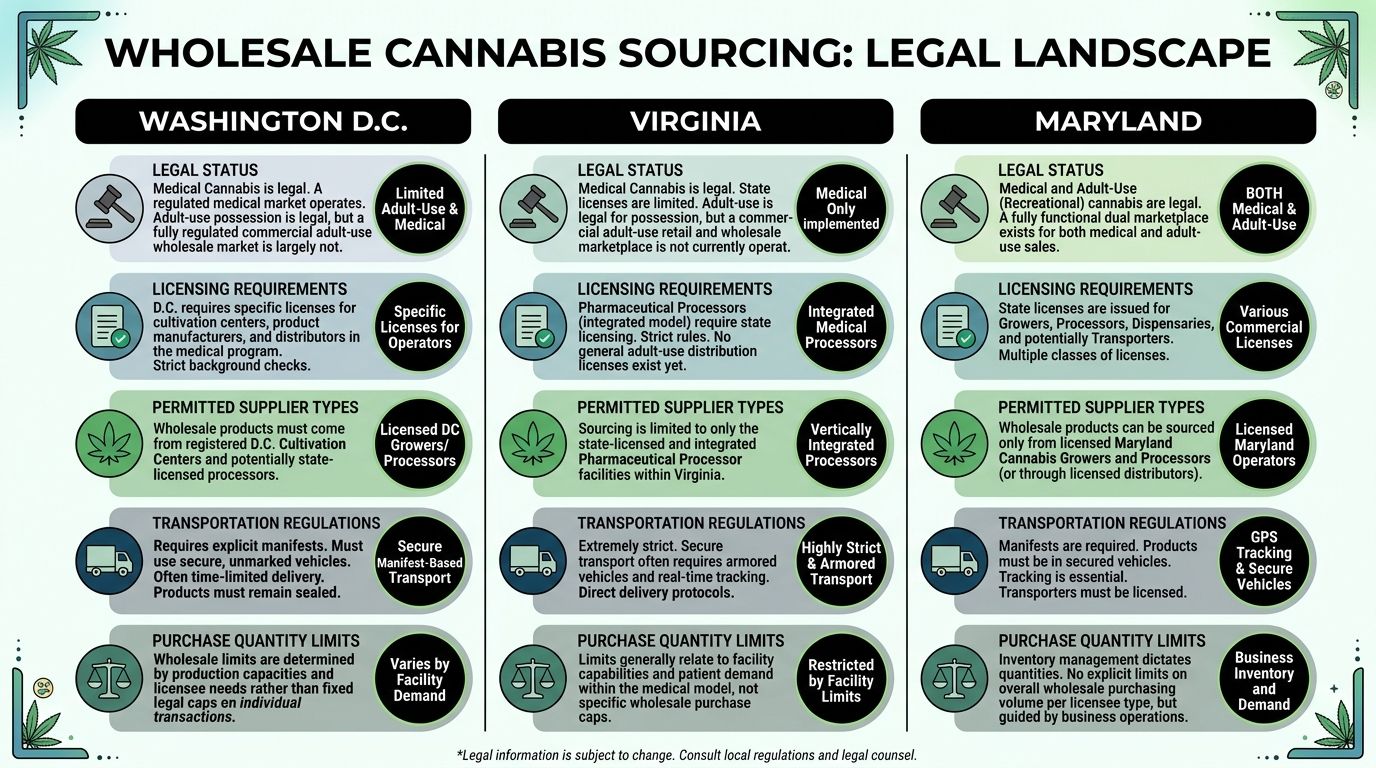
Understanding the Legal Framework for Sourcing in DC VA and MD
The first mistake people make is treating the DMV like a single operating zone. It’s not. Sourcing rules change when you cross from the District into Maryland, and they change again when Virginia enters the picture. If you’re buying, storing, packaging, or moving cannabis for delivery, the legal model in each jurisdiction matters more than your business plan.
DC operates on a different logic
In Washington, DC, sourcing conversations always have to account for the District’s unusual market structure. Operators and buyers often use the same words that licensed adult-use markets use, but the practical environment is different. That difference affects how products are described, how business relationships are formed, and how carefully you need to evaluate supply claims.
If you’re trying to understand the District’s compliance culture before you source, reviewing established I-71 compliant shops in DC gives useful context for how operators present products, gifting relationships, and customer-facing practices. It won’t replace legal advice, but it does show you the language and boundaries serious operators pay attention to.
Maryland is the cleanest wholesale environment in the region
Maryland gives buyers the most straightforward sourcing path in the DMV because the market is structured around licensed cultivation, processing, and retail. That doesn’t mean it’s simple. It means the chain of custody is more legible.
For buyers, that usually means:
You can evaluate suppliers through formal business records and product documentation.
Inventory tends to be easier to compare lot to lot.
Packaging and labeling expectations are more operationally standardized.
Wholesale discussions feel more like regulated CPG than informal cannabis networking.
That structure makes Maryland attractive for operators who want predictable procurement, especially for repeat SKUs like flower, prerolls, vapes, and concentrates.
Virginia remains the most restrictive practical environment
Virginia creates confusion because possession and market conversation often move faster than actual legal commercial options. From a sourcing perspective, that means buyers need to be especially careful about assumptions. Just because product is discussed openly in the region doesn’t mean there’s a straightforward legal wholesale path for a delivery business model.
The danger in Virginia isn’t just obvious noncompliance. It’s false confidence. Buyers hear “regional,” “DMV,” or “local” and assume supply can move smoothly. It can’t, unless the legal structure supports that specific movement and transaction.
Most costly sourcing mistakes in this region happen when someone assumes proximity equals permission.
DMV Cannabis Sourcing Regulations at a Glance 2026
Jurisdiction
Governing Model
Wholesale Source
Key Restriction for Delivery
Washington, DC
District-specific cannabis framework with unique compliance realities
Source legitimacy and documentation must align with local rules and enforcement posture
Delivery operators must be careful about how products are sourced, presented, and transferred
Maryland
Licensed adult-use and medical market
Licensed cultivators and processors are the clearest wholesale path
Delivery activity must stay inside Maryland’s legal and licensing boundaries
Virginia
Evolving and limited commercial landscape
Sourcing options are constrained by a narrower legal structure
Assumptions about retail-style delivery can create immediate legal exposure
What this means on the ground
For a DMV operator, the practical answer is simple. Don’t build one supply plan for three jurisdictions. Build separate sourcing logic for each place you touch.
That means:
Identify where the product originates.
Confirm whether that source is lawful for that jurisdiction.
Match packaging, labeling, and transfer practices to the place where the customer receives the product.
Never assume regional convenience overrides jurisdictional rules.
The operators who stay standing are usually the ones who get boring about this. They document everything, avoid cute shortcuts, and say no to supply that creates legal ambiguity.
How to Source and Vet Wholesale Cannabis Suppliers
A Friday restock can look fine at noon and turn into a mess by 6 p.m. if your supplier sends flower with mismatched batch tags, carts with weak hardware, or packaging that works in one jurisdiction and creates questions in another. For a delivery operator in DC, Maryland, and Virginia, supplier vetting is not a back-office task. It decides whether your menu stays stable, whether your drivers get put in bad positions, and whether a quick buy turns into a long cleanup.
Good sourcing starts with one question. Can this supplier hold up when you ask for specifics?
A nice logo, loud strain names, and polished jars do not answer that question. In the DMV, I want to know who controls the inventory, how batches are tracked, who packed the units, and what happens when a product issue shows up after delivery. Maryland usually gives buyers a cleaner path because licensed operators are easier to identify and verify. In DC and around the broader DMV, buyers have to work harder.
Start with legitimacy, not product hype
The first screen is simple and practical. Who are they, what do they sell in volume, and what paperwork do they send before you start chasing them?
I look for a few signals right away:
Clear operating identity. The supplier should be able to explain who owns the product and who handles the transfer.
Consistent paperwork habits. COAs, batch references, and packaging details should come over fast and match each other.
Stable communication. Slow replies happen. Vague replies are the problem.
Repeatable inventory. A hot sample matters a lot less than a reliable reorder.
That last point gets missed by newer buyers. One dialed-in batch can hide a sloppy operation. Consistency is revealed when lot two and lot three show the same care as the sample bag.
Ask questions that force specifics
Suppliers who know their operation can answer direct questions without turning the call into a pitch. Ask narrow questions and stay quiet long enough to hear where they get slippery.
Use questions like these:
What lab tests come with each batch?
Do the batch numbers on the COA match the batch numbers on the units?
Who packaged these items, and where?
What is your process for leaking carts, broken seals, or disputed concentrate weight?
Are these units ready for compliant sale, or will I need to relabel or rework them?
Can you provide samples from the same lot you plan to deliver on the first real order?
The answer quality matters as much as the answer itself. Clear operators speak in process. Weak ones speak in vibes.
For vape inventory, customer tolerance is low. A menu page like these Pure One carts shows why consistency matters so much. People notice hardware failure, burnt taste, oil color, and fill level right away. If a supplier cannot explain their cart hardware, oil source, and replacement policy, I treat that as a warning.
Watch behavior during the sample stage
The sample stage gives you free information if you pay attention. I learn more from the handoff than from the sales talk.
Did the sample arrive labeled in a way that makes sense? Was it tied to a real batch? Did the supplier mention storage conditions, production date, or shelf age without being prompted twice? If a seller gets loose with details on a tiny sample order, they usually get worse once larger invoices start going out.
This is also where regional friction shows up. A supplier may be solid on Maryland flower but careless about how products are packed for a DC-facing delivery workflow. Another may have attractive pricing on carts but no disciplined process for replacing defective hardware. Those are different risks, and they hit your operation in different ways.
That’s also a good point to watch a broader discussion on cannabis wholesale mechanics and supplier evaluation:
Treat testing habits like an operating signal
Strong suppliers do not make testing feel theatrical. They send clean paperwork, keep batch records straight, and answer questions without acting offended.
If testing only appears when you push hard, I assume the process is weak. If every batch seems to have a different explanation, I assume quality control is drifting. And if a supplier treats failed units as a normal cost of doing business, I price in the risk or walk.
A clean COA should arrive before you ask for it the second time.
Build a shortlist, not a dependency
A delivery business in the DMV should not lean on one source for everything. Keep a short bench and know what each supplier is good at.
One may be dependable on flower. Another may hold steadier on concentrates. A third may be worth using only for carts or pre-rolls because their packaging and replacement process are tighter. That mix gives you options when supply dries up, quality slips, or a product line stops moving.
The goal is not to collect supplier contacts. The goal is to know which suppliers stay organized when the week gets messy.
Decoding Lab Tests and Organic Claims for Quality Assurance
Friday night in DC, your menu is live, drivers are already asking what is ready to go, and a supplier drops off flower that looks great in the jar. Then you check the paperwork and the batch code on the label does not match the COA they texted over. In a DMV delivery operation, that is not a small admin problem. That is the kind of mistake that turns into refunds, pulled listings, and a long weekend of customer service.
A Certificate of Analysis, or COA, is the first quality screen I trust. Bag appeal matters once the product reaches the customer. Before that, paperwork has to carry the weight, especially if you are sourcing across a region where DC, Maryland, and Virginia all create different expectations around packaging, labeling, and how closely anyone may inspect your supply chain if something goes wrong.
What a usable COA should tell you
A usable COA ties to the exact lot in hand. Same batch number, same product form, same basic timing. If the supplier hands you paperwork for a similar run or says the current batch is “testing the same,” treat that as missing documentation.
Check five things first:
Potency data that fits the product being sold
Cannabinoid detail beyond one headline THC number
Contaminant screening for the product category
Batch identifiers that match the package and invoice
Testing dates that make sense for inventory age
For flower, I also compare the COA to the sales story. If a vendor is pitching top-shelf indoor with a loud terp profile, the lab sheet should support that. If they are pitching carts, I want to know whether the oil profile and hardware quality line up with what customers expect from that segment. Counterfeit-heavy categories deserve extra scrutiny, which is why it helps to know the real market range for Big Chief carts before you buy wholesale.
Red flags inside the paperwork
Weak COAs usually fail on small details. That is how bad product gets through.
A few problems show up over and over in the DMV:
Batch numbers that do not match the jar, pouch, or case
Missing contaminant results
Old testing dates on supposedly fresh inventory
Potency-only reports with no safety panel
Blurry screenshots instead of full lab PDFs
Sample names so generic they could apply to anything
Suppliers working clean rarely struggle to send complete paperwork. Suppliers cutting corners often turn every document request into a debate.
If a seller cannot connect the product in your hand to the report on your screen, do not list it.
Organic claims need records, not branding
“Organic” in cannabis is still loose language. In one room it means living soil. In another it means no synthetic sprays late in flower. In a third, it means somebody printed earth tones on the bag.
That creates a real sourcing problem in the DC, Maryland, and Virginia corridor, because buyers often move product through mixed consumer expectations and mixed regulatory pressure. A customer in DC may care about clean cultivation and flavor. A Maryland buyer may ask sharper questions about licensed production and testing discipline. A Virginia customer may be reading labels differently because the retail environment around them is still uneven. If you are delivering across that region, vague organic claims create more risk than value.
Ask direct questions and listen for specific answers:
What cultivation method was used?
Were synthetic pesticides or fungicides used at any stage?
Is there batch-level grow documentation?
Can the supplier explain nutrient inputs clearly?
Does the label language match the test results and production story?
As noted earlier, serious labeling standards are a useful benchmark even outside the state where they were written. I use that standard in practice. If a supplier wants premium pricing for “organic” flower but cannot show clear cultivation records, pesticide discipline, and batch consistency, I treat the claim as marketing.
Quality is broader than THC
Delivery customers do not reorder because a number on the sticker looked impressive. They reorder because the flower burned clean, the cart pulled right, the edible hit on time, and the second unit matched the first.
That is why I put more weight on repeatable quality than on flashy potency. In this business, consistency protects margin. It cuts returns, reduces menu churn, and keeps your team from explaining the same product problem to ten different customers in one day.
The best wholesale weed supplies usually come from suppliers who stay boring in the right ways:
same lot tracking
same test format
same labeling discipline
same handling standards
same answer when you ask for support documents twice
That kind of consistency matters more in the DMV than generic wholesale guides admit. One paperwork gap might be ignored by a casual buyer. For a delivery operator working across DC, Maryland, and Virginia, it can spill into compliance problems, customer disputes, and inventory you cannot move with confidence.
Negotiating Wholesale Prices and Purchase Terms
Friday at 4:30 p.m., a supplier sends over a "can’t miss" price sheet. The flower looks cheap, the carts are priced to move, and the rep wants an answer before close. In the DMV, that is exactly when buyers get trapped. By Monday, you may be holding too much of the wrong SKU, tied to terms that make no sense for a delivery operation serving customers with different expectations and legal exposure across DC, Maryland, and Virginia.
Price matters. Terms decide whether the buy works.
Cheap inventory can become expensive fast
A low per-unit quote means very little if the supplier forces a large opening order, limits returns, or pushes a product mix that does not fit your menu. Delivery businesses need margin, but they also need flexibility. A SKU that sits for two extra weeks can wipe out the savings you thought you won on the invoice.
That problem gets sharper in the DMV because demand is not uniform across the region. A product that moves easily with a DC customer base may stall in a Virginia-facing menu strategy. Maryland buyers can be different again. If you are sourcing with one blunt price target instead of location-specific sell-through expectations, you are negotiating half blind.
Wholesale pricing also moves. Product cycles are short. New drops get hype, then flatten out. So the right question is not "How cheap can I buy this?" It is "What happens if this slows down after the first push?"
Terms that protect the buyer
The best negotiations focus on risk allocation. If the supplier wants you to absorb all of the downside, the deal is weak even if the headline price looks good.
Push on these points:
Opening MOQ that matches real demand. First orders should test movement, not fill a closet.
Tiered pricing based on reorder volume. Earn the better price after the product proves itself.
Defect and replacement language in writing. This matters with carts, disposables, and concentrates, where leaks, clogs, hardware failures, and seal issues show up after delivery starts.
Clear payment timing. Net terms, split payments, or partial deposits can help if your cash flow comes in waves.
Batch consistency. If a product works, ask whether the next order will match closely enough to keep the menu stable.
Stale inventory options. Even limited swap support can save a buyer from getting stuck.
Get specific. "We stand behind our product" is not a term. "Any visibly leaking cartridge from the same batch gets credited within seven days with photo proof" is a term.
Use retail pressure in the negotiation
Suppliers sometimes price as if the customer will never compare menus. That is not how this business works. Retail pricing is visible, especially on recognizable brands and vape products. If the street-facing number is already tight, your wholesale buy has to leave room for promotions, customer service headaches, and the occasional replacement.
That is easy to see on consumer-facing pages tracking Big Chief carts price. Buyers should read that kind of pricing pressure as a warning. If your landed cost is too high, you will either compress your own margin or post menu prices that slow conversions.
Neither outcome helps a delivery operation.
Negotiate around product life, not sales talk
Suppliers know every SKU is not a long-term winner. Experienced buyers use that reality instead of arguing over pennies.
Ask for introductory pricing on new items. Ask for mixed cases instead of a full-case commitment on unproven products. Ask what support exists if the first round underperforms. If the answer is vague, assume you will own the whole problem.
I also want a straight answer on reorder timing. If something catches, can the supplier refill it fast enough to keep momentum? A sharp first week followed by no replenishment creates a different problem. Now your menu trained customers to want an item you cannot replace.
Match the deal to your menu plan
Procurement decisions hit the customer-facing side faster than many buyers expect. If you plan to run bundles, entry-price flower, premium eighths, or vape specials, those offers need to be built into your buy price and reorder terms from the start.
A practical review looks like this:
Which SKU is supposed to anchor daily sales?
Which item is there to bring in trial orders?
Which product can support bundles without killing margin?
Which category creates the most service issues if quality slips?
Which supplier can refill winning SKUs without changing the product every two weeks?
In the DMV, the smartest buyers negotiate for optionality. Laws differ. Customer behavior differs. Product risk differs by category. A deal that only works under perfect conditions is not a good wholesale deal.
Managing Logistics Packaging and Regional Compliance
Once inventory is purchased, the important work starts. At this stage, operators either become disciplined or become sloppy. Logistics, storage, packaging, and local compliance aren’t glamorous, but they decide whether a delivery business stays stable.
In the DMV, post-purchase handling gets complicated fast because the standards around labeling, packaging language, and product presentation don’t feel identical across DC, Maryland, and Virginia. Even when the product itself is fine, the package can still create exposure.
Start with MOQ discipline and storage reality
A lot of buyers over-order because they negotiated hard and don’t want to “miss the deal.” That mindset creates dead stock. Wholesale weed supplies should fit your turnover rate, your storage conditions, and your menu strategy.
Before saying yes to a larger buy, ask:
Can this product move while still fresh?
Do we have enough secure storage for the actual unit count?
Will we need to repackage or relabel anything?
Is this item a staple, a test, or a promotional piece?
Concentrates, prerolls, flower, and vapes all age differently in practical terms. Even when they remain saleable, they don’t all present the same after sitting. Aroma changes. hardware issues show up. seals weaken. customer perception shifts.
Packaging is part of compliance, not an accessory
Newer operators lose money because they focus on compliant cannabis and forget compliant packaging. In delivery, the package is part of the transaction record. It affects customer trust, transport handling, and regulator attention.
According to the verified data tied to MJ Wholesale’s packaging compliance content, 68% of DC dispensaries faced packaging compliance audits last year, and 22% incurred fines averaging $5,200. That should get every delivery operator’s attention.
The lesson is simple. You are not just sourcing product. You are sourcing:
the product,
the immediate container,
the outer packaging,
the printed label,
and the evidence that all of it belongs together.
What packaging needs to do in practice
Even before looking at specific local rules, packaging has to perform three jobs at once.
Packaging function
What it means operationally
Why buyers should care
Product protection
Keeps flower, concentrates, carts, and edibles stable in transit
Poor packaging creates leakage, odor issues, and damage
Consumer information
Communicates potency, batch identity, and warnings clearly
Weak labeling creates complaints and compliance risk
Controlled handoff
Supports child-resistant and tamper-evident handling where required
Delivery adds extra scrutiny at the point of transfer
Common mistakes that create avoidable trouble
The mistakes are rarely complex. They’re usually rushed.
Buying generic bags in bulk before checking local requirements
Using labels that don’t match the exact product lot
Relying on supplier claims about child resistance without verification
Splitting bulk units into smaller retail-ready packs without a compliance workflow
Treating outer delivery packaging as separate from regulated packaging concerns
In delivery, packaging is the last compliance step before the product touches a customer. That makes it one of the first things you should standardize.
Regional handling requires separate playbooks
DC, Maryland, and Virginia shouldn’t share one packaging SOP just because they share roads. The safer approach is to create separate internal checklists for each jurisdiction you operate in or near. Keep them short enough for staff to use.
A practical packaging and logistics checklist should cover:
approved package type,
required label elements,
batch-to-package match check,
seal check,
storage condition check,
courier handoff protocol,
issue escalation if a unit is damaged or mislabeled.
Keep logistics boring
That sounds simple, but it’s one of the best operating principles in this business. Boring means standardized bins, repeatable intake, clean batch records, predictable package types, and no last-minute relabeling at dispatch.
The more improvisation your team does at the fulfillment stage, the more likely mistakes become. A smooth delivery operation usually looks quiet behind the scenes. Product comes in. It’s logged. It’s checked. It’s stored correctly. It leaves in the right package with the right label. No drama.
That kind of discipline doesn’t just reduce risk. It makes service faster and customer experience cleaner.
Your Essential Wholesale Weed Buyer Checklist
When you’re evaluating wholesale weed supplies in the DMV, the easiest way to stay sharp is to walk into every supplier conversation with the same checklist. That prevents you from getting distracted by hype strains, glossy packaging, or one attractive number on a quote.
Questions to ask every potential supplier
Use these in calls, visits, and sample reviews.
Who exactly is the legal business behind this inventory Ask for the operating entity, not just the brand front.
Can you provide batch-specific COAs that match the units being offered You want current, readable documentation tied to the actual lot.
How do you package product for sale and transfer This reveals whether you’ll inherit repackaging work or compliance exposure.
What happens when a batch arrives with damage, leaks, or mismatched labels Their answer tells you whether post-sale support exists at all.
Can you maintain consistency on reorders A one-time strong batch doesn’t help if the next one is a different product wearing the same name.
What are your MOQ and reorder expectations This shows whether the relationship can scale sensibly.
Do you support mixed orders or only single-product volume buys Mixed orders help delivery menus test and rotate more intelligently.
Critical red flags to watch for
Some issues should end the conversation quickly.
They won’t send COAs until after payment That’s backwards.
Their batch numbers, labels, and test reports don’t line up Sloppiness at intake becomes your problem later.
They answer legal sourcing questions with attitude instead of clarity Confidence is not documentation.
They push huge opening orders That often means they want to offload inventory risk onto you.
Their pricing is weirdly low without an explanation Cheap can mean old, inconsistent, or hard to move.
They describe everything as top shelf Serious suppliers can tell the difference between premium, mid-tier, and value inventory.
Good buyers don’t just ask whether the product is good. They ask whether the relationship is manageable.
A simple pass fail filter
If you need a fast internal standard, use this:
Category
Pass signal
Fail signal
Documentation
Batch-specific paperwork is ready and clear
Documents are delayed, partial, or mismatched
Communication
Answers are direct and operational
Answers are vague, defensive, or overhyped
Packaging
Units appear sale-ready and consistent
Rework or relabeling looks likely
Terms
MOQ and support fit your menu reality
Supplier pushes one-sided risk
A supplier doesn’t need to be perfect. They do need to be usable. That’s a different standard, and in this market it matters more.
Building a Compliant and Profitable Supply Chain
A strong DMV delivery operation is built long before the customer places an order. It starts with sourcing discipline. You need supply that fits the jurisdiction, paperwork that holds up under scrutiny, packaging that won’t create avoidable trouble, and terms that leave room for real retail execution.
The operators who last in DC, Maryland, and Virginia usually aren’t the flashiest. They’re the most consistent. They know which supplier can restock. They know how to read a COA without guessing. They know when a “deal” is just old inventory in disguise. They know that regional convenience doesn’t erase legal boundaries.
That’s what turns wholesale weed supplies from a constant headache into a working system.
If you stay strict on legal fit, quality verification, packaging readiness, and purchase terms, you give yourself a real shot at building a menu customers trust. In delivery, trust compounds faster than hype. People remember clean product, accurate labels, reliable drops, and a menu that doesn’t feel random every week.
That’s the game in the DMV. Not just getting product. Getting product you can stand behind.
If you want a dependable option for premium cannabis delivery in the District, Green Express DC offers fast, discreet service with lab-tested, carefully selected products for adults 21+ across Washington, DC. From flower and prerolls to concentrates, vapes, edibles, and tinctures, the menu is built for customers who care about freshness, consistency, and a smooth same-day ordering experience.
So, you’re asking if Glo Carts are real. It’s one of the most common questions we hear from people looking for weed delivery in DC, Virginia, and Maryland, and the answer isn't a simple yes or no. A legitimate brand called Glo Extracts does exist, but they're fighting a losing battle against a tidal wave of counterfeits that have completely flooded the market, especially in the DMV.
For anyone navigating the complex cannabis laws of DC, Virginia, or Maryland, trying to figure this out can be a real headache.
The Real vs. Fake Glo Cart Dilemma
Think of it like this: you see a designer handbag for sale on a street corner. It has the logo, the right color, and from a few feet away, it looks just like the real thing. But you know it's not. The materials are cheap, the stitching is off, and it'll probably fall apart in a week.
That's the exact situation with most Glo Carts available through illicit channels in the DMV. Black market producers have gotten incredibly good at mimicking the packaging, but the oil inside? It's a complete mystery box, and you're the one taking the gamble.
Why This Is a Huge Problem in the DMV
When it comes to vape carts, that gamble isn't about wasting a few bucks—it's a serious health risk. An unregulated, counterfeit cartridge has no oversight. It could be filled with anything, from harmful cutting agents like Vitamin E acetate to pesticides and even heavy metals leached from the cheap hardware itself.
This is an especially tricky issue for us here in the DMV. The rules for cannabis are a patchwork quilt, changing drastically as you cross from Washington, DC, into Maryland or Virginia. This confusion creates the perfect environment for fake products from questionable delivery services to thrive.
The goal here is to arm you with the knowledge to see through the smoke and mirrors. We’re going to break down:
The very real health risks of using counterfeit vapes.
How to spot the tell-tale signs of a fake Glo Cart.
The safest way to get legitimate, lab-tested products via weed delivery in DC.
The heart of the matter is this: even though a real Glo Extracts company is out there trying to secure its products, the counterfeit market is so massive and convincing that finding a real one from an unregulated source is like finding a needle in a haystack.
Ultimately, keeping yourself safe comes down to two things: knowing what to look for and, more importantly, knowing where to get your delivery. Let’s get you up to speed so you can confidently find safe, tested products from trustworthy sources, like a licensed and compliant weed delivery service in Washington, DC.
The Glo Carts Story: From Viral Sensation to Counterfeit Crisis
To really get why the question "are Glo carts real?" is so loaded, you have to rewind a bit. Glo Extracts wasn't born a boogeyman. It started as a centrally-sourced brand that absolutely exploded in popularity, thanks in large part to its slick, memorable packaging and a seemingly endless menu of strains. It went viral in the gray market.
But that kind of explosive growth in an unregulated space is a magnet for trouble. It wasn't long before black market operators saw an easier path to profits: why build a brand when you can just steal one?
The Flood of Fakes Begins
This is where the real crisis started. Shadowy manufacturers began churning out counterfeit Glo packaging and empty cartridges by the thousands. These fakes, which looked startlingly like the real deal, were sold cheap online, ready to be filled with whatever mystery oil the buyer wanted.
For someone looking for weed delivery in DC or the surrounding DMV, where cannabis laws are a patchwork, telling a real product from a fake one became a nightmare. You had a brand name everyone recognized, but the products being sold under that name were almost all fakes.
The name recognition that once built the brand now worked against the consumer. People saw the logo and assumed legitimacy. The grim reality? The overwhelming majority of "Glo Carts" you'll find from unregulated delivery services or dealers in the DMV are—and still are—imposters.
The real problem wasn't just that they copied the product. They hijacked the brand's entire identity. This massive wave of fakes made it nearly impossible for the average person to tell what they were buying.
A Market Drowning in Doubt
The brand's own murky legal status and gray market roots only made things worse. Without a clean, state-licensed distribution pipeline, the entire supply chain is compromised. You're left with a market where every product's authenticity is in question from the start.
This mess puts all the pressure on you, the buyer, to play detective. Seeing a Glo logo means nothing. In fact, your default assumption should be that it's fake until you can definitively prove otherwise.
Especially here in the DMV—where Maryland has legal dispensaries, DC has its unique gifting delivery system, and Virginia has a legal void—understanding this counterfeit free-for-all is your first line of defense. It's what will push you to demand better and find sources you can actually trust.
The Hidden Dangers in Counterfeit Vape Cartridges
When you're trying to figure out if your Glo cart is "real," what you’re actually asking is, "Is this safe to smoke?" For any counterfeit, the answer is always a firm no. The problem isn’t just that you might get a weak or ineffective oil; the real danger is that the cart could be filled with toxic substances that have no business being in your lungs.
Think about it from the perspective of an unlicensed producer. Their one and only goal is to make as much money as possible. This means cutting every corner imaginable, from using cheap, hazardous additives to dilute the THC oil to thickening it just enough to mimic the look of a premium, high-quality product.
What’s Really Inside a Fake Cart?
The list of what’s been found inside black market carts is genuinely disturbing. We’re not talking about harmless fillers—these are chemicals and contaminants linked to severe, and sometimes permanent, health damage. The most infamous of these is Vitamin E acetate.
This oily chemical was pinpointed as the main cause of the tragic EVALI (e-cigarette or vaping product use-associated lung injury) outbreak back in 2019. It’s used as a cheap thickener, but when you heat it up and inhale it, it can literally coat your lungs and lead to catastrophic respiratory failure.
And it gets worse. Other common poisons found in fake carts include:
Pesticides: Chemicals like myclobutanil, which are often used on illegally grown cannabis, can transform into hydrogen cyanide when burned. Yes, the same highly toxic poison you’ve heard about.
Heavy Metals: The cartridge hardware itself is a risk. Cheap, unregulated metal components can leach lead, mercury, and other heavy metals straight into the oil you’re about to inhale.
Solvents: In a rush to produce, black market labs often do a sloppy job of purging the solvents (like butane or propane) used during extraction. Those chemical leftovers stay in the oil and can cause lung irritation and other health problems.
The 2019 EVALI outbreak was a terrifying wake-up call. It hospitalized over 2,800 people and resulted in 68 deaths, with the vast majority of cases linked directly to black market THC vapes. This is why being able to spot a fake isn't just about getting your money's worth—it's about protecting your health.
Why Verification Is Non-Negotiable
Legitimate brands are painfully aware of these dangers and invest heavily in protecting their customers. The official Glo brand, for example, has built a multi-layered authentication system specifically to fight the fakes that make up an estimated 80% of carts in unregulated areas.
Their master boxes have unique QR codes for each of the 10 sub-boxes inside, along with scratch-off authenticators and even Glo tap stickers for instant verification with your phone. The real brand explains this whole process on their website because they want you to be able to tell the difference.
Ultimately, whether you're buying a vape cart or any other cannabis product, you need to be certain that what you're consuming is pure. It’s great to understand the difference between distillate and live resin, but that knowledge is useless if the product is contaminated. In the DC, Maryland, and Virginia area, this risk is very real. The only way to guarantee your safety is to buy exclusively from sources, like a trusted DC weed delivery service, that provide transparent, up-to-date, third-party lab results for every single item they sell.
How to Verify Your Glo Cart Is Authentic
With the market drowning in fakes, knowing how to spot a genuine Glo Cart isn't just a good idea—it's absolutely critical for your health. The real Glo Extracts company has rolled out some pretty clever anti-counterfeiting features, and learning to spot them is your best defense against the dangerous knockoffs out there.
The first thing you should do is use the brand's own verification technology. It's the most surefire way to check.
The 'Glo Tap' NFC Sticker: On newer, authentic packaging, you'll find a 'Glo tap' sticker. Just tap your phone against it. If it's legit, your phone will instantly open the official Glo Extracts verification site to confirm the product is real. It’s that simple.
The Scannable QR Code: Every box has a unique QR code that links directly to the product's lab results. Here’s the brilliant part: this code has a built-in 10-scan limit. If you scan it and see it's already been scanned a bunch of times, you're looking at a fake. Scammers just copy one code and print it on thousands of counterfeit boxes.
This chart really drives home what you're avoiding when you take a moment to verify your cart.
As you can see, the risks from untested, black-market vapes are serious. We’re talking about contaminants you would never knowingly inhale.
Beyond the Box
Don't stop at the tech, though. Get a feel for the product itself. Hold it in your hand.
An authentic Glo cart has some heft to it—it's made with quality glass and solid metal. Fakes often feel cheap and flimsy because they're made with lightweight plastic.
Then, look at the oil. Real Glo oil should be a beautiful, thick, golden-amber color. If you see oil that’s thin and runny, has a weird dark or greenish tint, or has little specks floating around in it, put it down. That's a huge red flag. You can see some great side-by-side examples in this illustrated guide to vape carts.
A Critical Reminder: Some industry experts estimate that up to 80% of cartridges sold in illegal markets are counterfeit and filled with who-knows-what. This is exactly why real brands like Glo Extracts invest in features like limited-scan QR codes and NFC tags. You can learn even more about the tactics used to identify fake vapes on marijuanapackaging.com.
In places like DC, Virginia, and Maryland, where cannabis laws can be a patchwork, being able to spot a fake is an essential skill. Ultimately, the safest way to get clean, effective products is to use a trusted delivery service in DC that already does all this homework for you.
Navigating the DC, Virginia, and Maryland Cannabis Markets
Before we can even talk about whether Glo carts are "real," we have to talk about where you're getting them. Your safety starts with understanding the local laws, and the rules around cannabis in the DC, Maryland, and Virginia (DMV) area are a tangled mess. This legal confusion is precisely what allows the counterfeit market to thrive.
Each part of the DMV has its own set of rules, which dramatically changes how you can get cannabis and how safe those products are.
In Maryland, things are pretty straightforward. The state has a fully legal and regulated recreational market. That means you can walk into a state-licensed dispensary and buy vape cartridges that are required by law to be lab-tested for purity and potency. Some of these dispensaries may also offer delivery.
Virginia is a whole different story. While it's legal to have and grow small amounts of cannabis for personal use, there's no legal way to buy it recreationally. This creates a huge gap between demand and legal supply, and the black market—including unregulated delivery services—has rushed in to fill it. As a result, the state is flooded with untested—and often dangerous—products, including fake Glo Carts.
The Unique Challenge of DC Weed Delivery
And then there's Washington, DC, which operates on a completely unique model thanks to Initiative 71 (I-71). This law made it legal for adults to possess cannabis and "gift" it, but not to sell it. This created the city's famous "gifting economy" where weed delivery services thrive—you buy something else, like a sticker or a piece of art, and you receive cannabis as a complimentary gift.
While I-71 created a legal pathway for people to get cannabis, the system itself is completely unregulated. This puts all the responsibility on you and the gifting delivery service to ensure the products are safe. A sketchy operator can easily pass off fake vapes as legitimate gifts, and there's no government oversight to stop them.
It all boils down to this: in the DMV, your source is everything. Whether you're in Maryland's regulated market or trying to find a trustworthy delivery service in DC, counterfeit products are a very real threat. Your only defense is to be incredibly picky about who you buy from.
No matter where you are in the region, fake carts are a risk. But the gifting delivery model in DC makes it absolutely critical to find a reliable, compliant service that takes safety seriously. For a complete walkthrough of how this all works, our guide on how to buy weed in DC is a must-read. Sticking with an I-71 delivery service that voluntarily provides lab-tested products is the only way to steer clear of the counterfeit crisis and make sure you're getting something safe.
Finding Safe Vapes with a Trusted DC Delivery Service
After wading through all the information on counterfeit carts and the legal gray areas in the DC, Maryland, and Virginia area, the question changes. It’s no longer just, "are Glo Carts real?" but rather, "how can I find a product I can actually trust?"
The simplest and safest answer, especially in Washington, DC, is to stop taking chances with street-level sellers or unverified online sources. Instead, find a reputable, I-71 compliant weed delivery service.
When you do this, you’re essentially outsourcing the detective work. Instead of you having to scrutinize every QR code and package detail, you're choosing a provider that has already made safety and quality its entire business model. A good DC delivery service acts as a gatekeeper, building its name on providing clean, authentic products because they know that's what keeps customers safe and coming back.
What to Look for in a DC Weed Delivery Service
Of course, not all gifting services operate at the same level. The legitimate ones have a clear focus on customer safety and transparency, which makes them stand out from the crowd. Here are the clear signs you're dealing with a quality provider:
A Curated and Tested Menu: They don’t just sell everything; they offer a well-chosen selection of products. Most importantly, they back it up with accessible, third-party lab results (COAs) for what they carry.
Professional, Discreet Delivery: A reliable service ensures your order arrives the same day via professional couriers who respect your privacy and safety. They operate within the District of Columbia.
Strict ID Verification: They will always check your government-issued ID to confirm you're 21 or older. This isn't an annoyance—it's a critical sign of a legitimate business, and a step that shady operators often skip.
Knowledgeable Customer Support: You should be able to get in touch easily and ask real questions about their products, the lab tests, or how the delivery and gifting process works.
Choosing a delivery service that vets its products isn't just about convenience; it's about peace of mind. The risk of getting a fake, contaminated vape disappears because you've put a trusted filter between you and the unregulated market.
Ultimately, working with a trusted local delivery service is the smartest path forward for anyone in Washington, DC. You eliminate the guesswork, get access to genuinely high-quality products, and have a safe, professional experience from the moment you place your order to the moment it arrives at your door.
Your Questions About Vape Safety in DC, Answered
Trying to make sense of the cannabis rules across the DMV can be a real headache. With DC, Maryland, and Virginia each having their own playbook, it's no wonder people have questions about staying safe—especially when it comes to figuring out if products like Glo Carts from a local delivery service are the real deal.
Let's clear up the confusion.
Can I Get Vapes Delivered in Virginia?
In short, no, not legally from a recreational service. Recreational cannabis vapes are not for legal sale or delivery in Virginia. While the state has decriminalized personal possession, it hasn't established licensed recreational dispensaries or delivery services.
This creates a dangerous void. Without legal storefronts, any "delivery service" you find operating in Virginia is doing so illegally. The products are untested and unregulated, making them a massive gamble.
Is Maryland a Safer Bet for Delivery?
Absolutely. Shopping from a licensed dispensary in Maryland is a world apart from the situation in Virginia. Maryland has a fully regulated recreational cannabis market, and that makes all the difference. Some of these licensed retailers offer delivery services.
Every single product—from flower to vapes—has been subjected to mandatory third-party lab testing. This process is your guarantee that the product is free from nasty stuff like pesticides, heavy metals, or solvents and that the potency listed on the package is accurate.
What's the Real Risk with DC’s Delivery Market?
The single biggest risk in Washington, DC’s I-71 gifting and delivery scene is the total absence of required safety oversight. The "gifting" model, where cannabis is given away with the purchase of an unrelated item, operates in a legal gray area. Because nothing is technically "sold," there's no law compelling delivery services to test their products.
This loophole allows shady operators to push dangerous, untested fakes onto consumers who don't know any better.
Your safety isn't guaranteed by law; it's entirely dependent on the ethics of the delivery service you choose. A reputable service will voluntarily show you lab results to prove their products are clean. A bad one won't.
How Can I Actually Find Safe Weed Delivery in DC?
The only way to be confident about what you're getting delivered in DC is to stick exclusively with a professional I-71 compliant delivery service that puts transparency first.
Here’s what to look for:
They openly share third-party lab reports (often called Certificates of Analysis or COAs) for their entire menu.
They maintain a professional website with clear contact details and customer service.
They are serious about age verification, checking a government-issued ID to ensure you're 21+ upon delivery.
Choosing a delivery service that has already done the hard work of vetting its inventory is the smartest way to sidestep the counterfeit market. It’s how you ensure every product you consume is authentic and safe.
Ready for a safe, reliable, and convenient experience? Green Express DC offers a curated menu of premium, lab-tested cannabis products delivered directly to your door in Washington, DC. Browse our selection and place your order today for peace of mind in every puff.