You're probably here because you typed Washington medical card into Google and got a mess back. Some results are about Washington State. Some are about Washington, D.C. Some talk about dispensaries, others talk about “gifting,” and then Maryland and Virginia make the whole thing even harder to follow.
That confusion is normal in the DMV.
Around D.C., cannabis access doesn't work like it does in a single-state market. There's the official medical route in D.C., the everyday I-71 gifting reality in the District, a standard adult-use retail setup in Maryland, and a much more frustrating possession-without-retail situation in Virginia. If you live here, commute here, or visit often, you need the practical version of the rules, not just the headline.
The Washington Medical Card Puzzle Decoded
The first problem is the word Washington.
A lot of people searching for a Washington medical card mean Washington, D.C., not Washington State. Those are completely separate cannabis systems with different laws, agencies, and access rules. If you mix them up, the advice stops being useful fast.
Why the search results feel so messy
Washington State has a long-running medical cannabis program layered into its broader legal market. By December 2024, the Marijuana Policy Project reported 10,232 registered medical cannabis patients in Washington State, or about 0.13% of the state's 7,958,180 residents, and the state's adult-use system traces back to Initiative 502 approved on November 6, 2012, with the first legal non-medical retail stores opening in July 2014 according to Marijuana Policy Project's Washington patient summary.
That's real. It's also mostly irrelevant if you're trying to figure out how to buy legally in D.C., Maryland, or Virginia.
In the DMV, the phrase Washington medical card usually means one of three things:
- A D.C. medical cannabis registration someone wants for stronger legal access in the District
- A shortcut question from someone who really wants delivery in D.C.
- A regional confusion problem from someone comparing D.C., Maryland, and Virginia rules at the same time
Practical rule: If your goal is cannabis access in the DMV, always start by asking which jurisdiction you're standing in when you buy, possess, or receive delivery.
The DMV doesn't run on one cannabis system
At this point, locals stop talking like lawyers and start talking like residents.
In D.C., there's an official medical program. There's also the much more visible I-71 gifting economy, which is what many adults typically encounter first. In Maryland, adults can buy from licensed retail stores. In Virginia, adults can legally possess cannabis, but there aren't state-licensed recreational stores to solve the obvious next question: where do you get it?
That's why a simple “Do I need a card?” question usually turns into a bigger one:
- Are you a D.C. resident or a visitor?
- Do you want official patient status or fast practical access?
- Are you staying in D.C., crossing into Maryland, or living in Virginia?
What people usually get wrong
The biggest mistake is assuming the whole DMV works like one metro market. It doesn't.
The second mistake is assuming a medical card is the only meaningful path. It isn't. For some people, it's the best path. For others, especially tourists or occasional consumers in D.C., the practical answer is different.
The third mistake is forgetting that crossing borders changes the rules. A product that's easy to buy in one nearby jurisdiction can become a legal problem the moment you transport it somewhere else.
Your Guide to the DC Medical Cannabis Card
If you want the official route in the District, you're looking at the D.C. medical cannabis program, not Washington State's card system.
For many people, this path makes sense because it's formal, documented, and clearer than trying to interpret the everyday gray areas of D.C. cannabis culture.
What the D.C. medical card actually gives you
The biggest practical benefit is access under the city's medical framework, not the gifting framework.
According to the District's medical cannabis program page, registered patients may possess up to eight ounces of dried cannabis per 30-day period, and the program also offers temporary registration for visiting patients who hold a medical card from one of 38 states with equivalent programs as of 2026 through the D.C. medical cannabis program guidance.
That matters for two kinds of people:
- Frequent consumers who need more predictable legal access
- Visitors with valid out-of-state medical status who want to use D.C.’s formal system rather than guess their way through local norms
Here's the video version if you prefer seeing the process laid out visually.
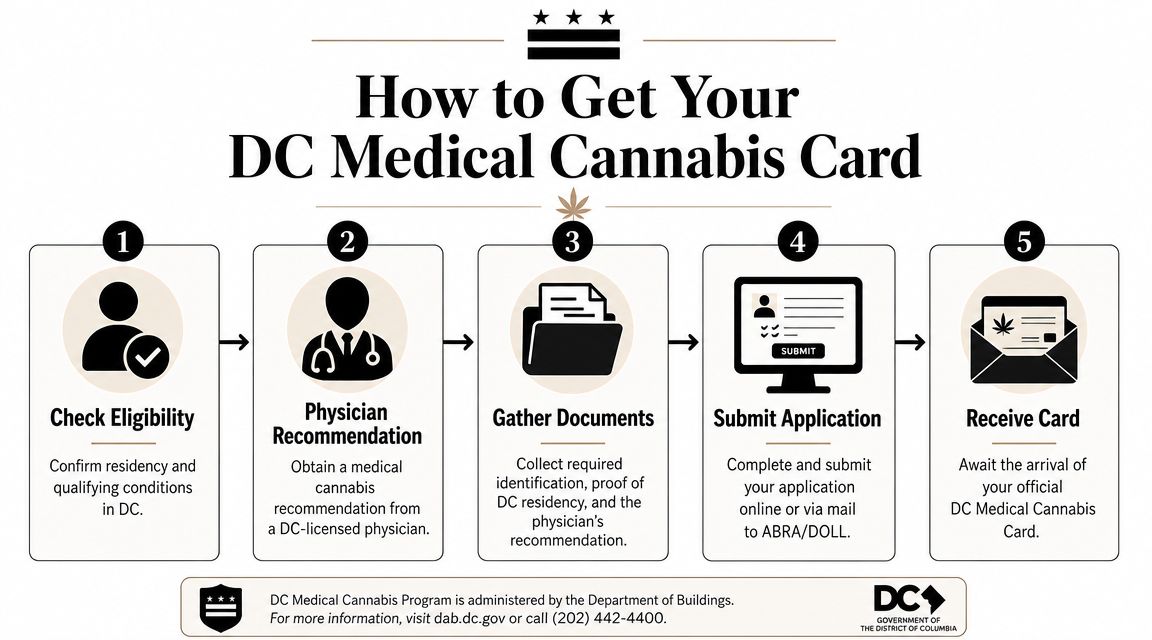
The application path in plain English
This is often overcomplicated. The logic is simple. You need to show who you are, show that you qualify under the District's rules, and submit what the city requires.
The usual process looks like this:
Confirm you're eligible
That means checking whether you can apply as a D.C. patient or through a visitor pathway if that applies to you.Get a physician recommendation
This is the medical piece people often skip over when they're used to recreational markets.Gather your documents
Think government ID, proof connected to your D.C. residency if required for your route, and your provider documentation.Submit the application
The city's medical program handles formal registration through its own process.Wait for approval and card issuance
Once approved, you use that patient status within the regulated medical system.
Where readers usually get confused
A common misunderstanding is thinking a D.C. medical card works like a casual membership. It doesn't. It's a regulated patient credential.
Another point of confusion is residency. Some people assume only long-term D.C. residents can benefit from the system. That's not always true, because the District also recognizes a temporary registration route for certain visiting patients, as noted above.
The medical card route is best for people who want the strongest official footing in D.C., not just the fastest path to getting cannabis today.
When the card path makes the most sense
The official route usually fits you better if any of these sound familiar:
- You use cannabis for a health condition: You'll likely value patient status more than convenience alone.
- You want higher legal limits: The formal program offers more room than everyday adult-use gifting practices.
- You prefer a documented system: Some people want the cleanest legal record of access.
- You visit D.C. with a valid medical card elsewhere: Temporary registration may be the difference between guessing and knowing.
If you only want occasional access in the District, though, the card isn't always the route people use. That's where local reality takes over.
Recreational Access in DC The I-71 Gifting Economy
If you spend any time around D.C. cannabis culture, you'll notice something quickly. A lot of adults aren't talking about medical registration at all. They're talking about gifts, delivery menus, pop-ups, stickers, apparel, artwork, and “free” cannabis attached to another purchase.
That all traces back to Initiative 71.
According to Marijuana Policy Project's summary of D.C. law, Initiative 71 passed with nearly 70% of the vote in November 2014, legalized possession of up to two ounces for adults 21 and older, and allows a person to transfer without payment, but not sell, up to one ounce to another adult. That transfer language is the legal foundation people mean when they talk about the District's gifting economy.
How the gifting model works in real life
The key thing to understand is this: D.C. didn't build a normal recreational retail system around direct adult-use sales in the same way many people expect.
So a workaround culture developed. Businesses offer a non-cannabis item or service, and the cannabis is treated as a gift connected to that transaction. That's why menus and websites can look strange to newcomers. You may think, “Why am I buying a sticker, print, or T-shirt?” The answer is that the visible purchase and the cannabis transfer aren't framed the way a standard dispensary sale would be framed in another state.
This is the local secret visitors often miss. They expect a clean recreational checkout flow. D.C. often operates through compliance language, not obvious retail language.
What makes a service feel more legitimate
Not every operation handles I-71 the same way. Some are careful. Some aren't.
A few signs people generally look for:
- Clear age verification: Adults should expect ID checks, not casual handoffs.
- Professional communication: Real businesses don't usually rely on vague, disappearing messages alone.
- Defined ordering procedures: The safer operators tend to explain what you're ordering and how fulfillment works.
- Consistency: If the menu, ordering process, and delivery terms constantly change, people get cautious.
If you want to understand what compliant operators in the city typically look like, this guide to I-71 compliant shops in DC gives a useful local reference point.
In D.C., the law on paper and the market on the street aren't the same thing. Locals learn to read both.
Why so many people use this path
The answer is convenience.
A tourist in a hotel, a professional staying for a conference, or a local who doesn't need formal patient status often wants practical access, not paperwork. The gifting ecosystem answers that demand. It's usually faster to understand once you've seen it once, but it's extremely confusing the first time because it doesn't resemble a normal dispensary purchase.
That doesn't mean the medical route is pointless. It just means the District has two different realities at the same time: the official one and the common one.
Medical Card vs I-71 Gifting Which Path Is for You
This decision usually gets easier once you stop asking which option is “better” and start asking which one fits your situation.
If you want formal legal status, more structured access, and the benefits that come with recognized patient standing, the D.C. medical route has a clear advantage. If you want convenience and you're an adult navigating the District's everyday access culture, I-71 gifting may feel more natural.
DC Cannabis Access Medical Card vs. I-71 Gifting
| Feature | DC Medical Card | I-71 Gifting / Delivery |
|---|---|---|
| Legal framework | Formal medical cannabis program | Adult-use transfer model built around gifting |
| Who it fits best | Patients, frequent users, visitors with qualifying medical status | Casual users, tourists, adults seeking practical access in D.C. |
| Possession structure | Higher medical allowance within the program | Lower practical transfer limits under I-71 culture |
| Paperwork | Requires application, documentation, and approval | Usually less formal from the customer side |
| Speed | Slower at the start because you need registration | Often faster for immediate access |
| Predictability | More official and easier to explain legally | More dependent on how a specific service operates |
| Visitor appeal | Useful if you already have recognized medical status | Often easier for adults who don't want to enter a patient system |
A simple way to decide
Some readers want a rule of thumb. Here it is.
Choose the medical card if you care most about official status, stronger structure, and using D.C.’s regulated medical system. Choose I-71 gifting if your main priorities are convenience, speed, and staying within the District's well-known adult-use workaround culture.
A few examples make this clearer:
You live in D.C. and use cannabis regularly for symptom relief
The medical path will probably feel worth the effort.You're visiting for a weekend and want a practical local option
You're much more likely to encounter gifting and delivery than a long medical onboarding process.You dislike gray areas
Medical registration is usually the cleaner fit.You already understand D.C. cannabis culture
Gifting may feel familiar and easy to manage.
The hidden tradeoff
People often focus only on access. The core tradeoff is certainty versus ease.
The medical route asks more from you upfront, but you know what system you're in. The gifting route feels lighter and more immediate, but it requires more judgment. You have to evaluate the operator, understand the setting, and stay aware of the line between what D.C. tolerates and what the law explicitly authorizes.
Bottom line: If your cannabis use is part of ongoing care, the card usually earns its keep. If your need is occasional and local to D.C., gifting may be the more realistic path.
Navigating Cannabis in Maryland and Virginia
DMV readers often get tripped up. They assume D.C., Maryland, and Virginia function like neighborhoods inside one shared market. They don't. Crossing from one into another changes what's legal, how you buy, and what “delivery” even means.
Maryland feels the most familiar to new consumers
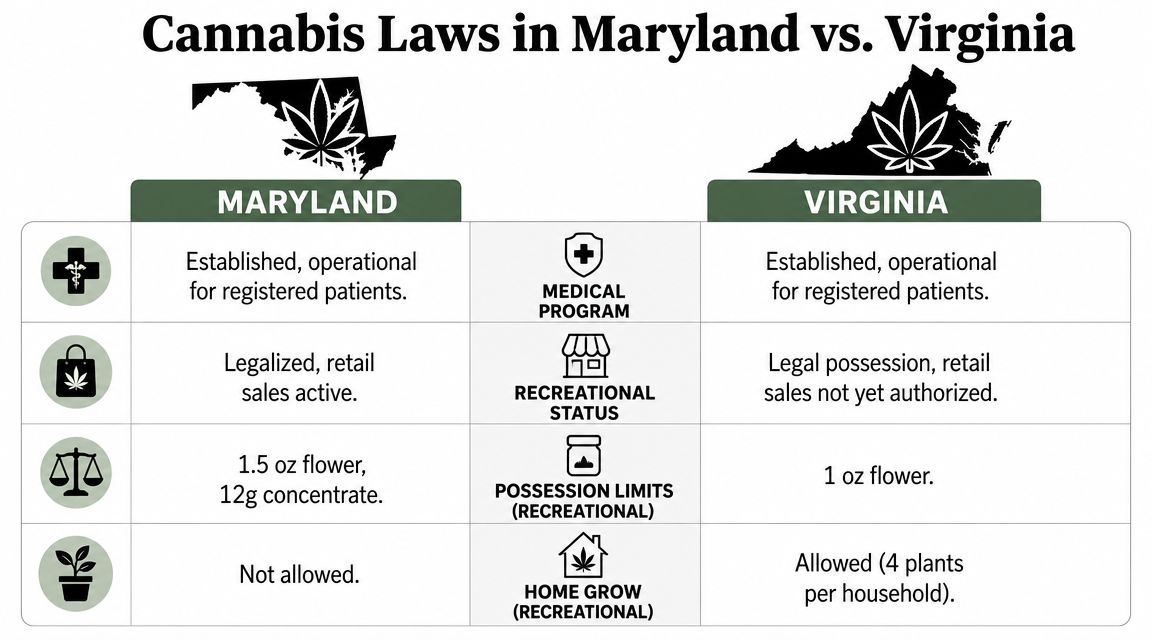
Maryland now operates the closest thing to a standard adult-use retail experience in the region. Adults can walk into licensed stores and buy cannabis in a way that looks much more recognizable to people who've visited legal states with mainstream dispensary systems.
That market came out fast. Maryland's adult-use cannabis market launched on July 1, 2023, and the state reported over $87.4 million in combined medical and recreational sales in the first month alone, according to Maryland cannabis sales data.
For ordinary buyers, the practical takeaway is simple. Maryland is the least confusing jurisdiction in this article if your question is, “Can I legally buy from a store?”
If you're comparing regional access models, this overview of DMV weed delivery options helps show why so many consumers think in metro terms even though the laws remain separate.
Virginia is legal enough to confuse everyone
Virginia is the opposite problem.
Adults can legally possess cannabis under state law, which makes many people assume legal stores must exist too. But possession and retail aren't the same thing. Virginia has become the classic “yes, but not really” cannabis state for DMV residents.
That gap matters most to people who live in Northern Virginia and work in D.C. They may hear that cannabis is legal in Virginia and then discover there's no normal recreational storefront path waiting for them.
The practical split between the two states
Here's the easiest way to keep it straight:
- Maryland gives adults a retail market.
- Virginia gives adults legal possession without a recreational retail system.
- D.C. gives adults a medical program and a separate gifting reality.
That's why one friend tells you to go to a Maryland dispensary, another tells you to use a D.C. delivery service, and a third says Virginia is legal. They're all describing different pieces of a fractured regional map.
The border issue people underestimate
The DMV trains people to think locally. Cannabis law doesn't.
A short drive from D.C. into Maryland or Virginia may feel like nothing in daily life, but legally it matters. Transporting cannabis across jurisdictional lines raises risks that many casual consumers don't think through. The fact that nearby places have legal access in different forms doesn't turn the region into a shared possession or transport zone.
Buy where you are allowed to buy. Possess where you are allowed to possess. Don't assume the Beltway erases legal boundaries.
That one habit avoids a lot of avoidable trouble.
How Safe and Legal Weed Delivery Works With Green Express DC
For many adults in the District, delivery is the form of access that makes the most sense. You browse a menu, choose what you want, confirm your details, and wait for a discreet handoff. But the part people want explained is the legal and safety side. How does that work without feeling sketchy?
The answer starts with understanding where delivery fits. In D.C., delivery usually operates inside the same local logic as the gifting market discussed earlier, not as a standard recreational dispensary shipment.
What the customer experience usually looks like
A careful delivery experience is usually straightforward.
You review the available menu, decide what category fits you best, place the order online or by phone, confirm that you meet the age requirement, and receive your drop-off in a private, direct way. Adults often prefer this because it avoids wandering into an unfamiliar storefront setup or trying to decode local etiquette on the spot.
The better delivery operations also make the process feel organized rather than improvised. They communicate clearly, set expectations, and verify identification at handoff.
What people mean by safe delivery
“Safe” in this context usually means a few things at once:
- You know who you're dealing with: The service has a real menu, real policies, and real communication.
- You know what you're ordering: Clear product categories reduce confusion for new users.
- Your handoff is professional: Couriers verify ID and complete the order without drama.
- Your privacy is respected: Most adults want discretion, especially in apartment buildings, hotels, or busy neighborhoods.
That's why customers often gravitate toward operators that explain their process instead of hiding it. If you want to see a local example of how a structured ordering flow is presented, cannabis delivery in DC shows the kind of customer-facing setup people often look for.
Why Virginia residents pay attention to D.C. delivery
A lot of this demand comes from regional frustration, especially on the Virginia side.
In a 2021 legislative update, Virginia legalized simple possession of up to one ounce of cannabis for adults 21 and over, but legislation to create a retail sales framework was rejected in 2023 and again in 2024, leaving adults able to possess cannabis without state-licensed stores to buy it from, according to NORML's Virginia penalties summary.
That doesn't make D.C. delivery a shortcut around every legal issue. It does explain why so many people in the wider metro area search for practical D.C. access. Virginia's system leaves a real-world gap, and D.C. is the nearest place many people look to fill it.
What to watch for before you order
Not every delivery option deserves your trust.
Use common sense and look for signs that a service takes compliance seriously:
- Age checks matter: If nobody plans to verify your ID, that's a warning sign.
- Ordering should be clear: You shouldn't have to guess what's happening.
- Product information should be organized: Confusion usually points to sloppy operations.
- Communication should stay professional: Fast replies help, but clarity matters more than hype.
For new consumers, delivery can be less stressful than navigating D.C.’s in-person gifting culture. It gives you time to read, compare, and ask questions before anything arrives.
Your DMV Cannabis Questions Answered
Can I use a Washington State medical card in D.C.
Possibly through the visitor framework if your state is among the recognized equivalent programs noted by the District. The important part is that Washington State and Washington, D.C. are separate systems, so don't assume your home-state card automatically functions everywhere the same way.
Do tourists need a D.C. medical card to get cannabis
Not always.
Some tourists use the District's gifting economy because it's the most visible practical option. Others may qualify for temporary medical registration if they already hold valid medical status from a recognized jurisdiction. Which path fits best depends on whether you want formal patient access or ordinary adult-use convenience inside D.C.’s local reality.
Is weed delivery legal everywhere in the DMV
No. That's one of the biggest mistakes people make.
Delivery rules depend on where you are and which legal framework applies there. D.C., Maryland, and Virginia do not share one regional delivery system just because they share roads and commuters.
Can I buy in Maryland and bring it back to D.C. or Virginia
That's a bad assumption to make.
Even when nearby jurisdictions each have some form of legal cannabis access, moving cannabis across borders creates legal exposure. The smart approach is to avoid treating the DMV like one combined possession zone.
Is the D.C. medical card worth it if I'm only an occasional user
Sometimes, but not always.
If you only need occasional access and you're comfortable navigating the District's adult-use culture, you may decide the medical route is more effort than you want. If you value official documentation and structured access, the card may still be worth it.
Why does Virginia still confuse so many people
Because the law answers only half the question.
People hear that possession is legal and naturally assume purchasing must be legal in a normal retail sense too. In practice, Virginia leaves adults with legal possession but without state-licensed recreational stores, which creates constant confusion for residents and visitors.
What's the safest mindset for navigating DMV cannabis laws
Keep your thinking local.
Ask where you are, which framework applies there, whether you're using a medical or adult-use route, and whether any travel across borders is involved. Most cannabis mistakes in the DMV come from people applying one jurisdiction's rules to another.
If you want a practical D.C. option that matches how locals typically obtain their supply, Green Express DC offers a straightforward delivery experience with lab-tested, organic products, discreet service, same-day availability, and professional ID verification at drop-off. It's a convenient fit for adults who want clarity, privacy, and a smoother way to handle cannabis access in the District.