You're standing in front of a cannabis menu in DC, and two products both call themselves organic. One says it in a clean, polished way. The other adds a few extra words about “natural cultivation” and “pesticide-free” but gives you nothing else. If you're trying to order something for delivery in Washington, Maryland, or Virginia, that word alone doesn't tell you much.
That's because organic certification requirements are a formal rulebook, not a vibe. In the USDA system, the claim has to rest on documented land history, approved handling, written plans, and inspections, and in cannabis the familiar USDA seal usually isn't available at all. The result is a lot of marketing language, a lot of confusion, and a real need to know who verified the claim, under what standard, and how current the paperwork is.
Why Organic Claims on a Cannabis Menu Are Harder to Read Than They Look
A DC buyer usually wants a simple answer, not a regulatory lecture. Is the flower certified by someone, or is “organic” just doing marketing work? That question gets even sharper with delivery, because you're often deciding from a phone screen, not standing in a shop with a binder of documents in front of you.
A menu can make two products look similar even when they're built on completely different systems. One might be tied to a named third-party standard with an inspection record and an expiration date. Another might only be using the word organic because it sounds clean, familiar, and premium.
The word itself tells you almost nothing without the verification context. You need to know who verified the claim, against which standard, and how recent the certification is. That matters in cannabis delivery across DC, Maryland, and Virginia, where the supply chain can involve cultivation, packaging, storage, handoff, and final delivery, all of which can affect whether a claim is meaningful.
Practical rule: if a product description uses organic, but doesn't name the standard, the certifier, or the document trail, treat it as a marketing claim until proven otherwise.
Four pieces make the label readable. First, the USDA framework shows what formal organic verification looks like. Second, the day-to-day certification workflow explains how those claims get checked. Third, the timeline and exemption rules show who can and can't rely on the seal. Fourth, cannabis-specific alternatives fill the gap where USDA Organic doesn't fit.
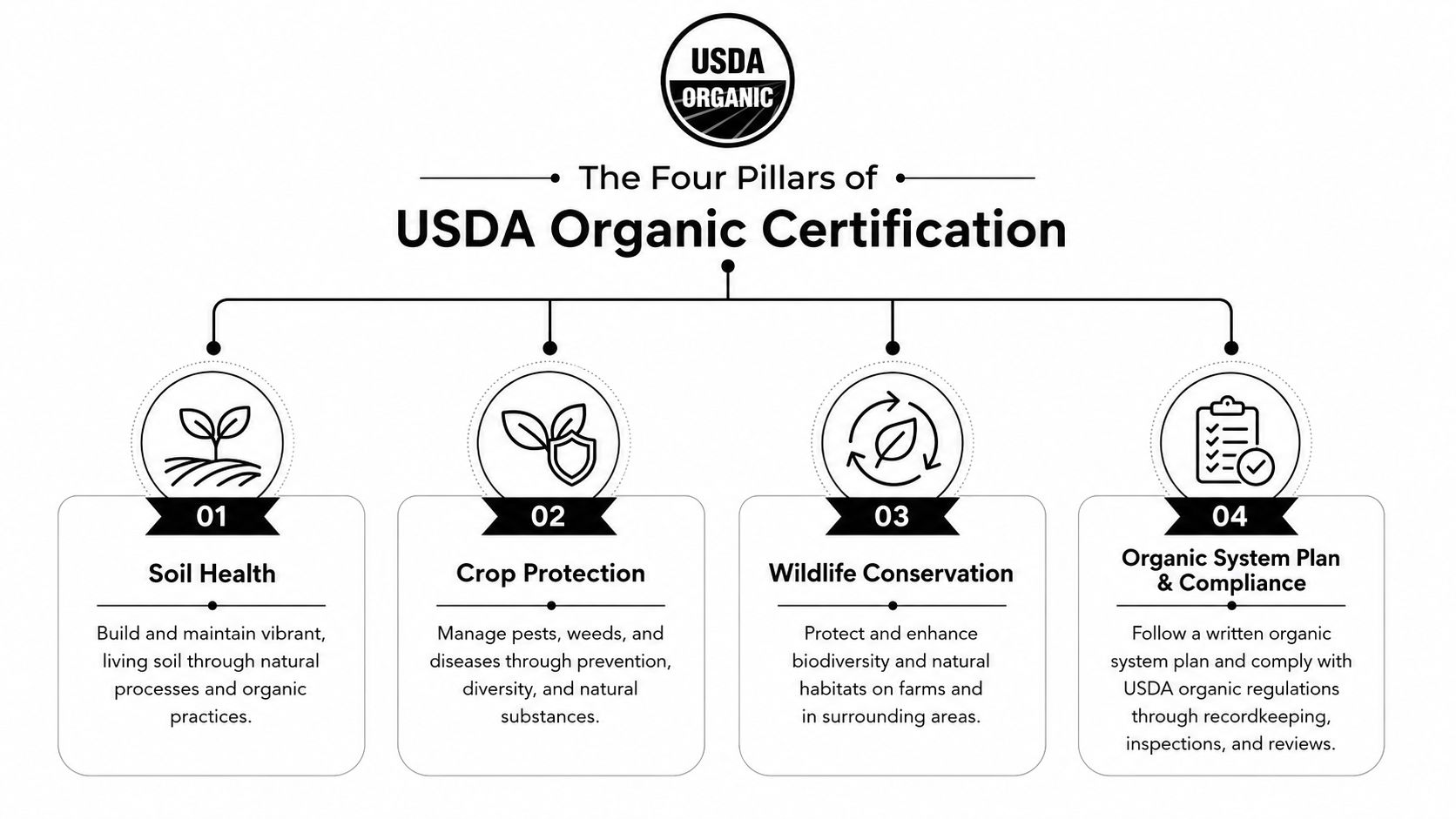
The Four Pillars of USDA Organic Certification
A USDA Organic claim follows a structured checklist from land to package. The label only means something if the operation can show how it protects the soil, controls inputs, avoids prohibited substances, and keeps records that match what inspectors see on the ground. USDA organic standards also require a 3-year transition period, so land must go three years without prohibited substances before the first organic harvest, and certification generally comes from a USDA-accredited certifier (USDA organic standards).
Soil and ecosystem management
The first pillar is the part most consumers picture first. Organic farming centers on soil stewardship, crop rotation, and a broader approach to ecosystem balance. In plain terms, the farm is not only trying to produce a harvest, it is trying to do it in a way that can be checked from one season to the next.
That matters because soil is treated as a living system, not just a place to hold roots. A grower has to show that the practices used support long-term fertility and fit the written organic plan.
Approved inputs
The second pillar is about what can go into the system. Organic certification does not mean anything natural is allowed. Inputs still have to be approved, and the operation has to show that what it used matched the standard. For cannabis buyers, that distinction matters because “organic sounding” and “certified organic” are completely different claims. A clear product-quality process, like the one described in the product quality assurance checklist, helps show how those claims should be documented rather than assumed.
This is the part that can confuse shoppers. A clean-looking ingredient list or a nature-themed brand name does not prove compliance. The claim has to rest on a documented system, not just on packaging language.
Prohibited substances
The third pillar is the bright line consumers usually care about most. USDA organic rules prohibit synthetic pesticides, sewage sludge, irradiation, and genetically modified organisms as intentional parts of the production system. That is why the input rules are much stricter than many people expect.
In practice, this means the operation has to avoid shortcuts that would weaken the organic claim. If a substance is prohibited, it cannot be treated like a casual exception.
Organic System Plan
The fourth pillar is the paperwork backbone. The Organic System Plan (OSP) is the written playbook for the operation, and it explains how the farm or handler keeps everything consistent. USDA treats that plan as central to certification because inspectors need something concrete to compare with actual practice.
For cannabis readers, the key point is structural. These rules were written for food and fiber systems, not for cannabis products moving through dispensary-style channels. That mismatch is why the familiar seal does not map neatly onto most cannabis menus.
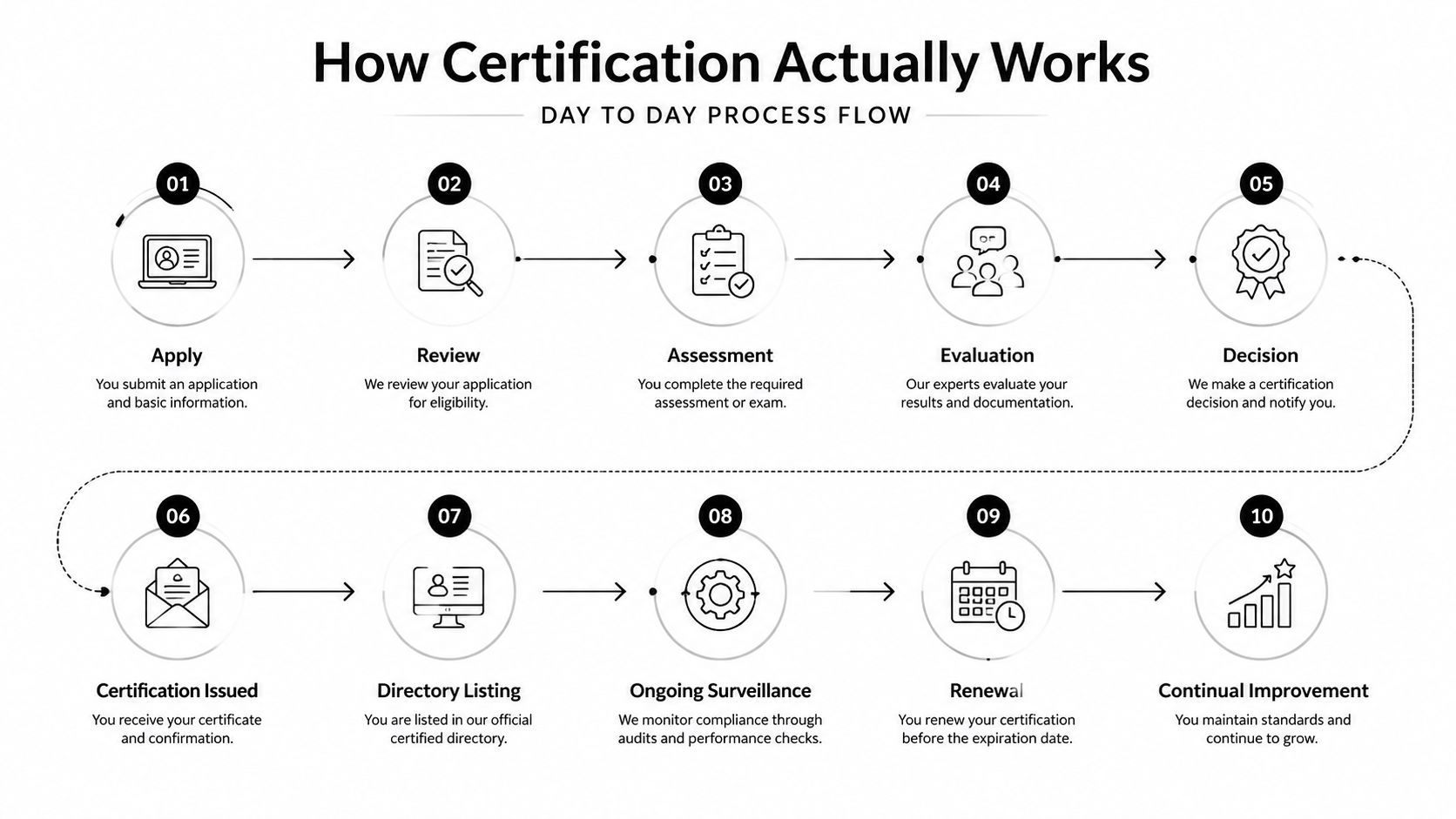
How Certification Works Day to Day
Certification starts with paperwork, then moves into review, inspection, and renewal. A business applies to a USDA-accredited certifying agent, submits its Organic System Plan, hosts an on-site inspection, and waits for the certifier to compare the application, the inspection report, and the records before a certificate is issued (USDA becoming certified). The process does not end there. Certification is renewed annually, with updated OSP information, another annual inspection, and another certification fee.
The inspection is the part that keeps the system honest. It is the point where the written plan meets the actual operation. If the OSP says one thing and the records show another, the mismatch can put the claim at risk.
What handlers and processors have to control
The rules do not stop at cultivation. For handlers and processors, compliance reaches into labeling, ingredient approval, and recordkeeping. The USDA organic standards require records to be kept for at least 5 years, which shows how seriously the system treats traceability.
That traceability has practical consequences. Organic ingredients and non-organic ingredients must stay separate, and procedures have to prevent commingling or misidentification. The Organic Trade Association also notes that even exempt operations still have to follow recordkeeping and contamination-prevention rules, along with labeling requirements (Organic certification and integrity standards).
For a delivery business, the claim does not live only at the grow site. It follows the product through packaging, storage, and the final handoff. If a menu item says organic, the business should be able to show where the claim came from and how the product stayed separated.
A clean label starts with clean custody. If the documents do not follow the product, the claim gets shaky fast.
If you want a practical way to think about the paperwork side, look at it the way you would review any quality file, not a marketing page. A useful example is a product quality assurance process that tracks how records, handling, and verification fit together.
Timelines, Costs, and the Small-Operator Exemption
Organic certification starts with timing, before it ever becomes a label issue. Under the USDA framework, land usually has to pass through a 3-year transition period before the first organic harvest. For a grower, that means the clock starts long before any organic claim can appear on a menu or package, and the business plan has to account for that gap from the beginning.
There is also a small-operator exemption built into the system. Businesses with less than $5,000 in annual organic sales are exempt from certification, but they may not use the USDA Organic seal. That rule helps explain why a very small producer might talk about organic practices in a limited way, yet still not be able to present the product as USDA certified.
| Stage | Duration | Typical cost | Required records |
|---|---|---|---|
| Land transition | 3 years before the first organic harvest | Not stated in the verified data | Land-use history, input history |
| Initial certification | On-site review plus application review | Not stated in the verified data | Organic System Plan, inspection records |
| Annual renewal | Every year | Certification fee required to maintain status | Updated OSP, annual inspection records |
| Small-operator exemption | Applies below $5,000 in annual organic sales | Certification not required | Still needs compliant handling and labeling records |
The table shows why paperwork matters even for small operations. Certification is not only about how carefully something was grown. It is also about whether the business can show that care in a paper trail an auditor can follow, the same way a delivery log lets someone trace where a product moved and who handled it.
That recordkeeping burden becomes easier to understand if you compare it to other compliance work. A business can have clean growing practices and still fall short if the documents are incomplete, inconsistent, or hard to verify. For a practical example of how records and verification fit together in a regulated setting, see this overview of legal compliance issues in cannabis delivery.
For cannabis delivery in legal markets, the pressure point is simple. Many operators will be too large to rely on the small-operator exemption, yet that does not mean a USDA organic claim is available to them in the same way it is for food products. The paperwork may be solid, but the label still depends on the rules that apply to the product itself.
Why USDA Organic Does Not Apply to Cannabis and What Fills the Gap
Here's the hard truth. USDA Organic does not function as a federal cannabis certification system, so the familiar green-and-white seal is not the standard most cannabis consumers will see. That's why a DC menu can say “organic” in a loose way while still not connecting to the USDA framework at all.
What replaces it is a patchwork. Some operators use third-party industry standards such as Clean Green Certification or Certified Kind, and some rely on state-level programs or state licensing systems that cover cultivation, testing, and handling in different ways. In Maryland, Virginia, and DC, the local licensing structure matters because it controls who can grow, process, store, and deliver, even when the product is described as organic in marketing language.
The useful comparison is not “USDA versus nothing.” It's USDA versus cannabis-specific verification. USDA organic is built around land history, approved inputs, inspection, and traceability. Cannabis standards typically focus more on inputs, lab testing, facility audits, and chain-of-custody controls. Those are related ideas, but they're not identical.
That difference matters for delivery. USDA says certification is generally required for anyone who produces or handles organic agricultural products, but there are low-risk exemptions, including retailers selling direct to consumers without processing, operations that only receive, store, or prepare sealed or retail-labeled organic goods, and buyers or sellers who don't otherwise handle the products (USDA need to be certified). The word handle is where confusion starts, because it can include selling, processing, or packaging. For a DC delivery brand, the line between pure delivery and handling activity can be thinner than people expect.
If you're looking for the compliance angle in more detail, a useful overview is legal compliance issues, because delivery businesses often need to think about labeling and custody together, not separately.
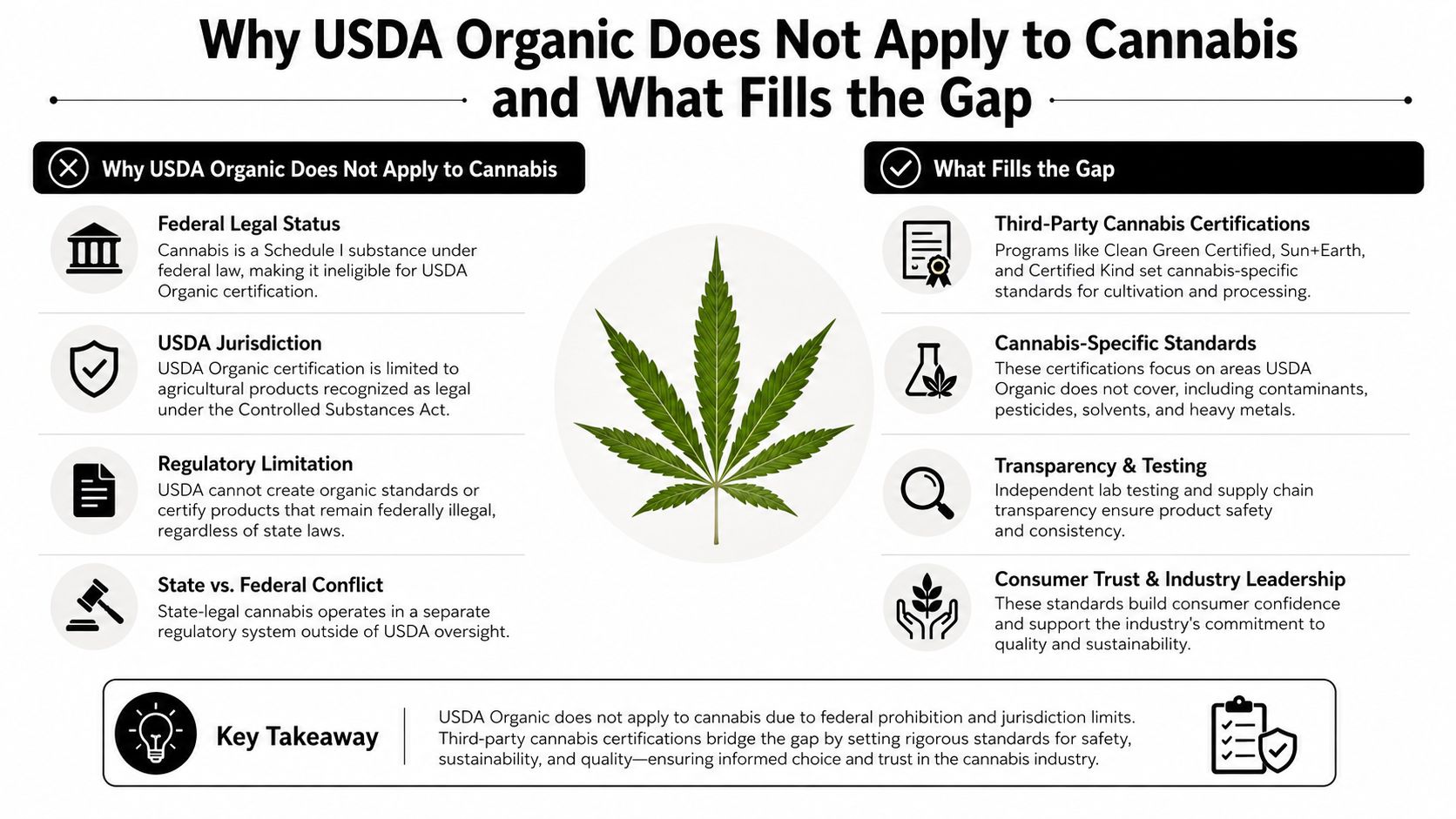
The consumer takeaway is simple. In cannabis, organic often means “claims to follow a verification standard,” not “certified under USDA Organic.” If the menu doesn't name the standard, the claim is incomplete.
How to Verify an Organic Claim on a DC, Maryland, or Virginia Delivery Menu
Start with the fastest question, who certified this? If the answer is vague, the claim is weak. A real verification trail should identify the third-party standard, the certifying body, and the certificate expiration date, plus whether the certificate covers the growing site, the handling site, or both.
A second question helps separate marketing from documentation. Ask whether the business can show the product's certificate of analysis and whether the lab results line up with the organic claim. For buyers, pesticide-panel results are often the easiest independent signal to read because they give you an outside look at what was found in the sample.
Practical rule: if the product is called organic but nobody can point to a named certifier and current paperwork, treat the claim like an unverified promise.
A quick checklist makes the process easier at drop-off or before ordering online:
- Ask for the standard name: Find out whether the product is tied to USDA, a private certification, or a state-specific system.
- Check the certificate date: A stale certificate is not the same as a current one.
- Match the product to the site: Cultivation, handling, and retail activity may be covered differently.
- Read the COA: Confirm that the lab record is for the batch being sold.
- Watch for vague wording: “Naturally grown” and “pesticide-free” are not the same as a verified organic claim.
- Look for the certifier's name: No certifier usually means no serious verification trail.
If you want to go deeper on lab documentation, a heavy metal analysis guide is a useful companion, because organic language alone doesn't tell you whether a product has been tested across the full quality spectrum.
The biggest red flag is simple. If the menu uses a premium-sounding term but refuses to name the standard, the claim is doing more branding than proof.
FAQ on Organic Certification and Cannabis Delivery
Can a delivery service in DC, Maryland, or Virginia use the word organic on a menu? Yes, but the word should be backed by a real verification standard, not just styling. If you can't see the certifier, the certificate, or the scope of coverage, ask before ordering.
How does the $5,000 small-operator exemption work for a cannabis brand with multiple locations? The exemption in the USDA system applies to annual organic sales at the operation level, but it doesn't create a free pass for unclear labeling. If the brand is handling cannabis products for delivery, it still needs a clean record trail and honest wording.
What label words usually signal an unregulated claim? Phrases like “natural,” “naturally grown,” or “pesticide-free” can sound reassuring without proving certification. A verified claim names the standard and the certifier.
What should you do if the driver can't produce verification? Don't guess. Ask for the certificate in writing, check the menu for the certifier's name, and skip the order if the claim stays vague.
Bringing It All Together for Your Next Delivery Order
For your next delivery order, treat organic as a spectrum of verification rather than a simple checkbox. The strongest signal is a named third-party standard paired with a current certificate. A weaker signal is a product with transparent sourcing and lab documentation that you can review.
That framing matters in DC, Maryland, and Virginia. On a cannabis menu, the word organic can sound reassuring even when it is doing very little on its own. Once you know what to ask for, the listing becomes easier to read, and you can separate a real certification trail from a marketing phrase.
If you are comparing products, look first for the standard, then for the certifier, then for the paperwork behind the claim. If those pieces are missing, ask for them before you place the order. A clear answer is useful. A vague answer is usually a warning sign.
If you're looking for a place to start, Green Express DC offers a curated cannabis delivery menu for adults in the District, with lab-tested products and clear ordering support. Visit Green Express DC to browse products, then ask the courier what documentation supports any organic-style claim at drop-off.