
You can have a clean menu, a polished website, and a courier who sounds professional on the phone, then still feel a little uncertain when the bag lands at your door. That hesitation is normal. In a regulated cannabis delivery market, product quality assurance is what closes that gap between trust and proof.
For a dispensary partner in the DC region, quality isn't a single lab report or a nice-looking seal on the jar. It's a system that starts before inventory is accepted, continues through storage and packaging, and stays active until the courier checks an ID at the door. If any part of that chain breaks, the customer feels it immediately, and the business owns the risk.
Why Product Quality Assurance Matters When Cannabis Comes to Your Door
A delivery handoff is where quality stops being abstract. The customer is standing there, watching a sealed package move from courier to doorstep, and the only thing backing up the product is the chain behind it. If that chain is weak, even a reputable supplier can't save the order.
The real job of quality at delivery
Product quality assurance is the system that prevents avoidable problems before they reach the customer. In cannabis delivery, that means checking what enters inventory, how it's stored, how it's packed, what the courier carries, and how the product is verified at the door. A trustworthy source helps, but it doesn't replace local controls, because the product can still be mishandled after intake.
That's the practical difference many overlook. A flower jar can leave a compliant supply chain and still arrive compromised if it sat in the wrong conditions, got relabeled badly, or went out with the wrong batch record. Delivery makes QA a live operational discipline, not a back-office concept.
Practical rule: if the service can't explain how it protects quality between intake and drop-off, it's relying on luck, not control.
The old inspection-only mindset doesn't work well here. Once a product has left the counter, recall gets harder, errors get costlier, and customer trust gets thinner. That's why a serious delivery operation builds checks at every handoff instead of hoping the final supplier was careful enough.
QA, QC, and SQC Explained Without the Jargon
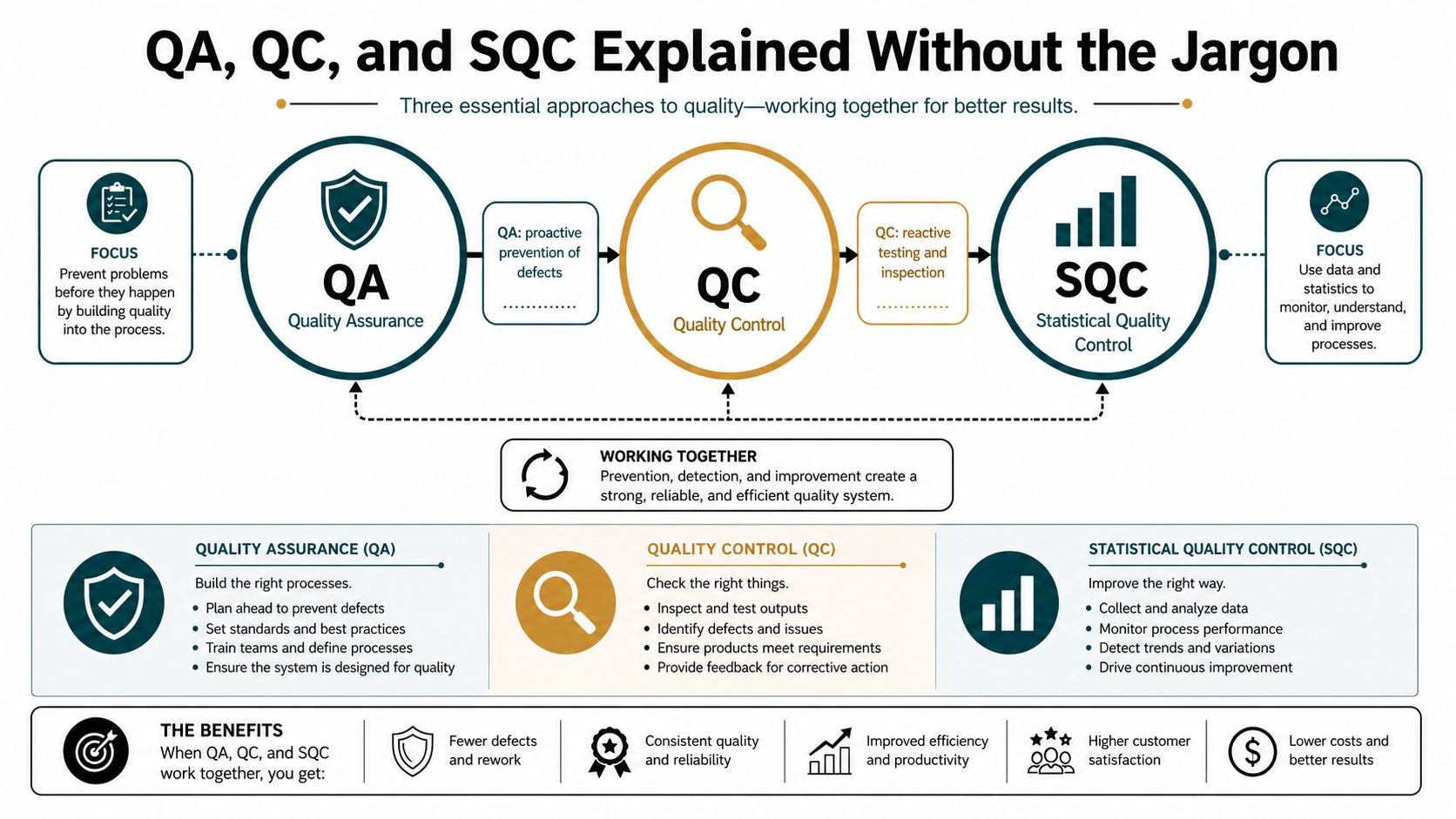
People often use QA and QC like they mean the same thing, but they don't. Quality assurance is the preventive system, quality control is the checking activity, and statistical quality control uses data to watch the process over time. In delivery operations, all three matter because each one catches a different kind of failure.
The kitchen analogy that actually works
Think of a coffee shop. QA is the recipe, the training, the cleaning routine, and the equipment standard that keep drinks consistent. QC is the barista tasting a pull, checking the milk temp, or redoing a drink before it goes out. SQC is the shop owner using patterns in orders and defects to spot when a machine is drifting before customers start complaining.
That same logic maps cleanly to cannabis delivery. QA defines how inventory is received, labeled, stored, and dispatched. QC checks the actual product, packaging, and paperwork. SQC looks for patterns, which is where Walter A. Shewhart's 1924 control chart matters, because it became the statistical basis for modern Statistical Quality Control and shifted quality work from end-of-line inspection toward process control EBSCO on Shewhart and control charts.
How each one shows up in a delivery business
- QA keeps defects out. That includes receiving rules, training, packaging specs, and storage conditions.
- QC catches defects before dispatch. That means checking labels, seals, weight, and batch match.
- SQC tracks variation. If a problem keeps appearing in one category, one shift, or one supplier stream, the process itself needs attention.
The useful test: if a task happens before the defect exists, it's QA. If it catches a defect after it exists, it's QC. If it reveals a pattern, it's SQC.
A delivery partner doesn't need the jargon, but it does need the distinction. Without QA, the team is always reacting. Without QC, the team has no checkpoint before the bag leaves. Without SQC, the same mistakes keep coming back in slightly different forms.
DC, Maryland, and Virginia Compared for Cannabis Delivery Quality
A delivery route can look clean on paper and still break at the border. In the DC region, product quality assurance has to work across three different legal systems, and each one changes what a courier can carry, how an order is checked, and what proof should be visible at the door.
What changes across the border
Washington, DC has unusually specific medical-cannabis courier rules. Under the city's 2022 framework, a medical cannabis courier license requires an existing DC medical cannabis retailer license, delivery must be vehicle-based, a vehicle can't carry more than 1 pound of cannabis or cannabis products at one time, tracking procedures are required for every delivery, and the courier must display a DC Medical Cannabis Program identification badge during delivery operations DC courier framework summary. Those are QA requirements as much as licensing requirements, because they determine what can physically move through the system.
Maryland works from a different pressure point. Adults 21 and older may possess up to 1.5 ounces of cannabis, 12 grams of concentrated cannabis, or products containing up to 750 mg of THC, and they may cultivate up to two plants per household under state law Maryland possession and home-grow thresholds. That does not create DC-style courier rules, but it still shapes the product mix, the size of orders, and the way a delivery business thinks about packaging and inventory control. A partner serving Maryland buyers has to plan for a broader range of consumer expectations, even when the legal delivery mechanics are different.
Virginia narrows the path again. Adults 21 and older may possess up to 1 ounce of marijuana in public and transfer up to 1 ounce to another adult without remuneration, while licensed medical-cannabis businesses operate under state oversight and may sell only to registered patients and their registered agents Virginia legal framework. For delivery operators, that means the lawful route for adult-use retail does not mirror DC or Maryland, and the QA checklist has to reflect that split instead of assuming one regional standard.
| Jurisdiction | Delivery Status | QA-Relevant Rule | Source |
|---|---|---|---|
| DC | Medical courier delivery is tightly licensed | Courier must already be a DC medical cannabis retailer licensee, use vehicle delivery, keep to a 1 pound vehicle limit, track each delivery, and show a medical program badge | DC courier framework summary |
| Maryland | Adult-use delivery demand is shaped by possession rules | Adults 21+ may possess up to 1.5 ounces, 12 grams of concentrates, or products up to 750 mg THC, with up to two plants per household | Maryland possession and home-grow thresholds |
| Virginia | Medical sales are licensed, adult-use retail is narrower | Adults 21+ may possess up to 1 ounce and transfer up to 1 ounce without payment, while medical businesses sell only to registered patients and agents | Virginia legal framework |
The larger operational issue is federal geography. Cannabis remains federally illegal, and that matters most in the capital region, where federal enforcement operates alongside state and local rules inside each authorized system federal enforcement geography. A delivery business that treats the area as one market will miss the point. The safer approach is to build one SOP for DC courier constraints, another for Maryland customer demand and packaging discipline, and another for Virginia's narrower legal path. That is how quality stays intact at the door instead of falling apart at the boundary.
Lab Testing and Certificates of Analysis Explained
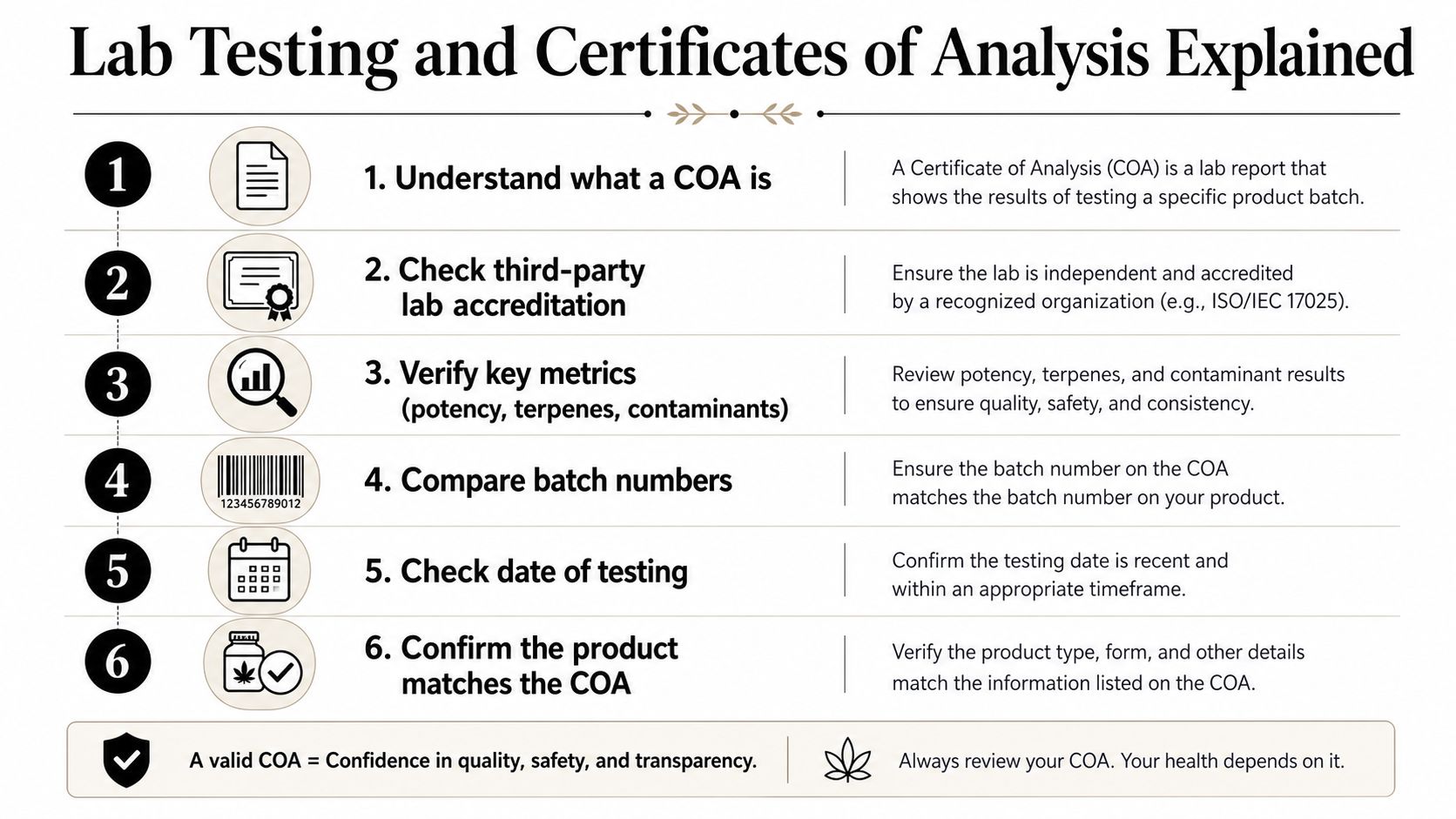
A Certificate of Analysis, or COA, is the document that turns “this product was tested” into something a buyer can verify. If you know how to read it, you can spot whether a product matches its batch, whether the claimed potency looks plausible, and whether the testing covers the risks that matter. If you don't, the paper becomes decoration.
What a COA is really telling you
At a minimum, a COA should connect a product to a specific batch and show what the lab found. The most useful parts are the cannabinoid panel and the contaminant results, because those tell you what's in the product and what shouldn't be there. A nutrition label is useful, but a COA is more like a nutrition label with a magnifying glass.
When a buyer reviews a COA, three checks matter most. First, the batch number on the product should match the batch number on the report. Second, the testing date should make sense for the product's shelf life and handling history. Third, the lab results should cover the product's relevant risks, which can include contaminants and potency claims.
You'll also see why third-party labs matter. Their role is to evaluate the sample independently rather than letting the seller grade its own product. That separation is the heart of credible quality documentation.
Customer rule of thumb: if the menu claims a batch was tested but the batch number on the package doesn't line up, stop there and ask questions.
For a deeper look at one contaminant topic, see heavy metal analysis in cannabis testing. Heavy metals are only one part of the full QA picture, but they're a good reminder that a product can look fine and still fail on a hidden risk.
Reading the report without getting lost
A buyer doesn't need to become a lab analyst. The job is narrower than that.
- Check identity first. Make sure the product name, strain, and batch line up with the report.
- Look at potency second. The cannabinoid numbers should match the kind of product you're buying.
- Scan for contaminant coverage. The report should show the safety checks relevant to that item.
If the report is vague, outdated, or missing the batch connection, treat that as a quality failure, not a paperwork nuisance. A strong QA system makes the COA easy to match to the product, because the document should be a control, not a scavenger hunt.
Handling, Packaging, and Storage SOPs That Protect Quality
A good delivery order can still go sideways in the back room. That's why the work between intake and dispatch matters so much. The product is vulnerable to labeling errors, mix-ups, moisture problems, unnecessary handling, and sloppy storage before anyone ever sees the driver.
The path from receiving to dispatch
The process should start with receiving and inspection. Staff compare the incoming shipment against the purchase record, verify the lot or batch details, and confirm that the product condition matches what was expected. Then the team verifies the product against the COA, because a batch that can't be matched cleanly shouldn't move into active fulfillment.
After that comes labeling and recordkeeping. Every unit needs a clear batch reference, and every movement should be traceable so the team can tell what came in, where it sat, and where it went. FIFO rotation matters here, because older inventory should move before newer inventory when the product type calls for it.
Storage is the part customers never see, but it makes a huge difference. Controlled storage protects flower, concentrates, and edibles in different ways, and child-resistant, odor-conscious packaging helps preserve privacy and reduce unnecessary exposure during transit. The point isn't theater, it's preserving the state of the product until it reaches the customer.
For a practical look at contamination controls, visit contamination prevention practices. That topic belongs inside handling SOPs, not as an afterthought.
Operational standard: if a team can't explain where a batch sat, who touched it, and how it was sealed before dispatch, the SOP isn't mature enough.
The final dispatch step should use tamper-evident packaging and a clean handoff log. A customer should be able to see that the product wasn't opened, swapped, or casually repacked on the way out. That's the physical proof of quality discipline.
A short video example can help staff visualize the flow.
Chain of Custody and Courier Verification at the Door
A delivery order has two lives, one in inventory and one in transit. The fragile point is the handoff between them, because that is where a sealed package turns into a personal transfer and every small mistake starts to matter. If the chain of custody is weak, the customer sees it at the door, not in the warehouse.
What a clean handoff looks like
The courier should leave with a sealed, traceable bag and a clear manifest or order record. That record should match the inventory pull, and the sealed transport bag should stay intact until the customer is verified. The handoff is a controlled release from one accountable system to another, much like a checkpoint in a regulated delivery route where every transfer has to line up with the paper trail.
At the door, the courier checks the customer's ID and confirms the order details before release. In DC medical delivery, the courier also has to display the required Medical Cannabis Program identification badge during delivery operations, which gives the customer a concrete sign that the person at the door is authorized under the local system DC courier framework summary. That badge check belongs inside the quality process, because it shows the courier is operating under the same controls the warehouse used when the order was packed.
A healthy chain of custody also depends on tracking. If the operator cannot tell where the order was, who handled it, and when it changed hands, the business cannot defend the quality of the delivery. QA and compliance meet most visibly at that point, because the door is where the paperwork and the physical package have to agree.
Green Express DC's delivery service process points to the same principle by making the final handoff visible to the customer. A simple example helps. A customer opens the door, the courier confirms the name, checks the ID, shows the delivery badge, and removes a sealed package from a marked transport bag. The order matches the receipt, the packaging looks untouched, and the customer can ask questions before signing off. That is the kind of handoff that builds confidence because it lets the customer verify the product at the point of release.
How Green Express DC Applies Product Quality Assurance
Green Express DC makes its quality system visible in a few concrete ways. Its menu covers flower, concentrates, vapes, edibles, and tinctures, which matters because each category needs different handling and storage attention. The business also describes its products as lab-tested and 100% organic, and it uses discreet packaging with same-day logistics to reduce unnecessary handling time, which is a real quality control advantage in delivery.
Where the quality signals show up
The site's operational model is built around verifiable touchpoints. Customers see category-based menus, order-flow simplicity, and a delivery process that includes government ID verification at drop-off. That's not just customer service language, it's a quality discipline because it reduces ambiguity at the last mile.
Pricing transparency matters too. Green Express DC advertises rotating specials like $150 for 10g of shatter or crumble, multi-gram disposable bundles, and seasonal 420 deals, along with a clear FAQ and cash-on-delivery structure. When pricing rules are visible, there's less incentive to substitute product or blur what's in the order, which is a genuine quality risk in a fast-moving delivery business Green Express DC delivery service.
The menu structure also signals how the operation thinks about consistency. Flower, concentrates, vapes, edibles, and tinctures are not interchangeable inventory, so a business that separates them clearly is showing some process maturity. That matters in regulated delivery, where packaging, handling, and verification all need to fit the product, not fight it.
Why this matters: quality isn't only what a product is made of, it's how clearly the business can prove what it is, where it came from, and how it got to the customer.
Green Express DC fits the model of a delivery operator that treats product condition, order clarity, and drop-off verification as part of the same system. That's the standard buyers should expect from any compliant service in the region.
Customer-Side Verification and Common Delivery Questions
Customers don't have to guess whether a delivery is handled well. A few checks at the door can tell you a lot about the operation behind it. If the business is serious, those checks will feel normal, not awkward.
A quick checklist to use at delivery
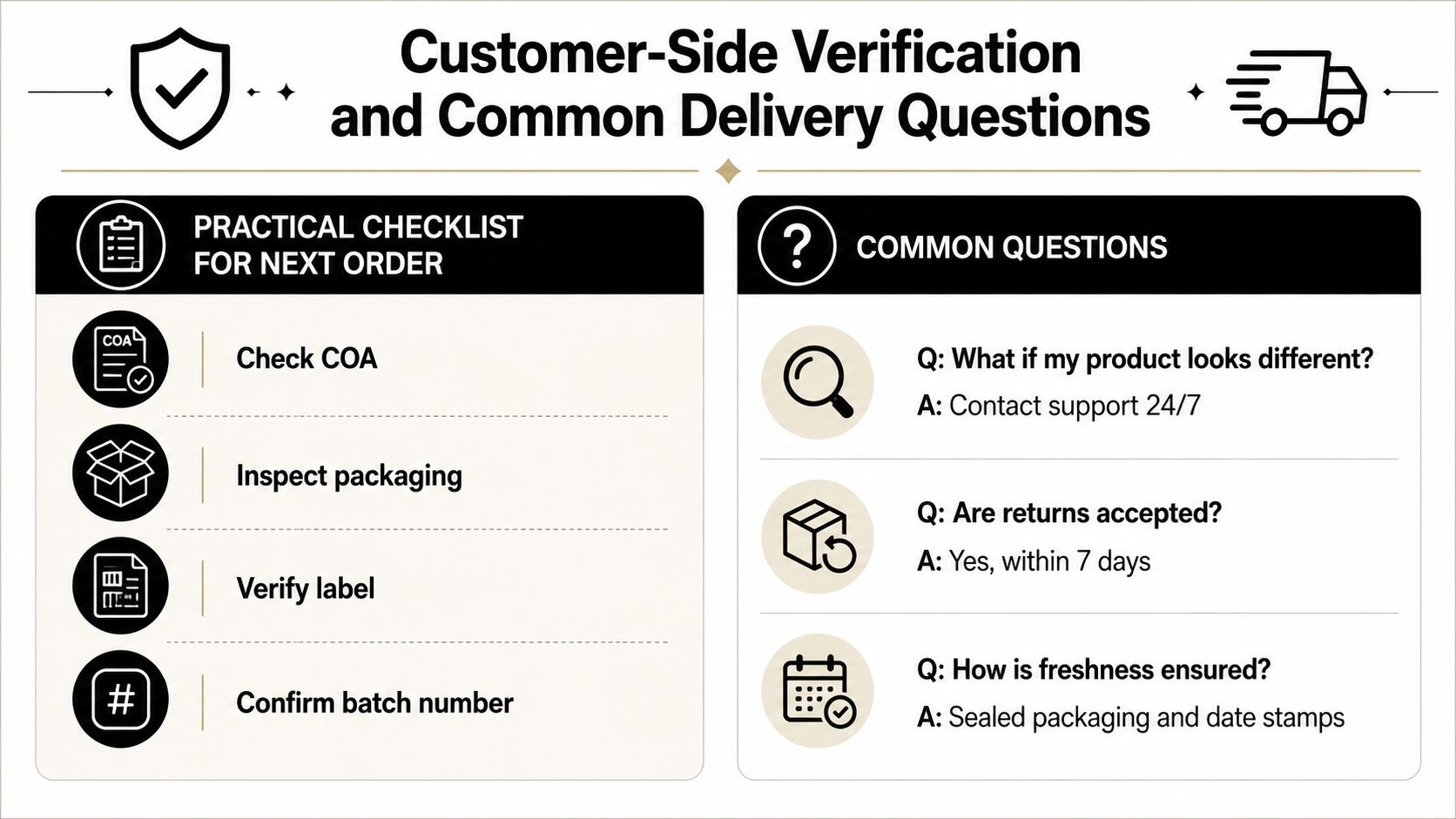
- Check the COA. Match the product to the batch and testing record before you accept it.
- Inspect the packaging. Look for intact seals and packaging that hasn't been tampered with.
- Verify the label. The item name and batch detail should match what you ordered.
- Confirm the batch number. If the package and the report don't line up, pause the handoff.
Questions people ask when something feels off
If the product looks different than expected, contact support right away and don't assume it's fine. If freshness is a concern, sealed packaging and date stamps should help you judge whether the product has been handled properly. If the service says it accepts returns or complaints, that policy should be clear before you order, because quality problems are easier to resolve when the business has a defined process.
The key question is not whether a mistake can ever happen. It can. The true test is whether the business has a clean way to identify the problem, document it, and make the customer whole without forcing them to fight for basic accountability.
A customer who checks the COA, packaging, label, and batch number is doing their part in the quality system. That kind of shared verification is how regulated delivery stays trustworthy.
If you want a delivery partner that treats verification, packaging, and customer handoff as part of one controlled process, visit Green Express DC and review how its menu, delivery flow, and order policies fit the quality standards discussed here. When you're choosing a service in DC, ask the same questions you'd ask any regulated operator, then compare the answers against what shows up at your door.