Shipping marijuana is illegal under federal law because it remains a Schedule I controlled substance, and any interstate shipment is treated as a federal offense. That's true even if both states involved have legalized cannabis, which is why a package that seems harmless in local conversation can still create serious legal risk.
That answer is the part many want first, especially if they're sitting in Washington, DC with legal cannabis and thinking about a friend in Maryland or Virginia. The confusion is real because local rules often make possession, gifting, or delivery feel normal inside one jurisdiction, while federal law draws a hard line the moment cannabis crosses a state border or enters the mail system.
Why Sending Weed Across State Lines Confuses Everyone
A lot of people in DC hit the same mental snag. You've got legal cannabis in front of you, your friend in Maryland wants a package, and the whole thing feels no more complicated than mailing snacks or headphones. Then you hear that shipping weed is illegal, and the question becomes, legal where, exactly?
That confusion makes sense because cannabis law in this region works like two different rulebooks sitting on top of each other. One rulebook is local, so DC, Maryland, and Virginia each have their own limits and delivery realities. The other rulebook is federal, and it doesn't bend just because the sender and recipient live in places that allow some cannabis use.
The mailbox is not the same as a local handoff
If you hand cannabis to another adult in a place where local law allows that kind of transfer, you're dealing with one set of rules. If you put the same item in the mail, you've crossed into a very different legal lane. The federal system treats that as shipment, not casual sharing.
Practical rule: if the package is marijuana, the mail is the wrong vehicle, even when both ends of the trip are in legal-cannabis states.
That's the part people miss. They assume state legalization travels with the product, but federal shipping law doesn't work that way. The result is a legal maze where a lawful local purchase can still become an unlawful interstate shipment the moment someone tries to “send it over.”
For DC residents, that difference matters even more because the District's cannabis culture is built around local access, not interstate transport. Maryland and Virginia add their own twists, so readers often mix up possession rights with shipping rights. Those are not the same thing, and treating them like they are is where most mistakes start.
Federal Law Clashes With State Cannabis Rules
The federal government still treats marijuana as Schedule I under the Controlled Substances Act. That status is the backbone of the shipping ban, because federal law controls the mail and interstate transport, even when a state has created its own legal cannabis system. In plain English, a state can relax local possession or retail rules, but it can't rewrite federal shipping law.
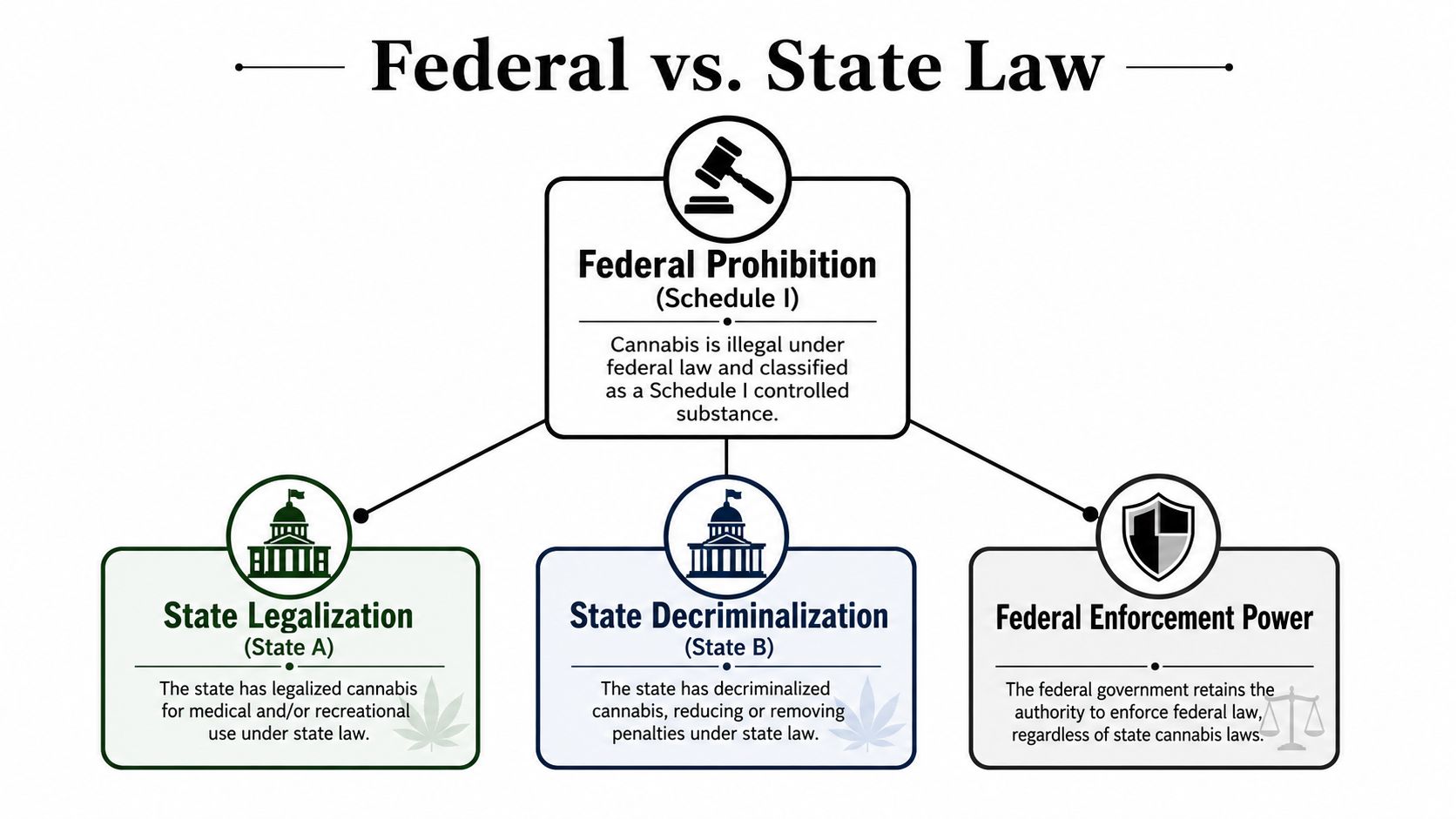
A building with different floors of authority illustrates the situation. State law may open a door on one floor, but federal law sits above it with the master key when the issue is mail or interstate commerce. That's why legal state possession doesn't automatically create legal shipping.
Why USPS cannot treat cannabis like ordinary mail
USPS is a federal agency, so it has to follow federal law. Multiple legal summaries state that any amount of marijuana is illegal to mail under federal law Rossen Law Firm. That means the question isn't whether the sender is careful, discreet, or sending a tiny amount. The core issue is what the item legally is.
The distinction matters because federal law doesn't ask whether the product is “for personal use” or “for a friend.” If it's marijuana, it's still marijuana in the eyes of federal shipping rules. That's why the interstate part is so important. Once a package moves across state lines, the federal interest is no longer theoretical.
A state can legalize possession within its borders. It can't make the postal system ignore federal drug law.
For DC readers, that hierarchy explains why local convenience doesn't equal shipping permission. It also explains why people often get tripped up by legal language that sounds broad at the local level but collapses when shipping enters the picture. The safest way to think about it is simple. If federal law controls the channel, state legalization alone won't save the shipment.
Carrier Policies Block Cannabis Shipments
Carrier policies follow federal law, not local approval, so the shipping rules stay strict even when a product is legal somewhere else. The dividing line is the 0.3% delta-9 THC threshold in the hemp framework. Products at or below that level can move only under specific conditions, while marijuana-derived products above it are not mailable. That is why the first question is usually about classification, not packaging, labels, or how discreet the parcel looks.
UPS makes the point plainly. It prohibits shipment of marijuana under any circumstances, including medicinal use and use that is legal under state law. A different carrier does not solve the problem. The issue follows the federal classification of the product, so a private shipping company cannot turn marijuana into a lawful parcel just by accepting it.
Carrier and THC Threshold Rules
| Product Type | Carrier Stance | Federal Classification |
|---|---|---|
| Marijuana flower or edibles | Not mailable through USPS or private carriers for interstate shipment | Prohibited marijuana |
| Marijuana-derived THC products | Not lawfully shippable across state lines | Prohibited marijuana |
| Hemp-derived products at or below 0.3% delta-9 THC | Can be shipped under specific conditions | Federally marketable hemp |
The table shows the practical test in plain form. If the product is marijuana, no carrier choice makes it legal. If the product is hemp and stays within the federal THC line, the shipping analysis changes because it falls into a different category.
For readers comparing logistics providers or trying to track package movement, the same rule still applies. A carrier can only move what the law already permits. A shipping platform may give the appearance of order and control, but it does not change federal drug classification. Some DC businesses separate compliance and logistics discussions for that reason, as in their order tracking systems guidance, because tracking a package is not the same thing as making its contents legal.
Cannabis Delivery Rules Across DC Maryland Virginia
Washington, DC, Maryland, and Virginia sit next to each other, but their delivery rules do not work the same way. A person can live near all three and still face three different legal systems, like three houses on the same street with different front-door rules. DC has a local cannabis gifting and delivery culture inside the District's own framework. Maryland opened its adult-use market after voters approved legalization, and adults 21 and over there may possess up to 1.5 ounces of cannabis flower and, in many circumstances, cultivate up to two plants per household FindLaw. Virginia is different again, because adults 21+ may possess up to 1 ounce in public and each household may cultivate up to four plants, but it does not operate a full adult-use retail sales system cannabisregulations.ai.

Why local delivery and interstate shipping are different things
A DC resident might legally receive cannabis through a District-based service, then assume the same product can be mailed to a friend in Maryland. That assumption breaks the moment the package crosses a state line. Local delivery happens inside a licensed or tolerated local system, while interstate shipment runs into federal prohibition.
Maryland's adult-use market shows the difference clearly. Its legal access is tied to licensed in-state commerce and age verification, not cross-border shipping FindLaw. Virginia gives another example. Adults can possess and grow limited amounts, but possession rights do not create a lawful shipping lane or a retail delivery market. A person can have a legal amount at home and still have no legal way to mail it.
A simple regional reality check
- Washington, DC: local gifting and delivery operate inside the District's own rules.
- Maryland: adults can buy through licensed in-state channels, not through interstate shipment.
- Virginia: adults can possess and grow limited amounts, but retail adult-use delivery is not the same thing as possession rights.
That regional split is the part people miss. They see cannabis allowed in more than one nearby place and assume one rule set carries across all of them. It does not. A lawful District delivery, a Maryland dispensary order, and a Virginia possession rule each sit in separate legal boxes.
For DC consumers comparing local options, the right question is not whether cannabis can move. It is which jurisdiction allows the move, and by what channel. That distinction keeps lawful local access separate from illegal shipping. For one DC-focused service model, see weed delivery in the District, which operates inside local rules rather than across state lines.
Legal Local Delivery and Compliance Tips
The safest path is boring, and boring is good here. If you live in DC, Maryland, or Virginia, use the channel that matches the law in your jurisdiction, and don't try to force a mail solution onto a product that federal law still treats as marijuana. Virginia's possession-and-home-cultivation model makes this especially important, because legal possession there does not create a retail delivery market the way people sometimes assume cannabisregulations.ai.
Compliance habits that actually matter
- Verify ID at delivery: adult-use access depends on age checks, not casual drop-off.
- Use in-state licensed channels: local rules govern local delivery, not the postal system.
- Never package cannabis for mail: the mailbox does not become legal just because the product is personal-use.
- Separate gifting from shipping: an in-person exchange is one thing, mailing is another.
Best practice: if you wouldn't explain the package contents to a federal postal inspector without flinching, don't ship it.
DC residents often ask whether a licensed local courier is a safer alternative. In a District context, local delivery is the lawful path when it stays inside the local framework, and some services, including Green Express DC, publish compliance guidance around that model. That doesn't change the federal rule on shipping, but it does show the difference between a local delivery system and an illegal interstate mailing attempt.
For Maryland and Virginia readers, the key is not to borrow DC assumptions. Maryland's market is tied to its own licensed retail structure, and Virginia's current setup doesn't turn possession into a shipping license. If the product is moving across borders, it has left the safe lane.
Key Takeaways on Weed Shipping Legality
The answer to is it legal to ship weed is still no when the product is marijuana and the route crosses state lines. Federal law controls the mail, marijuana remains Schedule I, and state legalization does not override that rule. That's the part that shuts down the common “but it's legal here” argument.
DC, Maryland, and Virginia show the difference between possession rights and shipping rights more clearly than most places. DC supports local delivery inside its own framework. Maryland's adult-use market is licensed and in-state. Virginia allows limited possession and cultivation, but not a full retail delivery system.
If you want to stay on the right side of the line, think local, not postal. Think licensed, not improvised. And think jurisdiction first, because cannabis law in the Mid-Atlantic is really a map of separate rules that only look similar from the outside.
Common Questions About Shipping Cannabis
Does DC gifting count as shipping weed
No. In-person gifting and mailing are different legal acts. If two adults exchange cannabis within a local framework, that's not the same as putting it in a box and sending it through the mail.
The confusion usually comes from the word “gift.” People hear it and assume any transfer is fine. The legal risk appears when the transfer crosses into shipping, especially across state lines, because federal law treats that as the transportation problem, not a casual handoff.
Can tourists in DC use local delivery
Tourists often assume local delivery is off-limits because they're not residents. In practice, what matters is whether the service follows DC's local rules, including age verification, and whether the transaction stays inside the District's permitted framework. The key point is that local delivery is not interstate shipping.
A visitor should still treat the process as a jurisdiction-specific service, not a general right to move cannabis anywhere. If you're staying in DC, the local rules matter while you're there. Once you try to carry that same expectation into Maryland or Virginia, the legal picture changes.
How do hemp-derived THC vapes differ from marijuana products
Hemp-derived products sit under the 0.3% delta-9 THC line, so they can be shipped under specific conditions 23state.com. Marijuana-derived products above that line are not mailable. That's the classification divide that drives the whole shipping analysis.
The mistake people make is assuming that any cannabis vape is treated the same way. It isn't. Federal law cares about how the product is legally classified, not just how it looks on the shelf or in an online catalog. If the product is marijuana, the shipping route is blocked.
For DC readers, that means you should separate local cannabis delivery from hemp shipping and from marijuana mailing. They can look similar in casual conversation, but the law treats them differently. If you want a clean rule to remember, keep it simple, hemp may travel under specific conditions, marijuana cannot be mailed across state lines.
If you live in DC and want cannabis delivered inside the District, use a service that works within local rules instead of risking a federal shipping problem. Green Express DC offers a DC delivery model built around adult ID verification, discreet local drop-off, and in-District service, which is the kind of setup this topic calls for. Visit their site, compare the menu, and choose the legal route that fits where you are.
177slot? Nice and easy to remember! I hope I can score some wins there. Time to spin those reels and hopefully walk away with some winnings. Go try and see what you get at 177slot