
Posted on

How to Order Premium Cannabis Flower in DC

How to Order Premium Cannabis Flower in DC

High-end cannabis is defined by more than just a strain name; it’s defined by a commitment to clinical purity and professional logistics. You’ve likely experienced the frustration of inconsistent quality or the lack of transparency that often plagues the market. It’s exhausting to navigate complicated interfaces only to receive a product that hasn’t been properly vetted for safety. You deserve a seamless experience that prioritizes your privacy and provides access to lab-tested, organic flower every time you make a selection. This article explains how Green Express DC provides a professional concierge model for ordering premium cannabis flower, eliminating guesswork and guaranteeing top-shelf excellence.

Reliability should be the standard, not the exception. We’ll explore the benchmarks of premium cultivation, including why lab-verified purity is non-negotiable for the modern consumer. You’ll also learn how to identify delivery services that value discretion and speed as much as product quality. By the end of this guide, you’ll have a clear framework for selecting the finest strains available with complete peace of mind. Our focus is on providing a streamlined, tech-forward solution for those who demand the absolute gold standard in their cannabis experience. Quality control and efficiency are the pillars of a truly premium service.

Key Takeaways

  • Identify top-shelf quality by analyzing trichome density and complex aromatic profiles to ensure a superior experience.
  • Secure a seamless transaction when you order cannabis flower dc using a discreet, concierge-style delivery service.
  • Verify product safety through clinical lab standards that screen for heavy metals, pesticides, and microbial contaminants.
  • Match your specific needs to the right variety by exploring the functional differences between Sativa, Indica, and Hybrid strains.
  • Navigate a professional ordering interface designed for real-time inventory updates and rapid, secure verification.

The procurement of high-tier cannabis has undergone a radical transformation. Traditional storefronts often lack the specialized attention required for boutique products. Discerning consumers now prioritize a direct-to-consumer model that emphasizes safety and speed. While various consumption methods exist, pure flower remains the gold standard for enthusiasts. It offers the most direct connection to the plant’s natural terpene profile and cannabinoid complexity. It’s the foundation of the entire industry. Understanding the Cannabis laws in Washington, D.C. is essential for a secure and legal experience. The current legal framework allows for professional services to operate with transparency, provided they adhere to rigorous standards of conduct. A premium facilitator acts as the bridge between organic cultivation and the end user. This ensures that every batch maintains a level of consistency that casual retail simply cannot match. Consistency is the hallmark of professional service. It means you receive the same potency and purity with every delivery.

The Evolution of Cannabis Delivery Services

Technology has removed the friction from the procurement process. You can now browse real-time inventories and select specific cultivars from your mobile device. This digital integration is vital for a professional lifestyle where time is a finite resource. This approach makes it easier to order cannabis flower dc with total confidence. High-end providers recognize that 24/7 availability isn’t just a convenience; it’s a requirement for modern accessibility. You shouldn’t have to adjust your schedule to accommodate restricted retail hours. Privacy remains a core priority. Discreet service ensures that your personal choices remain confidential throughout the entire fulfillment process. Sophisticated logistics allow for rapid arrival without drawing unnecessary attention to the transaction. It’s about maintaining a high standard of professional decorum at every touchpoint.

Defining the Premium Concierge Experience

A concierge service operates differently than a standard dispensary. Rather than managing a chaotic, unverified catalog, a premium facilitator focuses on a curated selection of lab-tested products. This boutique approach prevents decision fatigue and ensures that every item meets high purity standards. Green Express DC sets the standard for professional fulfillment by prioritizing organic quality and rigorous vetting. When you choose to order cannabis flower dc through a dedicated delivery model, you’re opting for a service that values your peace of mind. It’s a streamlined solution that treats cannabis procurement with the same clinical precision as any other high-tier luxury service. This model eliminates the guesswork often found in the “gifting” economy by providing clear data on strain effects and purity levels. You receive a product that is not only potent but also verified for safety.

Criteria for Identifying Top-Shelf Cannabis Flower

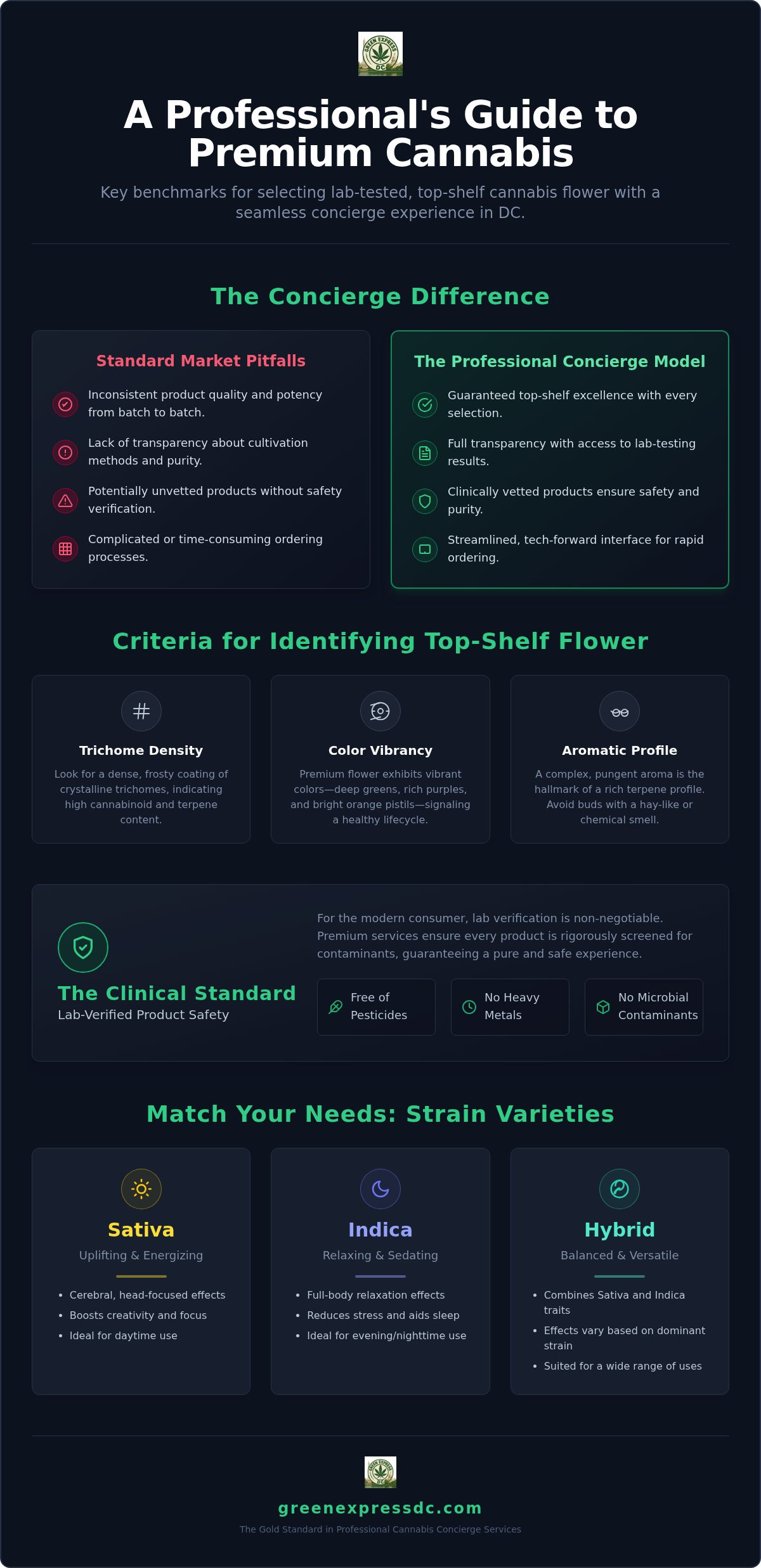
Identifying premium flower requires a clinical approach to sensory evaluation. It’s not just about potency; it’s about the integrity of the entire cultivation process. When you look to order cannabis flower dc, you should prioritize providers who offer detailed visual and aromatic profiles for every strain. True top-shelf flower displays high trichome density, appearing as a frosty layer of crystals across the bud. Color vibrancy is another indicator of health. Deep greens, vibrant purples, and bright orange pistils suggest a nutrient-rich lifecycle and careful harvesting. Avoid material that looks dull, brown, or overly compressed, as these are signs of poor handling, age, or the use of chemical growth regulators.

Organic cultivation is the foundation of a clean, sophisticated experience. Commercial growers often rely on synthetic pesticides and heavy fertilizers to maximize yield, which can leave behind harsh residues and affect the final flavor. Choosing pesticide-free, organic flower ensures a smoother intake and a more authentic representation of the strain’s genetics. This commitment to purity aligns with the safety standards found in D.C.’s official cannabis regulations, which emphasize consumer protection and product transparency. It’s a professional standard that separates boutique providers from mass-market operations. To ensure you’re receiving the high quality cannabis that meets clinical benchmarks, look for these specific indicators:

  • Trichome Coverage: A dense, “frosty” appearance suggests high cannabinoid content.
  • Bud Structure: Flowers should be springy and well-formed, not brittle or rock-hard.
  • Aromatic Depth: A pungent, multi-layered scent indicates a well-preserved terpene profile.
  • Clean Finish: Organic flower leaves behind a white or light gray ash, indicating a proper flush.

The Science of Trichomes and Terpenes

Trichomes are the microscopic glands that produce the plant’s cannabinoids and essential oils. These “crystal” powerhouses are fragile and must be handled with extreme care to preserve their potency. Terpenes work in tandem with cannabinoids to produce the “entourage effect,” guiding the specific outcome of each session. Terpenes are the aromatic compounds responsible for both scent and therapeutic nuance. Myrcene often suggests a sedative quality, while Limonene provides a citrusy, uplifting energy. A complex aromatic profile is a primary indicator of a high terpene count and overall freshness.

Evaluating the Cure and Freshness

The curing process is where the final quality is locked in. Artisanal curing involves a slow, controlled reduction of moisture that allows chlorophyll to break down without degrading the cannabinoids. You can test this by checking the stem; a clean “snap” indicates a perfect cure. If the stem bends without breaking, the flower is too wet and potentially prone to microbial issues. If it crumbles into dust, it’s over-dried and has lost its essential oils. Proper storage in temperature-controlled environments is essential to maintain this delicate balance. For those who demand these rigorous standards, exploring a curated catalog of organic flower is the most reliable way to ensure a premium experience every time you order cannabis flower dc.

Exploring the Catalog: Sativa, Indica, and Hybrid Varieties

Selecting the right cultivar is a clinical decision based on your desired physiological outcome. A professional catalog doesn’t just list names; it provides a roadmap for your daily performance and recovery. When you order cannabis flower dc, you’re choosing a specific functional state. Sativas are the primary choice for those requiring daytime focus. They provide a cerebral stimulation that supports creative workflows and physical activity without the heavy sedation associated with other varieties. Conversely, Indicas serve as the foundation for evening recovery. They prioritize physical relaxation and are essential for those looking to decompress after a high-stress day. Professional catalogs prioritize transparency, adhering to evolving cannabis lab testing standards to ensure that every variety delivers its promised profile.

Understanding Sativa and Indica Effects

The physiological differences between these varieties are rooted in their complex chemical makeup. Sativas typically feature terpene profiles that lean toward energizing scents, often associated with increased alertness and cognitive clarity. Indicas often contain higher concentrations of terpenes that facilitate a “body high,” making them ideal for managing physical tension or preparing for sleep. Refer to our guide on sativa vs indica effects for a deeper dive into these biological distinctions. Matching these profiles to your specific lifestyle requirements ensures that your cannabis use remains a productive part of your routine. It’s about precision and predictable results.

The Versatility of Hybrid Strains

Hybrids represent the pinnacle of modern cultivation. Expert growers cross-breed Sativa and Indica parents to achieve specific “designer” effects that a single variety might not provide. You might select a Sativa-dominant hybrid for a social gathering where you want to remain engaged but relaxed. Alternatively, an Indica-dominant hybrid can offer deep relaxation while maintaining enough mental clarity for a late-night film or reading. These artisanal hybrids have seen a massive rise in the premium market because they offer a tailored experience. They allow you to fine-tune your intake to match the exact nuance of your environment. When you order cannabis flower dc from a curated menu, you gain access to these sophisticated crosses that have been bred for consistency and potency. This versatility makes hybrids a reliable gold standard for both new and experienced users who demand a high-tier, predictable experience.
How to Order Premium Cannabis Flower in DC

The Importance of Lab-Tested Purity in Premium Cannabis

Clinical purity is the absolute foundation of a premium experience. When you order cannabis flower dc, you aren’t just looking for high THC levels. You’re looking for a product that has been rigorously vetted for safety. Many providers claim to offer top-shelf quality, but without third-party verification, those claims remain unverified marketing. A Certificate of Analysis (COA) serves as a professional document that confirms the purity and potency of a specific batch. This level of transparency is vital for consumers who value health as much as effect. It provides the peace of mind necessary for a truly relaxed experience.

Professional screening focuses on removing invisible threats that compromise your safety. Heavy metals like lead and arsenic can accumulate in the soil and be absorbed by the plant during growth. Pesticides used in commercial farming can leave harmful residues that are toxic when inhaled. Mold and microbial growth can occur during improper drying or storage, posing significant respiratory risks. Organic labeling is a professional starting point, but it must be backed by a clinical verification process. This ensures that the “organic” claim is a reality rather than a suggestion. Verification is the difference between a premium product and a potential health hazard. Consumers who also explore cannabis concentrates delivery dc will find that these same lab-verified purity standards apply equally to high-potency extracts, where the stakes for contamination are even higher. Those who prefer an alternative consumption method can apply the same clinical standards when seeking edibles delivery dc, where precise dosing and ingredient purity are equally non-negotiable.

What Lab-Verified Actually Means

Testing involves a multi-stage analysis performed by accredited third-party labs. They use high-performance liquid chromatography (HPLC) to measure cannabinoid profiles with extreme accuracy. This prevents potency variance, ensuring that the THC and CBD percentages listed on the menu match the product in your hand. Lab-testing is the only way to ensure a product is free from residual solvents. It provides a complete breakdown of the terpene profile and moisture content. You gain a comprehensive view of the flower’s quality before you ever make a selection. This data-driven approach removes the uncertainty from the procurement process. For a methodical breakdown of how to evaluate these clinical testing standards, our professional buyer’s guide to high quality cannabis provides a detailed framework for verifying certificates of analysis.

Safety Standards for the Sophisticated Consumer

Boutique services prioritize safety over raw, unverified potency. A high THC percentage is meaningless if the product contains microbial contaminants. Knowing the exact origin of your flower provides a sense of security that mass-market retail cannot replicate. Green Express DC maintains a gold-standard testing protocol to ensure every item in the catalog meets strict purity requirements. This commitment to clinical standards builds immediate trust. It removes the guesswork from your decision-making process when you order cannabis flower dc. Secure your peace of mind by choosing lab-verified organic flower that meets the highest professional standards.

A Streamlined Process to Order Cannabis Flower Online

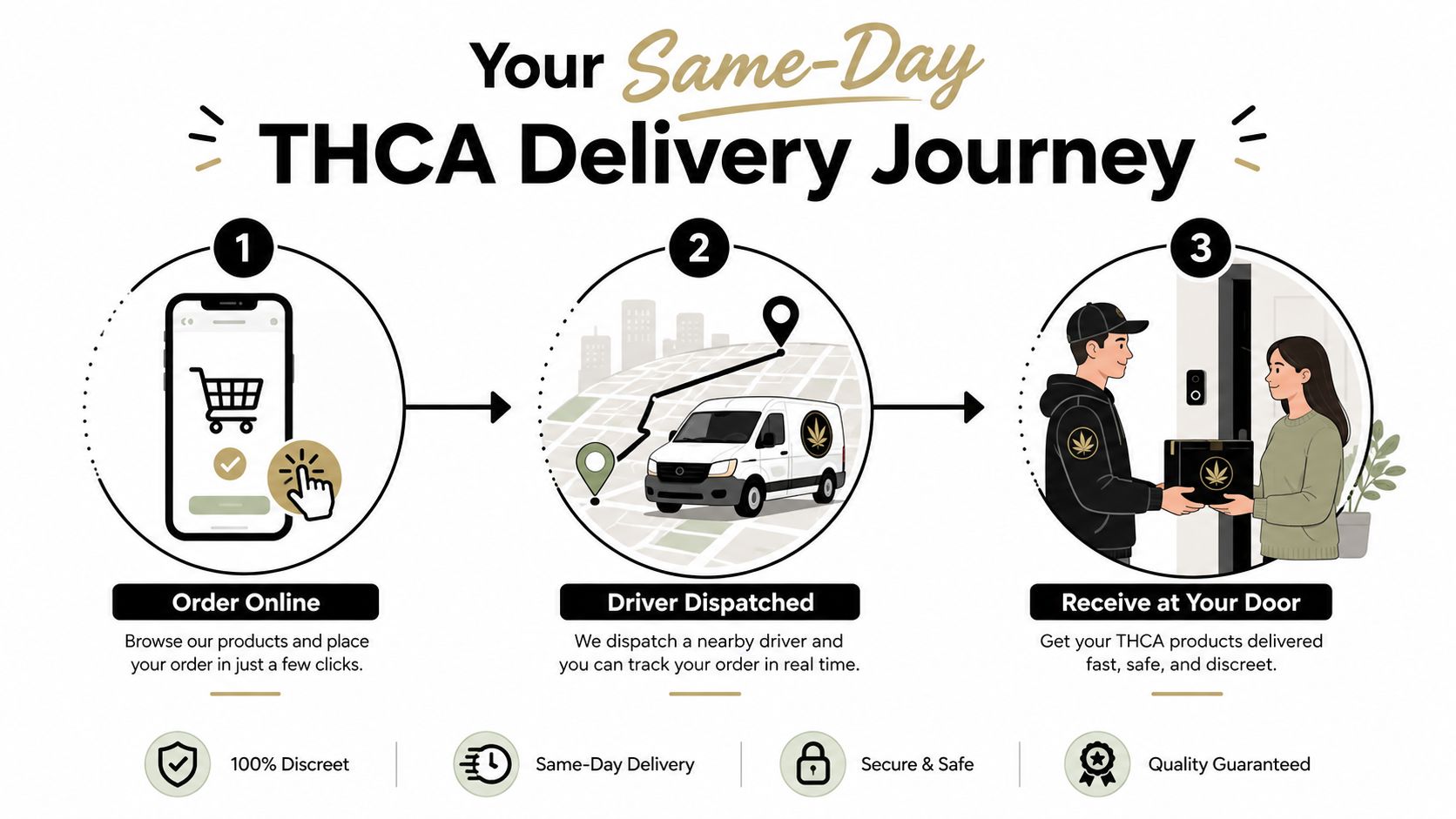
Modern procurement should be effortless. Digital menus provide immediate access to real-time inventory. This eliminates the uncertainty often found in fragmented retail environments where stock levels are rarely accurate. You can order cannabis flower dc with the absolute assurance that what you see on the screen is exactly what will arrive at your door. The verification process is designed to be both secure and legally compliant. It protects your personal data while ensuring the transaction meets all local standards. This tech-forward approach respects your time and your privacy. It removes the need for physical store visits and unnecessary social friction. A streamlined digital interface is the first step toward a premium experience.

Placing Your Order with Efficiency

Efficiency begins with a well-organized digital interface. Select your flower based on the specific physiological effects discussed in previous sections. Whether you need a Sativa for a morning creative session or an Indica for evening recovery, the menu should guide you with clinical precision. Understanding the distinct sativa vs indica effects before placing your order ensures you select the cultivar that best aligns with your intended outcome. A premium checkout experience is intuitive and fast. Most orders are processed for same-day delivery to fit into a busy professional schedule. Reliability is the core objective. You should expect a friction-free transition from selection to confirmation. Green Express DC provides 24/7 service availability to accommodate any lifestyle requirement. This level of accessibility is a hallmark of a gold-standard provider. It ensures you never have to compromise on quality due to timing.

Professional Fulfillment and Delivery

Professionalism extends to the final mile of the delivery journey. Premium services utilize discreet packaging to maintain total confidentiality. There are no external markings or branding to indicate the contents of your package. Professional couriers handle your order with the same care and decorum as a high-end concierge service. You’ll receive clear, real-time communication regarding your delivery window. This prevents you from waiting around and allows you to plan your day with precision. When you order cannabis flower dc through a professional model, the logistics are as refined as the product itself. Verify your items upon arrival to ensure the tamper-evident seal is intact. This final check guarantees the integrity of your purchase and provides ultimate peace of mind. Every step of the process is designed to be seamless, secure, and sophisticated.

Secure Your Access to Clinical-Grade Cannabis Excellence

Achieving a premium experience requires moving beyond the guesswork of traditional retail. You now understand that top-shelf quality is defined by dense trichome coverage, a complex aromatic profile, and the clinical certainty of a Certificate of Analysis. Prioritizing 100% lab-tested organic flower ensures that your sessions are both potent and free from harmful contaminants. This commitment to purity is the hallmark of a sophisticated consumer. When you are ready to order cannabis flower dc, choose a service that values your time and your privacy with the same rigor it applies to product selection.

Streamlined logistics and 24/7 professional service make it easier than ever to integrate high-tier cannabis into your lifestyle. You can expect same-day discreet delivery that maintains the highest standards of professional decorum at every stage. Professionalism is not just a goal; it’s a baseline for every transaction. Take the final step toward a more refined and reliable procurement model today.

Order Premium Lab-Tested Cannabis Flower from Green Express DC and experience the gold standard of professional fulfillment. Your peace of mind is our primary objective.

Frequently Asked Questions

Is it possible to order cannabis flower for same-day delivery?

Yes, same-day delivery is the standard for professional services operating within the District. Most boutique providers prioritize rapid fulfillment, ensuring your selection arrives within a few hours of order confirmation. This efficiency is essential for maintaining a seamless experience that fits into a busy professional schedule. You can expect real-time updates throughout the delivery window to ensure you are available for the final hand-off.

What is the difference between top-shelf and mid-grade cannabis flower?

Top-shelf flower is defined by its superior trichome density, complex terpene profile, and organic cultivation. These premium buds are handled with extreme care to preserve their potency and aromatic integrity. Mid-grade options are typically mass-produced, often resulting in a less refined scent and lower cannabinoid concentration. Choosing top-shelf ensures a cleaner, more predictable outcome without the harshness associated with commercial-scale drying and curing processes.

Do I need a medical card to order cannabis flower in the District?

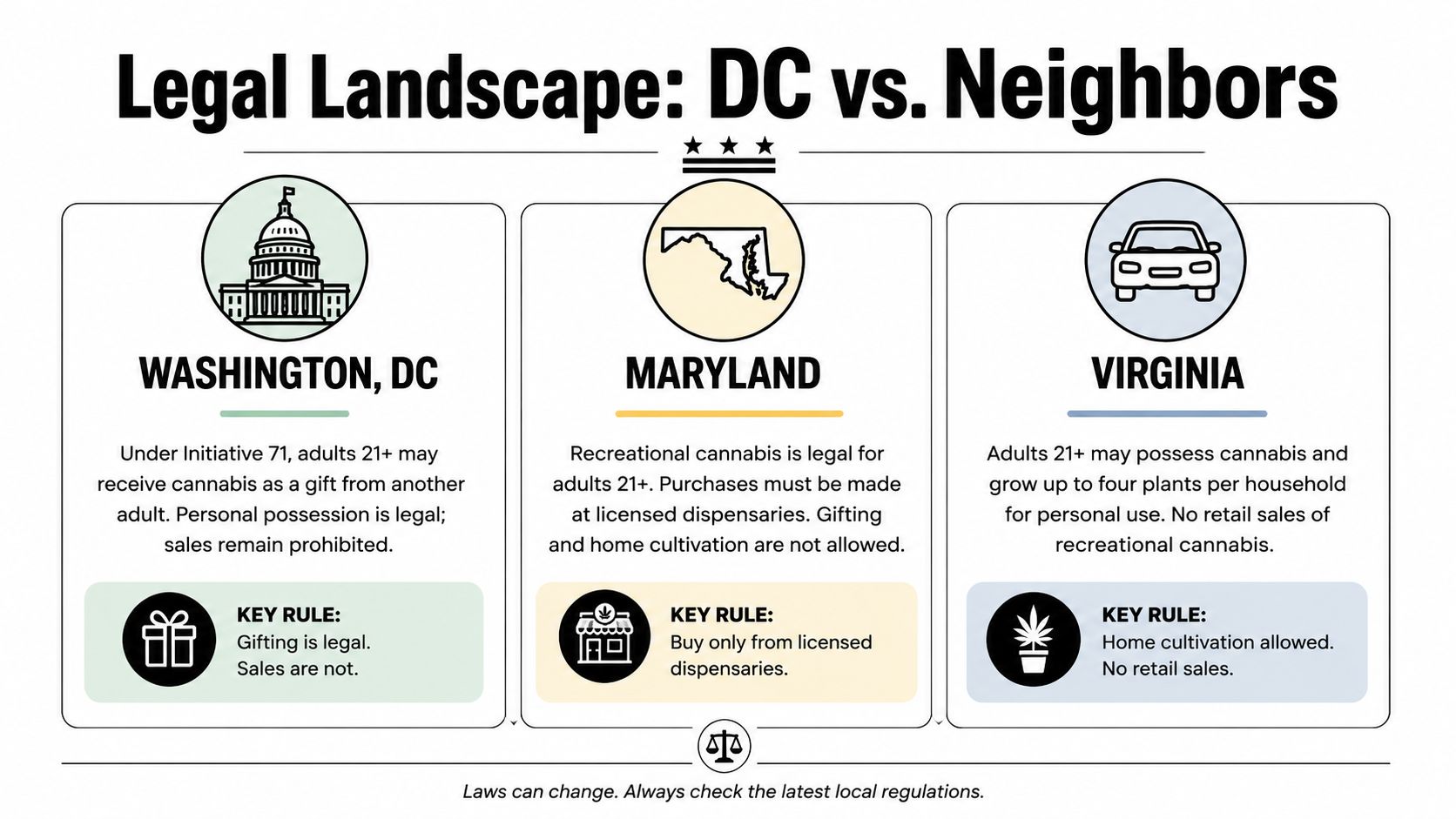
No, you don’t need a medical card to participate in the local gifting economy. Under Initiative 71, adults 21 and older can legally receive cannabis as a gift when they purchase a non-cannabis item. This system allows you to order cannabis flower dc without the need for a doctor’s recommendation or self-certification. You only need to provide a valid government-issued ID to verify your age during the secure checkout process.

How is the privacy of my order maintained during delivery?

Privacy is maintained through the use of discreet, unmarked packaging and professional couriers. Your order is placed in smell-proof containers that prevent any aromatic leaks during transit. There are no external labels or branding that indicate the contents of the package. This high-tier concierge approach ensures that your transaction remains entirely confidential from the moment it leaves the facility until it reaches your door.

Are all cannabis products lab-tested for safety?

Not all providers in the local market adhere to the same safety standards, but premium services make lab-testing a non-negotiable requirement. High-end catalogs feature products that have been screened for heavy metals, pesticides, and mold. This clinical verification is the only way to ensure the flower you receive is free from invisible contaminants. Always prioritize services that provide transparent data regarding the purity and potency of their inventory.

What should I look for in a professional cannabis delivery service?

A professional service should offer a tech-forward interface, 24/7 availability, and a curated menu of organic products. Look for clear communication protocols and a commitment to discreet logistics. The best providers act as expert facilitators, removing the guesswork from the selection process with detailed strain descriptions. Reliability and transparency are the most important indicators of a gold-standard delivery model.

Can I order cannabis flower 24/7?

Yes, boutique concierge services often provide 24/7 digital access to their menus. This allows you to order cannabis flower dc at your convenience, regardless of your personal or professional schedule. While delivery fulfillment typically occurs during specific operational windows, the ability to browse real-time inventory and secure your items at any hour provides maximum flexibility. This modern approach ensures that premium products are always accessible when you need them.

How do I know if a strain is organic?

Organic status is verified through the absence of synthetic chemical residues in lab reports. Professional growers who prioritize organic methods avoid the use of harsh pesticides and artificial growth regulators. You can identify these products by their clean finish and white ash when consumed. Reliable services will explicitly state their cultivation standards and provide the necessary third-party data to back up their organic claims.
Posted on

Nerd Rope Bites Explained: Cannabis vs Candy Guide for DC

You're standing in a checkout line or scrolling late at night, and the name Nerd Rope Bites pops up. It sounds like candy you already know, but it could also be a hemp listing, a dispensary edible, or an illicit product with a very different dose profile. If you live in the DC region and you're trying to buy something that's safe, legal, and predictable, that name alone can send you in the wrong direction.

That confusion isn't random. The same rope-style name shows up in mainstream candy, cannabis-adjacent products, and enforcement actions tied to high-dose intoxicating edibles, including packages labeled 400 mg THC per rope, 600 mg THC, and products described as having a 60-minute activation time. Search behavior makes it worse, because buyers often land on mixed listings when they really want a legal adult-use option, not a novelty candy look-alike. If you're trying to sort out what's real before you order in DC, Maryland, or Virginia, the safest place to start is with the product itself.

Why Nerd Rope Bites Confuse So Many Adults

A lot of adults don't run into Nerd Rope Bites through cannabis culture first. They hear the name from a friend, see it in a search result, or remember the bright rope candy from a store shelf, then assume it's all the same thing. That assumption is where the trouble starts, because the exact same visual language is used for a regular candy, a hemp-derived edible, and an illicit THC product.

The confusion gets sharper in the DC region because buyers are often comparing several markets at once. A person in DC might want a discreet edible, a person in Maryland might be comparing dispensary options, and a Virginia resident might still be trying to understand what's legal to possess versus what can be sold through licensed retail. Those are different questions, but the rope-bite name blurs them together.

Practical rule: if a product looks like grocery candy but is being sold with cannabinoid claims, treat it as a separate category until you verify the label, source, and potency.

That matters because buyer-safety questions are practical, not academic. What is it? Is it a mainstream candy, a hemp product, or a cannabis edible? How strong is it per piece? And if you're ordering around DC, what legal delivery path fits your jurisdiction? Those are the questions that protect you, especially when packaging is trying to look familiar on purpose.

For readers who want the candy-side baseline before comparing anything infused, the standard rope candy form is laid out clearly in the mainstream product listing at this rope candy reference. Once you know what the ordinary candy looks like, the look-alikes become easier to spot.

What Mainstream Nerds Rope Candy Is

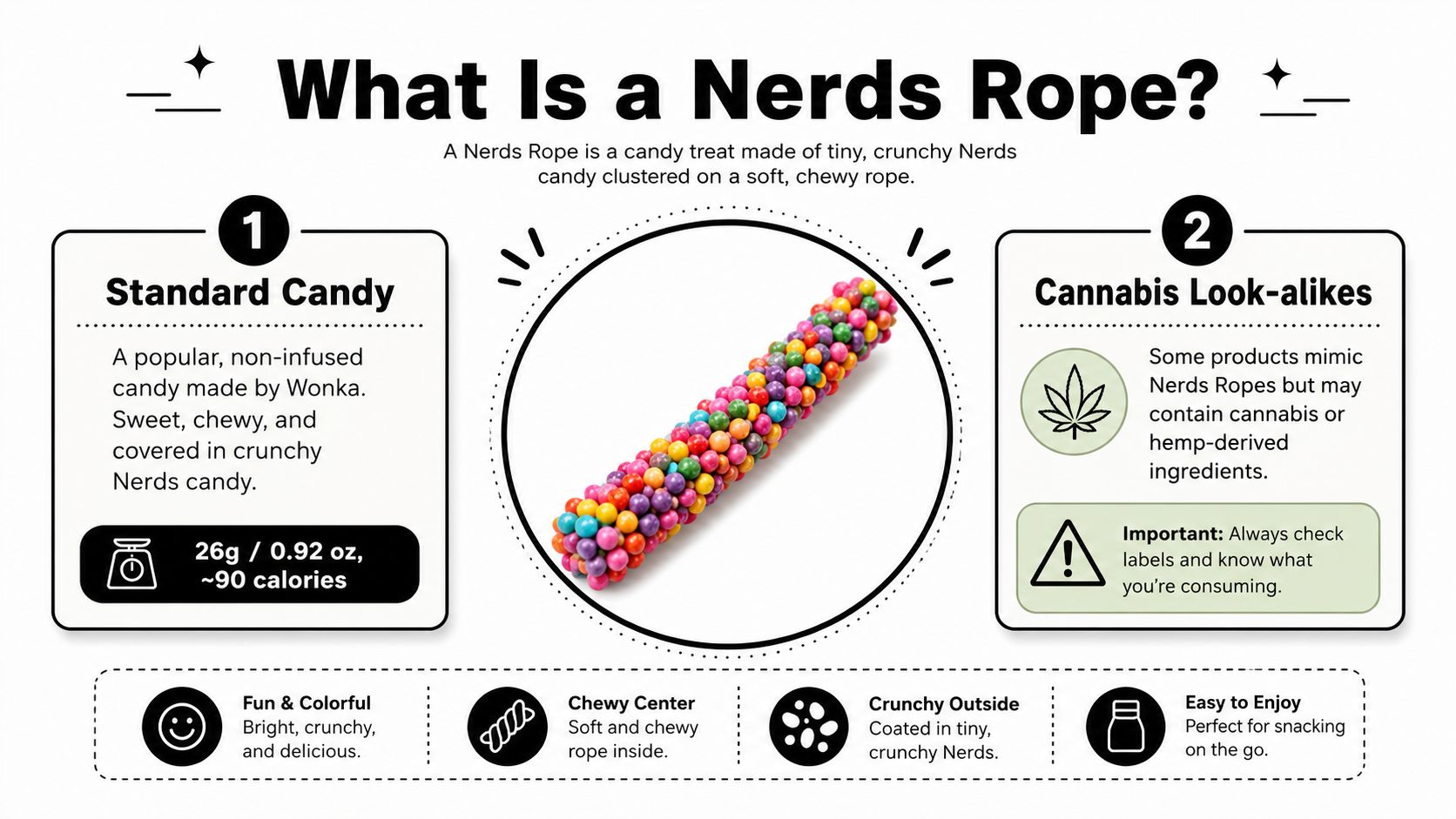
The ordinary version is just candy, and that is the baseline buyers should hold onto. A standard Nerds Rope is a 26 g / 0.92 oz single-serving treat with about 90 calories, 22 g carbohydrates, and 20 g total sugars per rope (Target product listing). It belongs in the familiar candy aisle, not in the cannabis category.

The ingredient profile reads like a confection, not an infused edible. The listing centers on dextrose, sugar, and corn syrup, with gelatin and acids such as malic acid and citric acid giving it the chewy, tart-sweet texture (Target product listing). If you have ever bitten into the regular version, the experience is predictable, sticky, sugary, and built for snacking rather than dosing.

What that means in practice

A mainstream rope candy behaves like a shelf-stable confection. It comes as one piece, with one serving and one ingredient story, and it does not ask you to think about cannabinoid content, activation time, or batch consistency. That is the line buyers need to keep in mind before they click on anything with a similar name.

The candy shape is familiar, but the function changes completely once cannabinoids enter the picture.

That is why the mainstream rope works as a useful anchor. If a product is sold in a store context with ordinary candy nutrition and ingredient language, you are probably looking at the candy aisle. If the label starts talking about milligrams of THC, delta-8, or infused servings, you are no longer looking at the same product family.

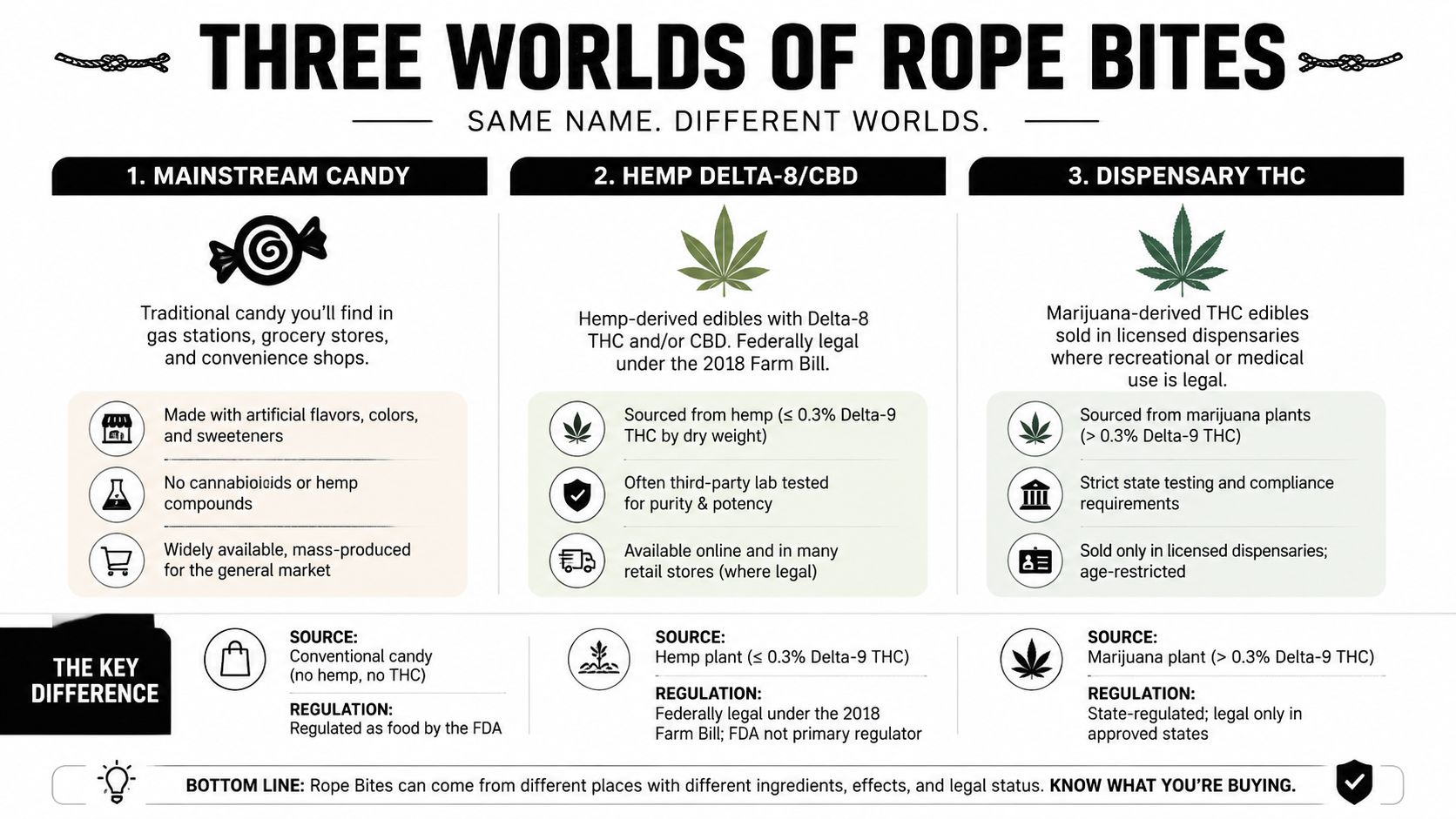
An infographic explaining the difference between standard Nerds Rope candy and cannabis-infused look-alike products.

Cannabis and Hemp Versions vs the Candy

Three different product worlds share the rope-bites name, and they do not work the same way. One is the mainstream candy just described. Another is the hemp or delta-8/CBD version that uses rope-style branding and packaging. The third is the dispensary or illicit THC version, which may look similar but carries a completely different intoxication profile.

Side-by-side differences that matter

Product world What it is Why buyers confuse it
Mainstream candy Regular confectionery sold as candy Familiar look, familiar taste
Hemp delta-8/CBD rope bites Infused product sold in hemp or CBD channels Same name, but cannabinoid claims change everything
Dispensary or illicit THC rope bites THC edible in rope or bite form Looks like candy, but the dose can be far stronger

The enforcement record shows why caution is justified. In 2020 to 2023, Nerds Rope Bites appeared repeatedly in UK and U.S. enforcement actions as an illicit cannabis confectionery product, not a standard candy. One UK report described seizures labeled “Medicated Nerds Ropes, 400 mg THC per rope” and “Medicated Nerdz Rope Bites, 600 mg THC”, while a 2023 FDA warning letter identified “Medicated Dope Rope Bites” and similar delta-8 products as adulterated foods because they contained an unsafe food additive (UK report and enforcement summary).

That history matters because the same rope shape can signal wildly different realities. A buyer who assumes every rope-shaped edible is just candy can miss a very high-dose intoxicating product. A buyer who assumes every hemp listing is equivalent to a licensed dispensary edible can also end up with the wrong cannabinoid type or a different legal status than expected.

An educational infographic explaining the three distinct types of candy products known as Rope Bites.

Dosing and Onset for Bite-Sized Edibles

Bite-sized formats create a special kind of risk because they feel smaller than they are. A single piece can look harmless, especially if it resembles candy, but the dose still depends on the cannabinoid load, how evenly the batch was mixed, and whether the label is honest. The candy shape doesn't control the effect, the milligrams do.

Independent listings for rope-bite products commonly describe 120 mg THC per piece or about 600 mg THC per package (rope-bite product listing). Recipe guides can point even wider in the other direction, because one source describes 320 mg THC bites, while another references 40 mg per bite across multiple cannabinoids (recipe and guide reference). That spread tells you the core issue is not the snack size, it's the formulation.

A simple adult framework

  • Check the total package milligrams. If the package is strong, the size of each bite doesn't make it gentle.
  • Divide by the actual number of pieces. Don't guess based on how it looks in the bag.
  • Wait through the activation window before redosing. A 60-minute activation time has been reported on rope-style illicit packaging, and that kind of delay is exactly why people get impatient and take too much.
  • Avoid untested batches. If one bite can be much stronger than another, your body is doing guesswork instead of dosing.

The practical difference is easy to miss. A rope bite can invite casual snacking because it looks like something you'd eat without thinking, but that's precisely why people overdo it. If the batch isn't uniformly infused or independently lab-tested, one bite can be light and the next can hit much harder.

For readers who want a more detailed look at timing, the wider edible-onset guidance is captured in this when-edibles-kick-in guide. The core message stays the same, wait before deciding the first dose didn't work.

DC, Maryland, and Virginia Rules at a Glance

A rope-bite label can look familiar enough to lower a buyer's guard, but the rules behind it change quickly once the product crosses a state line. In the DC region, the first question is jurisdiction, then product type, then delivery method. That order matters because what an adult may possess, what a licensed seller may offer, and what a courier may deliver are not always the same thing.

In Washington, DC, adults 21+ may legally possess cannabis and use regulated delivery services that verify ID at the door. In Maryland, adults 21+ may possess up to 1.5 ounces of flower and 12 g of concentrate and buy from licensed dispensaries. In Virginia, adults 21+ may possess up to 1 ounce, cultivate up to four plants per household, and share limited amounts without payment, but licensed adult-use retail sales have not opened statewide. For a plain-language overview of how to buy through DC delivery channels, see this guide to buying weed in DC.

Virginia is where many nearby buyers get tripped up. A person can have possession rights and home-grow rights without having access to a conventional adult-use retail market like Maryland's licensed system. That makes DC delivery especially relevant for Virginia-adjacent adults who want a compliant purchase path instead of relying on product listings that may look familiar but tell them very little about legality.

What buyers should keep straight

  • DC buyers: use verified adult-use delivery and expect ID checks at the door.
  • Maryland buyers: buy from licensed dispensaries and stay within Maryland possession limits.
  • Virginia buyers: do not treat possession rights as the same thing as open adult-use retail access.

The clearest rule is simple. Buy through the jurisdiction that can verify age, source, and product type at the point of sale or delivery. Rope-style edibles create extra confusion because the candy look can hide the core issue, which is whether the product is properly regulated and whether the potency information is trustworthy.

Practical rule: legal possession does not guarantee a legal retail purchase path, and a familiar candy shape does not tell you anything reliable about source or potency.

Compliant Alternatives Available Through Green Express DC

The safer path is usually the predictable one. If you want the flavor and convenience of an edible without the labeling chaos that comes with rope-style look-alikes, a compliant adult-use menu is easier to verify and much easier to dose. That's the whole appeal of a regulated delivery option in DC.

A well-built menu gives you real choices without forcing you into novelty packaging. Buyers can pick flower in indica, sativa, hybrid, and preroll formats, or move into concentrates like shatter, live resin, wax, and rosin. If they prefer vapor, disposables and carts give them another route, while edibles with clear per-piece dosing and THC tinctures give more measurable control.

What makes a compliant substitute feel safer

  • Clear product labeling helps you compare servings instead of guessing.
  • Lab-tested selection gives you more confidence in consistency.
  • Discreet packaging and ID verification reduce the risk of accidental confusion at the door.
  • Same-day delivery is useful when you want convenience without drifting into an unregulated market.

Green Express DC also highlights rotating specials, including $150 for 10 g of shatter or crumble, along with a $50 minimum, cash on delivery, and 24/7 availability. Those details matter because they make the purchase process straightforward for adults who already know what they want and don't want to gamble on a rope-shaped product with unclear sourcing.

The bigger point is that a tasteful edible experience comes from consistency, not novelty. A chocolate square, gummy, tincture, or clearly labeled bite is much easier to manage than a candy mimic that leaves you wondering whether it belongs in the grocery aisle or the enforcement bulletin.

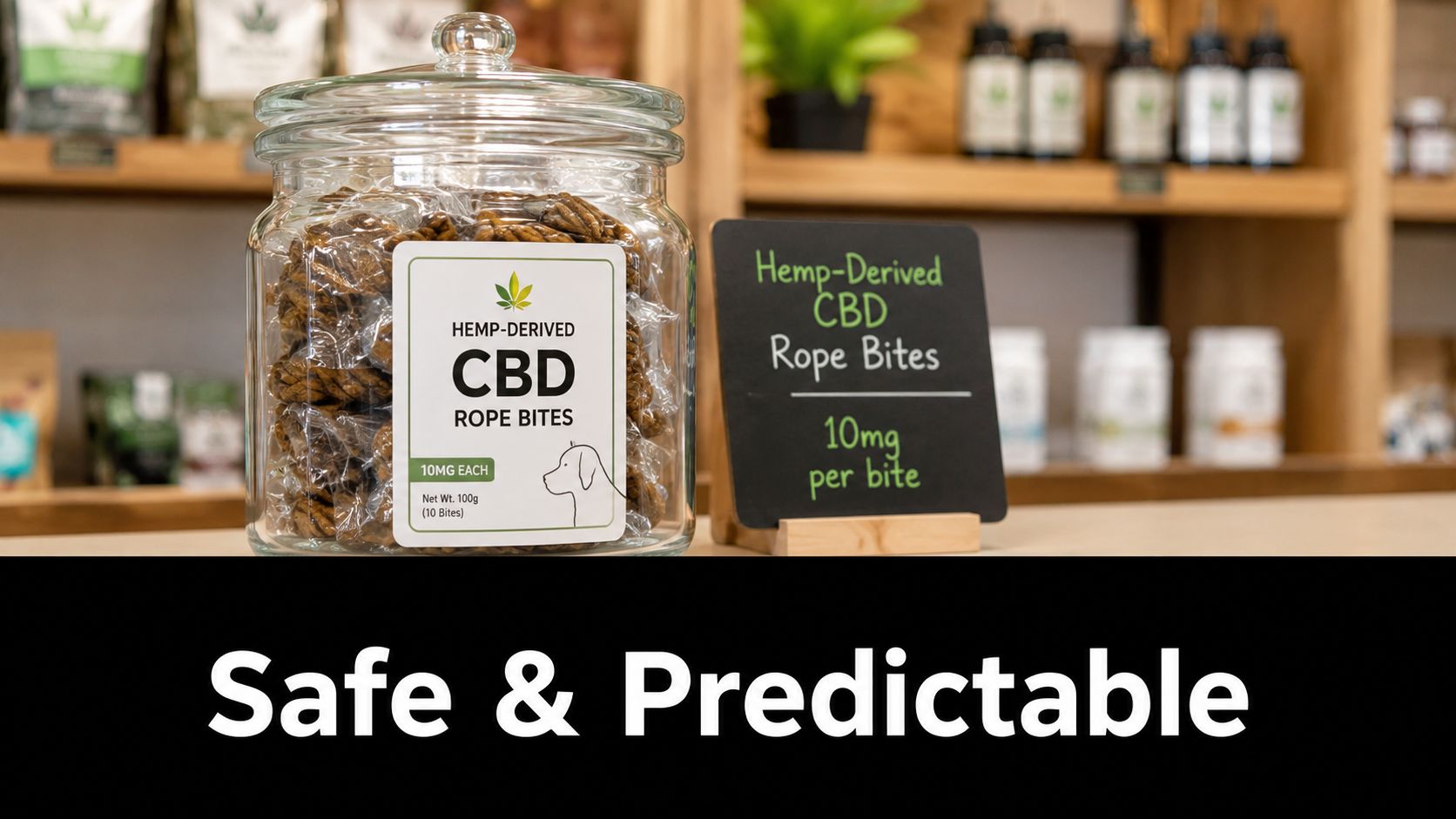
A glass jar filled with hemp-derived CBD rope bites for dogs displayed on a wooden shelf.

A Safer Buying Checklist for Adult Consumers

If you're buying in the DC region, keep the check simple. Make sure you're 21+, choose products with clear per-piece milligram labeling, and stick to a licensed source that verifies ID at delivery or pickup. If the item looks like regular candy but offers no batch testing or cannabinoid detail, walk away.

The next part is just as important. Never redose inside the first activation window, because rope-style and bite-sized edibles are exactly where people underestimate potency. The smaller the piece looks, the easier it is to snack past your own limit.

A good purchase should feel boring in the best way. You should know what the product is, how strong it is, and where it came from before you take the first bite.


If you want a cleaner way to buy in DC, Green Express DC offers same-day delivery, discreet packaging, ID-verified drop-off, and a menu built around lab-tested products adults can compare. For buyers who are tired of confusing rope-bite labels and want predictable edibles instead, it's a practical place to start. Visit their site, check the menu, and choose the product category that matches your comfort level, not the one that looks most like candy.

Posted on 1 Comment

Is It Legal to Ship Weed? DC, Maryland, Virginia Guide

Shipping marijuana is illegal under federal law because it remains a Schedule I controlled substance, and any interstate shipment is treated as a federal offense. That's true even if both states involved have legalized cannabis, which is why a package that seems harmless in local conversation can still create serious legal risk.

That answer is the part many want first, especially if they're sitting in Washington, DC with legal cannabis and thinking about a friend in Maryland or Virginia. The confusion is real because local rules often make possession, gifting, or delivery feel normal inside one jurisdiction, while federal law draws a hard line the moment cannabis crosses a state border or enters the mail system.

Why Sending Weed Across State Lines Confuses Everyone

A lot of people in DC hit the same mental snag. You've got legal cannabis in front of you, your friend in Maryland wants a package, and the whole thing feels no more complicated than mailing snacks or headphones. Then you hear that shipping weed is illegal, and the question becomes, legal where, exactly?

That confusion makes sense because cannabis law in this region works like two different rulebooks sitting on top of each other. One rulebook is local, so DC, Maryland, and Virginia each have their own limits and delivery realities. The other rulebook is federal, and it doesn't bend just because the sender and recipient live in places that allow some cannabis use.

The mailbox is not the same as a local handoff

If you hand cannabis to another adult in a place where local law allows that kind of transfer, you're dealing with one set of rules. If you put the same item in the mail, you've crossed into a very different legal lane. The federal system treats that as shipment, not casual sharing.

Practical rule: if the package is marijuana, the mail is the wrong vehicle, even when both ends of the trip are in legal-cannabis states.

That's the part people miss. They assume state legalization travels with the product, but federal shipping law doesn't work that way. The result is a legal maze where a lawful local purchase can still become an unlawful interstate shipment the moment someone tries to “send it over.”

For DC residents, that difference matters even more because the District's cannabis culture is built around local access, not interstate transport. Maryland and Virginia add their own twists, so readers often mix up possession rights with shipping rights. Those are not the same thing, and treating them like they are is where most mistakes start.

Federal Law Clashes With State Cannabis Rules

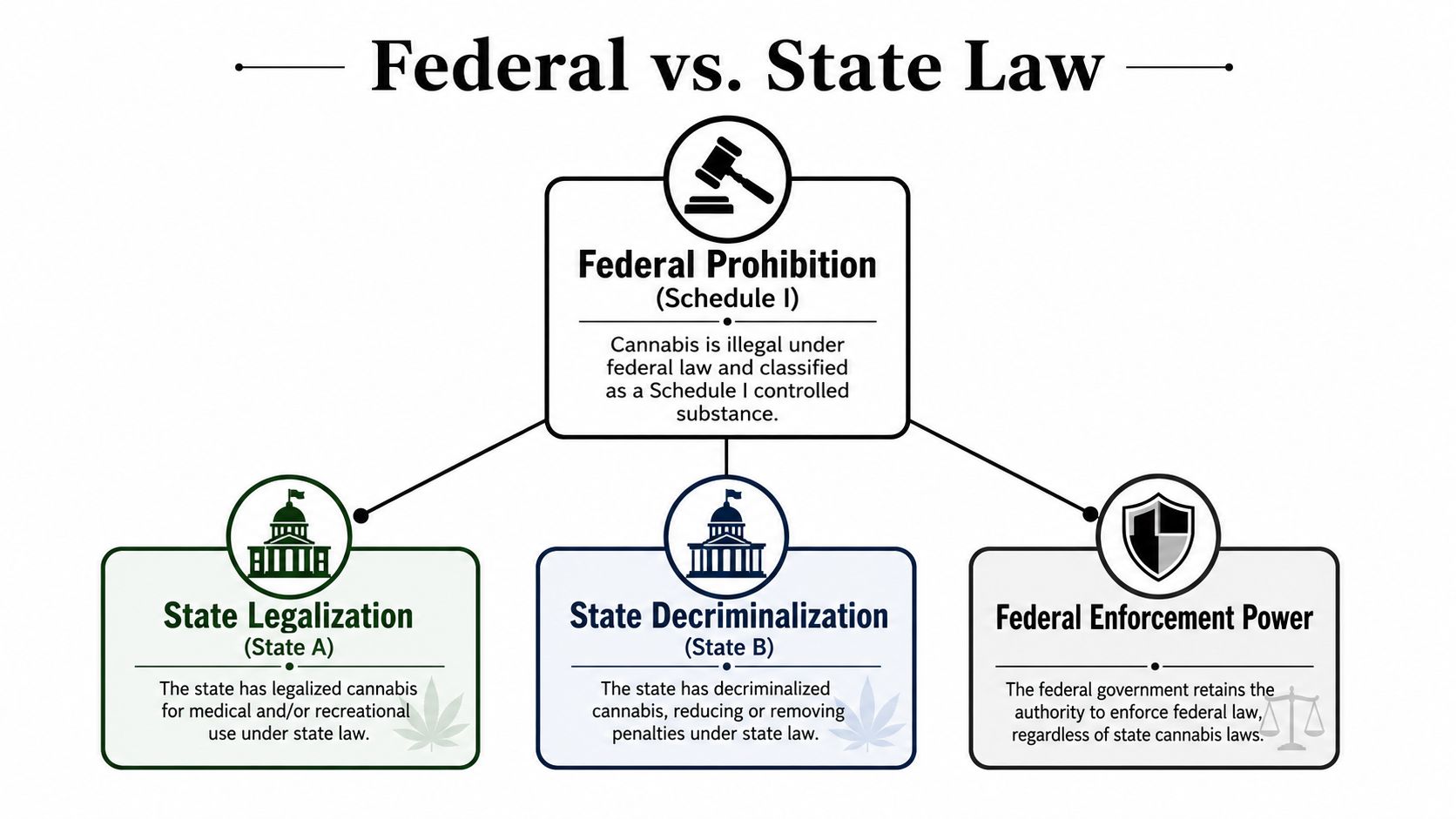
The federal government still treats marijuana as Schedule I under the Controlled Substances Act. That status is the backbone of the shipping ban, because federal law controls the mail and interstate transport, even when a state has created its own legal cannabis system. In plain English, a state can relax local possession or retail rules, but it can't rewrite federal shipping law.

A diagram illustrating the conflict between federal cannabis prohibition and various state marijuana laws in the USA.

A building with different floors of authority illustrates the situation. State law may open a door on one floor, but federal law sits above it with the master key when the issue is mail or interstate commerce. That's why legal state possession doesn't automatically create legal shipping.

Why USPS cannot treat cannabis like ordinary mail

USPS is a federal agency, so it has to follow federal law. Multiple legal summaries state that any amount of marijuana is illegal to mail under federal law Rossen Law Firm. That means the question isn't whether the sender is careful, discreet, or sending a tiny amount. The core issue is what the item legally is.

The distinction matters because federal law doesn't ask whether the product is “for personal use” or “for a friend.” If it's marijuana, it's still marijuana in the eyes of federal shipping rules. That's why the interstate part is so important. Once a package moves across state lines, the federal interest is no longer theoretical.

A state can legalize possession within its borders. It can't make the postal system ignore federal drug law.

For DC readers, that hierarchy explains why local convenience doesn't equal shipping permission. It also explains why people often get tripped up by legal language that sounds broad at the local level but collapses when shipping enters the picture. The safest way to think about it is simple. If federal law controls the channel, state legalization alone won't save the shipment.

Carrier Policies Block Cannabis Shipments

Carrier policies follow federal law, not local approval, so the shipping rules stay strict even when a product is legal somewhere else. The dividing line is the 0.3% delta-9 THC threshold in the hemp framework. Products at or below that level can move only under specific conditions, while marijuana-derived products above it are not mailable. That is why the first question is usually about classification, not packaging, labels, or how discreet the parcel looks.

UPS makes the point plainly. It prohibits shipment of marijuana under any circumstances, including medicinal use and use that is legal under state law. A different carrier does not solve the problem. The issue follows the federal classification of the product, so a private shipping company cannot turn marijuana into a lawful parcel just by accepting it.

Carrier and THC Threshold Rules

Product Type Carrier Stance Federal Classification
Marijuana flower or edibles Not mailable through USPS or private carriers for interstate shipment Prohibited marijuana
Marijuana-derived THC products Not lawfully shippable across state lines Prohibited marijuana
Hemp-derived products at or below 0.3% delta-9 THC Can be shipped under specific conditions Federally marketable hemp

The table shows the practical test in plain form. If the product is marijuana, no carrier choice makes it legal. If the product is hemp and stays within the federal THC line, the shipping analysis changes because it falls into a different category.

For readers comparing logistics providers or trying to track package movement, the same rule still applies. A carrier can only move what the law already permits. A shipping platform may give the appearance of order and control, but it does not change federal drug classification. Some DC businesses separate compliance and logistics discussions for that reason, as in their order tracking systems guidance, because tracking a package is not the same thing as making its contents legal.

Cannabis Delivery Rules Across DC Maryland Virginia

Washington, DC, Maryland, and Virginia sit next to each other, but their delivery rules do not work the same way. A person can live near all three and still face three different legal systems, like three houses on the same street with different front-door rules. DC has a local cannabis gifting and delivery culture inside the District's own framework. Maryland opened its adult-use market after voters approved legalization, and adults 21 and over there may possess up to 1.5 ounces of cannabis flower and, in many circumstances, cultivate up to two plants per household FindLaw. Virginia is different again, because adults 21+ may possess up to 1 ounce in public and each household may cultivate up to four plants, but it does not operate a full adult-use retail sales system cannabisregulations.ai.

An infographic showing cannabis delivery and sales rules for Washington DC, Maryland, and Virginia.

Why local delivery and interstate shipping are different things

A DC resident might legally receive cannabis through a District-based service, then assume the same product can be mailed to a friend in Maryland. That assumption breaks the moment the package crosses a state line. Local delivery happens inside a licensed or tolerated local system, while interstate shipment runs into federal prohibition.

Maryland's adult-use market shows the difference clearly. Its legal access is tied to licensed in-state commerce and age verification, not cross-border shipping FindLaw. Virginia gives another example. Adults can possess and grow limited amounts, but possession rights do not create a lawful shipping lane or a retail delivery market. A person can have a legal amount at home and still have no legal way to mail it.

A simple regional reality check

  • Washington, DC: local gifting and delivery operate inside the District's own rules.
  • Maryland: adults can buy through licensed in-state channels, not through interstate shipment.
  • Virginia: adults can possess and grow limited amounts, but retail adult-use delivery is not the same thing as possession rights.

That regional split is the part people miss. They see cannabis allowed in more than one nearby place and assume one rule set carries across all of them. It does not. A lawful District delivery, a Maryland dispensary order, and a Virginia possession rule each sit in separate legal boxes.

For DC consumers comparing local options, the right question is not whether cannabis can move. It is which jurisdiction allows the move, and by what channel. That distinction keeps lawful local access separate from illegal shipping. For one DC-focused service model, see we​​​​ed delivery in the District, which operates inside local rules rather than across state lines.

Legal Local Delivery and Compliance Tips

The safest path is boring, and boring is good here. If you live in DC, Maryland, or Virginia, use the channel that matches the law in your jurisdiction, and don't try to force a mail solution onto a product that federal law still treats as marijuana. Virginia's possession-and-home-cultivation model makes this especially important, because legal possession there does not create a retail delivery market the way people sometimes assume cannabisregulations.ai.

Compliance habits that actually matter

  • Verify ID at delivery: adult-use access depends on age checks, not casual drop-off.
  • Use in-state licensed channels: local rules govern local delivery, not the postal system.
  • Never package cannabis for mail: the mailbox does not become legal just because the product is personal-use.
  • Separate gifting from shipping: an in-person exchange is one thing, mailing is another.

Best practice: if you wouldn't explain the package contents to a federal postal inspector without flinching, don't ship it.

DC residents often ask whether a licensed local courier is a safer alternative. In a District context, local delivery is the lawful path when it stays inside the local framework, and some services, including Green Express DC, publish compliance guidance around that model. That doesn't change the federal rule on shipping, but it does show the difference between a local delivery system and an illegal interstate mailing attempt.

For Maryland and Virginia readers, the key is not to borrow DC assumptions. Maryland's market is tied to its own licensed retail structure, and Virginia's current setup doesn't turn possession into a shipping license. If the product is moving across borders, it has left the safe lane.

Key Takeaways on Weed Shipping Legality

The answer to is it legal to ship weed is still no when the product is marijuana and the route crosses state lines. Federal law controls the mail, marijuana remains Schedule I, and state legalization does not override that rule. That's the part that shuts down the common “but it's legal here” argument.

DC, Maryland, and Virginia show the difference between possession rights and shipping rights more clearly than most places. DC supports local delivery inside its own framework. Maryland's adult-use market is licensed and in-state. Virginia allows limited possession and cultivation, but not a full retail delivery system.

If you want to stay on the right side of the line, think local, not postal. Think licensed, not improvised. And think jurisdiction first, because cannabis law in the Mid-Atlantic is really a map of separate rules that only look similar from the outside.

Common Questions About Shipping Cannabis

Does DC gifting count as shipping weed

No. In-person gifting and mailing are different legal acts. If two adults exchange cannabis within a local framework, that's not the same as putting it in a box and sending it through the mail.

The confusion usually comes from the word “gift.” People hear it and assume any transfer is fine. The legal risk appears when the transfer crosses into shipping, especially across state lines, because federal law treats that as the transportation problem, not a casual handoff.

Can tourists in DC use local delivery

Tourists often assume local delivery is off-limits because they're not residents. In practice, what matters is whether the service follows DC's local rules, including age verification, and whether the transaction stays inside the District's permitted framework. The key point is that local delivery is not interstate shipping.

A visitor should still treat the process as a jurisdiction-specific service, not a general right to move cannabis anywhere. If you're staying in DC, the local rules matter while you're there. Once you try to carry that same expectation into Maryland or Virginia, the legal picture changes.

How do hemp-derived THC vapes differ from marijuana products

Hemp-derived products sit under the 0.3% delta-9 THC line, so they can be shipped under specific conditions 23state.com. Marijuana-derived products above that line are not mailable. That's the classification divide that drives the whole shipping analysis.

The mistake people make is assuming that any cannabis vape is treated the same way. It isn't. Federal law cares about how the product is legally classified, not just how it looks on the shelf or in an online catalog. If the product is marijuana, the shipping route is blocked.

For DC readers, that means you should separate local cannabis delivery from hemp shipping and from marijuana mailing. They can look similar in casual conversation, but the law treats them differently. If you want a clean rule to remember, keep it simple, hemp may travel under specific conditions, marijuana cannot be mailed across state lines.


If you live in DC and want cannabis delivered inside the District, use a service that works within local rules instead of risking a federal shipping problem. Green Express DC offers a DC delivery model built around adult ID verification, discreet local drop-off, and in-District service, which is the kind of setup this topic calls for. Visit their site, compare the menu, and choose the legal route that fits where you are.

Posted on

Jeeter Live Resin Disposable: A DC Buyer’s Guide

You're checking a menu after work, the driver is already nearby, and the question is simple: is a Jeeter Live Resin Disposable worth it, or is it just another flashy vape with a better label? In DC, that question gets even messier because the product, the hardware, and the local delivery rules all matter at the same time.

A good answer starts with what the device is, not what the marketing says. A Jeeter live resin disposable is a rechargeable, strain-specific cannabis device filled with fresh-frozen extract, and that alone puts it in a different lane from a basic distillate pen. The details matter because the way it's made shapes the flavor, the feel, and how you should use it.

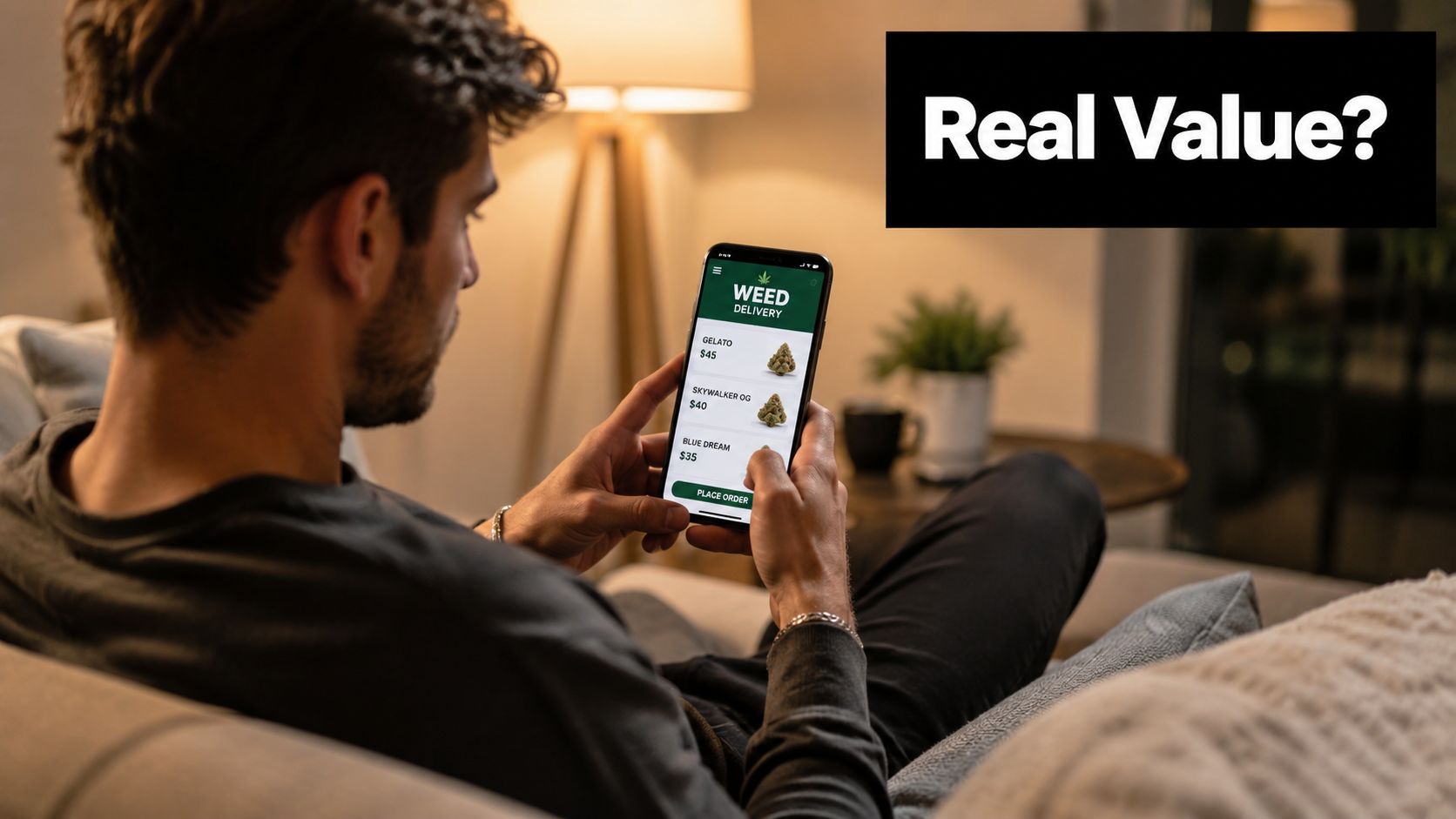
A man relaxing on a couch, using his smartphone to order cannabis products from a delivery app.

What a Jeeter Live Resin Disposable Really Is

A lot of people first meet a Jeeter Live Resin Disposable the same way they meet most cannabis products in DC, on a same-day menu after a long day. The name sounds straightforward, but the actual device is doing several jobs at once. It holds the oil, heats it, powers itself through a rechargeable battery, and is built around a specific strain profile rather than a neutral, generic vape base.

That's why it helps to think of it less like a simple pen and more like a small, self-contained smoking setup with one job, deliver live resin in a controlled way. Jeeter describes its live resin line as fresh-frozen, full-spectrum cannabis extract, and its live-resin disposables include standardized 500 mg devices in some product lines, while other listings show larger-capacity formats depending on the menu page Jeeter live resin product category. One tested Jeeter Juice Live Resin 0.5G Disposable Straw reported 79.633% total THC and 81.654% total cannabinoids, with 300 servings per container in the lab report, which tells you this is a multi-use device, not a one-and-done puff toy test report.

What that means in plain language

If you've only used standard vape oil before, the biggest shift is that live resin tries to keep more of the plant's original character intact. The hardware is meant to work with that extract, not flatten it into a generic high-heat experience. Jeeter's own description of its AIO system and TerpReserve™ design says the device is tuned for the oil's viscosity and terpene profile, with wick porosity, coil resistance, and airflow adjusted to keep heat lower and preserve flavor Jeeter live resin design overview.

Practical rule: if the menu says live resin, expect a strain-specific, flavor-forward device that's usually built for more than one session.

How Live Resin Extraction Works

Live resin starts with a simple kitchen comparison. Frozen berries usually taste brighter than berries that sat warm, cooked down, or lost their juice before you opened the container. Cannabis follows a similar logic, because the volatile compounds that shape aroma and much of the strain's character can fade during curing and long storage.

Jeeter says its live resin is made from fresh frozen flower, flash-frozen right after harvest so the plant keeps more of its terpenes and minor cannabinoids Jeeter live resin product category. From there, the extraction process pulls resin from that frozen material instead of from fully cured flower. The goal is not only potency. It is also to keep the strain's original aroma and flavor closer to what the plant had at harvest.

Why that matters compared with distillate

Distillate follows a different path. It is often stripped down and then rebuilt, which can leave you with a cleaner THC-heavy oil but less of the strain-specific taste and nuance that live resin tries to preserve. For a DC buyer, that usually means the difference between “this gets me high” and “this tastes and feels like this exact strain.”

Jeeter's live resin pages say the device is engineered to reduce terpene burn-off by keeping temperature low enough to respect the oil's profile, and the brand presents that as part of the experience, not a side note Jeeter live resin design overview. The hardware matters because live resin is carrying more of the plant's original material. If the heat is too aggressive, those lighter compounds are the first ones to disappear. That is the same reason a vape that handles live resin well can feel more aromatic and layered than one designed for thinner oil.

The best way to think about it is that live resin is closer to tasting the strain, while distillate is closer to extracting the strength and adding flavor back later.

For buyers comparing product styles, a Green Express DC vape cartridge guide can help frame how extract type, hardware, and legality questions fit together in the District.

Inside the Hardware and TerpReserve Design

A disposable pen can look simple from the outside, but with live resin, the small parts decide a lot of the experience. If the hardware does not move oil cleanly and keep heat in check, the flavor drops off fast and the draw can start to feel harsh. That is why buyers should pay attention to the device, not just the oil inside it.

A common Jeeter disposable listing shows the kinds of details worth checking, ceramic coil, draw activation, preheat, LED battery indicator, USB-C charging, and an integrated rechargeable battery on a 3 g device Jeeter-style device listing. Ceramic matters because it spreads heat more evenly than an exposed metal coil, which helps protect terpene-heavy oil from scorching. One listing also describes a 1 g unit at about 80.06% THC with minor cannabinoids such as 0.24% CBD, which is a reminder that these devices are built for concentrate-grade output, not light casual vaping.

Jeeter Live Resin Disposable Hardware at a Glance

Spec Typical Value What It Means for You
Coil type Ceramic coil More even heat, better flavor consistency
Activation Draw activation No button learning curve, just inhale
Battery Integrated rechargeable battery The oil can outlast a dead battery if you recharge it
Charging USB-C Easier to top up than older micro-USB setups
Heat control Preheat Helps move thicker oil in colder conditions
Battery feedback LED indicator Reduces guesswork about charge level
Capacity 1 g, 3 g, or 500 mg formats depending on product Bigger reservoirs usually mean longer use cycles

Jeeter describes its TerpReserve™ concept as a tuning system for wick porosity, coil resistance, and airflow, all aimed at holding temperature low enough to protect flavor while still producing solid vapor Jeeter live resin design overview. That tradeoff is the whole point. A live resin disposable is built to stay stable, keep the terps alive, and give you a smoother session over multiple uses.

If you are comparing it to a standard cart setup, a guide to THC vape cartridges can help you see why the hardware choices matter as much as the oil itself.

Potency, Dose, and What the Effects Feel Like

The most useful number in a lab report is the one that hints at how strong the oil may feel per puff. Jeeter's tested 0.5G Disposable Straw came back at 79.633% total THC and 81.654% total cannabinoids lab report. That puts it firmly in concentrate territory, so pacing matters even if you already use vapes regularly.

A percentage by itself still leaves out a lot. Terpenes, strain choice, the hardware, and even your surroundings all shape the session. A live resin device can feel more expressive and layered than a stripped-down vape oil because it keeps more of the plant's original profile intact, which is why two products with similar THC can still hit differently.

How to pace a multi-use disposable

Start with one small puff, then wait a few minutes before deciding whether you want more. That pause gives you time to notice whether the effect is building cleanly or whether you have already gone farther than you planned. A fresh device, a fresh strain, or a colder room can all change how it feels.

Start low, even if you're experienced. High-THC live resin can stack quickly, and stronger per-puff output is the main thing people underestimate.

A calm setting helps, too. Keep water nearby, do not rush, and give the oil time to settle in. If you are used to distillate, live resin may feel more flavorful and more layered at the start, while still delivering a stronger concentrate-style effect than a typical vape oil. That is why dose control matters more here than bravado.

If you are comparing hardware styles, a look at Green Express DC's Pure One carts can help you see how different devices shape the feel of similar oil.

Reading Lab Tests and Avoiding Fakes

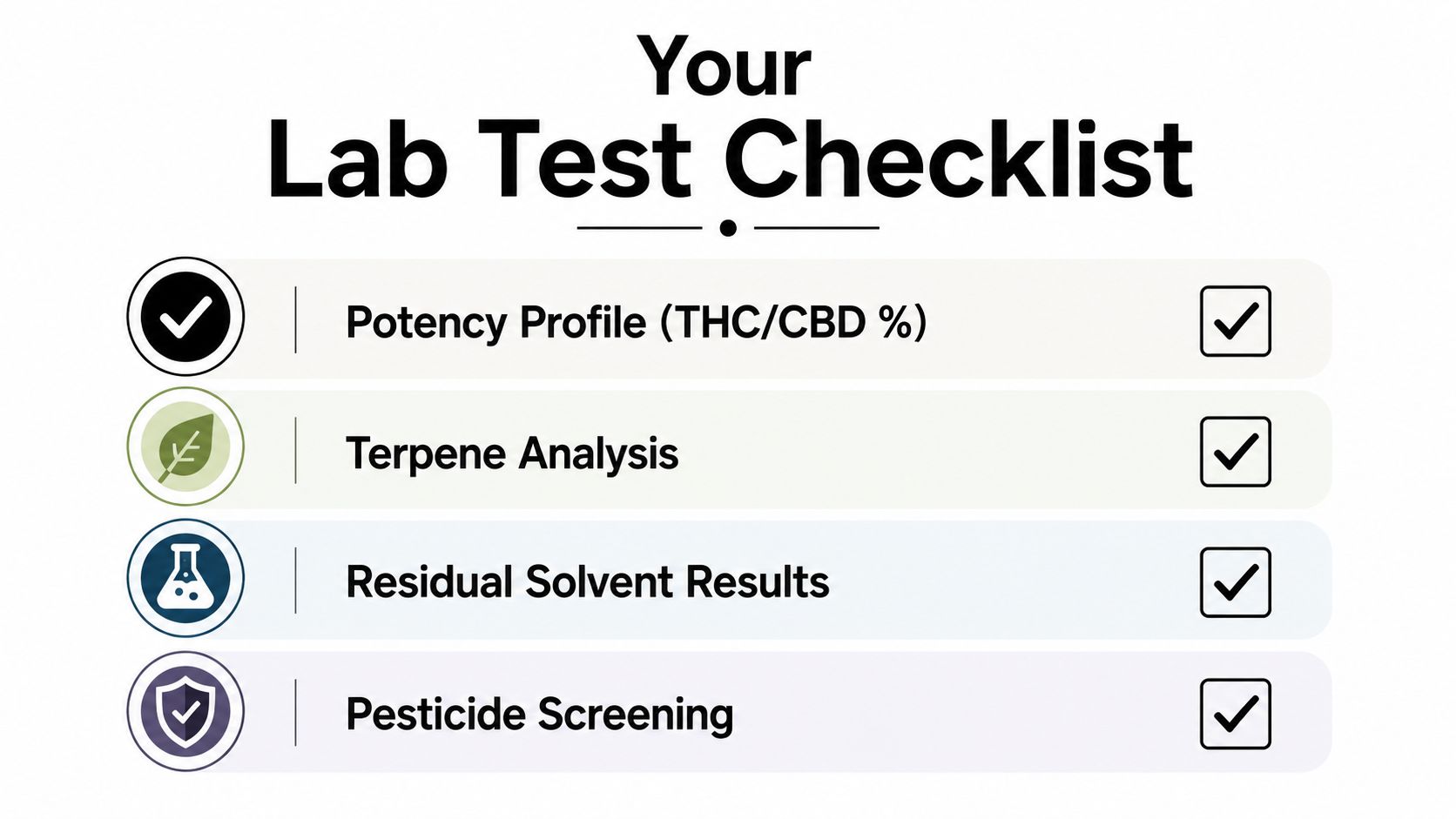
A real certificate of analysis is more useful than the brand name printed on the box. It's the document that tells you what's in the oil, and it should match the exact product you're buying, not just the general brand or strain family. For a Jeeter live resin disposable, you want the lab report to line up with the menu item you're about to order.

Look for a few basics. The batch or lot number should match, the test date should be recent, and the lab should be identifiable rather than vague. A solid COA will usually cover potency, terpenes, solvents, pesticides, heavy metals, and microbial screening, because those are the practical questions that matter when you're inhaling a concentrate.

Red flags worth slowing down for

  • Missing COA: If the seller can't show a product-specific test, that's a problem.
  • Mismatched batch numbers: A report for a different lot doesn't prove the item in your cart was tested.
  • Brand-only paperwork: A generic Jeeter PDF without a matching product code isn't enough.
  • Oddly cheap high-capacity devices: If the price looks way below normal for a large rechargeable disposable, ask why.
  • No clear test date: Old paperwork can be useless if the menu item has changed.

Simple buying rule: if a delivery service can't point you to the exact batch before checkout, keep looking.

That's especially important in DC, where delivery shoppers often rely on menus and text updates instead of walking into a storefront. A reputable service should be able to show the COA for the exact live resin disposable on the menu before you place the order. The same habit applies to other cart-style products too, including pure one carts, because the label on the device is never as trustworthy as the test behind it.

A lab test checklist for cannabis products showing icons for potency, terpenes, solvents, and pesticides.

Live Resin vs Other Concentrate Formats

A Jeeter live resin disposable makes sense when flavor and convenience matter at the same time. If you want to compare formats the way a budtender would, start with the extraction method and then ask what kind of session you want.

Format Extraction Flavor Typical Use Best For
Live resin disposable Fresh-frozen extract in a rechargeable device Strong, strain-specific Portable sessions People who want flavor and convenience
Distillate cart Refined oil with terpenes added back Cleaner, usually less layered Everyday vaping Buyers who want consistency and simpler pricing
Wax Concentrate prepared for dabbing Intense, less discreet Rig or dab pen use Users who like direct, hot hits
Rosin Solvent-free concentrate Rich and plant-forward Dab or specialty vape use Buyers who prefer solvent-free rituals
Shatter Hardened concentrate for dabbing Less aromatic than live resin Dab setup People who want classic dab-style strength

The key trade-off is simple. Live resin leans into flavor and nuance, distillate leans into budget and consistency, rosin leans into solvent-free purity, and wax or shatter leans into dab-style intensity. That's why a live resin disposable fits best when you want strain-specific taste in a low-commitment device.

If you're trying to decide between oil styles, this difference between distillate and live resin guide gives you a useful shorthand. For a quick night in, live resin is usually the more expressive pick. For the cheapest everyday cart, distillate often wins. For a tabletop ritual, a dab concentrate may make more sense.

Buying in DC, Virginia, and Maryland

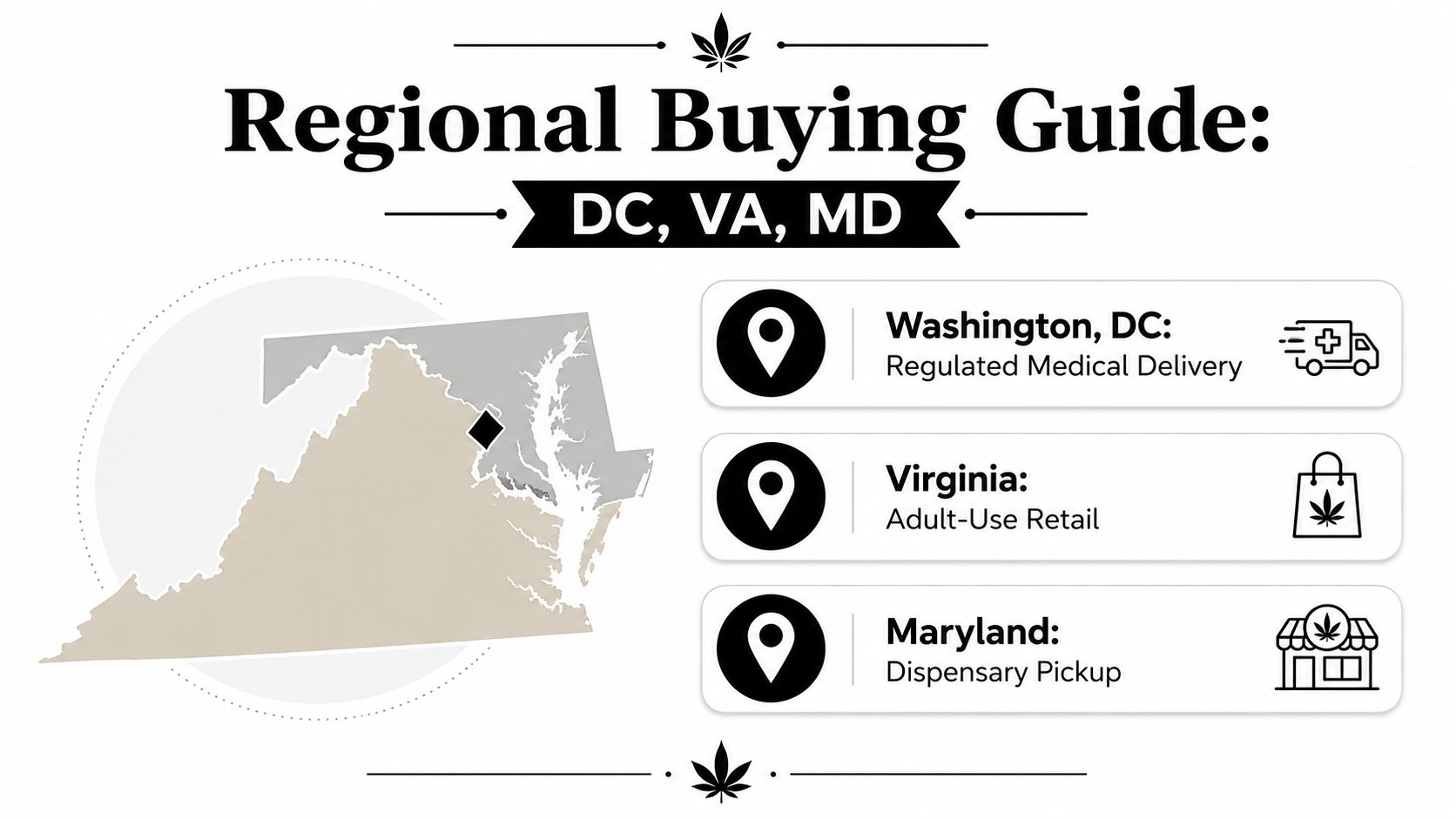
DC delivery is not the same as ordering in a normal adult-use state, and that matters before you click buy. Washington, DC cannabis delivery operates under a tightly regulated framework where medical cannabis licensees may deliver to patients and caregivers, while adult-use rules under Initiative 71 allow possession and home cultivation but not a standard commercial recreational sales system DC policy context. That creates a very different shopping reality from nearby states.

Virginia and Maryland shoppers live in a different setup, but the same caution still applies. Cross-state buying means respecting the rules where the product is sold and where you receive it. If you're in the District and want a same-day option, a vetted, ID-verifying delivery service is the practical route, and Green Express DC is one example that offers local delivery, lab-tested products, and discreet drop-off for adults in the city.

What to verify before checkout

  • Clear DC menu: Make sure the product is listed for your location.
  • Lab-tested batch info: Ask for the COA before you place the order.
  • ID verification at drop-off: Don't skip this, it protects you and the courier.
  • Discreet packaging: Useful if you live with roommates or in an apartment building.
  • Single-person minimums: Check the order floor before you build a cart.
  • Transparent specials: Good delivery menus show deals without hiding the price structure.

A regional buying guide chart for cannabis purchase methods in Washington DC, Virginia, and Maryland.

Safety, Storage, and Final Takeaways

A live resin disposable lasts better when you treat it like a rechargeable device, not a throwaway pen. Keep it upright, away from direct sunlight and car heat, and aim for roughly 60°F to 70°F storage when you can, because that helps the oil stay workable and reduces clogging risk storage and troubleshooting notes. If the oil thickens in cold weather, use the preheat function before you pull.

Charge it with the supplied USB-C cable, and don't assume the battery and oil will die together. A rechargeable disposable is designed to stretch across multiple sessions, so the goal is to finish the oil comfortably, not force the whole device into one long night. If it clogs, warm it gently, keep it upright, and avoid pulling too hard.

Quick FAQ

What if the battery dies before the oil is gone? Recharge it before deciding the device is finished.
How do I know it's authentic? Match the batch to the lab test and the exact menu listing.
What if it clogs? Let it warm slightly, use preheat, and store it upright.
How can DC adults order responsibly? Use a same-day delivery service that verifies ID at drop-off and shows the exact product details before checkout.

For a DC adult who already knows the difference between live resin and a standard cart, a discreet, lab-tested delivery option makes the process easier without changing the buying rules around it.


If you want a straightforward way to order live resin, flower, edibles, or other concentrate options in the District, Green Express DC offers same-day delivery, discreet packaging, and ID-verified drop-off for adults in Washington, DC. It's a practical fit for readers comparing Jeeter live resin disposables and looking for a local menu with lab-tested products and clear delivery steps.

Posted on

Contamination Prevention for Cannabis Delivery in DC

You just opened a delivery order, checked the menu, and now you're waiting for it to arrive at your door in DC, Virginia, or Maryland. That handoff feels simple, but contamination prevention is what makes the product you receive safer, cleaner, and easier to trust. In cannabis, the same logic that keeps a kitchen sanitary and a clinic controlled also protects flower, concentrates, vapes, and edibles from avoidable problems.

The big idea is straightforward. Contamination can enter at multiple points, from the grow room to the courier's vehicle to your own pantry. The World Health Organization estimates 866 million people worldwide, about 1 in 9, fall ill each year after eating contaminated food, leading to 1.52 million deaths annually (WHO burden estimate), and that scale is why prevention is treated as a systems issue, not a single wipe-down. Cannabis is not food, but the safety logic is similar, because materials, handling, storage, and monitoring all matter.

Why Contamination Prevention Matters When Cannabis Shows Up at Your Door

A DC delivery order seems routine until you think about how many hands and surfaces can touch a product before it reaches you. A courier may carry sealed packages, but the product itself has already moved through cultivation, processing, packaging, and transport. Each step creates a chance for contamination prevention to succeed, or fail.

The reason this matters is not abstract. The CDC estimates at least 1.1 million people in the United States get sick every year from germs in drinking water, about 1 in every 300 people (CDC drinking water facts). That number is about water, not cannabis, but it shows a useful lesson, contamination risk can persist even in regulated systems when infrastructure, handling, and maintenance slip. In cannabis delivery, the same principle applies, the safest product on paper can still be mishandled on the way to your door.

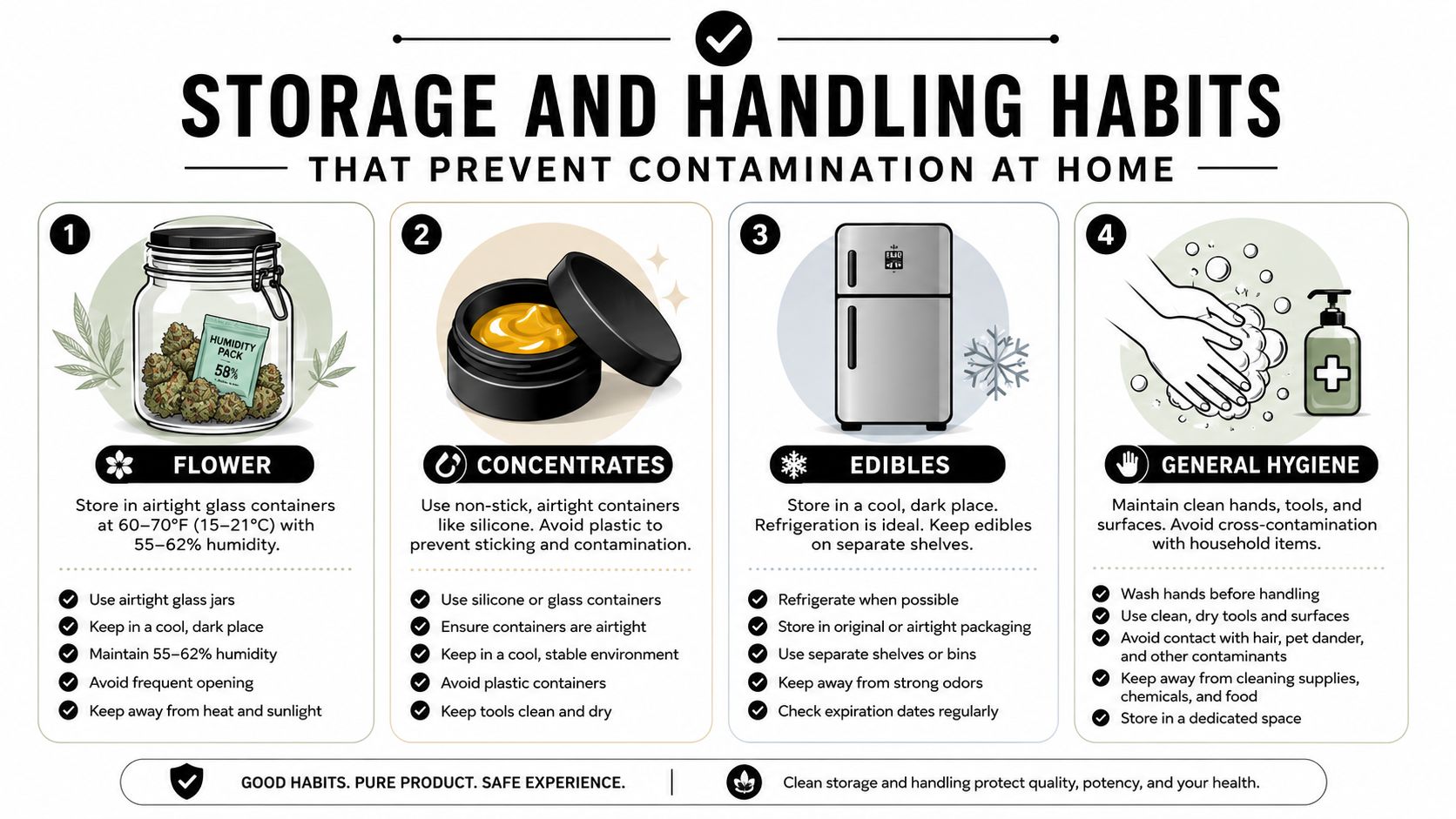
For adult consumers in DC, Virginia, and Maryland, the practical takeaway is simple. Don't think of contamination as one dramatic failure like visible mold. Think of it as a chain of small decisions, clean tools, sealed packaging, verified identity, and proper storage. A strong delivery service reduces risk, but your own handling habits still matter once the product is in your home, especially if you keep cannabis near food, medicine, or shared household items.

Green Express DC cannabis delivery is one example of how a delivery experience can be organized around discretion, verification, and product handling. The reason that matters is that contamination prevention starts long before you open the package.

Practical rule: if a product arrives with broken seals, damaged packaging, or a strong off odor that doesn't fit the item, stop using it and inspect everything before you store it.

What Contamination Prevention Actually Means

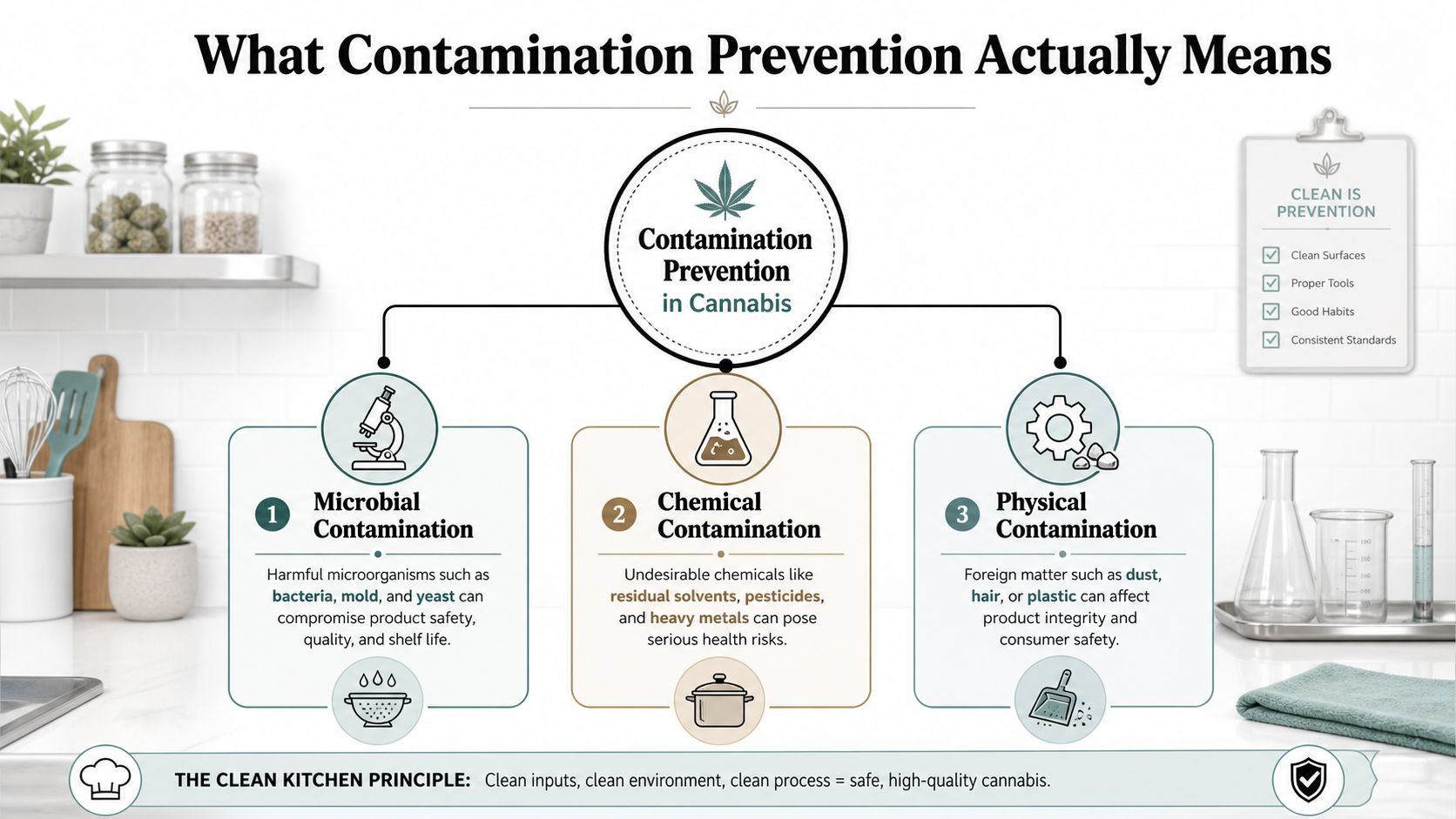
Contamination prevention means keeping unwanted material out of the product and out of the workflow. In a clean kitchen, you wouldn't chop raw chicken on the same board you use for salad without washing and separating tools first. Cannabis safety uses the same mental model. You're trying to stop germs, chemicals, and stray physical debris from moving where they don't belong.

An infographic illustrating three types of cannabis contamination: microbial, chemical, and physical, in a clean kitchen setting.

The three contamination types to keep in mind

Microbial contamination is the one many picture first. It can involve bacteria, mold, or yeast, and it tends to show up when moisture, poor sanitation, or weak drying and storage practices create the right environment. In cannabis, that can mean flower that's handled badly, stored too wet, or exposed to dirty surfaces.

Chemical contamination is harder to see, which makes it more confusing for consumers. It can include residual solvents, pesticides, lubricants, or other unwanted residues left behind by equipment, cleaning products, or processing mistakes. In concentrates and vape products, this category deserves special attention because the consumer may not notice a problem just by looking.

Physical contamination means foreign matter, dust, hair, plastic, fragments, or other debris. It doesn't need to be large to matter. A tiny piece of packaging material or a loose particle in a container can point to weak process control somewhere upstream.

Contamination prevention works best when people treat cannabis like any other sensitive product, not like a casual household item.

The useful habit is to ask one question at every stage. What could enter the product here, and what stops it from entering? That question helps you evaluate everything from sealed jars to courier bags to the shelf where you store your edibles. It also prepares you to read lab results with a more informed eye later, because a product can only be as clean as the system that produced and protected it.

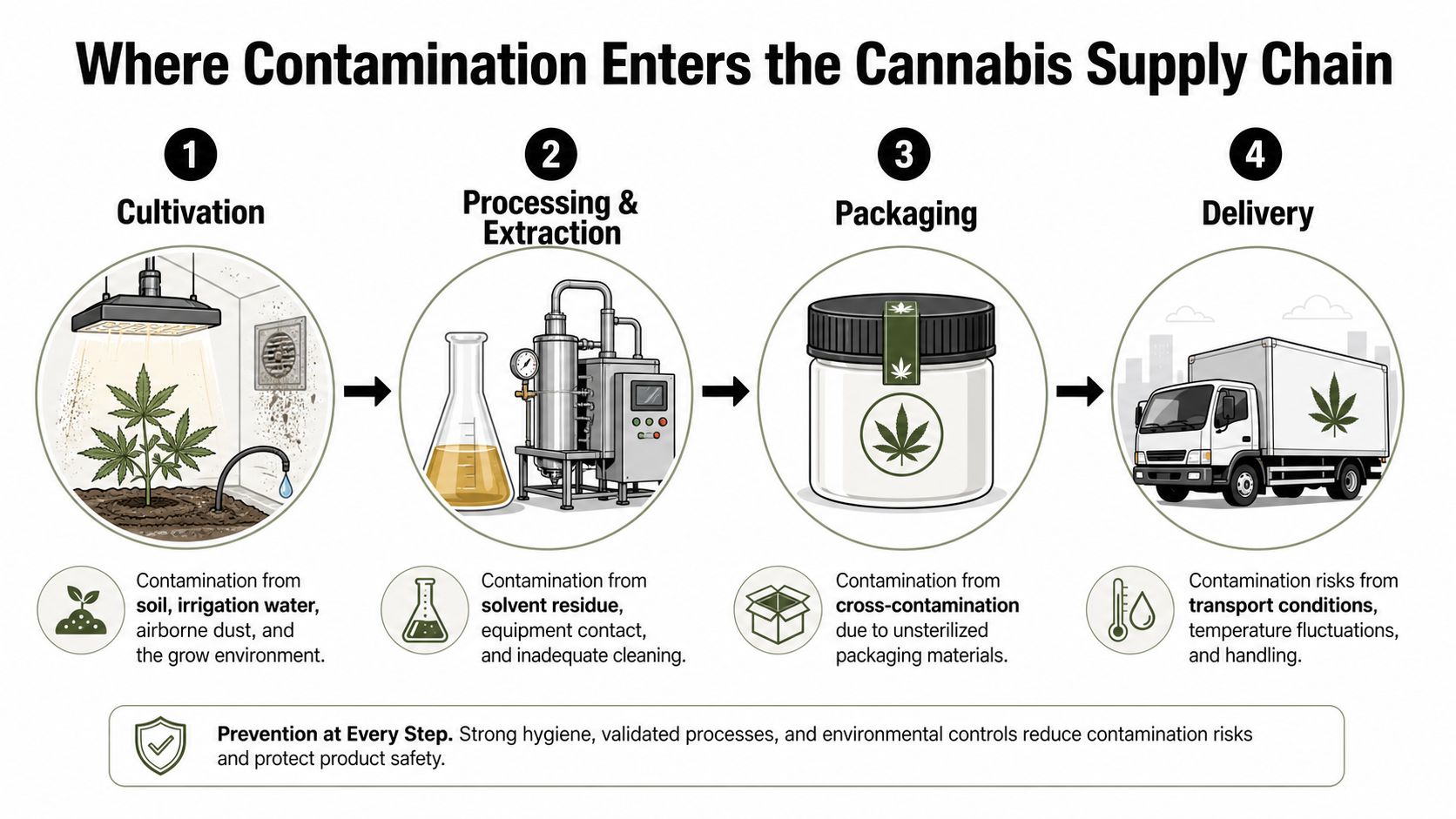
Where Contamination Enters the Cannabis Supply Chain

Cannabis contamination usually doesn't come from one dramatic mistake. It comes from small failures stacked across the supply chain. That's why a dusty cultivation room, a rushed extraction line, and a careless delivery handoff can all matter even if each one looks minor on its own.

An infographic detailing the four key stages of contamination entry in the cannabis production supply chain.

Cultivation and processing

In cultivation, contamination can start with soil, irrigation water, pests, or poor airflow. If the room is dusty or sanitation is inconsistent, that material can travel onto the plant and then into the finished product. In processing and extraction, the risks shift to equipment contact, shared containers, and leftover solvents if cleanup is weak.

A point many consumers miss is that a product can look polished and still carry a process problem underneath. A clean package doesn't prove a clean workflow. It only tells you the final presentation was controlled well enough to reach the shelf.

Packaging and delivery

Packaging can create another gap if materials aren't clean, intact, or stored properly before use. Shared trays, reused containers, or poor seal integrity can allow cross-contamination. Delivery adds its own conditions, temperature swings, vehicle cleanliness, and how carefully the product is handled during transport.

The delivery handoff matters because that's when a regulated product enters a less controlled environment. A courier can preserve a lot by keeping sealed items separate, protecting them from heat and dirt, and avoiding rough handling. A consumer can help by checking seals, keeping the package away from household chemicals, and storing the product right away after receipt.

The lesson is simple. Contamination prevention is chain management. If one link is weak, the whole product becomes less reliable. That's why the safest brands and services focus on process design, not just final inspection.

The Risk-Based Framework That Keeps Products Clean

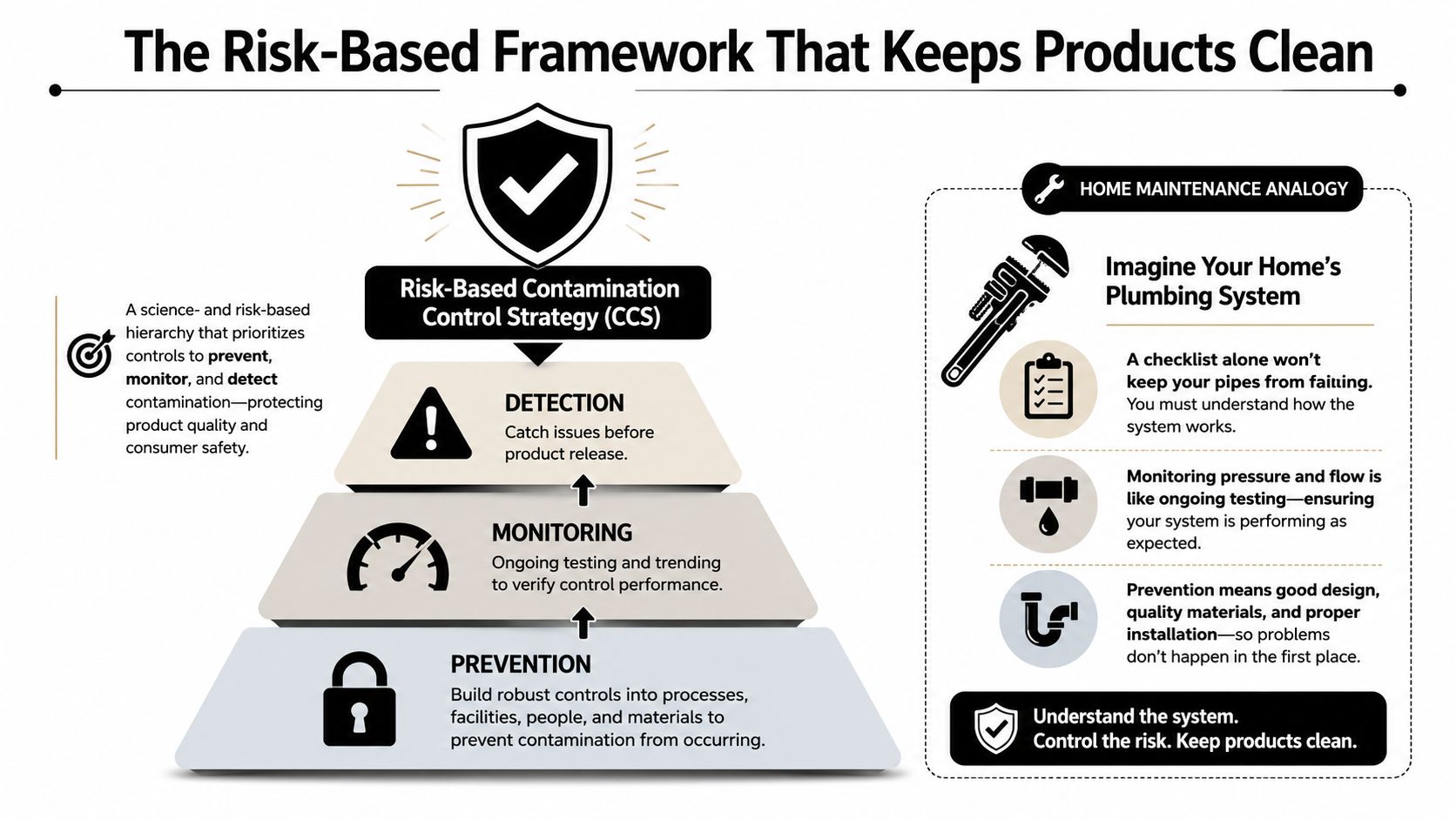
A checklist can help, but it can't replace a real control system. The better model is a risk-based contamination control strategy, or CCS, which identifies both viable and non-viable contamination sources, justifies controls through risk assessment, and keeps reviewing monitoring data so the plan stays effective over time (risk-based CCS overview). That matters in cannabis because contamination risk changes with the product, the process, and the environment.

A diagram illustrating a risk-based contamination control strategy pyramid for product quality and safety maintenance.

Why prevention has to come before detection

If a company waits until the end to look for problems, it's already too late to fix the process that created them. A CCS flips that logic. It starts with prevention, then adds monitoring, then uses detection to confirm the controls are working. That's why a clean result in one test doesn't mean the system is healthy forever.

A good home analogy is plumbing. You don't wait for a pipe to burst before checking whether the joints, valves, and seals are sound. You look for wear, leaks, and weak points before the damage spreads. Cannabis safety works the same way, because cleaning once and hoping for the best isn't a strategy.

What a consumer can infer from a real CCS

You won't build the manufacturer's control system at home, but you can recognize the signs of one. Clean packaging, consistent labeling, clear storage guidance, and transparent testing all suggest the producer has thought through contamination prevention instead of treating it like a box to check. If the product arrives with sloppy labeling or damaged seals, that's a cue to slow down and inspect more closely.

A strong CCS is a living system. It doesn't just prove a product was clean once, it keeps asking whether the controls still work.

This is also why lab testing alone isn't enough. Testing finds problems after production. A CCS reduces the chance that problems appear in the first place, which is the more valuable protection for consumers who rely on safe delivery.

How DC, Virginia, and Maryland Regulate Cannabis Delivery Safety

The consumer experience at the door depends on the jurisdiction, and that's where confusion often starts. In the District, Virginia, and Maryland, the details differ, but the safety logic is similar, the delivery should be tied to lawful access, verified identity, traceability, and controlled handoff. For a practical compliance overview, see legal compliance issues for cannabis delivery.

Jurisdiction Buyer Verification Testing Requirements Delivery Logistics
DC Adult delivery should involve identity checks at handoff and a verified order process. Consumers should look for products backed by lab testing and clear labeling. Delivery should preserve package integrity, discretion, and chain-of-custody handling.
Virginia Consumers should expect lawful, age-gated access and careful product handling where delivery is available under state rules. Product quality depends on the seller's testing and labeling practices. Safe delivery relies on traceable handoff procedures and clean transport conditions.
Maryland Medical cannabis delivery is permitted under a state-regulated framework for qualifying patients and caregivers, with registration and purchase-limit verification at point of sale. Delivery exists within a regulated medical framework that emphasizes compliant product oversight. Maryland also regulates delivery logistics such as vehicle storage and manifest or recordkeeping requirements for transported products.

What matters at the doorstep

The key point for consumers is not memorizing every legal clause. It's understanding what good compliance looks like in practice. The courier should know who can receive the product, the package should stay intact, and the handoff should happen in a way that protects both the product and the customer.

Maryland is especially clear about delivery mechanics in its medical program, because the system requires verification, limits, and records that track the product in transit. That doesn't just protect the seller. It also helps the buyer know the item they're receiving followed a controlled path.

In DC and Virginia, the same basic expectation applies, even if the local rules differ. Ask yourself whether the service seems organized, age-gated, and transparent. If it looks improvised, treat that as a warning sign, because poor logistics are often the first clue that contamination prevention and compliance are weak too.

How to Read a Cannabis Lab Report Without the Jargon

A lab report, or certificate of analysis, should answer one question first, is this product clean enough to trust? Treat it as a nutrition label for cannabis, except the details matter more than the marketing language. You don't need to decode every line. You do need to know which lines deserve your attention.

Four values that matter most

Total yeast and mold tells you whether the product shows signs of microbial contamination pressure. If that number is called out, you want it to make sense for the product type and to be reported clearly, not buried in vague wording. A clean-looking flower sample can still be a concern if the microbial profile looks off.

Total aerobic count gives another picture of general microbial load. It doesn't tell the whole story by itself, but it helps you see whether the sample looks controlled or sloppy. If the report is incomplete, hard to read, or missing this kind of detail, that's not reassuring.

Residual solvents matter most for extracts and concentrates. These values help show whether chemicals used during extraction were adequately removed. A report that avoids clear solvent data on a concentrate deserves more skepticism than one that spells it out.

Cannabinoids versus label claim is the consumer's reality check. If the report says one thing and the package claims something very different, the product may not have been labeled carefully. That doesn't prove contamination, but it does raise a quality-control question.

What to do when the report is unclear

If the lab report is missing a test you expected, or the formatting is hard to follow, slow down before you use the product. A report should make the product easier to trust, not more confusing. You're looking for consistency, clarity, and enough detail to show the producer didn't skip the boring parts that protect safety.

Quick filter: if the report reads like marketing copy instead of a test summary, you probably don't have enough information.

The safest habit is to compare the package, the report, and the product itself. Those three should tell a consistent story. When they don't, contamination prevention is no longer a theoretical idea, it becomes a reason to pause.

Storage and Handling Habits That Prevent Contamination at Home

Once the product is in your home, your habits decide whether the protection holds up. Heat, moisture, light, and cross-contact with household items can all create avoidable problems. Good storage is less about being fancy and more about being consistent.

An infographic showing four essential storage and handling tips for cannabis products to prevent contamination at home.

Keep each product in its own lane

Flower does best in an airtight glass jar, kept in a cool, dark place with stable humidity. Concentrates should stay in non-stick, airtight containers, not loose plastic that can trap residue or pick up debris. Edibles should stay sealed and separated from food prep areas, especially if your kitchen is busy.

Don't store cannabis next to cleaning supplies, medicine bottles, or loose household tools. That's how cross-contamination happens in real life, not through dramatic accidents, but through ordinary clutter. Clean hands and clean tools matter just as much as the container.

Product Type Ideal Storage Key Risk to Avoid
Flower Airtight glass, cool, dark storage, stable humidity Moisture damage and contact with dirty surfaces
Concentrates Non-stick, airtight container Residue transfer and plastic contamination
Edibles Sealed, cool, dark cabinet or refrigerator space if the label allows it Mixing with food and accidental exposure
Tinctures Upright storage in a clean, dry place Leaks and cap contamination

Make handling part of the routine

Wash your hands before opening anything. Use clean scissors, dab tools, or grinders, and don't set them down on counters that also hold food prep items. If you're opening multiple cannabis products at once, keep lids and containers separate so you're not mixing residue from one item into another.

The best home rule is boring but effective. Open one thing, close it, store it, then move to the next. That simple sequence lowers the chance that dust, spills, or fingerprints become part of the product environment.

For readers keeping track of freshness or shelf life, expiration date tracking is worth building into the same routine. If a product is old, poorly stored, or hard to identify, caution is smarter than guessing.

Green Express DC Safeguards and Your Quick Reference Checklist

A good delivery experience should make contamination prevention easier, not harder. Green Express DC's approach centers on lab-tested products, discreet packaging, delivery verification, and a transparent menu, which fits the basic safety logic described above. Those details matter because the safest handoff is the one that keeps product identity, cleanliness, and compliance clear from order to door.

  1. Check the seal before you open anything.
  2. Verify the label matches the item you ordered.
  3. Inspect the packaging for damage, leaks, or unusual odor.
  4. Store it immediately in a clean, separate place.
  5. Keep tools and hands clean every time you handle it.

If you want a delivery experience that respects both compliance and product care, visit Green Express DC to see how a professional DC cannabis service handles ordering, verification, and delivery with contamination prevention in mind.

Posted on

How to Write Delivery Instructions for Cannabis Orders

You're outside a DC building with a sealed bag in hand, the customer isn't answering on the first ring, and the lobby desk is asking for a name that doesn't match what's on the call sheet. In that moment, delivery instructions stop being a convenience field and become the difference between a smooth handoff and a second trip across the city.

That's especially true in DC, Maryland, and Virginia cannabis delivery, where the driver has to balance timing, access, discretion, and ID checks at the door. A short note can work if the building is simple and the customer is ready, but the wrong note, or no note at all, can turn a clean route into a stalled one.

Why Delivery Instructions Matter More Than You Think

A courier standing outside a locked high-rise is already working against the clock. The driver has the order, the package is sealed, and the customer still has to be reached, verified, and met at the right entrance before the handoff can happen. In local cannabis delivery, that is the job, not a minor detail.

The broader parcel world shows why this field matters. 8 to 20% of parcels fail on the first delivery attempt (SmartRoutes), and common failure reasons include the recipient not being home, incorrect addresses, and timing issues tied to signature requirements. Cannabis delivery has the same last-mile pressure, plus a stricter handoff because ID has to be checked in person and the delivery has to stay within the licensed service area.

Practical rule: If the driver has to guess the entrance, call twice, or hunt for a buzzer, the note was not specific enough.

Good notes do three things at once. They help the courier find the right door, help the customer stay reachable, and help the order move through the route without wasted time. Weak notes sound polite but unusable. Risky notes ask the driver to break the process. The rest of this guide is about writing the kind of note that gets the bag to the right hand.

The Five Building Blocks of Every Strong Delivery Note

An infographic detailing the five essential building blocks for creating a strong and accurate delivery note.

A usable note starts with the basics: who, how to reach them, when to arrive, how to get in, and what to do if there's a snag. That sounds simple, but those five pieces map directly to how dispatch and the courier work the route. Industry guidance also recommends keeping timestamps consistent and using a clear delivery window, with a 2 to 4 hour default slot often used as a practical benchmark because shorter windows are easier for customers to plan around (DocShipper).

1. Full name on the order

The name in the note should match the order and the ID the customer will show. That matters because the driver needs a clean, quick confirmation at the door, not a debate in a lobby or stairwell. If a spouse, roommate, or guest is the one receiving the package, the note should say so clearly and directly.

2. Working phone or email

The contact method needs to be real and checked. A phone number helps the courier send a discreet text before arrival, which is often better than a loud call in an apartment hallway. Green Express DC's ordering flow also asks for a phone number and a delivery address within DC so the team can confirm the route before dispatch.

3. Preferred delivery window

If the customer is in a meeting, on the metro, or walking a dog, the driver needs that timing detail up front. A window keeps the route moving and cuts down on repeated attempts. For cannabis delivery, timing matters even more because a customer who isn't ready at the door can slow the whole run.

4. Access details

Gate code, buzzer number, floor, building name, unit, loading dock, or security desk. Use the detail the driver can act on immediately. In Green Express DC's workflow, this is the sort of information that belongs in the dispatch note, not buried in a vague “please be careful” line.

5. Fallback plan

This is the one people skip most often, and it causes a lot of failed drop-offs. If nobody answers, should the driver text, wait at the lobby, call a second number, or move to the next stop? A clear fallback keeps the route from stalling.

A strong note sounds like this, “Taylor Jordan, text on arrival at this number, deliver between 5 and 7 p.m., enter through the side lobby on 14th Street, use the 2B buzzer, if no answer text once and wait at the desk.” That one sentence gives dispatch the name, contact, timing, access, and backup path in a form a courier can use immediately.

ID Verification and Legal Compliance Reminders

Cannabis delivery is different from ordinary e-commerce because the handoff isn't finished until the driver sees a valid government-issued photo ID in person. DC's ABCA says licensed retailers may deliver cannabis to consumers in the District when the retailer is licensed and follows the delivery rules, and the delivery has to come from a valid retail sale and stay within the District (ABCA guidance). That's the legal lane, and the note field can't rewrite it.

The right wording helps the driver move faster because it removes uncertainty. The wrong wording, especially anything like “leave at door” or “just ring and go,” creates a compliance problem because the courier still has to verify age at handoff. The customer should have the ID ready, not uploaded into a note field, and not buried in a message thread where the driver can't use it.

A clean compliance note keeps it simple:

  • Have your government-issued photo ID ready.
  • Make sure the name on the order matches the ID.
  • Stay reachable when the driver is close.
  • Don't ask for a no-contact drop, because the ID check happens at handoff.

Sensitive ID numbers don't belong in delivery instructions. The driver doesn't need them, and the note field isn't a secure document vault. If a customer is coordinating for a multi-person household, the note should identify who will be present and what name that person will show at the door.

The fastest compliant deliveries are the ones where the customer is already standing by with ID in hand.

For readers dealing with policy questions, this legal compliance reference from Green Express DC is the kind of internal resource that belongs in the same mental bucket as ID readiness, not in the notes field itself.

Building Access and Parking Scenarios Solved

A diagram illustrating the pros and cons of building access and parking lot design for modern buildings.

Apartment lobbies and buzzer systems

In a DC high-rise or a Maryland apartment, the driver often gets stuck at the lobby desk or the call box. The useful note gives the exact entry point and the exact buzz-in path.

Copy-ready version, “Enter through the front lobby, buzz unit 4C, customer will meet you at the desk with ID.”

Gated condos and townhouse communities

Gate codes and security desks are where a good delivery can slow down fast. If the community has a visitor lane, a side gate, or a staffed entrance, say which one to use and who will open it.

Copy-ready version, “Use the guest gate on the east side, code 2419 if needed, customer will meet at the clubhouse entrance with ID.”

Suburban homes with side or back entries

In parts of Maryland and northern Virginia, the front door isn't always the easiest access point. Side doors, porch lights, and backyard fences matter more than people think, especially when the house number is hard to spot at night.

Copy-ready version, “Please use the side driveway and ring the bell by the kitchen door, house number is posted there, customer will come out with ID.”

High-security buildings and loading docks

Some buildings only allow deliveries through a loading dock, freight elevator, or service corridor. That's not a place for a vague note. The driver needs the exact entrance and the person who will meet them there.

Copy-ready version, “Deliver to the loading dock on the west side, security will call up on arrival, meet at the service desk with ID.”

Parking notes save time too. A line like “use the alley off P Street” can stop a courier from circling the block with a sealed package in the car. That's not about convenience alone, it keeps the route moving and lowers the chance that the driver misses the customer while hunting for a space.

If you're meeting the courier somewhere other than the exact address, be specific. “Meet around the corner at the coffee shop on the first floor” is useful. So is “I'll step outside when you text.” The ID still has to be ready at the handoff, even at an alternate spot.

Privacy and Discretion Without Overthinking It

Good discretion is quiet, not cryptic. Licensed services already use discreet packaging, so the customer's job is to keep the note clean and easy to scan. That means leaving out strain names, product names, and casual labels like “weed” or “cannabis” in the instruction field, because the driver already knows what's in the bag.

The bigger privacy issue is the setting. A shared lobby, a front desk with neighbors nearby, or a crowded mailroom can all expose more than the customer wants. The better move is to tell the driver exactly how to contact you, then choose the least awkward handoff point that still works with the building.

A short text instruction usually works better than a noisy call. “Text on arrival, I'll come down” is cleaner than a long note full of explanations. On some apps, the notes field is buried behind other checkout steps, so the driver may only glance at it for a second. That makes clear, compact wording more valuable than clever wording.

The platform side matters too. Drivers often have to jump between maps, order details, and dispatch screens, which is why hidden notes can get missed or read late. The order tracking workflow Green Express DC uses depends on the customer staying reachable, but the note still has to be written in a way that survives a quick glance.

Practical rule: Short is good only when it still says everything the courier needs.

One common mistake is writing “leave at door, do not knock” and calling that discreet. For cannabis, that doesn't work because the handoff still requires ID verification in person. A better note protects privacy without breaking the process: “Text when you arrive, I'll meet you at the lobby with ID.”

Three Real Examples You Can Copy and Adjust

The easiest way to fix a weak note is to compare it against a version that helps the driver. These examples stay close to the kinds of addresses I see every week in Adams Morgan, Silver Spring, and Capitol Hill.

Address Type Original Note Improved Note
Adams Morgan apartment “Call me when you're here.” “Text on arrival, deliver to the front desk, buzz 12A, customer will meet you in the lobby with ID.”
Silver Spring townhouse “Leave outside if I'm not home.” “Use the side door by the driveway, ring the bell once, if no answer text first and wait two minutes, I'll come out with ID.”
Capitol Hill rowhome “Delivery to back.” “Use the alley entrance behind the rowhouse, parking is easier there, text before arrival, customer will come to the back gate with ID.”

The original versions are vague because they leave out the entrance, the timing, and the backup plan. The revised notes work because they tell the courier where to go, how to contact the customer, and what happens if the first attempt doesn't land.

A quick platform note matters here too. On some apps, the delivery instructions field is tucked below more visible checkout elements, so the note has to be readable in two seconds. That means no clutter, no extra story, and no words the driver has to decode while standing on a sidewalk.

Your Delivery Instruction Checklist Before You Check Out

A bad note usually causes the same scene, a driver circling an apartment, a front desk that will not confirm access, or a customer answering the phone five minutes late. Before you hit submit, check these items once and save yourself a follow-up call:

  • Name matches the ID.
  • Working phone number or email is in the order.
  • Preferred delivery window is clear.
  • Gate code, buzzer, floor, or desk access is included.
  • Parking or building quirks are spelled out.
  • Fallback instructions are listed if nobody answers.
  • A discreet handoff signal is set, usually text instead of a call.

That last part matters because cannabis delivery is not standard parcel delivery. The order has to be verified, the ID has to be present, and the handoff has to fit the rules of the district or jurisdiction. In DC apartments, Maryland suburbs, and Virginia condos, the note saves time only if it tells the driver exactly how to complete the drop without guessing at the curb, in the lobby, or outside a security desk.

Write the note the way a driver needs to use it, direct, specific, and complete. The courier wants to finish the handoff, and you want the order at the right door, so the notes field should make both of those things easy.

If you want one more prep check before checkout, use this delivery preparation guide and make sure the details in your order match the instructions you typed.

Posted on

Cereal Milk Cookies Strain: A Complete Strain Profile

You're standing in the middle of a delivery menu, staring at Cereal Milk Cookies, and trying to answer a very adult question: is this just another Cookies name, or is it the one you want in the bag tonight? Maybe you're in DC, maybe you're in Northern Virginia or Maryland, and you want something sweet, strong, and not too sleepy, with enough real-world verification to feel good about clicking order. That's exactly where this strain makes sense, because it looks like dessert, smells like a cereal bowl, and still needs to be judged like any other serious flower.

What Makes Cereal Milk Cookies Worth a Second Look

The first tell is the jar itself. Open it, and the room can pick up that sweet cream, vanilla sugar, and cereal-like aroma before you even break a bud apart, which is why the cereal milk cookies strain has become such a memorable name in the Cookies lineup. It doesn't smell abstract or hard to describe. It smells like the bottom of a bowl after breakfast, with a creamy edge that makes people stop scrolling the menu and read the listing.

The visual hook matters too

The flower usually earns attention before the lighter gets near it. Descriptions of the strain consistently point to frosty trichomes, sugar-dusted surfaces, and resin-heavy buds that look like they belong in the modern dessert-strain era rather than an old-school hash jar. That visual identity helped it stand out when menus started filling with sweet names and purple phenotypes.

For a first-time buyer, that matters because a delivery order can feel abstract until the bag arrives. Cereal Milk gives you a clear sensory checkpoint, smell first, then appearance, then effect. It's easier to understand than strains that hide behind generic “hybrid” language.

Practical rule: if a Cookies-family flower smells like milk, vanilla, and cereal, the name isn't just branding, it's trying to tell you what to expect in the jar.

The timing helped too. Verified strain guides place Cereal Milk on California retail menus around 2019, with spread into other regulated markets by 2020 (Joint Commerce). That puts it in the late-2010s dessert wave, when shoppers were clearly leaning toward sweet, nostalgic flavor rather than only raw potency. In other words, it didn't become popular by accident. It landed when the market was ready for a strain that tasted familiar, looked premium, and still carried the Cookies reputation.

For delivery buyers in DC, Virginia, and Maryland, that combination helps explain why it keeps showing up on menus. It's recognizable, easy to talk about, and usually positioned as a flower people order again once they've tried it. If you've been hunting for a strain that feels like a treat but still reads like a real adult-use purchase, Cereal Milk deserves the second look.

The Family Tree Behind Cereal Milk Cookies

Start with the core lineage, because that's where the strain's personality comes from. Cereal Milk is widely described as a Snowman x Y Life cross, and Y Life itself is a Cookies x Cherry Pie hybrid (Leafly). That single step explains a lot of the flavor and structure you get later, because it puts Cereal Milk directly inside the broader Girl Scout Cookies genetic family tree.

Why the lineage matters

Snowman is the side that many guides connect to the vanilla-sugar and icy, frosted character. Y Life brings a creamy, fruity, dessert-like quality through its Cookies and Cherry Pie background. Put those together, and you get a strain that reads like breakfast cereal poured into sweet milk instead of a flat one-note cookie profile.

That's useful for shoppers because lineage predicts more than a cool story. It gives you a working idea of the aroma, the structure of the buds, and the type of high you're likely to get. A lot of people see “Cookies” and assume every cut will feel heavy and sedating. Cereal Milk shows why that shortcut doesn't always work.

Good lineage reading starts with the parents, not the menu name. Snowman and Y Life point you toward sweetness, cream, and lift, not just raw potency.

The dessert-strain wave of the late 2010s made this kind of cultivar especially visible. Retail menus started leaning hard into sweet, nostalgic names because shoppers were looking for something that felt approachable and flavorful, not just loud in THC. Cereal Milk fit that shift perfectly because it paired Cookies heritage with a more playful, milky finish. It wasn't a rebrand of the same old thing. It was a newer expression of the same family.

A family tree diagram displaying the Cereal Milk Cookies strain and its two variants, Snowman and Y Life.

That's also why some dispensary pages emphasize the strain's name as a sensory clue. They're not just being cute. They're pointing to a real breeding pattern where the sweetness is built into the genetics. For a buyer, especially one ordering delivery in DC or nearby, that means you can read the strain like a label, not a mystery box.

Aroma, Flavor, and the Terpenes Behind the Milk

Open a sealed jar and the first thing you usually get is sweet cream with vanilla frosting. After the bud gets broken up, the scent often shifts toward berry cereal, citrus zest, and a faint peppery warmth, which is why Cereal Milk feels more layered than a simple dessert strain (Joint Commerce). The smell is plush, but it doesn't flatten out into sugary fog. There's structure under the sweetness.

Reading the aroma in plain language

A strain guide that says “sweet” doesn't tell you much. A better read is this, caryophyllene tends to show up as that peppery spice, limonene pushes the bright citrus edge, myrcene contributes the softer body and herbal depth, and humulene can keep the finish from getting syrupy (Joint Commerce). That mix is why the inhale can feel like berries and cream, while the exhale can lean more citrus-forward than you'd expect from the name.

The bag appeal tracks with that chemistry. Cereal Milk buds are commonly described as frosted, resinous, and heavily trichome-covered, with pistils that give off a milky, almost sugar-dusted appearance. That visual density usually lines up with the strain's aromatic strength. When the flower looks coated, the nose often confirms it.

A careful shopper can use sight and smell as a first pass before looking at a COA. If the buds look dry and dull, or the jar doesn't carry that creamy cereal note, the batch probably isn't expressing what makes the strain distinctive. That doesn't automatically make it bad flower, but it does mean the classic Cereal Milk profile may be muted.

Use your nose before your expectations. Cereal Milk should smell dessert-like, but the best jars still have a bright edge, not just sweetness.

Flavor usually follows the same arc. The inhale reads creamy and confectionary, then the exhale brings a fruitier lift and a gentle spice finish. That's why people remember it. You don't have to strain to describe it to a friend, because the profile is familiar in a way that most modern hybrids aren't.

Reading the THC and CBD Numbers

A first-time buyer in DC looking at a Cereal Milk Cookies menu card can read the numbers like a label on a strong espresso. The strain is consistently described as a high-THC cultivar, with reported THC ranges clustering around 22-29% or 23-28%, and some batches documented as high as 30-32% (MedBud). Another guide places it commonly in the 20-28% range, with some cuts reaching about 30% (Joint Commerce). CBD is usually trace, often around 0.1-0.5%, and some listings note it can go up to about 1.2% (MedBud).

How to read that like a buyer

Start with the practical takeaway. This is not a middle-of-the-road flower, and the label usually puts it above what many retail menus call average strength. If you would normally choose an easygoing hybrid for a first order, this one can feel like a bigger step up, especially if you are still learning how your body responds to THC-rich flower.

CBD matters because it rarely shows up here in a way that softens the ride very much. When CBD stays in trace territory, the THC tends to come through with less buffering, so the effect can feel more direct. That is one reason budtenders often tell newer buyers to start slowly and give the flower time to show you what it is doing.

The minor cannabinoids add a little more texture to the lab picture. CBG can appear around 0.3-1.0% in some guides (Joint Commerce). You are not choosing this flower for CBG alone, but the presence of minor cannabinoids can help explain why a batch feels rounded instead of one-note.

A simple menu check for DC delivery

If a DC menu lists Cereal Milk Cookies below 20% THC, treat that as a prompt to read the rest of the listing closely. Check the harvest date, the lab details, and whether the menu gives enough context to explain the lower number. That does not mean the flower is wrong by default. It means the strain usually lives above that range, so a lower figure deserves a closer look before you place a delivery order.

For a first-time buyer comparing strains on a delivery app, the useful question is not whether the number sounds impressive. It is whether the number fits the cultivar you are about to buy. If you want a quick refresher on indica, sativa, and hybrid effects, that frame can help you place the THC total in context before you choose a cart, eighth, or pre-roll for delivery.

How It Actually Feels and How to Dose It

Cereal Milk usually opens with a lifted, clear-headed start, then settles into a smoother body finish. That fits the balanced-hybrid reputation attached to the strain in mainstream references and budtender descriptions (Joint Commerce). The high doesn't usually slam in like a heavy indica. It eases in, which is part of why people reach for it in social settings.

Where it sits compared with neighboring Cookies strains

Compared with heavier dessert cuts, Cereal Milk tends to feel more upbeat and functional. Compared with sharper daytime hybrids, it usually feels softer and more rounded. That middle ground is the whole point. It gives experienced users a flavor-forward smoke that still leaves room for conversation, music, or a quiet creative session.

The safest starting plan for a new user is simple, one small inhalation, then a 15-minute wait before deciding whether you need more. If you're new to THC-rich flower, don't treat a potent Cookies strain like a light sampler. A single pull can be enough to tell you what the batch is doing.

Medical users and lower-tolerance buyers often prefer the same structure, just with more patience between hits. That isn't about being cautious for its own sake. It's about keeping the experience in the pleasant range instead of drifting into racing thoughts or a heavy, unfocused high.

Practical dosing rule: with a strain like this, the second hit should be a decision, not a reflex.

The mood tends to work best earlier in the evening, during a low-key hang, or when food, music, or a movie is already part of the plan. It's not the first choice if you want a sleep-only end to the night, because the initial lift can keep the mind active longer than some people expect. The strain is a better fit for relaxed engagement than for deliberate shutdown.

See the hybrid effect categories here

An infographic illustrating three dosing guidelines for Cereal Milk Cookies cannabis edibles with icons and text.

Cereal Milk Cookies Compared to Similar Cookies Cultivars

People shopping a delivery menu often compare Cereal Milk with names like Gelato and Wedding Cake, because they all live in the same dessert-adjacent conversation. Cereal Milk usually comes off as the one with the bright cereal-milk identity, while Gelato often leans more creamy and polished, and Wedding Cake tends to read denser and heavier. That's why Cereal Milk is such a good pick for someone who wants dessert flavor without feeling flattened.

Quick comparison through the buyer's lens

The best way to sort them is by what you want the night to feel like. If you want sweetness with lift, Cereal Milk is the friendlier choice. If you want a more indulgent, sink-into-it profile, Wedding Cake may feel more weighty. If you want to split the difference, Gelato sits close enough to be a useful comparison, especially for delivery shoppers trying to avoid a blind buy.

The listed lineage helps too. Cereal Milk sits in the Cookies tree through Snowman x Y Life. Gelato and Wedding Cake come with their own strong dessert reputations, which is exactly why they're the most useful comparison points when you're browsing a DC menu. They're not identical, but they occupy the same flavor neighborhood.

Cereal Milk's aroma is easier to spot once you know what to look for. It reads as sweet cereal, creamy milk, and a bright berry-vanilla edge. That makes it more playful than strains that lean purely doughy or cakey. If the menu description sounds like breakfast dessert rather than bakery dessert, you're probably in the right lane.

A comparison chart showing the lineage, aroma, effects, and best uses for Cereal Milk Cookies, Gelato, and Wedding Cake.

Related Cookies-family reading on Gelatti

What to check before you click buy

A good delivery listing should show the batch clearly, not hide it behind vague strain naming. Look for harvest date, potency, and whether the flower looks like the described phenotype. If the product page is thin, that's a signal to ask for more detail before paying.

For a first-time buyer, the safest comparison strategy is simple. Choose Cereal Milk if you want sweet flavor, balanced lift, and a more social feel. Choose a heavier Cookies cultivar if you're chasing a deeper evening finish. Choose a brighter dessert hybrid if you want flavor without the couch-lock reputation.

Buying and Verifying Cereal Milk Cookies in DC, Virginia, and Maryland

Delivery only works if the bag that arrives matches the menu. In DC, Virginia, and Maryland, the practical buyer's job is to verify the strain name, batch details, and lab test, then make sure the courier checks a valid government ID at drop-off. That process matters just as much as the terpene story, because Cereal Milk only helps if it's fresh, correctly labeled, and handled like regulated flower.

What to look for on the menu

Start with the obvious fields. A solid listing should show the strain name, product type, potency, and any available test information. If the menu includes a harvest date or batch date, that's even better, because this strain is usually bought for its fresh dessert profile and frosty bag appeal. Older flower can still be fine, but the aroma and texture should justify the purchase.

A compliant COA should match the product you're ordering. The numbers should make sense for the strain, and the batch name should line up with the menu listing. If the THC percentage looks unusually low for Cereal Milk, pause and compare it with the range described earlier in this article.

Discreet delivery also matters here. Legitimate adult-use couriers in the region usually use neutral packaging, and same-day windows are common for local service. That's helpful for privacy and convenience, especially if you're ordering from a home office, a hotel, or a shared building.

Save this before you order: verify the strain, check the batch, confirm the COA, and be ready to show ID at the door.

The order process itself should stay simple. Browse the menu, place the order, and wait for confirmation rather than juggling back-and-forth messages. If the service is legitimate, the handoff should feel professional, not improvised. For buyers in DC and nearby areas, that predictability is the difference between a good first order and a frustrating one.

Read a practical guide to buying weed in DC

Screenshot from https://greenexpressdc.com


If you want a delivery experience that pairs premium flower with clear service, Green Express DC is built for that kind of order. Their menu makes it easy to browse lab-tested options, and Cereal Milk Cookies is exactly the sort of dessert-forward hybrid that fits a careful first-time pick in DC, Virginia, or Maryland. Visit the site, check the menu, and place your next order with a service that treats cannabis delivery like a real adult purchase.

Posted on

Medical Dispensary Washington DC: Complete Patient Guide

You're in DC, you need cannabis, and you don't want to guess wrong at the door or end up on the wrong side of the rules. That's the problem for many people searching for a medical dispensary Washington DC guide, not whether the city has options. It's figuring out who can legally buy, how delivery works, and which services are operating inside the legal system instead of around it.

DC's market has grown into a real citywide network, not a handful of storefronts tucked away in one neighborhood. If you want the cleanest path, start with the medical rules, then choose between in-store pickup and licensed delivery based on your schedule, mobility, and how much friction you're willing to tolerate.

The State of Medical Cannabis in Washington DC

A person looking for a medical dispensary Washington DC options usually runs into the same confusion fast, the city has medical access, general cannabis rules, storefront dispensaries, and delivery services all operating with different expectations. The market no longer feels like a small neighborhood program. You can live in one ward, work in another, and still find licensed access spread across the city instead of clustered in one corner.

That spread is real. ABCA's retailer directory shows operational dispensaries across Wards 2, 4, 5, 6, 7, and 8, including Capital City, Metropolitan Wellness, Takoma Wellness, Herbal Alternatives, National Healing Center, Anacostia Organics, and DC Wellness Center. ABCA's market update.pdf) also shows how far the system has expanded, with DC moving from a small group of medical dispensaries in 2023 to a much larger network by early 2025, alongside a sharp rise in patient registrations. DC is no longer a niche market.

An infographic showing the growth from 6 to 17 medical cannabis dispensaries in Washington DC since 2023.

What that growth means in practical terms

More locations change how patients use the system. People do not have to plan a full day around one dispensary across town, and licensed delivery operators can cover more neighborhoods without building every stop around one part of the city.

ABCA-linked reporting shows the market is carrying real volume, not just occasional traffic. In January 2026, medical cannabis sales reached $8,741,275, and dispensaries accounted for $5,715,068 of that total in the same reporting tied to ABCA data. The market reporting tied to ABCA data also shows the city's long base, with legal cannabis sales around $31 million in 2020, above $35 million in 2021, $36 million in 2022, and nearly $38 million in 2023.

The practical takeaway is simple, DC cannabis access is citywide, regulated, and busy enough that planning matters.

For patients, the choice is not whether legal access exists. It is which legal source fits the day. Some people want the lowest-friction delivery option. Others want to see flower, compare labels, and leave with product in hand the same day. Both fit within the current DC medical system, but they serve different needs, and the unregulated options outside it do not offer the same protections.

How to Register as a Medical Cannabis Patient

DC registration is built for speed if you prepare correctly. Adults 21+ can self-certify online without hunting for a doctor's recommendation, and non-residents can do the same, which is why visitors and business travelers should pay attention to the rules before they land. One DC legal explainer says registrations issued after March 2, 2025 are valid for two years. DC's medical marijuana guidance and the consumer guidance on Washington medical card registration are the fastest references for the mechanics.

What to bring and what to expect

Start with the basics, because dispensaries don't improvise around identity checks. DC materials require a valid registration card issued by the Department and a valid government-issued photo ID showing proof of age before a sale or delivery can happen. If either document is missing, the transaction stops there.

The process itself is straightforward:

  1. Complete self-certification online if you're eligible.
  2. Use your real ID information exactly as it appears on your government-issued photo ID.
  3. Keep the registration accessible on your phone and save a copy if you travel often.
  4. Carry the same ID every time you buy or accept delivery.

That's not bureaucracy for its own sake. It's the gatekeeping that keeps the system medical and lets dispensaries verify the purchase legally.

Practical rule: don't show up expecting a tourist-friendly walk-in model. In DC, access still runs through registration.

If you're a visitor, that registration step is what makes the difference between legal purchase and wasted time. A lot of people think DC works like a recreational market because the city is cannabis-friendly, but the actual access path is still registration-based. That's the detail that matters when you're standing at a counter or answering the door.

What Products You Can Buy at DC Dispensaries

A DC dispensary menu looks broader than people expect, but the buying rules stay medical. Patients usually see flower first, then concentrates, vapes, edibles, and tinctures, and the category mix reflects what registered buyers use.

Flower still drives the market. Reporting on DC's medical cannabis sales recovery showed flower leading April 2025 sales, with vape cartridges close behind. That pattern is easy to understand once you know how patients shop, flower gives you the most choice, while vapes and other formats fill narrower needs.

An infographic detailing various cannabis products available for purchase at Washington DC dispensaries, including flower, concentrates, and edibles.

The categories that matter

The practical product map looks like this:

  • Flower: indica, sativa, hybrid, and prerolls. This is still the anchor category for most patients.
  • Concentrates: shatter, live resin, wax, and rosin. These suit buyers who already know their potency tolerance.
  • Vapes: disposable devices and cartridges. They are portable and easy to use discreetly.
  • Edibles: a slower, longer-lasting option for patients who do not want to inhale.
  • THC tinctures: a measured format that gives more control over dosing.

DC purchase limits are generous for medical patients, and you should know them before you order. Patients 21+ may purchase up to 8 ounces of flower, 240 grams of concentrates, or products containing a combined total of 600,000 mg of THC in a 30-day period, while patients 18 to 20 have a lower concentrate cap. Weedmaps' District of Columbia law summary lays out the limits clearly.

That limit structure tells you a lot about the market. DC dispensaries are set up for patients with real demand, not casual browsers. If you buy regularly, pay attention to potency, batch labels, and how flower and concentrates fit into the same monthly allowance. Lab testing and COAs matter here, especially if you mix formats and want a clean record of what you brought home.

Storefront Dispensaries Versus Delivery Services

Some patients want the counter, the menu board, and the chance to ask questions face to face. Others want the product at the door, the interaction kept short, and no errand added to the day. In DC, both paths sit inside the medical system, but they suit different kinds of buyers.

Licensed medical dispensaries can operate, sell, and deliver on any day except between 9:00 p.m. and 7:00 a.m. That time window shapes the whole experience, including dispatch timing and end-of-day compliance checks. DC's medical cannabis rules make it clear that storefronts and delivery are tied to the same legal framework.

Picking the right format

If you buy in person, you get the advantage of immediate inspection. You can compare flower, ask about potency, and walk out with your order right away. That still matters for people who care about aroma, trim quality, or specific product formats.

Delivery wins on convenience and discretion. It's a better fit if you have mobility issues, a packed schedule, or you just don't want to move around the city carrying cannabis. One option in the market is Green Express DC, which lists same-day delivery and uses discreet packaging with ID verification at drop-off.

A short video can help if you're comparing the practical trade-offs.

If you care most about privacy, delivery usually beats storefront shopping. If you care most about seeing the product before you buy, go in person.

The decision is friction versus control. Delivery cuts out travel and waiting rooms. Storefront shopping gives you direct product comparison and staff interaction. Neither is universally better, but one will fit your routine better than the other.

How to Order Cannabis Delivery Safely and Discreetly

Good delivery in DC should feel boring in the best possible way. You browse, place the order, verify your identity, and get your product without drama. If the process feels confusing, the service is either poorly run or trying to do too much outside the rules.

The cleanest order flow is simple. Browse the menu online or call, choose what you want, and keep the legal side in mind before you submit anything. Green Express DC states a $50 minimum and cash on delivery, so have the right payment ready before the courier arrives. Its delivery page also notes 24/7 availability for browsing and order placement, even though deliveries still have to stay inside the legal hours covered earlier.

What happens at the door

The courier should not hand over product casually. Expect ID verification, a check of your registration card, and discreet packaging that doesn't advertise what's inside. That's the point of a compliant service, the transaction stays private without skipping the paperwork.

If you like deals, watch for rotating specials instead of assuming every menu is priced the same way every day. Green Express DC describes offers like $150 for 10g of shatter or crumble, multi-gram disposable bundles, and seasonal 420 deals on its menu and promo pages. Those kinds of specials matter if you buy concentrates or vapes regularly and want to stretch a budget without dropping to low-quality product.

A few habits make delivery smoother:

  • Order early enough that you're not racing the legal cutoff.
  • Have your ID ready before the driver arrives.
  • Keep cash on hand if the service uses cash on delivery.
  • Choose a safe handoff spot with a clear address and working phone number.
  • Check the package before the courier leaves so any issue gets caught immediately.

The best delivery services are predictable. They confirm the order, show up on time, verify the right documents, and leave you with exactly what you expected. If a service can't explain its payment method, ID check, or delivery hours clearly, skip it.

Common Misconceptions About DC Cannabis Laws

The biggest mistake people make in DC is assuming the city has a general adult-use dispensary model just because cannabis is visible everywhere. It doesn't. DC's retail system is structured as a medical-only system, and licensed medical dispensaries are the lawful point of sale under the rules already covered.

That distinction trips up visitors the most. Adults 21+ can self-certify, including non-residents, but self-certification is still not the same thing as walking into a recreational store and buying on impulse. You still need registration, and you still need to present the right ID and card at the time of purchase or delivery.

DC is not Virginia or Maryland

Don't assume the rules in nearby states work the same way. DC's system is built around licensed medical cannabis retailers, internet retailers, and couriers, while Virginia and Maryland follow different legal structures and should be checked separately before anyone plans a purchase across the border. The safest move is to treat DC as its own system and verify each nearby jurisdiction on its own terms.

Another common misunderstanding is tourist access. Visitors do have a path through self-certification, but that does not erase the need for medical registration or the ID checks that dispensaries and couriers are required to perform. If you show up thinking the city operates like an informal retail zone, you're setting yourself up for rejection at the counter or the door.

The rule that matters most is the one that applies when payment is collected. If the service can't verify your registration and ID, the sale doesn't happen.

That's why so much online content misses the mark. It lists shops, but it doesn't clearly separate who can buy, what documents are required, and how delivery fits into the legal framework. Once you separate those pieces, DC gets easier to understand.

Your First-Time Patient Checklist

The first order goes smoother when you verify the pieces in the right order. In DC, the mistakes usually happen before checkout, not after, so do the prep work before you browse menus.

Use this checklist before you place an order

  • Confirm your registration status before you start shopping, especially if you recently self-certified or renewed.
  • Keep your government-issued photo ID nearby and make sure the name matches your patient record.
  • Choose a licensed service only and verify the business type before you trust the menu.
  • Check whether the service is set up for pickup or delivery so you do not waste time on the wrong option.
  • Review the service's ordering window before you expect same-day fulfillment.
  • Look over the menu before you commit, especially if you want a specific product form and do not want substitutions.
  • Decide your first order size in advance so you can test the service without overbuying.
  • Have payment ready in the form the service accepts so checkout is not delayed.
  • Read the product details carefully if you are new to a format, especially stronger edibles or concentrates.
  • Keep your registration details accessible in case the service asks you to confirm them again.

A smart first order is small, confirmed, and boring. That is what you want. Pick one licensed option, verify the menu matches what you want, and avoid services that are vague about where they operate or how they verify patients.

If you are choosing between a licensed service like Green Express DC and an unregulated option, the decision is simple. Use the licensed one if you want a real record of who is handling your order, what products are offered, and how the service checks patients before release.

Start with your registration status, then look at the menu only after you know the service is licensed. That order saves time and keeps you out of the usual DC patient mistakes.

Posted on

Same Day Delivery THCA: A DC, Maryland, and Virginia Guide

You're in DC, it's midweek, and you want something for tonight, not two days from now. That's the whole appeal of same day delivery THCA in the DC, Maryland, and Virginia corridor. You browse, you compare a few products, you check the cutoff, and if the service is run right, a courier is at your door the same day with a discreet handoff and an ID check.

The smart way to think about it is simple. Same-day delivery is not a mail-order promise with a faster label, it's a local logistics system built around inventory already in the market, a tight dispatch window, and a delivery address that fits the service zone. If you're ordering in the District or near the Maryland and Virginia borders, that difference matters because the rules change fast once you cross a line.

What a Same-Day THCA Delivery Actually Looks Like

A real same-day order starts with a local menu, not a warehouse ship-out. You're choosing from inventory that's already cleared for dispatch, which is why the experience feels fast and why product selection is narrower than a national hemp cart.

A three-step infographic showing the simple same-day delivery process for ordering THCA products online.

The flow from menu to door

You place the order, the shop confirms it can legally and operationally fulfill it, and a courier gets assigned to a specific neighborhood route. That's the practical reason same-day delivery behaves differently from a normal hemp shipment, where the package can sit in a national network for days before it reaches you.

Practical rule: if a seller can't tell you the service area, the cutoff, and the expected handoff method, it's not a real same-day system. It's a vague promise.

The other part people miss is the handoff. With local delivery, the seller is thinking about a single evening, not a generic shipping window, so order timing, courier availability, and address verification all matter at once. In a city like DC, that's the difference between “tonight” and “tomorrow.”

Why local beats a generic hemp shipment

A same-day THCA offer only works when the inventory is already staged for release. That means the product needs to be ready, the menu needs to be accurate, and the courier has to be able to move within a tight radius without wasting the evening on dead miles.

A good operator treats the order like a live route, not a parcel. That's why you should expect a status update, a driver call or text, and a discreet package at the door instead of a loose delivery estimate.

Choosing THCA Products That Match Your Tolerance

The menu is where people either make a clean choice or overbuy. Flower, pre-rolls, vapes, concentrates, and edibles all look similar on a screen, but they don't feel similar once you use them.

An assortment of THCA products including flower in a jar, a pre-roll, a vape pen, and concentrate.

Start with the form, not the label

For a first order, flower and pre-rolls are the easiest reads because they're familiar and easy to dose by session. Vapes are better when you want a cleaner, more controlled pull. Concentrates are for people who already know their tolerance and don't need a gentle introduction.

Edibles deserve a separate warning. Raw THCA is non-psychoactive orally, and the effect profile changes only when heat is involved, so edibles are not a casual same-day impulse buy if you're still learning your limits.

The label number matters, but it isn't a guarantee of the exact experience after storage, handling, and combustion. A COA is a snapshot, not a prophecy, so treat the THCA percentage as a starting point and the product form as the decision.

What to buy for the setting you're in

A low-key weekday order should usually be a pre-roll or a lighter flower pick. That keeps the first session easy to manage, especially if you're in a hotel, a shared apartment, or a place where you want a quiet landing.

An experienced user who already knows what they like can go straight to a concentrate or a stronger vape. That's sensible if you want less material and more intensity, but it's a bad move if you're still testing how your body reacts.

The best same-day sellers keep product fresh and packed cleanly, because fast order-to-dispatch cycles reduce the chance of potency drift between the lab snapshot and the handoff. Fresh handling matters more than fancy branding.

How to Place Your Order Online or by Phone

Ordering should feel simple, and if it doesn't, the service is already making you work too hard. The clean version is a digital menu, a cart, a delivery address, and a checkout flow that makes the delivery window obvious before you commit.

Online is faster, phone works when you need human help

Online ordering is the move if you already know what you want. You can browse the menu, compare formats, and let the cart do the arithmetic before you finalize the order.

Phone ordering is better when you're unsure about a product or you need to confirm something basic before paying. It's the right choice if you want a human to talk you through the menu instead of guessing from thumbnails and product names.

The $50 minimum changes how people shop. If you're under that threshold, you're either adding a small bundle or you're not ordering yet. That's not a gimmick, it's the economics of same-day dispatch.

Good practice: don't place a half-thought-out order just to hit the minimum. Add something you'd actually use, not a random filler item.

Budget-conscious buyers should pay attention to rotating specials and bundles, because same-day ordering is easiest when the cart makes sense on its own. Green Express DC's menu structure, for example, includes delivery ordering with a digital cart and address entry, which is the right kind of setup for a local drop-off service.

What matters before you click submit

Check the address field, the product count, and the delivery notes. If the service needs age verification or a contact number, fill it in cleanly the first time so the courier doesn't waste time chasing you later.

A same-day cart should also surface timing in plain language. If the site hides the cutoff or the delivery zone, that's a bad sign for an order you want tonight.

Legal and ID Compliance Across DC, Maryland, and Virginia

Buyers care about one thing before they hit submit, will this arrive legally. The answer depends on which rule set applies, because hemp rules, DC possession rules, and neighboring state cannabis rules are not the same thing.

The federal hemp line is the first filter

The central compliance line for hemp-derived THCA is the 0.3% delta-9 THC threshold by dry weight, which is the standard cited for hemp compliance in shipping guidance about hemp-derived products. If the product or the shipment falls outside that line, you're no longer in the simple hemp lane.

That matters because marijuana can't be shipped across state lines, while hemp-derived THCA can only move if it stays compliant with that threshold and local rules. For a buyer, that means the product label and the delivery address both matter.

DC is its own world

In Washington, DC, adults 21+ may possess up to 2 ounces of cannabis and cultivate up to 6 plants per household, with no more than 3 mature at one time, according to the District's adult-use possession framework referenced by the ABCA bulletin. DC also doesn't function like a standard state retail dispensary market for adult-use sales, so delivery in the District has to fit the city's distinct structure.

That's why a delivery operator in DC cares about where the order lands just as much as what's in the bag. The handoff has to make sense under DC's local model, not a generic interstate hemp assumption.

Maryland and Virginia are not DC, and the border matters

Maryland and Virginia have their own cannabis frameworks, and that's exactly why a courier needs a precise destination before dispatch. A buyer near the border can't assume a DC-style handoff will work everywhere, even if the distance looks short on a map.

If you're ordering around the DMV, use the service zone first and the product second. That's the clean way to avoid a refused delivery or a confusing last-minute address problem.

A comparison chart outlining recreational cannabis laws in Washington DC, Maryland, and Virginia for adults.

For a deeper look at a local delivery menu, the District's own service flow is laid out at Green Express DC weed delivery.

Cutoff Times, Delivery Windows, and Tracking

Timing is the whole game. A same-day order isn't really about speed, it's about hitting the cutoff early enough that your order can be routed while the courier still has time to move.

Order before the afternoon, not after dinner

One documented cannabis delivery model uses a 3:00 PM local cutoff for same-day service, and another regulated market uses a 1:30 PM cutoff with same-day arrivals scheduled for later that evening. Those examples show the basic rule, order early enough to fit the driver's route, not late enough to force a next-day fallback. same-day delivery cutoff examples

Same-Day Delivery Timing by Scenario Order Time Zone Expected Arrival
Example A Before 3:00 PM local time Eligible same-day service area Same calendar day, often within a few hours
Example B Before 1:30 PM Same-day market with later delivery block Same day between 5:00 PM and 10:30 PM
Example C After the cutoff Same or outside service area Next-day or non-same-day service

Distance changes the clock

A local provider in the Houston market says standard same-day delivery can take 2 to 6 hours depending on location, with inner-loop deliveries often 1 to 2 hours and farther suburbs 3 to 4 hours. That's the right mental model for DC too, because a short urban run and a border-area drop don't live on the same timeline. delivery-window mechanics and distance effects

Rule of thumb: if you need it tonight, order before mid-afternoon and keep your phone on. The courier can't help you if you go silent when the route is already moving.

Tracking should tell you where your order sits, not just say “in progress.” If the service offers live status updates, use them. For a cleaner dispatch flow, the menu and route status should line up with the same-day tracking basics used by local order systems such as Green Express DC order tracking systems.

At the Door, ID Checks, and Payment Basics

The drop-off should feel routine. A courier arrives, confirms the recipient, and hands over the package without turning your hallway into a scene.

What happens when the driver shows up

Expect a valid government ID check at the door. That's standard for adult cannabis delivery in DC, and it's there so the courier can confirm the adult recipient before release.

Cash on delivery is still the cleanest payment setup for same-day service. It keeps the handoff quick and avoids fumbling with payment issues after the driver is already outside your building.

Discreet packaging matters more than people think. In an apartment lobby, a hotel corridor, or a townhouse stoop, you want a package that doesn't advertise what it is. That protects privacy and keeps the transaction simple.

Keep the handoff easy

If the courier calls and you're in a meeting, answer or reply quickly. A missed call can turn a smooth drop-off into a delay, especially if the driver is trying to stay on route.

Tipping is optional, but if the courier is navigating a difficult building or waits while you come downstairs, a modest tip is the courteous move. Treat the handoff like a normal delivery, not a mystery exchange.

For a smoother first order, use the preparation guidance at Green Express DC delivery preparation. It's the kind of basic checklist that prevents avoidable delays.

FAQs and Troubleshooting for First-Time Buyers

First-time buyers usually ask the same questions after they hit submit. The good news is that most problems are simple if you address them fast and keep the dispatcher informed.

A hand holding a smartphone displaying a delivery tracking app with map and courier information.

What to check before you buy

Ask for the COA, and make sure it matches the batch you're buying. For THCA testing, a lab should use HPLC rather than heat-based GC if the goal is to preserve the acidic form, because GC can convert THCA to THC during analysis. In lab practice, basic potency testing often uses 3 to 5 g of flower, while more panels may need 10 to 15 g. THCA lab testing process

If you're new to the experience, start with a pre-roll or a lower-intensity vape instead of a concentrate. That's the safer call for a first session because you can stop early if it's stronger than expected.

What to do if something goes wrong

If the delivery is late, check the quoted window first and then message dispatch. Don't sit and guess. A delayed route is usually a routing issue, not a mystery.

If the order is missing an item or something looks wrong, contact the team immediately and keep the packaging intact. The faster you flag it, the easier it is for dispatch to sort out a correction.

Raw THCA is non-psychoactive orally, and inhaled effects typically begin in 2 to 15 minutes, peak around 30 minutes, and last about 1 to 3 hours. how THCA behaves after heating

If you're unsure, choose the format you can control best. A smaller, cleaner first order is better than buying too much strength and trying to manage it later.


If you want same-day cannabis delivery in DC done without drama, place the order early, stay reachable, and use a service that treats the cutoff, ID check, and delivery zone like they matter. For a straightforward local order flow, browse Green Express DC and pick the option that fits your address, your timing, and your tolerance.

Posted on

Cannabis Expiration Date Tracking: A DMV Guide

You find an old vape cart in a drawer, or a half-forgotten edible bag in the back of the pantry, and the first question is always the same, is this still good, or am I about to waste money on something that's already gone flat? In cannabis, expiration date tracking isn't just about avoiding a stale product. It's about protecting potency, reducing waste, and keeping your inventory honest whether you're buying for personal use or moving product through a delivery workflow in the DMV.

Businesses managing perishable goods, including cannabis, can lose an estimated 2% to 5% of inventory value each year because products expire before they're sold or used, which is why tracking is a real financial control, not a housekeeping chore Zenventory. In a market where some operators are juggling flower, concentrates, vapes, edibles, and tinctures, a bad date doesn't just mean a weaker experience. It means stock that should've been rotated, discounted, returned, or removed got left sitting until it became dead weight.

Why Tracking Cannabis Expiration Dates Matters

A product that's been sitting around too long usually doesn't announce itself. Flower dries out, concentrates lose their texture, vape oil can drift in quality, and edibles can become less appealing long before anyone throws the package away. For consumers, that means disappointment and inconsistent effects. For operators, it means a quiet leak in margin that shows up as spoilage, missed rotation, and avoidable write-offs.

The real cost is bigger than freshness

The point of expiration date tracking is not to obsess over a label for its own sake. It's to build a routine that catches aging product early enough to do something about it. That matters even more in cannabis delivery, where inventory may sit in a back room, travel between locations, or move through multiple hands before it reaches a customer.

Practical rule: if a product is close enough to worry you at home, it's close enough to need a decision at the business level.

For individual users, that decision is simple. Use the older item first, store it properly, or toss it if it's clearly degraded. For operators, the decision has compliance, customer experience, and cash-flow consequences. A delivery service can't afford to discover too late that a batch should've been pulled from active stock weeks ago.

What a tracking mindset changes

Good tracking shifts the habit from guessing to knowing. You stop asking whether a jar or carton is “probably fine,” and start recording what it is, when it arrived, where it's stored, and how close it is to the end of its useful life. That's the difference between a stash and a system.

A complete worksheet should include the product name or SKU, batch or lot number, manufacturing date, expiration date, quantity, location, and status LaceUp Solutions. That same logic works for a home shelf, just on a smaller scale. The details matter because the date alone doesn't tell you enough. The batch, location, and status tell you whether the product is still usable, needs rotation, or should be removed.

A hand holding a glass jar filled with dried cannabis flowers, questioning the safety of the product.

Understanding Cannabis Product Shelf Life

Shelf life is not a single clock for every product, and that is where casual tracking breaks down. Flower, concentrates, vape cartridges, edibles, and tinctures each fail in different ways because air, heat, light, moisture, and handling affect them differently. Treat everything as if it ages on the same schedule, and you will either toss usable product too early or keep weak product in rotation too long.

What changes shelf life by product type

Flower usually loses quality through air exposure, light exposure, and moisture swings that leave it too dry or make mold more likely. Concentrates are less fragile in one sense, but they still suffer when heat is high or the container does not seal tightly. Vape cartridges are especially sensitive to heat and oxidation, and the oil can separate or darken as time passes.

Edibles and tinctures depend more on packaging integrity and steady storage. If they stay sealed and sit in stable conditions, they often hold up better than people expect. If they end up in hot cars, near windows, or in a kitchen drawer that warms up and cools down all day, they age faster than the label suggests.

Storage rule: the best date on earth will not save a product that has been stored badly.

Cannabis Product Estimated Shelf Life

Product Type Estimated Shelf Life Key Storage Factors
Flower Shorter when exposed to light, air, and humidity swings Airtight container, cool space, dark storage
Concentrates Can hold well if sealed and kept away from heat Tight seal, low heat, limited air exposure
Vape Cartridges Sensitive to heat and oxidation Upright storage, moderate temperature, sealed packaging
Edibles Depends on the formula and packaging Original packaging, cool storage, moisture control
Tinctures Often more stable when sealed properly Dark bottle, cool area, cap kept tight

That table is a working reference, not a guarantee. It helps set expectations so you do not treat every item as if it follows the same aging curve.

The intake log only works if the first entry is accurate. Log the product name, lot or batch, manufacturing date, expiration date, quantity, location, and status as soon as the product arrives, the same way a delivery team in the DMV would document incoming stock for compliance and rotation control. Sloppy data on day one creates cleanup work later, and no spreadsheet fixes that after the fact.

For a product-specific reference on edibles, use this guide on how long weed edibles last to compare your own storage expectations with the item in front of you.

A Simple Tracking System for Home Use

Home tracking doesn't need software that feels built for a warehouse. A small stash can stay organized with a label, a reminder, and a note app if you're disciplined about using them. The trick is to make the process so easy that you'll keep doing it after the first week.

The setup I'd use for a personal stash

Start with a simple label convention. Put the purchase date, or the opening date if that's more useful for you, on the package with a small sticker or marker dot. If you keep several types of product together, color-coding helps too, one color for flower, one for edibles, one for concentrates, so you can spot older items fast.

Then build a basic log in your phone notes app or a spreadsheet. You don't need fancy fields. Product name, date bought, estimated use window, and storage location are enough for home use. The goal is to know what you own and what should be used first.

Here's a simple habit that works:

  1. Label every new item immediately. Don't wait until later, because “later” is when the receipt disappears.
  2. Put older product in front. That's personal FIFO, and it keeps you from always reaching for the newest jar.
  3. Set a calendar reminder. A recurring monthly check keeps old items from hiding in the back.
  4. Note anything that changes quality. Dryness, smell, separation, or packaging damage are worth logging.
  5. Review before restocking. Don't buy more until you know what's already sitting there.

A checklist graphic titled Your Home Cannabis Tracking Checklist with five numbered steps for organizing storage.

What a good home routine catches

A simple system helps you notice what would otherwise get ignored. If an eighth of flower has been open for a while, you'll use it before the fresher jar. If a multi-pack of edibles is already old, you'll stop shoving it behind the new stuff. That's not complicated, but it prevents waste.

A practical tracking system should use a staged alert model, with an early-warning alert, a critical warning to trigger removal, and routine audits to make sure expired items don't stay in stock Resgrid. At home, that can be as low-tech as a phone reminder and a monthly drawer check. The principle is the same whether you keep three items or thirty.

The rule that matters most is consistency. If you label one product and forget the next five, the system falls apart. If you check your stash regularly, you'll always know what's getting old before it becomes useless.

Inventory Control for Delivery and Retail Operators

A delivery operation cannot run on memory. Once you are handling multiple SKUs, multiple batches, and multiple customer orders, FEFO, First-Expired, First-Out, has to replace guesswork. The oldest-dated stock moves first, even if the newest inventory is easier to reach on the shelf.

Build the workflow at receiving

The process starts at intake. Every item should be logged with its batch or lot number, expiration date, and storage location the moment it arrives. Skip that step, and everything downstream gets harder because you are trying to manage stock without reliable identity data.

For real expiry risk, batch-level tracking is the standard. Expert guidance recommends FEFO picking, tiered 30, 60, and 90-day alerts, and a weekly review of near-expiry stock StockPilot. In practice, that means the team checks the oldest-dated items first, watches the warning windows, and uses weekly review time to decide what needs promotion, movement, or removal.

Operational truth: if the picker cannot see the date clearly, the system is already failing.

Keep the data aligned with the shelf

Inventory control only works when the digital record matches the physical product. Barcode scanning, clear shelf labels, and routine exception checks keep that alignment from drifting. If the batch says one thing and the shelf says another, the record needs correction before the order goes out.

A useful worksheet for operators should include product name or SKU, batch or lot number, manufacturing date, expiration date, quantity, location, and status. That gives the delivery team enough visibility to fulfill correctly and enough proof to spot problems before they become waste. It also creates a clean trail for audits and internal reviews.

For operators who already use order tracking systems, expiration control fits into the same workflow. Once an order is matched to the right item, batch integrity matters all the way through packing and handoff.

What actually prevents loss

The biggest mistake is relying on SKU-only pick lists. That is how a fresh batch gets shipped while an older one sits untouched. Another mistake is not training staff to put new stock behind older stock. That sounds small, but it is where a lot of avoidable shrink starts.

Use a staggered alert structure, then tie the alerts to action. Early warnings should trigger review, critical warnings should trigger removal or transfer, and weekly audits should confirm the retired items are verified as gone. That rhythm keeps inventory moving instead of aging in place.

A diagram illustrating the FEFO principle for cannabis business inventory flow from receiving to monitoring stock.

Navigating DMV Cannabis Regulations

DC, Maryland, and Virginia don't behave like one market, even when the customer lives only a few miles apart. That's why expiration tracking has to follow the actual operating environment, not a generic cannabis playbook. What counts as enough control in one place may be too loose, or not even relevant, in another.

Why DC needs stricter self-discipline

Washington, DC's adult-use cannabis market runs under a unique gifting model legalized by Initiative 71, and it doesn't have the same retail licensing structure used in neighboring states DIVA portal. That makes internal controls especially important, because operators can't lean on a standard dispensary framework to organize inventory for them. Date logging, batch control, and rotation discipline become part of the brand's credibility.

For delivery services working in this environment, tracking isn't a back-office bonus. It's part of how product quality stays consistent when the legal structure is less formal than a fully licensed retail market. A sloppy intake process in DC doesn't just risk waste. It risks reputation.

Maryland and Virginia require different thinking

Maryland's adult-use market is fully regulated, with licensed retail and cultivation structures and seed-to-sale tracking built into the system. That means batch identification and product traceability sit inside a formal compliance environment. For an operator serving Maryland consumers, expiration tracking has to fit into that more structured workflow.

Virginia is different again. Adults 21 and over can possess and privately grow cannabis, but the state still lacks a fully functioning legal recreational retail market for standard adult-use sales. That means delivery operators there can't assume the same retail model exists, so inventory handling has to stay aligned with whatever legal sourcing pathway is in use.

The result is simple, even if the rules aren't. DC delivery, Maryland retail, and Virginia-adjacent logistics each demand a different level of control, and expiration tracking has to match that reality.

For operators sorting through the legal edge cases, the internal page on legal compliance issues fits the broader compliance picture. Once legality gets complicated, date control becomes one of the few parts of the process you can tighten immediately.

What one-size-fits-all misses

A flat spreadsheet might work in a tiny stash, but not across a mixed DMV operation. In DC, the key is internal discipline. In Maryland, the key is systemized traceability. In Virginia, the key is making sure the product flow itself matches the legal structure before you worry about the shelf-life logic.

That's why the same date field can mean different things in different places. In one market, it's a rotation trigger. In another, it's a compliance checkpoint. In all three, though, it's the difference between a product that gets used on time and one that turns into a loss.

Proper Storage and Disposal Practices

Tracking only pays off if storage supports it. A product can have a clean date in the system and still go bad early because it was left in the wrong environment. Good storage doesn't make cannabis immortal, but it does help it stay closer to its intended condition for longer.

Store each format the right way

Flower should stay in an airtight container, out of direct light, and away from heat swings. Concentrates do better when sealed tightly and kept cool, because excess heat and air exposure change their consistency and quality. Edibles and tinctures need stable, dark, and dry conditions, preferably in their original packaging until use.

Humidity control matters for flower, but so does consistency. A shelf that's always cool is better than one that swings from warm to cold every day. The same goes for cabinets near ovens, windows, or places where the air conditioner blasts directly onto the product.

Keep the product where you'd want a fragile item stored, cool, dark, and out of the way of daily temperature swings.

Dispose of expired product safely

Once a product is clearly expired or badly degraded, don't keep negotiating with it. For personal users, the safest move is to make it unusable before disposal, then follow local disposal rules for household waste. For operators, expired stock should be removed from active inventory immediately, documented, and handled through the company's waste process so it doesn't drift back into circulation.

Don't mix expired product back into sellable stock, even if the package still looks fine. Don't rely on smell alone. Don't assume a sealed package is automatically safe forever. The whole point of tracking is to remove doubt before the product becomes a problem.

If you want fresher product, fewer surprises, and less waste in the DMV, make expiration date tracking part of your weekly routine instead of something you only think about after you find an old jar. Check what you own, label it the day it arrives, and rotate it before it turns into a loss. For reliable same-day delivery in Washington, DC, shop with Green Express DC and build your stash around product you can use on time.