Posted on

Cannabis Store Guide: DC, MD & VA Weed Delivery Rules

You’re in Arlington, your friend is staying near Dupont, and your cousin just texted from Bethesda asking where to order tonight. Three locations. Three different rule sets. One metro area. That’s why buying cannabis in the DMV confuses so many people.

A lot of buyers assume the whole region works the same way. It doesn’t. A legal option in Maryland may not exist in Virginia. A delivery setup in DC may look strange if you’re used to standard dispensaries. If you’re visiting for work, it gets even more annoying because hotel staff, rideshare drivers, and random Reddit threads usually give half-right advice.

That confusion matters more now because cannabis isn’t some tiny niche anymore. The U.S. cannabis dispensary industry reached 16,077 businesses operating in 2025 and $33.6 billion in revenue, up 6.0% from the prior year, according to IBISWorld’s marijuana store industry data. More people are buying, more stores are opening, and more consumers are trying to figure out the rules fast.

Your Guide to Cannabis in the DMV

The easiest way to think about the DMV cannabis store scene is this. DC is its own universe, Maryland is straightforward, and Virginia is the awkward middle ground. If you don’t understand that before you shop, you’ll waste time and probably order from the wrong kind of business.

Why people get tripped up

A buyer in Silver Spring can walk into a licensed adult-use dispensary and shop in a way that feels familiar. A buyer in DC often deals with delivery, medical access, or older I-71 style habits people still talk about. A buyer in Northern Virginia may legally possess cannabis under state rules but still not have a clean retail adult-use path the way Maryland does.

That patchwork creates bad habits. People cross borders assuming products, limits, and purchase methods all transfer neatly. They don’t. The smarter move is to shop based on where you are standing, not where you saw a menu online.

Practical rule: In the DMV, never ask only “Where can I buy weed?” Ask “What’s legal where I am right now?”

What actually matters when choosing a cannabis store

Most buyers don’t need a lecture. They need a short checklist:

  • Know your jurisdiction: DC, Maryland, and Virginia don't run on the same framework.
  • Decide your format: Some people want an in-person dispensary. Others want delivery for privacy and convenience.
  • Shop by product, not hype: Flower, prerolls, concentrates, vapes, and edibles all fit different situations.
  • Check the process before ordering: Age verification, delivery area, and payment method matter more than flashy menu names.

If you live in the DMV, the good news is that you do have options. If you’re visiting, you still have options, but you need to be a little more deliberate. The rest comes down to understanding the legal lane in each part of the region and picking the buying method that fits how you want to shop.

The Legal Labyrinth DC vs Maryland vs Virginia

If you only remember one thing, remember this. Maryland has a clean adult-use retail system. Virginia does not. DC is separate from both and has its own operating logic. A lot of bad information starts when people treat these three jurisdictions like one market.
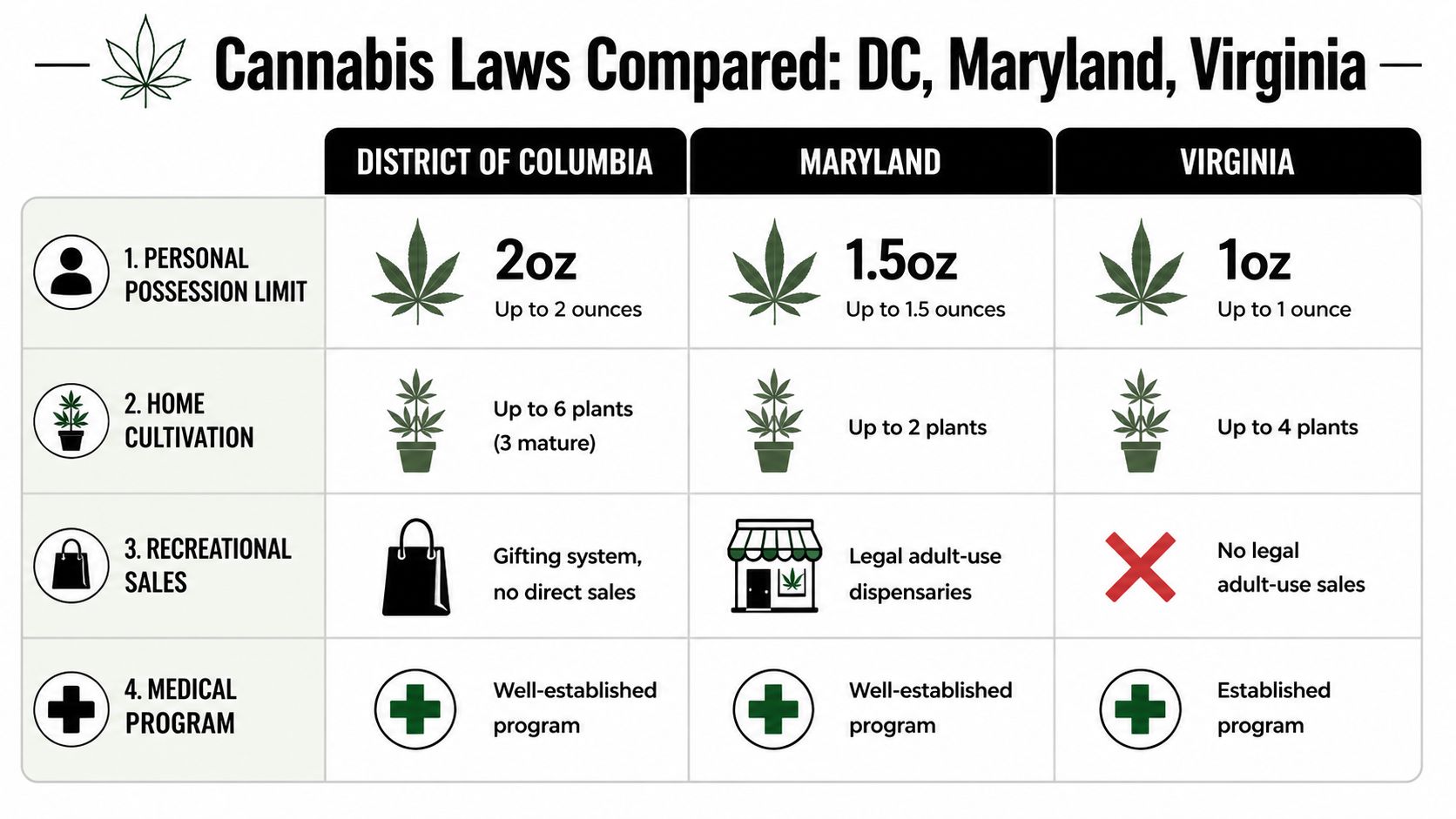
A comparison chart showing cannabis laws for personal possession, home cultivation, sales, and medical programs in DC, Maryland, and Virginia.

What changes when you cross the border

Here’s the simplest side-by-side view.

DMV Cannabis Laws at a Glance (2026) Washington, DC Maryland Virginia
Legal Status Adult possession allowed, medical program active, no standard adult-use retail system in the same way as Maryland Adult-use cannabis available through licensed dispensaries Possession and home cultivation allowed under state rules, but no legal adult-use retail sales
Personal Possession Limit Up to 2 ounces Up to 1.5 ounces Up to 1 ounce
Home Cultivation Up to 6 plants, with 3 mature Up to 2 plants Up to 4 plants
How people buy Delivery and medical channels are what most buyers need to understand Licensed adult-use dispensaries No legal adult-use retail market
Medical program Established Established Established
Public consumption Not the move. Keep it private and compliant Same basic practical rule. Private, not public Same practical rule

DC isn’t Maryland with monuments

People from Maryland often assume DC will feel similar. It won’t. DC cannabis access has long involved rules and workarounds that are different from a standard suburban dispensary visit. That’s why so many buyers in the city rely on delivery-oriented services and clear verification processes instead of expecting a simple walk-in adult-use storefront experience.

If you’re shopping in the District, use a service that explains its ordering flow clearly and serves the city directly, like DC weed delivery options through Green Express DC. The key isn’t hype. The key is knowing what process the business uses, what ID it checks, and whether it operates in a way that matches DC’s framework.

Maryland is the least confusing option

For adults who want the most conventional cannabis store experience in the region, Maryland is the easiest. You go to a licensed dispensary, show ID, and shop through an adult-use market that feels familiar to anyone who has bought from a regulated store elsewhere.

That doesn’t mean every Maryland shop is equal. Some are better for selection, some for speed, some for concentrates, and some for budget flower. But the legal structure itself is cleaner and easier to understand than what you’ll deal with in DC or Virginia.

Virginia is where people make bad assumptions

Virginia causes the most consumer confusion because people hear one true thing and then leap to the wrong conclusion. Yes, possession rules changed. Yes, home cultivation exists. No, that does not mean there’s a normal adult-use retail buying system.

That’s where people get themselves into sketchy situations. They assume legal possession automatically means easy legal purchase. It doesn’t.

If you live in Northern Virginia, don’t confuse possession rules with a retail market. Those are different questions.

Why this matters beyond convenience

A legal retail system isn’t just about making shopping easier. It also improves access to safer, more accountable products and takes buyers away from unregulated channels. Broader cannabis retail expansion has also been linked with societal benefits. NORML’s fact sheet on societal impacts of cannabis dispensaries notes that higher cannabis store density has correlated with lower opioid mortality rates in legal states, and median home prices in zip codes with dispensaries rose 1.6% more than surrounding areas.

The practical takeaway is simple. If you want to buy legally and with less hassle, stop thinking of the DMV as one big cannabis market. It’s three separate rulebooks sharing the same traffic.

How You Buy Dispensary vs Delivery Service

Buying from a cannabis store works a lot like deciding between going out to eat and ordering dinner in. Both can be good. One gives you the browse-and-chat experience. The other saves you the trip and keeps things private.

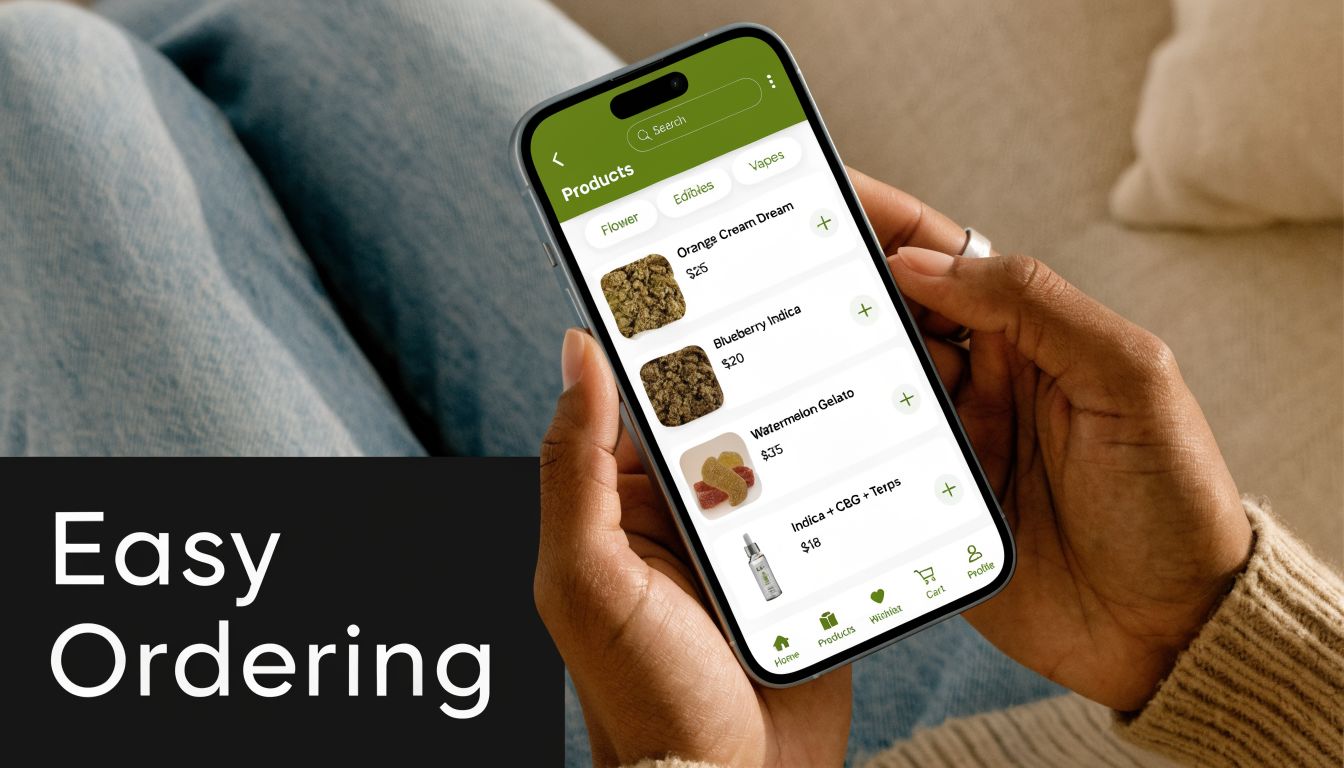
A person holding a mobile app for a cannabis store while holding a refreshing cold drink.

When a dispensary makes sense

An in-person dispensary is the better fit if you want to slow down, ask questions, and look at products before choosing. That’s common in Maryland, where adult-use storefront shopping is straightforward.

A store visit works well for buyers who:

  • Want face-to-face guidance: You can ask a budtender about flower, carts, gummies, or a specific strain type.
  • Need to compare options physically: Some shoppers like seeing packaging, brand variety, and product formats in person.
  • Prefer instant pickup: Once you’re checked in, you leave with your order.

The downside is obvious. You have to get there, park, wait, and shop in public. If you’re busy, staying in a hotel, or just don’t want the errand, that can feel like too much friction.

When delivery is the smarter play

Delivery makes more sense when convenience and discretion matter more than browsing a showroom. That’s especially true in DC, where many buyers already expect to order through a menu, verify their information, and have a courier complete the handoff.

This route fits people who want:

  • Privacy: No waiting room, no storefront visit, no public stop on your way home.
  • Convenience: You order from your phone and handle the rest from your couch, hotel, or apartment.
  • A focused menu: Delivery menus often feel more curated, which helps buyers who don’t want to dig through endless options.

The real difference

A dispensary gives you a retail outing. Delivery gives you a completed task.

That sounds small, but it changes everything. If you already know you want a hybrid preroll, a live resin cart, or a bundle of concentrates, delivery is usually the cleaner move. If you’re brand new and want a longer conversation, a physical dispensary may feel more comfortable if you’re in a jurisdiction where that’s available.

Choose a dispensary when you want an experience. Choose delivery when you want efficiency.

For most DC buyers, and a lot of visitors, efficiency wins.

How to Safely Order Cannabis Online

Ordering online is easy when the service is legitimate. It feels sketchy when it isn’t. The difference usually shows up before checkout.

Step one is vetting the service

Don’t start with the menu. Start with the business itself. A serious cannabis store or delivery service should explain who it serves, how ordering works, what ID it checks, and how customers get support if something goes wrong.

Look for:

  • Clear contact information: A real phone number or support channel matters.
  • Defined service area: The site should tell you whether it serves DC, and not pretend it covers places where the law doesn’t support that model.
  • Straightforward policies: Age checks, payment expectations, and delivery terms shouldn’t be buried.
  • A professional menu flow: If the menu is chaotic, mislabeled, or full of mystery products with no useful descriptions, move on.

Then read the menu like a normal person

A lot of buyers overcomplicate this part. You don’t need to decode the entire cannabis universe in one sitting. Pick the product type first. Flower if you want the classic route. Vapes if you want convenience. Edibles if you don’t want to smoke. Concentrates if you already know your tolerance is high.

Once you narrow the format, check details like strain type, flavor profile, and whether the product sounds right for day use or nighttime use. Don’t buy the strongest thing just because it has the flashiest name.

Expect ID verification and don’t fight it

A reputable service verifies age and identity because that’s basic compliance, not an annoyance. If a business seems too casual about that, that’s a warning sign, not a bonus.

This is especially important for visitors. National Holistic’s published information about DC patient access and visitor options highlights a bigger local problem. Tourists represent 25% of DMV cannabis traffic, yet many FAQs still fail to explain non-resident purchasing options clearly. Good delivery services close that gap by making out-of-state ID verification more manageable and more transparent.

If a service doesn’t care who you are, it probably doesn’t care what it delivers either.

What the ordering flow usually looks like

Most smooth online orders follow a simple pattern:

  1. Browse the menu
    Pick your category first, then narrow by effect or format.

  2. Submit your order
    Add your items, include delivery details, and follow any checkout instructions.

  3. Respond to verification
    You may need to upload ID details or confirm them before drop-off.

  4. Wait for confirmation
    A real business confirms availability, timing, and the handoff process.

  5. Complete the delivery
    Have your valid government ID ready when the courier arrives.

If you want a direct example of how a city-focused service presents this process, look at Green Express DC’s cannabis delivery page. The useful part isn’t the branding. It’s the clarity around service flow, product categories, and verification expectations.

Payment and common sense

In DC, payment methods can be more limited than what buyers expect from mainstream retail. Cash on delivery is still common. That means you should confirm payment expectations before the courier arrives, not after.

Also, don’t order to a place where you can’t receive the handoff cleanly. If you’re in a hotel, know the property’s front desk setup. If you’re at an apartment building, be reachable. If you’re visiting from out of state, have your ID ready and don’t improvise at the door.

Safe online ordering isn’t complicated. Pick a service that acts like a real business, follow the verification process, and don’t chase shady shortcuts.

A Simple Guide to Cannabis Products

Most menus look overwhelming because they mix beginner products and heavy-hitter products on the same page. The easiest way to make sense of a cannabis store menu is to think in everyday categories. Flower is like craft beer. Concentrates are like spirits. Edibles are the slow burn. Vapes are the grab-and-go option.
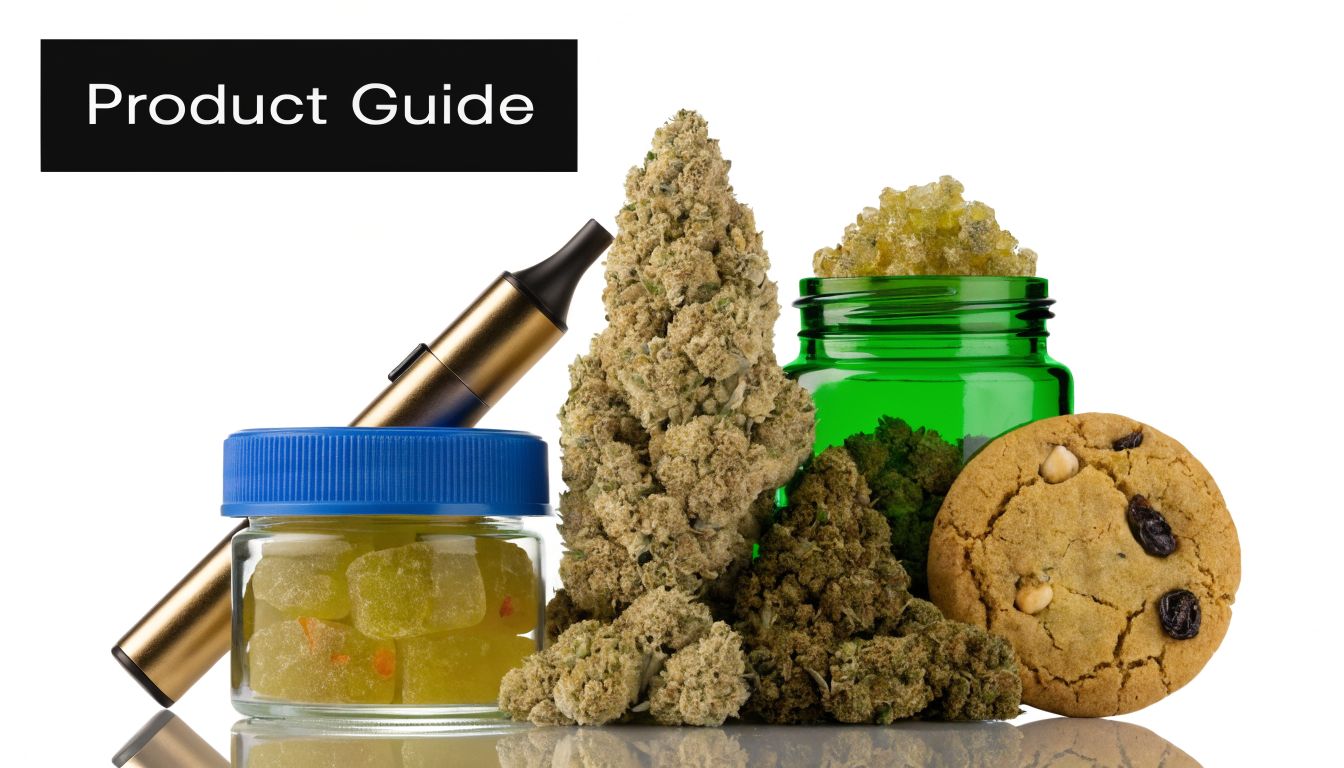
An assortment of cannabis products including dried buds, gummies, a vape pen, and a baked cookie.

Flower is the classic lane

Flower is typically what's pictured first. Buds, jars, grinder, lighter, preroll. It’s the most familiar category and still one of the easiest for a new buyer to understand.

Think of flower like beer or wine. There’s variety, nuance, and room to explore without jumping straight into the deep end. You’ll usually see three broad labels:

  • Indica: Often chosen for evening use or a heavier, slower vibe
  • Sativa: Often picked for daytime or a lighter headspace
  • Hybrid: A middle lane that can lean either direction

These aren’t magic categories, but they’re useful starting points when you’re scanning a menu.

Concentrates are for experienced users

Concentrates include products like shatter, wax, live resin, and rosin. These are the stronger formats people usually move to after they already know how they respond to cannabis.

Think of them like liquor. You use less, the effects hit harder, and a little too much can turn a good time into a bad hour. If you’re brand new, don’t start here just because the names sound cool.

A few common types:

  • Shatter: Glassy and brittle. Popular with buyers who want a potent, straightforward concentrate.
  • Wax: Softer texture and easy to recognize on many menus.
  • Live resin: Known for preserving more of the plant’s flavor and aroma profile.
  • Rosin: Solventless and often chosen by people who care a lot about extraction style.

Here’s a quick visual explainer before you pick your format.

Vapes are built for convenience

Vapes are the easiest category for buyers who want low fuss. Cartridges and disposables are portable, simple to use, and easier to keep discreet than flower.

They’re a good fit if you want:

  • Less smell
  • No grinding or rolling
  • Quick use without much setup

The tradeoff is that quality matters a lot. Don’t treat all carts and disposables like they’re interchangeable. Hardware quality, oil consistency, and brand reputation make a real difference.

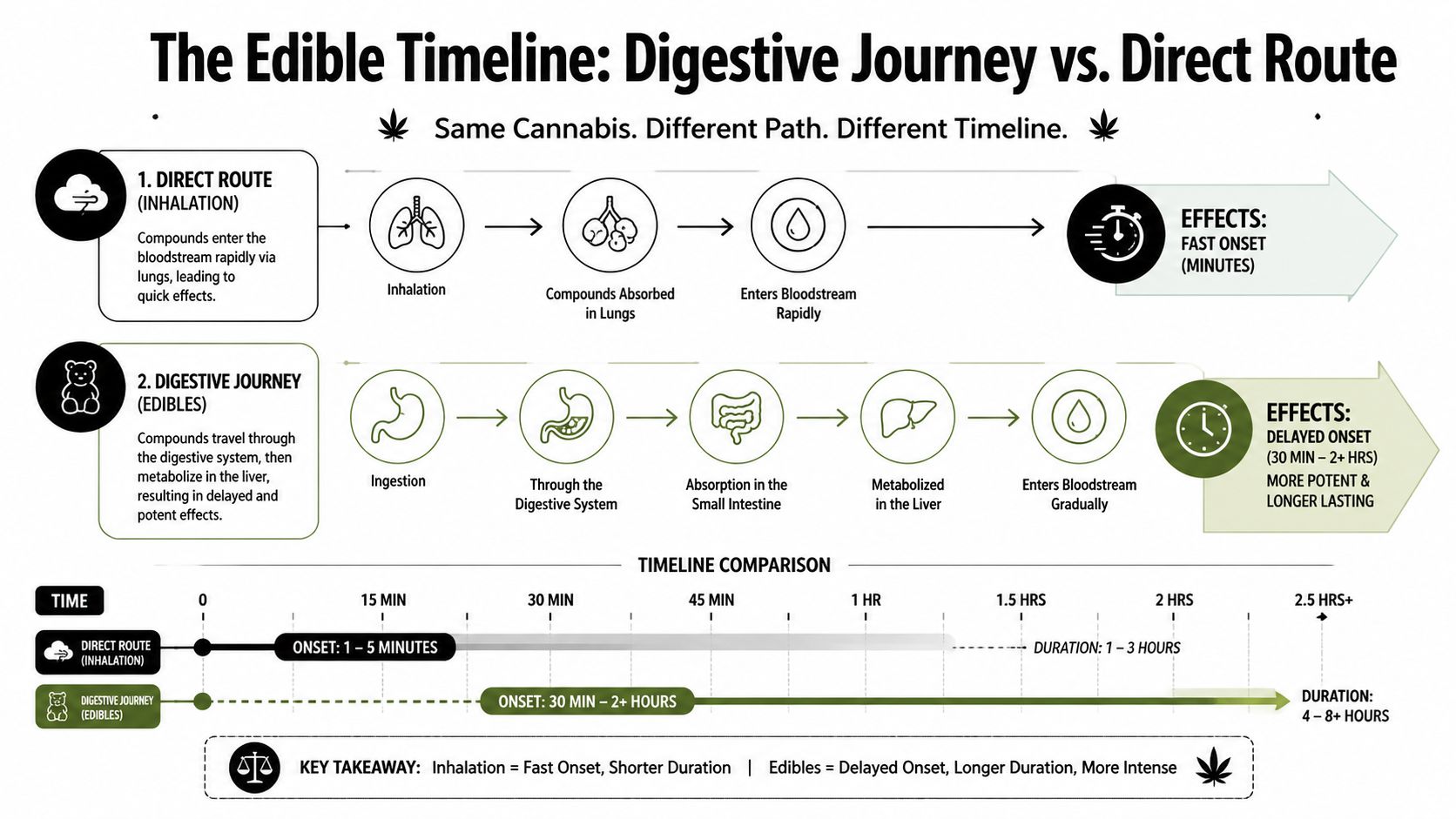
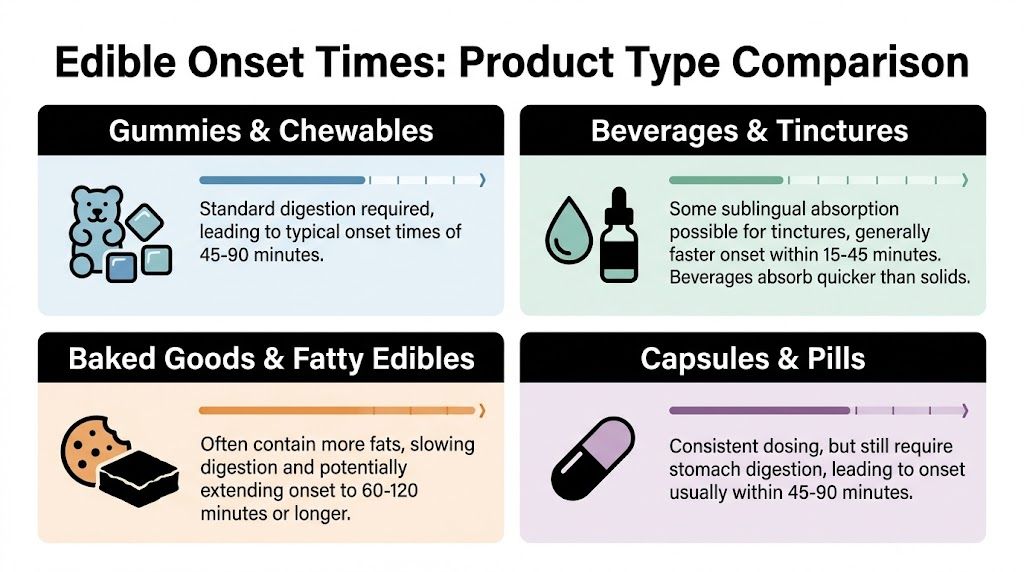
Edibles take patience

Edibles are where new users make the same mistake over and over. They don’t feel anything right away, assume nothing’s happening, then take more.

Don’t do that. Edibles take longer to come on and can feel much stronger than expected once they do. Gummies and baked products can be great if you want to avoid smoking, but they require patience and a calm setting.

Start low and go slow. Especially with edibles.

Matching the product to the moment

If you’re trying to choose fast, use this simple filter:

What you want Better starting point
Traditional experience Flower or prerolls
Portable and discreet Vape cart or disposable
Longer-lasting option Edibles
High potency Concentrates
Beginner-friendly menu choice Flower, prerolls, or a low-dose edible approach

The smartest cannabis store shoppers don’t chase the strongest item on the page. They match the product to the situation. If you’re heading to bed, your choice may be different from what you’d pick before a museum day, a concert, or a quiet night in.

Tips for First-Timers and Budget Buyers

First-timers and budget shoppers need the same thing. A little discipline. New buyers need it so they don’t overdo it. Budget buyers need it so they don’t waste money on the wrong product.

If it’s your first time, keep it boring

That’s advice, not an insult. Your first order shouldn’t be a random pile of high-powered products because a menu looked exciting. Go simple. One flower option, maybe a preroll, or a very modest edible approach if you don’t want to smoke.

A few rules make the first experience much better:

  • Use cannabis somewhere comfortable: Home, hotel room, or another private place where you don’t need to be “on.”
  • Don’t mix recklessly: If you’re drinking heavily too, you’re asking for a sloppy night.
  • Give it time: Especially with edibles.
  • Stay with familiar company if possible: A calm setting helps more than people admit.

Budget shopping isn’t about buying the cheapest thing

Cheap and good are not the same. A better approach is to shop for value per session and value per effect. That’s where bundles, bulk specials, and stronger formats can make sense for some buyers.

Don Fuego’s DC cannabis pricing discussion notes that DC cannabis prices rose 15% in 2025 due to supply chain issues, which is exactly why more buyers are hunting for rotating specials and bundles. The same source also points out a nuance many menus ignore. Premium concentrates can offer better long-term value per mg of THC than lower-end flower.

That doesn’t mean everyone should buy concentrates. It means you should stop measuring value only by sticker price.

How to shop smarter

Use this framework instead of chasing random “deals”:

  • Check bundle logic: A bundle is only a bargain if you want all the items in it.
  • Compare product type, not just price: A flower special and a concentrate special solve different needs.
  • Look for lab-tested, clearly described items: Vague product listings usually lead to regret.
  • Buy for your routine: If you mostly use at night, don’t let flashy daytime vapes distract you.
  • Know your minimum order habits: If a service has a minimum, plan a smarter basket instead of panic-adding junk.

The cheapest cart on the menu can still be the most expensive mistake if you hate using it.

My blunt recommendation

If you’re new, pay for simplicity. If you’re experienced, pay for consistency. If you’re budget-conscious, buy fewer things, but buy the right things.

That’s how you stretch your money without filling a drawer with products you barely touch.

Why Green Express DC Is Your Go-To Delivery Service

If you’re buying in DC, the service matters as much as the menu. A good delivery operation should make the process cleaner, not more confusing. That means clear ordering, solid verification, discreet drop-off, and a menu that doesn’t feel stale or random.

A friendly delivery worker wearing a green cap and high visibility vest holding a package.

What reliable delivery should look like

The baseline is simple. You should be able to browse products, place an order without confusion, know what the handoff requires, and expect professional ID verification at delivery. Fast service is nice. Predictable service matters more.

For DC buyers, that’s why Green Express DC’s delivery service page is worth a look as one local option. The service focuses on same-day delivery in Washington, DC, uses discreet packaging, verifies valid government ID at drop-off, and offers a menu that includes flower, concentrates, vapes, edibles, and tinctures.

Fresh inventory isn’t luck

A lot of people judge a cannabis store by branding, logo, or how fancy the menu looks. That’s the wrong test. What matters is whether the operation keeps products moving, tracks what sells, and avoids stale inventory.

That part is measurable. MJ Platform’s analysis of inventory tracking in cannabis retail says modern cannabis delivery services use inventory tracking reports to optimize menus, directly uplifting revenue by 12-22%. By analyzing sales velocity for products like live resin and flagging reorders when stock runs low, delivery services can keep menus fresher and more reliable.

For buyers, the practical benefit is obvious:

  • Better chance the item you want is available
  • Less old inventory sitting around
  • A more curated menu instead of clutter
  • Smoother repeat orders because the operation tracks demand

Who this fits best

A DC delivery service is the right move for a few types of buyers:

  • Busy locals: You don’t want to build your evening around a store run.
  • Visitors: You want a cleaner, more private process while staying in the city.
  • Experienced users: You know what you like and don’t need a storefront trip.
  • People who care about discretion: Door delivery is easier than making a public stop.

My view is simple. In DC, convenience only counts if it comes with professionalism. If the service is sloppy, it’s not convenient. It’s a headache in disguise.


If you want a straightforward way to shop a cannabis store menu in DC without the usual confusion, take a look at Green Express DC. You can browse the menu, place an order, and use a delivery process built around discreet drop-off, age verification, and same-day convenience for adults 21+ in Washington, DC.
Posted on

Weed Delivery Guide for DC, MD & VA

You’re in the DMV, it’s been a long day, traffic has already taken enough from you, and the last thing you want is to sit in another line just to buy cannabis. Maybe you live in DC, work in Maryland, and have friends in Virginia. Maybe you’re visiting for a conference and trying to figure out what’s legal without stumbling into a gray-market mistake.

That’s where weed delivery gets useful, and also where people get confused fast.

The tricky part isn’t understanding why delivery appeals to people. That part is simple. It’s private, convenient, and easier to fit into real life. The hard part is that DC, Maryland, and Virginia do not follow the same rules. A service that sounds normal in one part of the DMV may be restricted, medical-only, or not legally structured the same way in another.

This guide walks through weed delivery the way a careful local would explain it to a friend. We’ll keep it practical. We’ll focus on safety, legality, and how to choose wisely.

The Modern Convenience of Cannabis at Your Doorstep

A lot of people come to weed delivery for ordinary reasons. They’ve got work, kids, errands, roommates, neighbors, or just a strong preference not to turn a simple purchase into a public outing. Delivery solves a basic problem. It lets adults shop from home, read a menu at their own pace, and receive products without adding another stop to the day.

That convenience didn’t become popular by accident. During the pandemic, cannabis delivery moved from a niche option to a mainstream one. Delivery and curbside pickup surged to 40% of all US weed sales in spring 2020, according to this cannabis delivery market whitepaper. That change was tied to lockdowns, safety concerns, and the appeal of contactless service.

A delivery person wearing a flat cap holds a large black bag with a green logo.

Why delivery feels normal now

For many adults, delivery now fits cannabis into the same mental category as food delivery, grocery drop-off, or pharmacy pickup. You browse, compare, order, verify your identity, and wait at home. That rhythm feels familiar.

A few things make weed delivery especially appealing:

  • Privacy at home: You can browse flower, edibles, vapes, or concentrates without standing at a counter while other people listen.
  • More time to choose: Delivery menus let you slow down and read product details instead of making a rushed decision.
  • Less friction: You don’t have to plan parking, store hours, or a trip across town.
  • Better for newcomers: People who feel unsure in a dispensary often find online browsing less intimidating.

Practical rule: Convenience matters, but with cannabis, convenience only counts if the service is operating legally where you are.

Why the DMV needs a closer look

In the DMV, weed delivery isn’t one single thing. A person in Washington, DC may have access to options that don’t work the same way in Arlington or Bethesda. A Maryland resident can’t assume DC rules apply at home. A Virginia consumer can’t assume adult-use delivery exists just because adult possession gets discussed so often.

That mismatch causes most of the confusion. People hear “weed delivery” and picture one standard model. The actual situation differs. The legal path depends on the jurisdiction, whether the order is medical or adult-use, and how the business is licensed.

If you remember only one thing from this section, remember this: weed delivery is now a common part of the cannabis market, but in the DMV, the legality depends on your side of the border. Border lines matter here more than is commonly understood.

Navigating Weed Delivery Laws in DC Maryland and Virginia

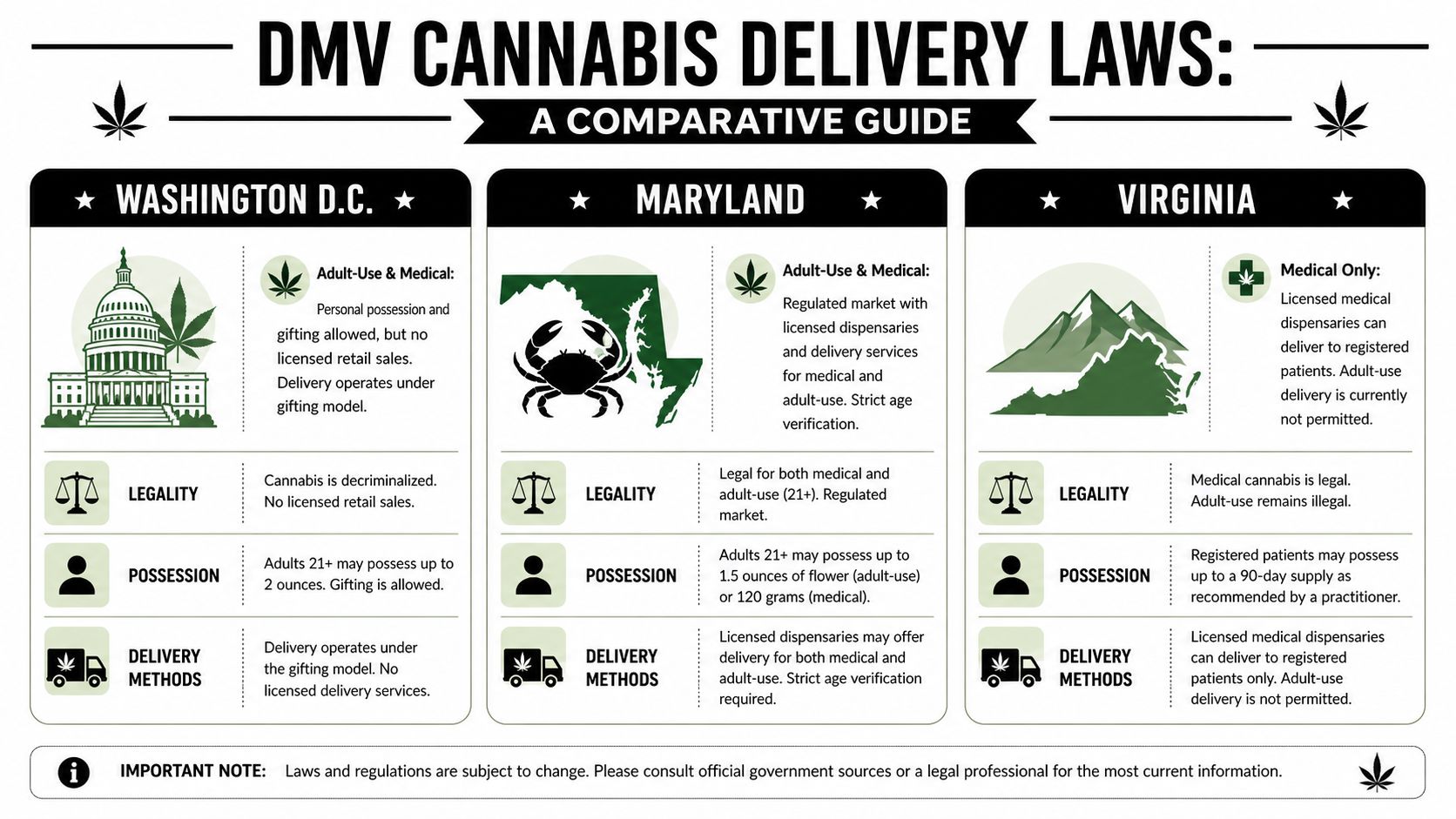
The fastest way to understand weed delivery in the DMV is to compare the three jurisdictions directly. DC, Maryland, and Virginia sit close together on the map, but they don’t handle cannabis delivery the same way.

A comparative infographic outlining cannabis delivery laws and possession limits in Washington D.C., Maryland, and Virginia.

The core difference at a glance

Jurisdiction Recreational Delivery Status Medical Delivery Status Key Consideration
Washington, DC Adult-use access exists in a unique local environment, but it does not work like a standard licensed retail system Licensed medical delivery is allowed DC has separate realities for medical delivery and adult-use access
Maryland Adult-use cannabis is regulated through the state market Medical access also exists Buyers should expect a more traditional regulated retail framework
Virginia Adult-use delivery is not currently permitted Medical delivery is allowed for registered patients Virginia is the most restrictive of the three for delivery

Washington, DC

DC is the jurisdiction that confuses people most.

Many people have heard about Initiative 71 and the long-running “gifting” model. That history matters, but it often gets mixed up with the District’s licensed medical cannabis delivery system. Those are not the same thing. If you’re trying to stay on solid legal ground, it’s important to separate informal assumptions from licensed operations.

For licensed medical delivery in DC, the rules are strict. Under ABCA regulations, courier vehicles must stay within District boundaries and cannot transit through Virginia or Maryland, as stated on the ABCA medical cannabis courier license page. That sounds like a small detail, but it tells you a lot about how seriously the District treats chain of custody and compliance.

Here’s what that means in plain language:

  • The delivery starts and ends inside DC: A licensed courier can’t cut through Maryland or Virginia to save time.
  • The route is part of compliance: The trip itself has rules, not just the product.
  • Tracking matters: The product must stay tied to a licensed source and a documented delivery process.

In DC, legal delivery is less about speed claims and more about whether the service can document where the product came from and how it reached the customer.

If you’re trying to understand adult-use shops and the local gray areas, it helps to read a focused breakdown of I-71 compliant shops in DC. That kind of context is useful because many consumers use the phrase “weed delivery” to describe systems that don’t all operate under the same license structure.

Maryland

Maryland is easier for many readers to understand because it looks more like a standard regulated market. The state has adult-use and medical cannabis within a formal framework, and consumers generally expect licensed dispensaries, age checks, and clearer retail boundaries.

That doesn’t mean every business model is identical, and it doesn’t mean you should assume all services deliver to all addresses. But Maryland consumers are typically dealing with a more conventional setup than DC’s mix of local policy, medical delivery rules, and broader public confusion around gifting versus licensed activity.

A practical way to think about Maryland is this:

  • Expect a regulated purchasing experience
  • Expect identity and age verification
  • Expect service areas and operating policies to vary by provider

Virginia

Virginia is the most limited of the three if you’re talking specifically about delivery. The key point is simple. Adult-use delivery is not currently permitted, while medical delivery is tied to registered patients through licensed medical channels.

That distinction matters because many people hear “Virginia has cannabis laws” and assume that means delivery is broadly available. It doesn’t. If you’re in Northern Virginia, the legal analysis is different from DC and different from Maryland.

People often get tripped up by geography. You may be only minutes from the District, but cannabis rules don’t travel with you just because the Beltway does.

A few DMV rules people often misunderstand

Some mistakes show up again and again:

  • Thinking a DC service can just cross into Maryland or Virginia: It can’t if the licensed framework says the delivery must remain in DC.
  • Assuming “adult-use legal” means “adult-use delivery legal”: Those are separate questions.
  • Believing proximity changes the law: Living near a border doesn’t blend legal systems together.
  • Treating every online menu as equally compliant: A professional website doesn’t prove a legal operating model.

For DMV residents, the safest habit is to start with location. Ask one question first: Where will the order be delivered? Once you answer that, the legal options narrow quickly.

Your First Weed Delivery Order A Step by Step Guide

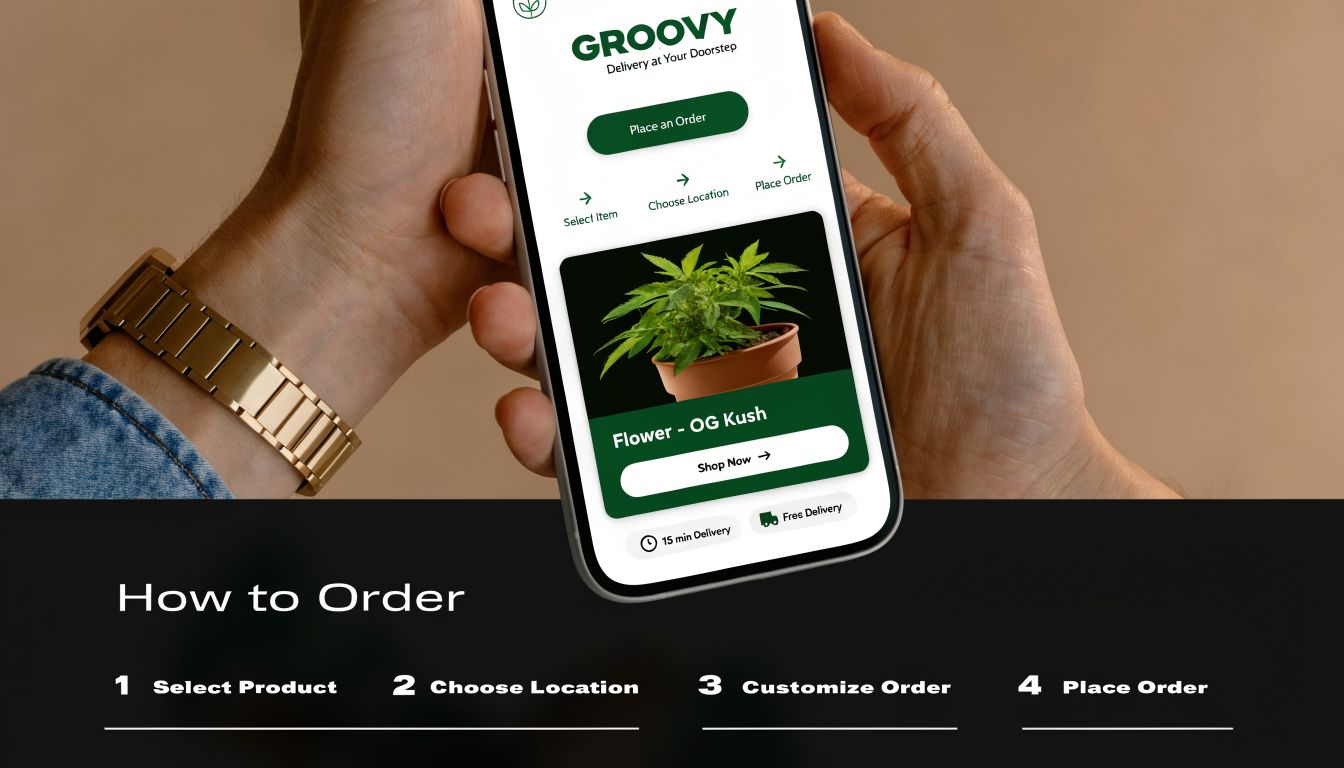
If you’ve never used weed delivery before, the process is usually simpler than people expect. The anxiety mostly comes from not knowing what happens after you place the order. Once you understand the sequence, it feels much more routine.

A smartphone held in hand displaying a cannabis delivery app interface with an ordering guide below.

Step one is checking that the service fits your location

Before you browse products, confirm that the service delivers to your address and does so under the rules that apply there. This matters a lot in the DMV because crossing from one jurisdiction to another changes the legal picture.

Look for basics first:

  • Delivery area: Does the service clearly name where it operates?
  • Eligibility: Is it medical-only, adult-use, or tied to a specific local structure?
  • Hours: Delivery windows can be narrower than people expect.
  • ID requirements: A serious service explains this up front.

If the site is vague about where it delivers or how verification works, that’s a reason to pause.

Step two is reading the menu like a calm shopper, not a rushed one

A delivery menu can feel overwhelming at first. You may see flower, prerolls, vape carts, disposables, shatter, wax, live resin, gummies, tinctures, and more. Don’t try to understand everything in one pass.

Start with three simple choices:

  1. Product type
    Ask whether you want something inhaled, eaten, or used more gradually, such as a tincture.

  2. Desired experience
    Are you looking for something light, relaxing, social, or more potent?

  3. Comfort level
    If you’re new, choose the most straightforward format, not the most intense one.

Order the product you understand best, not the one with the flashiest description.

Step three is placing the order

Most services let you order online, and some also accept phone orders. During checkout, you’ll usually enter your name, delivery address, and contact details. Some services may ask for identification details before dispatch. Others verify mainly at drop-off.

The main thing to know is that ID checks are normal. They’re not a nuisance. They’re a sign that the courier is following procedure.

A short visual walkthrough can help if you like seeing the process before trying it yourself.

Step four is preparing for delivery

Once your order is accepted, stay reachable. Keep your phone nearby. Delivery windows can shift with traffic, order volume, and route planning.

Have these ready:

  • A valid government ID: Don’t wait until the driver arrives to start looking for it.
  • Access instructions: If you live in an apartment, condo, or building with a front desk, be clear.
  • Payment method: Some services use cash on delivery, so confirm before arrival.

Many first-time customers ask about packaging. In a legitimate delivery setup, packaging is usually designed for privacy and professionalism. That generally means sealed products and a low-key handoff, not a flashy branded exchange.

Step five is the handoff

When the courier arrives, the interaction is usually brief. They verify identity, confirm the order, complete the transaction, and hand off the package. If you were expecting a long or awkward exchange, it usually isn’t.

A few smart habits make the experience smoother:

  • Be on time: Drivers are working a route, not making open-ended social calls.
  • Use your legal name if required by the service: Matching records reduces confusion.
  • Meet at an appropriate location: Follow the service’s rules for where handoff can happen.
  • Check the order promptly: Make sure what you received matches what you ordered.

For most adults, the first weed delivery order feels unfamiliar only once. After that, it’s just another service you know how to use.

How to Verify Quality and Safety in Cannabis Products

When people talk about cannabis delivery, they often focus on speed. That’s understandable, but speed is not the most important question. Quality control is. If a service can’t clearly explain where its products come from, how they’re tracked, and whether they’re tested, convenience stops being a benefit.

The strongest safety concept to understand is seed-to-sale tracking. In DC’s licensed delivery ecosystem, products are logged through a METRC-integrated system so they can be tracked from source to final handoff. According to this DC delivery compliance update, that system enables recalls if contaminants exceed ABCA limits, including pesticides below 0.1 ppm, and it has been associated with a 30 to 40% reduction in adulterated product incidents compared with unregulated markets.

What lab-tested should mean

“Lab-tested” gets used a lot, and some consumers treat it like a decorative phrase. It shouldn’t be decorative. It should signal that the product has gone through a controlled testing process tied to a regulated supply chain.

A careful buyer looks for signs that the service takes testing seriously:

  • Clear product labeling: The menu should identify what the item is, not hide behind vague names.
  • Consistency across listings: Random, uneven descriptions can signal weak inventory controls.
  • Traceability language: A reputable service should be able to explain where products come from and how they’re handled.
  • Compliance mindset: If the service talks openly about ID checks, sourcing, and packaging, that’s usually a better sign than a site focused only on hype.

If you want to see how a delivery menu can present products in a more organized way, browsing a structured DC cannabis delivery menu can help you understand what transparent product categories and descriptions look like.

What to watch for when claims sound too loose

“Organic,” “top shelf,” “gas,” and “exotic” can all sound appealing. They’re not useless terms, but they don’t replace evidence of safe handling. A product can be marketed beautifully and still leave important questions unanswered.

Here’s a simple filter that works well:

Question Why it matters
Is the product clearly categorized? You should know whether you’re buying flower, concentrate, vape, or edible
Does the service explain verification? Strong compliance often reflects stronger overall operations
Does the business sound professional about sourcing? Safety starts long before delivery day
Are the claims specific or just flashy? Specific information is usually more trustworthy than pure hype

Safety starts before the driver leaves the shop. It begins with sourcing, testing, recordkeeping, and a business that acts like those details matter.

For beginners, this is the easiest rule to remember: buy from services that make quality boring in a good way. The safer operation is often the one that sounds calm, clear, and procedural.

Choosing the Right Product From Flower to Edibles

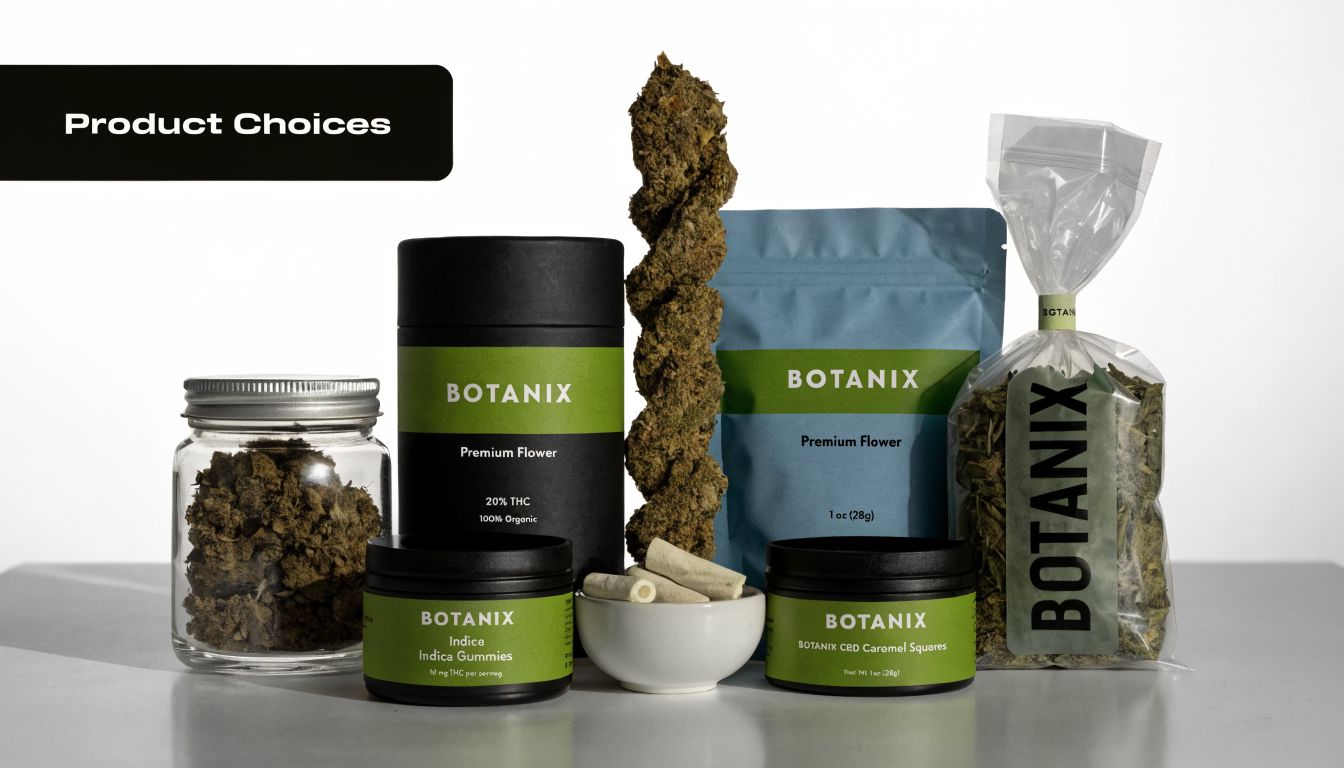
A weed delivery menu can look huge, but most products fall into a few familiar groups. Once you understand those groups, shopping gets easier. You stop scrolling aimlessly and start matching a product to the kind of experience you want.

A display of various Botanix brand cannabis products including flower jars, pouches, gummies, and pre-rolls.

Flower for the classic experience

Flower is still where many people start. It’s the dried cannabis bud sold in jars, bags, or as prerolls. If you’ve heard terms like indica, sativa, and hybrid, that language usually appears here first.

A simple way to think about them:

  • Indica-leaning options: Often chosen by people who want a slower, more settled vibe
  • Sativa-leaning options: Often chosen for daytime, conversation, or a more lifted feel
  • Hybrid options: A middle ground for people who want a blend of effects

Those labels can guide you, but they aren’t magic formulas. Strain details, terpene profiles, and potency all matter too. For a newer user, flower is often easier to understand than concentrates because the experience is usually more familiar and easier to pace.

Vapes for convenience and lower odor

Vapes appeal to people who want portability and a more discreet format. On a menu, you’ll usually see disposables and cartridges.

Disposables are simple. You buy the device ready to use. Cartridges usually attach to a compatible battery. If you don’t already own the hardware, a disposable is often the easier first purchase.

People often choose vapes because they’re convenient, but there’s a tradeoff. They can feel so easy to use that some beginners consume more than intended. Short pulls and patience matter.

If you’re new to vaping cannabis, wait before taking another hit. Ease of use can make it feel milder than it is.

Concentrates for experienced users

Concentrates include products like shatter, wax, live resin, and rosin. These products are more potent and usually better suited to people who already know how cannabis affects them.

The texture and format vary:

  • Shatter: Glass-like and brittle
  • Wax: Softer and easier to handle
  • Live resin: Known for strong aroma and flavor
  • Rosin: Popular with buyers who pay attention to extraction style

If you’re brand new, concentrates usually aren’t the best first stop. They can be excellent products, but they reward experience and careful dosing.

Edibles for people who don’t want to inhale

Edibles include gummies, chocolates, baked items, and infused drinks where available. Many adults prefer them because there’s no smoke or vapor involved.

The part that trips people up is timing. Edibles take longer to kick in than inhaled products. That delay causes many bad first experiences, because someone feels nothing, takes more, and then gets far more intoxicated than planned.

A smart beginner approach looks like this:

  1. Choose a clearly labeled edible
  2. Start with a modest amount
  3. Wait patiently before taking more
  4. Don’t mix impatience with extra dosing

A quick match guide

If you want Start with
Familiar, traditional cannabis use Flower or prerolls
Convenience and portability Disposable vape
Stronger, more advanced options Concentrates
No inhalation Edibles or tinctures

The best product isn’t the one another person recommends with the most enthusiasm. It’s the one that fits your experience level, your setting, and your willingness to go slow.

Spotlight on Green Express DC Services and Deals

In DC, people often care about three things at once. They want convenience, they want discretion, and they want products that feel worth the money. A service stands out when it can handle all three without making the process confusing.

That’s where Green Express DC is a useful example. The service focuses on same-day cannabis delivery in Washington, DC, with a menu that includes flower, concentrates, vapes, edibles, and tinctures. The setup is simple for customers. Browse, order, verify, and receive the package with a professional handoff. You can see the service details on the Green Express DC delivery page.

Why this model fits DC especially well

DC has a lot of people who don’t want a drawn-out retail experience. Some are locals with packed schedules. Others are travelers, conference attendees, or people staying in short-term accommodations who want a low-key process.

That preference is reflected in visitor behavior. According to this contactless cannabis delivery article focused on traveler preferences, up to 40% of urban cannabis-using visitors prefer delivery for privacy, especially when services use unmarked vehicles and vacuum-sealed packaging.

Green Express DC also highlights details many customers look for right away:

  • A $50 minimum, which keeps ordering accessible
  • Cash on delivery, which keeps payment simple for many buyers
  • Rotating specials, including deals like $150 for 10g of shatter or crumble
  • Lab-tested, organic products, which matters to buyers who care about safety, not just speed

The practical takeaway

A good delivery service doesn’t just move products from point A to point B. It reduces hassle without making the experience feel sketchy. In DC, that means clear menus, discreet packaging, reliable communication, and a process that respects both privacy and compliance.

For locals, that’s convenience. For visitors, it can also mean avoiding the uncertainty that comes from trying to decode unfamiliar local cannabis norms on the fly.

Frequently Asked Questions About Weed Delivery

Can you get weed delivery to a hotel or Airbnb in DC

Sometimes, but you should never assume. The key issue is whether the service allows that destination and whether the location itself permits a handoff. Hotels, apartment buildings, and short-term rentals may have their own policies, and delivery services may also set rules about where they can complete an order.

The safest move is to ask before ordering. Be clear about whether you’re at a hotel front desk, in a lobby-access building, or at a private rental.

Do you need to show ID every time

You should expect to. That’s a normal part of a professional cannabis delivery process. Even if you’ve ordered before, the courier may still need to verify that the person receiving the order is the correct, eligible customer.

If a service acts casual about ID, that’s not reassuring. It’s a warning sign.

Is packaging actually discreet

Usually, yes, if you’re dealing with a serious service. Discreet packaging generally means the products are sealed, the exterior isn’t screaming for attention, and the handoff is handled professionally.

People sometimes imagine something theatrical. In reality, the best delivery experience is usually uneventful.

The ideal delivery is the one your neighbors never notice and you barely have to think about.

What happens if you miss the driver

That depends on the service. Some will contact you and try to coordinate. Others may need to move on and reschedule. Drivers usually operate on routes, so being unavailable can affect more than just your own order.

If you think you’ll be delayed, communicate early. A quick reply is much better than silence.

Should you tip the delivery driver

Tipping practices vary, and not everyone follows the same standard. If the service is prompt, professional, and helpful, many customers choose to tip the courier the same way they would tip for other delivery services. Check the service’s policy if you’re unsure.

Can a DC delivery service bring cannabis into Maryland or Virginia

Don’t assume that it can. Jurisdiction lines matter. Delivery legality depends on where the order is going and how the business is licensed to operate. A service that can legally deliver in DC is not automatically cleared to deliver across the border.

That’s one of the biggest misconceptions in the DMV, and one of the easiest ways to make a bad decision.


If you want a dependable option in Washington, DC, Green Express DC offers same-day cannabis delivery, discreet packaging, a curated menu of lab-tested products, and a straightforward ordering process for adults 21+ across the District.

Posted on

Wholesale Weed Supplies: A DC, VA & MD Delivery Guide

You’re ready to launch or tighten up a delivery operation in the DMV. You’ve got demand, a menu concept, maybe even a route plan. Then you hit a significant bottleneck. Wholesale weed supplies are never just about finding flower, carts, or concentrates. In DC, Maryland, and Virginia, sourcing is tied to licensing, transport risk, packaging rules, lab paperwork, and the practical question every operator eventually asks: who can deliver consistent product without creating headaches two weeks later?

That’s where most generic wholesale guides fall apart. They talk like the whole market works under one clean statewide system. The DMV doesn’t. DC has its own compliance reality. Maryland has a licensed adult-use structure. Virginia has its own limits and unresolved friction around sales. If you’re serving customers near state lines, or sourcing with one eye on compliance and the other on same-day fulfillment, those differences decide whether your operation stays smooth or starts bleeding time and money.

The upside is real. The global cannabis wholesale market is projected at USD 137.67 billion in 2026, North America held 83.82% of global market share in 2025, and the US market is projected to reach USD 428.22 billion by 2032, according to Fortune Business Insights cannabis market projections. Opportunity isn’t the problem. Execution is.

Navigating the DMV Wholesale Cannabis Market

In the DMV, sourcing isn’t just a purchasing task. It’s an operating system. The supplier you choose affects menu stability, courier workflows, customer complaints, returns, packaging, and how exposed you are if a regulator starts asking questions.

A lot of new operators focus on price first. That’s understandable, especially when customers compare menus fast and expect bundles, bulk options, and reliable same-day drops. But the cheapest supply is often the most expensive inventory you’ll ever buy. Product arrives late, labels don’t match, test paperwork is incomplete, units vary lot to lot, and your team spends the week patching problems instead of selling.

Why the DMV is harder than it looks

DC, Maryland, and Virginia sit close enough that people talk about the region as one market. It isn’t one market from a sourcing standpoint. Each jurisdiction has a different regulatory posture, a different enforcement reality, and a different level of maturity around licensed supply.

That creates a few real-world trade-offs:

  • Speed versus traceability. Fast supply is useful, but if paperwork is weak, you inherit the risk.
  • Menu breadth versus consistency. A supplier with endless SKUs can still fail on repeatability.
  • Price versus survivability. If products don’t move, low buy-in pricing doesn’t save you.
  • Regional access versus transport exposure. Close geography tempts bad decisions around movement across jurisdictions.

Practical rule: In the DMV, a “good supplier” isn’t the one with the biggest menu. It’s the one whose product, paperwork, and handoff process still look clean when an order goes wrong.

What experienced operators watch first

Before looking at flavor names or margin, smart buyers look at four basics:

Priority What to check Why it matters
Legal fit Whether the source actually fits the jurisdiction you operate in A product can be fine in one place and a liability in another
Lab discipline Whether every batch comes with usable, recent documentation Missing paperwork slows delivery and creates exposure
Packaging readiness Whether units are already prepared for compliant sale and handoff Repackaging creates mistakes
Reorder reliability Whether the same SKU can be supplied again in similar quality Customers hate menu churn

If you get those four right, you can build around them. If you get them wrong, no amount of branding or route efficiency fixes the problem.

Understanding the Legal Framework for Sourcing in DC VA and MD

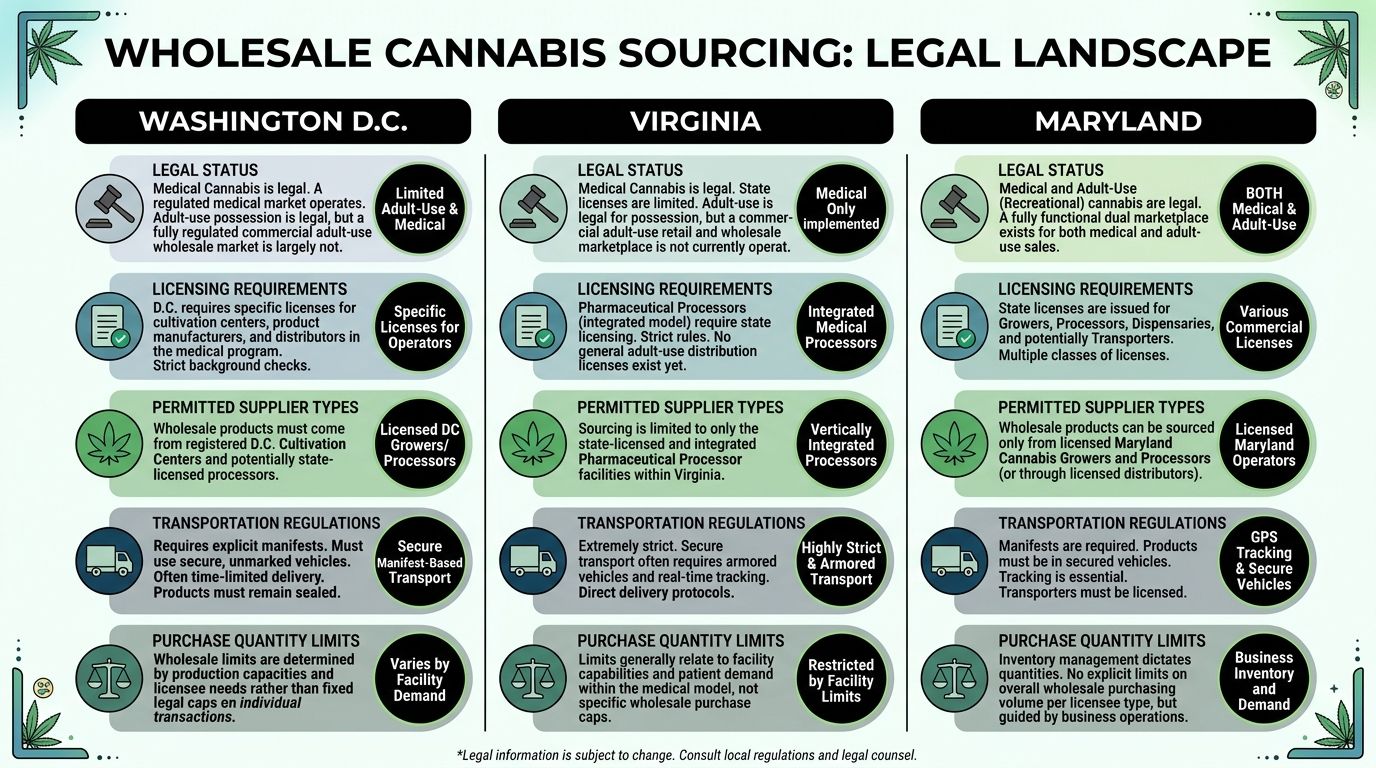
The first mistake people make is treating the DMV like a single operating zone. It’s not. Sourcing rules change when you cross from the District into Maryland, and they change again when Virginia enters the picture. If you’re buying, storing, packaging, or moving cannabis for delivery, the legal model in each jurisdiction matters more than your business plan.

A comparison chart outlining the legal landscape for wholesale cannabis sourcing in Washington D.C., Virginia, and Maryland.

DC operates on a different logic

In Washington, DC, sourcing conversations always have to account for the District’s unusual market structure. Operators and buyers often use the same words that licensed adult-use markets use, but the practical environment is different. That difference affects how products are described, how business relationships are formed, and how carefully you need to evaluate supply claims.

If you’re trying to understand the District’s compliance culture before you source, reviewing established I-71 compliant shops in DC gives useful context for how operators present products, gifting relationships, and customer-facing practices. It won’t replace legal advice, but it does show you the language and boundaries serious operators pay attention to.

Maryland is the cleanest wholesale environment in the region

Maryland gives buyers the most straightforward sourcing path in the DMV because the market is structured around licensed cultivation, processing, and retail. That doesn’t mean it’s simple. It means the chain of custody is more legible.

For buyers, that usually means:

  • You can evaluate suppliers through formal business records and product documentation.
  • Inventory tends to be easier to compare lot to lot.
  • Packaging and labeling expectations are more operationally standardized.
  • Wholesale discussions feel more like regulated CPG than informal cannabis networking.

That structure makes Maryland attractive for operators who want predictable procurement, especially for repeat SKUs like flower, prerolls, vapes, and concentrates.

Virginia remains the most restrictive practical environment

Virginia creates confusion because possession and market conversation often move faster than actual legal commercial options. From a sourcing perspective, that means buyers need to be especially careful about assumptions. Just because product is discussed openly in the region doesn’t mean there’s a straightforward legal wholesale path for a delivery business model.

The danger in Virginia isn’t just obvious noncompliance. It’s false confidence. Buyers hear “regional,” “DMV,” or “local” and assume supply can move smoothly. It can’t, unless the legal structure supports that specific movement and transaction.

Most costly sourcing mistakes in this region happen when someone assumes proximity equals permission.

DMV Cannabis Sourcing Regulations at a Glance 2026

Jurisdiction Governing Model Wholesale Source Key Restriction for Delivery
Washington, DC District-specific cannabis framework with unique compliance realities Source legitimacy and documentation must align with local rules and enforcement posture Delivery operators must be careful about how products are sourced, presented, and transferred
Maryland Licensed adult-use and medical market Licensed cultivators and processors are the clearest wholesale path Delivery activity must stay inside Maryland’s legal and licensing boundaries
Virginia Evolving and limited commercial landscape Sourcing options are constrained by a narrower legal structure Assumptions about retail-style delivery can create immediate legal exposure

What this means on the ground

For a DMV operator, the practical answer is simple. Don’t build one supply plan for three jurisdictions. Build separate sourcing logic for each place you touch.

That means:

  1. Identify where the product originates.
  2. Confirm whether that source is lawful for that jurisdiction.
  3. Match packaging, labeling, and transfer practices to the place where the customer receives the product.
  4. Never assume regional convenience overrides jurisdictional rules.

The operators who stay standing are usually the ones who get boring about this. They document everything, avoid cute shortcuts, and say no to supply that creates legal ambiguity.

How to Source and Vet Wholesale Cannabis Suppliers

A Friday restock can look fine at noon and turn into a mess by 6 p.m. if your supplier sends flower with mismatched batch tags, carts with weak hardware, or packaging that works in one jurisdiction and creates questions in another. For a delivery operator in DC, Maryland, and Virginia, supplier vetting is not a back-office task. It decides whether your menu stays stable, whether your drivers get put in bad positions, and whether a quick buy turns into a long cleanup.

A professional woman in a green blazer uses a digital tablet near a bright window.

Good sourcing starts with one question. Can this supplier hold up when you ask for specifics?

A nice logo, loud strain names, and polished jars do not answer that question. In the DMV, I want to know who controls the inventory, how batches are tracked, who packed the units, and what happens when a product issue shows up after delivery. Maryland usually gives buyers a cleaner path because licensed operators are easier to identify and verify. In DC and around the broader DMV, buyers have to work harder.

Start with legitimacy, not product hype

The first screen is simple and practical. Who are they, what do they sell in volume, and what paperwork do they send before you start chasing them?

I look for a few signals right away:

  • Clear operating identity. The supplier should be able to explain who owns the product and who handles the transfer.
  • Consistent paperwork habits. COAs, batch references, and packaging details should come over fast and match each other.
  • Stable communication. Slow replies happen. Vague replies are the problem.
  • Repeatable inventory. A hot sample matters a lot less than a reliable reorder.

That last point gets missed by newer buyers. One dialed-in batch can hide a sloppy operation. Consistency is revealed when lot two and lot three show the same care as the sample bag.

Ask questions that force specifics

Suppliers who know their operation can answer direct questions without turning the call into a pitch. Ask narrow questions and stay quiet long enough to hear where they get slippery.

Use questions like these:

  • What lab tests come with each batch?
  • Do the batch numbers on the COA match the batch numbers on the units?
  • Who packaged these items, and where?
  • What is your process for leaking carts, broken seals, or disputed concentrate weight?
  • Are these units ready for compliant sale, or will I need to relabel or rework them?
  • Can you provide samples from the same lot you plan to deliver on the first real order?

The answer quality matters as much as the answer itself. Clear operators speak in process. Weak ones speak in vibes.

For vape inventory, customer tolerance is low. A menu page like these Pure One carts shows why consistency matters so much. People notice hardware failure, burnt taste, oil color, and fill level right away. If a supplier cannot explain their cart hardware, oil source, and replacement policy, I treat that as a warning.

Watch behavior during the sample stage

The sample stage gives you free information if you pay attention. I learn more from the handoff than from the sales talk.

Did the sample arrive labeled in a way that makes sense? Was it tied to a real batch? Did the supplier mention storage conditions, production date, or shelf age without being prompted twice? If a seller gets loose with details on a tiny sample order, they usually get worse once larger invoices start going out.

This is also where regional friction shows up. A supplier may be solid on Maryland flower but careless about how products are packed for a DC-facing delivery workflow. Another may have attractive pricing on carts but no disciplined process for replacing defective hardware. Those are different risks, and they hit your operation in different ways.

That’s also a good point to watch a broader discussion on cannabis wholesale mechanics and supplier evaluation:

Treat testing habits like an operating signal

Strong suppliers do not make testing feel theatrical. They send clean paperwork, keep batch records straight, and answer questions without acting offended.

If testing only appears when you push hard, I assume the process is weak. If every batch seems to have a different explanation, I assume quality control is drifting. And if a supplier treats failed units as a normal cost of doing business, I price in the risk or walk.

A clean COA should arrive before you ask for it the second time.

Build a shortlist, not a dependency

A delivery business in the DMV should not lean on one source for everything. Keep a short bench and know what each supplier is good at.

One may be dependable on flower. Another may hold steadier on concentrates. A third may be worth using only for carts or pre-rolls because their packaging and replacement process are tighter. That mix gives you options when supply dries up, quality slips, or a product line stops moving.

The goal is not to collect supplier contacts. The goal is to know which suppliers stay organized when the week gets messy.

Decoding Lab Tests and Organic Claims for Quality Assurance

Friday night in DC, your menu is live, drivers are already asking what is ready to go, and a supplier drops off flower that looks great in the jar. Then you check the paperwork and the batch code on the label does not match the COA they texted over. In a DMV delivery operation, that is not a small admin problem. That is the kind of mistake that turns into refunds, pulled listings, and a long weekend of customer service.

A Certificate of Analysis, or COA, is the first quality screen I trust. Bag appeal matters once the product reaches the customer. Before that, paperwork has to carry the weight, especially if you are sourcing across a region where DC, Maryland, and Virginia all create different expectations around packaging, labeling, and how closely anyone may inspect your supply chain if something goes wrong.

A microscope inspecting a green plant sample in a laboratory setting for cannabis purity verification purposes.

What a usable COA should tell you

A usable COA ties to the exact lot in hand. Same batch number, same product form, same basic timing. If the supplier hands you paperwork for a similar run or says the current batch is “testing the same,” treat that as missing documentation.

Check five things first:

  • Potency data that fits the product being sold
  • Cannabinoid detail beyond one headline THC number
  • Contaminant screening for the product category
  • Batch identifiers that match the package and invoice
  • Testing dates that make sense for inventory age

For flower, I also compare the COA to the sales story. If a vendor is pitching top-shelf indoor with a loud terp profile, the lab sheet should support that. If they are pitching carts, I want to know whether the oil profile and hardware quality line up with what customers expect from that segment. Counterfeit-heavy categories deserve extra scrutiny, which is why it helps to know the real market range for Big Chief carts before you buy wholesale.

Red flags inside the paperwork

Weak COAs usually fail on small details. That is how bad product gets through.

A few problems show up over and over in the DMV:

  • Batch numbers that do not match the jar, pouch, or case
  • Missing contaminant results
  • Old testing dates on supposedly fresh inventory
  • Potency-only reports with no safety panel
  • Blurry screenshots instead of full lab PDFs
  • Sample names so generic they could apply to anything

Suppliers working clean rarely struggle to send complete paperwork. Suppliers cutting corners often turn every document request into a debate.

If a seller cannot connect the product in your hand to the report on your screen, do not list it.

Organic claims need records, not branding

“Organic” in cannabis is still loose language. In one room it means living soil. In another it means no synthetic sprays late in flower. In a third, it means somebody printed earth tones on the bag.

That creates a real sourcing problem in the DC, Maryland, and Virginia corridor, because buyers often move product through mixed consumer expectations and mixed regulatory pressure. A customer in DC may care about clean cultivation and flavor. A Maryland buyer may ask sharper questions about licensed production and testing discipline. A Virginia customer may be reading labels differently because the retail environment around them is still uneven. If you are delivering across that region, vague organic claims create more risk than value.

Ask direct questions and listen for specific answers:

  • What cultivation method was used?
  • Were synthetic pesticides or fungicides used at any stage?
  • Is there batch-level grow documentation?
  • Can the supplier explain nutrient inputs clearly?
  • Does the label language match the test results and production story?

As noted earlier, serious labeling standards are a useful benchmark even outside the state where they were written. I use that standard in practice. If a supplier wants premium pricing for “organic” flower but cannot show clear cultivation records, pesticide discipline, and batch consistency, I treat the claim as marketing.

Quality is broader than THC

Delivery customers do not reorder because a number on the sticker looked impressive. They reorder because the flower burned clean, the cart pulled right, the edible hit on time, and the second unit matched the first.

That is why I put more weight on repeatable quality than on flashy potency. In this business, consistency protects margin. It cuts returns, reduces menu churn, and keeps your team from explaining the same product problem to ten different customers in one day.

The best wholesale weed supplies usually come from suppliers who stay boring in the right ways:

  • same lot tracking
  • same test format
  • same labeling discipline
  • same handling standards
  • same answer when you ask for support documents twice

That kind of consistency matters more in the DMV than generic wholesale guides admit. One paperwork gap might be ignored by a casual buyer. For a delivery operator working across DC, Maryland, and Virginia, it can spill into compliance problems, customer disputes, and inventory you cannot move with confidence.

Negotiating Wholesale Prices and Purchase Terms

Friday at 4:30 p.m., a supplier sends over a "can’t miss" price sheet. The flower looks cheap, the carts are priced to move, and the rep wants an answer before close. In the DMV, that is exactly when buyers get trapped. By Monday, you may be holding too much of the wrong SKU, tied to terms that make no sense for a delivery operation serving customers with different expectations and legal exposure across DC, Maryland, and Virginia.

Price matters. Terms decide whether the buy works.

Two people working together at a desk signing a contract to negotiate business terms effectively.

Cheap inventory can become expensive fast

A low per-unit quote means very little if the supplier forces a large opening order, limits returns, or pushes a product mix that does not fit your menu. Delivery businesses need margin, but they also need flexibility. A SKU that sits for two extra weeks can wipe out the savings you thought you won on the invoice.

That problem gets sharper in the DMV because demand is not uniform across the region. A product that moves easily with a DC customer base may stall in a Virginia-facing menu strategy. Maryland buyers can be different again. If you are sourcing with one blunt price target instead of location-specific sell-through expectations, you are negotiating half blind.

Wholesale pricing also moves. Product cycles are short. New drops get hype, then flatten out. So the right question is not "How cheap can I buy this?" It is "What happens if this slows down after the first push?"

Terms that protect the buyer

The best negotiations focus on risk allocation. If the supplier wants you to absorb all of the downside, the deal is weak even if the headline price looks good.

Push on these points:

  • Opening MOQ that matches real demand. First orders should test movement, not fill a closet.
  • Tiered pricing based on reorder volume. Earn the better price after the product proves itself.
  • Defect and replacement language in writing. This matters with carts, disposables, and concentrates, where leaks, clogs, hardware failures, and seal issues show up after delivery starts.
  • Clear payment timing. Net terms, split payments, or partial deposits can help if your cash flow comes in waves.
  • Batch consistency. If a product works, ask whether the next order will match closely enough to keep the menu stable.
  • Stale inventory options. Even limited swap support can save a buyer from getting stuck.

Get specific. "We stand behind our product" is not a term. "Any visibly leaking cartridge from the same batch gets credited within seven days with photo proof" is a term.

Use retail pressure in the negotiation

Suppliers sometimes price as if the customer will never compare menus. That is not how this business works. Retail pricing is visible, especially on recognizable brands and vape products. If the street-facing number is already tight, your wholesale buy has to leave room for promotions, customer service headaches, and the occasional replacement.

That is easy to see on consumer-facing pages tracking Big Chief carts price. Buyers should read that kind of pricing pressure as a warning. If your landed cost is too high, you will either compress your own margin or post menu prices that slow conversions.

Neither outcome helps a delivery operation.

Negotiate around product life, not sales talk

Suppliers know every SKU is not a long-term winner. Experienced buyers use that reality instead of arguing over pennies.

Ask for introductory pricing on new items. Ask for mixed cases instead of a full-case commitment on unproven products. Ask what support exists if the first round underperforms. If the answer is vague, assume you will own the whole problem.

I also want a straight answer on reorder timing. If something catches, can the supplier refill it fast enough to keep momentum? A sharp first week followed by no replenishment creates a different problem. Now your menu trained customers to want an item you cannot replace.

Match the deal to your menu plan

Procurement decisions hit the customer-facing side faster than many buyers expect. If you plan to run bundles, entry-price flower, premium eighths, or vape specials, those offers need to be built into your buy price and reorder terms from the start.

A practical review looks like this:

  1. Which SKU is supposed to anchor daily sales?
  2. Which item is there to bring in trial orders?
  3. Which product can support bundles without killing margin?
  4. Which category creates the most service issues if quality slips?
  5. Which supplier can refill winning SKUs without changing the product every two weeks?

In the DMV, the smartest buyers negotiate for optionality. Laws differ. Customer behavior differs. Product risk differs by category. A deal that only works under perfect conditions is not a good wholesale deal.

Managing Logistics Packaging and Regional Compliance

Once inventory is purchased, the important work starts. At this stage, operators either become disciplined or become sloppy. Logistics, storage, packaging, and local compliance aren’t glamorous, but they decide whether a delivery business stays stable.

In the DMV, post-purchase handling gets complicated fast because the standards around labeling, packaging language, and product presentation don’t feel identical across DC, Maryland, and Virginia. Even when the product itself is fine, the package can still create exposure.

Start with MOQ discipline and storage reality

A lot of buyers over-order because they negotiated hard and don’t want to “miss the deal.” That mindset creates dead stock. Wholesale weed supplies should fit your turnover rate, your storage conditions, and your menu strategy.

Before saying yes to a larger buy, ask:

  • Can this product move while still fresh?
  • Do we have enough secure storage for the actual unit count?
  • Will we need to repackage or relabel anything?
  • Is this item a staple, a test, or a promotional piece?

Concentrates, prerolls, flower, and vapes all age differently in practical terms. Even when they remain saleable, they don’t all present the same after sitting. Aroma changes. hardware issues show up. seals weaken. customer perception shifts.

Packaging is part of compliance, not an accessory

Newer operators lose money because they focus on compliant cannabis and forget compliant packaging. In delivery, the package is part of the transaction record. It affects customer trust, transport handling, and regulator attention.

According to the verified data tied to MJ Wholesale’s packaging compliance content, 68% of DC dispensaries faced packaging compliance audits last year, and 22% incurred fines averaging $5,200. That should get every delivery operator’s attention.

The lesson is simple. You are not just sourcing product. You are sourcing:

  • the product,
  • the immediate container,
  • the outer packaging,
  • the printed label,
  • and the evidence that all of it belongs together.

What packaging needs to do in practice

Even before looking at specific local rules, packaging has to perform three jobs at once.

Packaging function What it means operationally Why buyers should care
Product protection Keeps flower, concentrates, carts, and edibles stable in transit Poor packaging creates leakage, odor issues, and damage
Consumer information Communicates potency, batch identity, and warnings clearly Weak labeling creates complaints and compliance risk
Controlled handoff Supports child-resistant and tamper-evident handling where required Delivery adds extra scrutiny at the point of transfer

Common mistakes that create avoidable trouble

The mistakes are rarely complex. They’re usually rushed.

  • Buying generic bags in bulk before checking local requirements
  • Using labels that don’t match the exact product lot
  • Relying on supplier claims about child resistance without verification
  • Splitting bulk units into smaller retail-ready packs without a compliance workflow
  • Treating outer delivery packaging as separate from regulated packaging concerns

In delivery, packaging is the last compliance step before the product touches a customer. That makes it one of the first things you should standardize.

Regional handling requires separate playbooks

DC, Maryland, and Virginia shouldn’t share one packaging SOP just because they share roads. The safer approach is to create separate internal checklists for each jurisdiction you operate in or near. Keep them short enough for staff to use.

A practical packaging and logistics checklist should cover:

  1. approved package type,
  2. required label elements,
  3. batch-to-package match check,
  4. seal check,
  5. storage condition check,
  6. courier handoff protocol,
  7. issue escalation if a unit is damaged or mislabeled.

Keep logistics boring

That sounds simple, but it’s one of the best operating principles in this business. Boring means standardized bins, repeatable intake, clean batch records, predictable package types, and no last-minute relabeling at dispatch.

The more improvisation your team does at the fulfillment stage, the more likely mistakes become. A smooth delivery operation usually looks quiet behind the scenes. Product comes in. It’s logged. It’s checked. It’s stored correctly. It leaves in the right package with the right label. No drama.

That kind of discipline doesn’t just reduce risk. It makes service faster and customer experience cleaner.

Your Essential Wholesale Weed Buyer Checklist

When you’re evaluating wholesale weed supplies in the DMV, the easiest way to stay sharp is to walk into every supplier conversation with the same checklist. That prevents you from getting distracted by hype strains, glossy packaging, or one attractive number on a quote.

Questions to ask every potential supplier

Use these in calls, visits, and sample reviews.

  • Who exactly is the legal business behind this inventory
    Ask for the operating entity, not just the brand front.

  • Can you provide batch-specific COAs that match the units being offered
    You want current, readable documentation tied to the actual lot.

  • How do you package product for sale and transfer
    This reveals whether you’ll inherit repackaging work or compliance exposure.

  • What happens when a batch arrives with damage, leaks, or mismatched labels
    Their answer tells you whether post-sale support exists at all.

  • Can you maintain consistency on reorders
    A one-time strong batch doesn’t help if the next one is a different product wearing the same name.

  • What are your MOQ and reorder expectations
    This shows whether the relationship can scale sensibly.

  • Do you support mixed orders or only single-product volume buys
    Mixed orders help delivery menus test and rotate more intelligently.

Critical red flags to watch for

Some issues should end the conversation quickly.

  • They won’t send COAs until after payment
    That’s backwards.

  • Their batch numbers, labels, and test reports don’t line up
    Sloppiness at intake becomes your problem later.

  • They answer legal sourcing questions with attitude instead of clarity
    Confidence is not documentation.

  • They push huge opening orders
    That often means they want to offload inventory risk onto you.

  • Their pricing is weirdly low without an explanation
    Cheap can mean old, inconsistent, or hard to move.

  • They describe everything as top shelf
    Serious suppliers can tell the difference between premium, mid-tier, and value inventory.

Good buyers don’t just ask whether the product is good. They ask whether the relationship is manageable.

A simple pass fail filter

If you need a fast internal standard, use this:

Category Pass signal Fail signal
Documentation Batch-specific paperwork is ready and clear Documents are delayed, partial, or mismatched
Communication Answers are direct and operational Answers are vague, defensive, or overhyped
Packaging Units appear sale-ready and consistent Rework or relabeling looks likely
Terms MOQ and support fit your menu reality Supplier pushes one-sided risk

A supplier doesn’t need to be perfect. They do need to be usable. That’s a different standard, and in this market it matters more.

Building a Compliant and Profitable Supply Chain

A strong DMV delivery operation is built long before the customer places an order. It starts with sourcing discipline. You need supply that fits the jurisdiction, paperwork that holds up under scrutiny, packaging that won’t create avoidable trouble, and terms that leave room for real retail execution.

The operators who last in DC, Maryland, and Virginia usually aren’t the flashiest. They’re the most consistent. They know which supplier can restock. They know how to read a COA without guessing. They know when a “deal” is just old inventory in disguise. They know that regional convenience doesn’t erase legal boundaries.

That’s what turns wholesale weed supplies from a constant headache into a working system.

If you stay strict on legal fit, quality verification, packaging readiness, and purchase terms, you give yourself a real shot at building a menu customers trust. In delivery, trust compounds faster than hype. People remember clean product, accurate labels, reliable drops, and a menu that doesn’t feel random every week.

That’s the game in the DMV. Not just getting product. Getting product you can stand behind.


If you want a dependable option for premium cannabis delivery in the District, Green Express DC offers fast, discreet service with lab-tested, carefully selected products for adults 21+ across Washington, DC. From flower and prerolls to concentrates, vapes, edibles, and tinctures, the menu is built for customers who care about freshness, consistency, and a smooth same-day ordering experience.

Posted on

When Do Edibles Hit? A DC, VA & MD Guide (2026)

Edibles usually hit in 30 minutes to 2 hours because they have to be digested and processed by the liver before THC enters the bloodstream. For many people, the first effects show up in 30 to 90 minutes, the experience builds for a while, and the full ride can last much longer than smoking.

If you're reading this after taking a gummy, chocolate, or drink and staring at the clock, you're in very familiar territory. A lot of people in DC, Virginia, and Maryland get tripped up not because they took a wild amount, but because they expected edible timing to work like a vape or joint.

The good news is that edible timing isn't random. Your body, your stomach, and the kind of product you took all change the experience in ways that are pretty understandable once you know what to look for.

I Just Ate an Edible Now What

You take half a gummy at 8:00. By 8:30, you feel normal. By 8:45, the package starts to look suspicious, and taking more begins to sound reasonable.

That waiting window is where a lot of first edible experiences go sideways.

A person resting their chin on their hands while looking intently at a digital alarm clock.

The safest assumption is simple. If you do not feel much yet, the edible may still be on its way. Edibles usually take longer than people expect, and the effects often build in layers instead of arriving all at once. That is why someone in Adams Morgan, Crystal City, or Silver Spring can mistake a normal delay for a weak product and accidentally stack doses too early.

Treat the first couple of hours like waiting for bread to bake. Opening the oven every few minutes does not speed it up, and adding more dough halfway through only makes the result harder to predict. With edibles, your main control levers are timing, dose, and setting. Those are the parts you can manage.

Practical rule: If you are not sure whether it is working, wait longer before taking more.

A better first move is to set yourself up for an easy, low-stress wait:

  • Set a timer: Pick a clear check-in point so you are not guessing every 10 minutes.
  • Stay where you are: Do not start driving, taking Metro, or running errands during the maybe-it's-starting phase.
  • Keep water nearby: It will not speed anything up, but it can make the wait more comfortable.
  • Save the package: If the effects feel stronger later, you will want the serving size and milligram information.
  • Avoid mixing substances: Alcohol and extra cannabis can make the experience harder to read and harder to control.

Many first-time users expect one dramatic moment. More often, it starts subtly. You may notice your body feels heavier, your thoughts feel slower, or music suddenly grabs more of your attention.

That slow ramp can be frustrating, but it is also useful. If you stay patient, you give yourself time to notice how your body responds to that specific product, whether it is a gummy, chocolate, or drink bought in DC, Virginia, or Maryland. That is how you build confidence with edibles instead of guessing your way through them.

The Digestive Journey vs The Direct Route

Smoking is like a direct flight. Edibles are like a scenic train ride with a layover.

When you inhale cannabis, compounds move through the lungs and into the bloodstream fast. That's why smoking or vaping tends to feel quick and easier to dose in the moment. Edibles take the longer route.

An infographic comparing the digestion and onset time of inhaled cannabis versus edible cannabis consumption methods.

What your body is doing

With an edible, THC goes through your digestive system first. Then the liver gets involved. During that process, delta-9-THC is converted into 11-hydroxy-THC, which is a major reason edible highs often feel different from smoked highs.

According to Healthline's explanation of edible timing, this first-pass metabolism in the liver creates the usual onset delay of 30 to 90 minutes, with peak levels around 2 to 3 hours after eating it.

That sounds technical, but the practical takeaway is simple. Smoking is fast because it skips digestion. Edibles are slower because your body has more steps to complete before you feel the effects.

Why edible highs can feel stronger

A lot of first-time users ask, "Why does a gummy feel so different from a few puffs?" This is usually the reason.

Edibles often feel:

  • More body-heavy: You may notice more couch-lock, warmth, or physical relaxation.
  • Longer lasting: The experience doesn't come and go quickly.
  • More layered: Instead of one quick rise, the effects can build in stages.

Here's a useful visual if you want the science broken down in a simple way:

Think of inhalation as flipping a light switch. Edibles are more like turning a dimmer knob that keeps rising for a while.

Why people misread the timeline

The confusing part is that the edible may already be "working" before it feels obvious. During that slow build, people often assume nothing is happening and redose too early.

That's why when people ask when do edibles hit, the full answer isn't just a number. It's also a process. Your body is digesting, absorbing, converting, and circulating THC before the experience becomes clear.

Once you understand that route, the waiting period stops feeling mysterious. It starts feeling predictable.

Factors That Change Your Edible Timeline

Two people can take the same gummy from the same package and have very different nights. That's normal. It doesn't mean one product is good and the other is bad. It means edible timing is shaped by a handful of variables you can pay attention to.

A person in a green sweater eats a healthy salad while drinking a glass of ice water.

Your body matters

Some of the biggest differences come from your own physiology. This guide to edible dosing and timing factors notes that genetics and liver enzymes such as CYP2C9 and CYP3A4 can strongly affect onset time, and slow CYP2C9 metabolizers can have delayed onset up to 4 hours with more intense peaks.

That helps explain why one friend says, "I always feel it in under an hour," while another says, "Mine don't really kick in until much later." Both can be telling the truth.

Age, body composition, and your general metabolism also matter. You don't need a lab test to use that information. You just need to stop assuming your body will react exactly like someone else's.

If edibles always seem slow or unusually strong for you, trust your own pattern more than your friend's advice.

Food changes the schedule

What's already in your stomach can shift the experience a lot.

A few common patterns:

  • Empty stomach: Effects may show up sooner, but they can also feel sharper.
  • Full meal: Onset may take longer and feel more gradual.
  • Heavy meal: The edible can seem delayed enough that people get impatient.

This is one reason "when do edibles hit" is such a frustrating question. The clock starts at the same time, but digestion doesn't move at the same speed every day.

If you want a broader look at edible timing basics, this Green Express DC guide on how long edibles take gives a useful overview.

Product type changes absorption

Not every edible behaves the same way.

Gummies and chews often feel different from a dense brownie. Drinks can feel different from candy. Some products are designed to absorb more quickly, while others move through the classic slower path. Texture, fat content, and formulation all play a role in how quickly your body starts processing the THC.

A practical example helps. A lightly dosed beverage may feel more "clean and early" for some people, while a baked edible can feel like nothing is happening until it suddenly becomes very obvious.

Tolerance changes what you notice

Tolerance doesn't just affect strength. It also changes how easy it is to notice the early signs.

For someone who uses cannabis regularly, the first wave might feel subtle enough to ignore. For someone newer, that same amount can feel very noticeable. That's why copying another person's dose is a bad strategy, even if you're similar in size.

A better approach is to track your own patterns:

  1. Write down what you took
  2. Note whether you had eaten
  3. Record when you first noticed a shift
  4. Notice what type of product it was

After a few sessions, your own notes become more useful than generic advice.

The Start Low and Go Slow Method in Practice

Most edible mistakes come from one decision: taking more before the first dose has had time to fully show itself. The fix is simple, but it only works if you follow through.

Start low. Wait. Then decide.

A practical dosing table

Here is a simple framework you can use.

Tolerance Level Recommended Starting Dose Potential Effects
New or very low tolerance 2.5-5 mg THC Mild to noticeable effects, easier to assess your reaction
Some prior experience 5-10 mg THC More obvious psychoactive and body effects
Higher regular tolerance 10-20 mg THC Stronger effects that may still build slowly

The low-end starting guidance comes from verified edible safety guidance that recommends 2.5-5 mg THC for lower-tolerance users, while broader consumer guidance often points to 5-10 mg THC as a common starting range and 10-20 mg THC for people with higher tolerance. In practice, the safest move is to begin at the lower end if you're unsure.

The two-hour rule

The most reliable habit is to wait a full 2 hours before even thinking about another dose. That's especially important if you're trying a new brand, a drink instead of a gummy, or anything homemade.

"Start low, go slow" works because edibles keep building after the moment most people get impatient.

This matters for a few familiar situations:

  • First timer on a Friday night: Take a small amount, settle in, and don't treat silence at minute 45 as failure.
  • Regular smoker trying edibles: Don't assume smoking tolerance maps neatly onto edible tolerance.
  • Trying a new product type: Drinks, gummies, chocolates, and baked goods can feel different enough that caution still matters.

A simple routine that works

Use this checklist instead of winging it:

  1. Choose one serving size and stick to it
  2. Take it in a comfortable place
  3. Set a timer for 2 hours
  4. Avoid alcohol and extra THC while waiting
  5. Judge the dose only after enough time has passed

If you're curious about making your own products later, this Green Express DC article on how to make edibles is helpful. Homemade edibles can be enjoyable, but they're also one of the easiest ways to end up with uneven dosing if you're not careful.

What patience looks like in real life

Patience doesn't mean staring at yourself and asking every five minutes if you feel different. It means setting things up so the waiting period is easy.

Put on a movie. Queue a playlist. Keep water nearby. Have a snack ready. Let the edible arrive without chasing it.

That's the version of "responsible use" that works in real life. It's less about discipline and more about not forcing the experience.

What to Do If the Ride Is Too Intense

Sometimes the edible hits harder than expected. Maybe you took more because you thought it wasn't working. Maybe you tried a new product after a long break. Maybe your stomach, mood, and environment all lined up in the worst way.

First, remind yourself of one important fact. The intense part will pass.

According to this dosing guide on edible peaks and duration, peak effects typically happen around 2 to 4 hours after consumption, and the total experience can last 6 to 12+ hours. That long arc is exactly why impatience causes problems, and it's also why your best move is usually to settle in rather than fight it.

What helps right away

If you're too high, focus on comfort and simplicity:

  • Change rooms: A quieter, calmer space can make a big difference.
  • Sit or lie down: Stop trying to power through errands or social plans.
  • Sip water: Small sips are better than chugging.
  • Eat a light snack: Something plain can help you feel more grounded.
  • Reduce stimulation: Dim lights, lower the volume, put the phone down.

What to tell yourself

Your inner monologue matters here. A rough edible experience often gets worse because people start narrating it as danger instead of discomfort.

Try this instead:

You took cannabis. It's stronger than you wanted. That feels unpleasant, but it is temporary.

If you have a trusted friend nearby, tell them plainly what you need. Something as simple as "Can you sit with me for a bit?" is often enough.

When to get help

If someone has severe distress, trouble staying responsive, or you feel unsafe, seek medical help. There's no prize for toughing it out. Being responsible includes knowing when to ask for support.

Most too-strong edible experiences improve with time, hydration, rest, and a calmer setting. The main job is to stop making it worse by adding more THC, adding alcohol, or putting yourself in a chaotic environment.

Ordering with Confidence in DC VA and MD

You are standing on your porch in DC, or sitting in your apartment in Arlington or Bethesda, scrolling through edible options and wondering which one will give you a calm, manageable night instead of a six-hour lesson in patience. This is the point where a lot of edible outcomes are shaped. Before the first bite.

A common edible mistake starts at checkout. Someone picks the product that looks fun, ignores the serving size, and assumes all gummies work about the same. They do not. If you want more control over when an edible may start to hit and how intense it may feel, the product itself matters almost as much as your dose.

For shoppers in DC, Virginia, and Maryland, confidence starts with clear information. You want to know how much THC is in one piece, how many pieces are in the package, and what format you are buying. A gummy, chocolate, drink, and fast-acting product can behave differently, even if the package numbers look similar.

What to check before you order

Use a short pre-order checklist:

  • Per-piece THC is easy to read: You should be able to tell what one serving is in seconds.
  • Total THC is listed separately: This helps you avoid eating a full package by accident.
  • Product type matches your goal: A low-dose gummy for a quiet evening is a different tool than a higher-dose edible meant for someone with more experience.
  • Instructions are plain: Good labeling should not make you do math while high.
  • The seller handles the basics clearly: Age checks, delivery details, and product descriptions should feel straightforward, not vague.

That last point matters more in this region than many first-time buyers expect. DC, VA, and MD consumers are not all shopping under the same rules, and the local market can feel a little patchwork. That makes it even smarter to buy from services that explain what you are getting instead of forcing you to guess.

If you want a place to compare formats, strengths, and availability in the area, Green Express DC cannabis delivery options give local shoppers a practical starting point.

The goal is simple. Reduce surprises before you order.

Clear labeling will not make edibles perfectly predictable. Your stomach, metabolism, tolerance, and timing still play a role. But a well-labeled product gives you better control over the levers you can pull, and that is the difference between hoping for a good experience and setting one up carefully.

Frequently Asked Questions About Edibles

Can I make an edible hit faster

Only a little, and not in a guaranteed way. Product type, whether you've eaten, and your own metabolism all matter. Some people notice a faster onset with drinks or sublingual-style products, while dense foods can feel slower. But once you've swallowed a standard edible, patience matters more than hacks.

What if I fall asleep before it hits

That can happen. In many cases, you may wake up feeling the effects or feel groggy later. The practical concern isn't that sleep itself is harmful. It's that you should be in a safe place and shouldn't take more before bed just because you think it never arrived.

Why do edibles hit my friend faster than me

Because your bodies aren't identical. Digestion, liver enzyme activity, genetics, stomach contents, and tolerance all change the timeline. Edibles are one of the least copy-and-paste cannabis experiences.

How do I know it's starting

The first signs are often subtle. You might notice physical heaviness, a shift in mood, dry mouth, a stronger interest in music or food, or that time feels a little different. The early phase can be quiet.

What's the safest beginner mindset

Treat your first few edible experiences like information-gathering. You're not trying to prove anything. You're learning how your body responds.


If you want a dependable place to browse lab-tested options and order discreetly in Washington, DC, take a look at Green Express DC. For adults 21+, it's a straightforward way to explore edibles, flower, vapes, concentrates, and tinctures with clear menu information, delivery convenience, and the kind of consistency that makes dosing easier to manage responsibly.

Posted on

What Can You Roll a Blunt with? Best Wraps 2026

You get home in DC, crack open a fresh bag of flower, and realize the worst part of the session isn’t the setup. It’s that you’re out of your usual wraps. That’s usually when people start asking the same question in different ways: what can you roll a blunt with, what works, and what’s just a bad idea when you’re trying not to waste good bud.

Around the DMV, that question comes up more than people admit. Someone in Northwest is improvising after work. Someone in Prince George’s County wants a tobacco-free option. Someone in Arlington likes the ritual of a classic leaf but doesn’t want the harshness that comes with a sloppy roll. The material matters because the wrap changes the burn, the flavor, the draw, and the whole mood of the smoke.

The Ultimate Guide to Blunt Rolling Materials

A blunt session usually starts with good flower and a simple plan. Then the missing piece shows up. No wraps, no papers, and no patience for trial and error. At that point, one either makes a smart substitute or ruins a premium stash with whatever is lying around in the kitchen.

A close-up view of fresh green cannabis buds positioned in front of a branded brown paper pouch.

In practical terms, you’ve got a few lanes. There are the old standards, like cigar wraps and split cigarillos. There are modern tobacco-free options, like hemp wraps and palm leaf cones. Then there are the desperate DIY choices people talk about online, which sound creative until you think about what you’re actually burning and inhaling.

That distinction matters more in the DMV than a lot of people realize. Consumers in DC, Maryland, and Virginia are often choosing flower more carefully than they used to. People pay attention to quality, smell, cure, and how clean the smoke feels. If that’s your standard for flower, your wrap should meet it too.

Here’s the clean way to understand it:

  • Classic route: Tobacco-based wraps give you the traditional blunt feel, stronger aroma, and that familiar slow burn.
  • Modern route: Tobacco-free wraps keep the larger blunt format without adding nicotine.
  • Emergency route: Household substitutes exist, but they come with real trade-offs and, in some cases, risks you shouldn’t ignore.

Good flower can carry an average wrap. A bad wrap can ruin good flower in one light.

The best answer to what can you roll a blunt with depends on what you care about most. Flavor. Burn time. Ease of rolling. Tobacco presence. Or simple convenience when you don’t feel like engineering a session from scratch.

Understanding the Blunt What Makes It Unique

A blunt isn’t just a joint with more flower packed inside. It’s a different smoking format with a different pace.

A standard blunt is cannabis rolled in a tobacco wrap, cigarillo shell, or a blunt-style non-tobacco alternative. The wrap is thicker than standard rolling paper, and that changes almost everything about the experience. It burns slower, feels denser in the hand, and usually asks for a more deliberate roll.

According to Sluggers blunt guide, standard blunts hold 1 to 1.5 grams of flower on average, with larger wraps holding up to 3 grams. The same source notes that blunts gained wider U.S. visibility in 1993 and that their slower burn, often 45 to 90 minutes versus a joint’s 20 to 30 minutes, helped lock in their popularity.

Why the format feels different

If a joint is a quick pour, a blunt is the slow-sipping version of the same idea. You’re not just tasting the flower. You’re tasting the wrap, the seal, the heat level, and the way the material holds a cherry.

That’s why people who love blunts usually care about:

  • Capacity: More room for flower changes how the smoke develops.
  • Burn rhythm: Thicker wraps support a longer session.
  • Wrap flavor: Tobacco, hemp, palm, and floral materials all shift the profile.
  • Shareability: A blunt is often rolled for a group, not just a solo smoke.

Why the wrap choice matters

The wrap is not a neutral container. It adds texture, resistance, and flavor. It also affects whether the blunt canoes, stays lit, or turns harsh halfway through.

A lot of new smokers focus only on strain selection. Experienced smokers know the wrap can be the difference between a relaxed evening and a frustrating relight marathon.

A blunt works best when the wrap and the flower are pulling in the same direction.

That’s the heart of the question. What can you roll a blunt with? Technically, a lot of things. Practically, only a few materials give you the burn, seal, and flavor that make a blunt worth rolling in the first place.

Classic Choices The World of Tobacco-Based Wraps

For a lot of longtime smokers, a true blunt starts with tobacco leaf. Not because it’s the healthiest option. It isn’t. But because the texture, smell, and slow roast of a tobacco wrap create the profile many people still associate with an authentic blunt.

A collection of branded cigar wraps and blunt tubes displayed on a rustic wooden table outdoors.

Cigarillos and split blunts

This is the old-school method familiar to many in the region at some point. Swisher-style cigarillos, Phillies-style cigars, and similar products get split, emptied, and refilled with flower.

The upside is obvious. They’re familiar, accessible, and they deliver that classic blunt aroma. The downside is that they can be messy, dry, and inconsistent. Some split clean. Some crumble in your fingers.

For beginners, split cigarillos can be frustrating because the wrap already has tension and shape memory from the original fill. Once you open it, you’re fighting the leaf the whole way.

Standalone wraps and full tobacco leaves

If you want more control, standalone wraps are cleaner than splitting a cigar. You can shape the roll yourself and avoid dealing with leftover filler. Full tobacco leaves go one step further. They offer more flexibility, but they also require more touch and patience.

According to Root and Bloom’s blunt rolling guide, tobacco wraps need 10 to 15% humidity for pliability. That’s why skilled rollers lightly moisten the edges instead of soaking the whole wrap. The same guide notes that pros often dry-seal the seam with a lighter and that this method can preserve terpene profiles with 95% fidelity.

That sounds technical, but the practical lesson is simple: too dry and the wrap cracks. Too wet and it gets floppy, sticky, and hard to seal.

What tobacco wraps do well

Tobacco wraps still win in a few areas:

  • Deep flavor: They bring a darker, richer note that many smokers want.
  • Sturdy body: A decent leaf can hold shape well once sealed.
  • Ritual: Splitting, filling, tucking, and baking the seam is part of the appeal.

They also come with trade-offs that deserve honesty.

  • Nicotine presence: Even if you’re focused on the flower, the wrap changes the effect.
  • Harshness risk: A bad leaf or poor moisture control can smoke rough fast.
  • Learning curve: Tobacco leaf is less forgiving than many tobacco-free wraps.

For smokers who still like jumbo-format tobacco wraps, this blunt jumbo roll option shows the kind of product people often reach for when they want that traditional feel without splitting a cigar by hand.

A quick visual always helps if you’re working on your form:

Tobacco wraps reward good technique and punish lazy prep.

If you like the classic blunt profile, tobacco-based materials still have a place. You just need to respect the material and be honest about the trade-offs.

Modern Rolling Alternatives Tobacco-Free Wraps

A lot of DMV smokers still want the blunt format but don’t want tobacco in the mix. That’s where modern wraps changed the conversation. You can keep the larger roll, the slower pace, and the handfeel of a blunt without relying on a cigar shell.

According to the PMC blunt use research summary, the global blunt wrap market reached $1.2 billion in 2024, and non-tobacco alternatives like hemp have grown at 15% CAGR since 2020. The same source notes that tobacco blunts can contribute to 30% higher nicotine exposure than joints. That’s a big reason many smokers have switched to non-tobacco wraps.

An infographic showing five tobacco-free wrap alternatives for smoking, including hemp, palm leaf, cellulose, rose petal, and terpene-infused options.

Hemp wraps

Hemp wraps are the easiest recommendation. They’re familiar in size, usually easier to handle than brittle tobacco leaf, and they don’t force a nicotine note into the session.

They tend to let the flower speak more clearly. If you’re smoking something with a loud terpene profile, that matters. The trade-off is that some hemp wraps feel slightly drier or more papery than a rich leaf wrap, depending on brand and storage.

Palm leaf and pre-rolled botanical cones

Palm leaf options are popular with smokers who want a denser, slower session and don’t want to hand-roll from scratch every time. Many come pre-formed, which removes a lot of the skill barrier.

They don’t taste like tobacco, and they don’t pretend to. The flavor is more earthy and neutral. If you want the wrap to stay out of the way, that can be a strength. If you want the old-school cigar note, it won’t scratch that itch.

Rose petal, cellulose, and terpene-infused wraps

These are more style-driven choices. They can be enjoyable, but they’re not always everyday materials.

Rose petal wraps bring aroma first. Cellulose wraps are about appearance and novelty. Terpene-infused wraps can add a flavored edge that some smokers enjoy and others think overwhelms the flower. These are the kinds of wraps you choose on purpose, not just because they’re available.

Blunt Wrap Material Comparison

Material Flavor Profile Burn Rate Health Impact Ease of Use
Hemp Wraps Mild, neutral, flower-forward Steady slow burn Tobacco-free Usually beginner-friendly
Palm Leaf Wraps Earthy, natural Slow and dense Tobacco-free Often easiest in cone form
Cellulose Wraps Minimal flavor Can vary by brand Tobacco-free, but novelty-focused Moderate
Rose Petal Wraps Floral and aromatic Can be uneven if poorly made Tobacco-free, but quality matters Moderate to difficult
Terpene-Infused Wraps Added flavor on top of flower Varies Tobacco-free if made from plant material Easy to moderate

What actually works for daily use

For most adults asking what can you roll a blunt with, the practical answer is short. Hemp wraps work. Palm leaf products work. Good-quality botanical wraps can work. The best choice depends on whether you want tradition, neutrality, or convenience.

  • Best for flavor purity: Hemp
  • Best for low-effort sessions: Palm leaf cones
  • Best for novelty: Rose petal or terpene-infused wraps
  • Best if you hate nicotine: Any purpose-made tobacco-free wrap

If the wrap has a strong personality, make sure it complements the flower instead of covering it up.

The modern market is better than it used to be. You don’t have to choose between a harsh tobacco shell and a flimsy substitute anymore.

DIY Household Items A Word of Caution

Much online advice often goes sideways.

Yes, people have used corn husks, fruit peels, onion paper, and other household items as emergency rolling material. Some of those methods also have cultural roots, and they shouldn’t be dismissed as random internet hacks. But there’s a difference between acknowledging a tradition and pretending every home workaround is safe to burn.

The biggest issue is simple. Most improvised materials were never made for combustion and inhalation. That means you’re guessing about residue, treatment, moisture, and what happens when heat hits the material.

According to Mellow Fellow’s discussion of rolling paper alternatives, “most household items release toxins when burned” and “long-term health risks rise from repeated exposure to unsafe combustion byproducts.” That’s the line too many people skip past when they’re looking for a quick fix.

What people try in a pinch

A few examples come up often:

  • Corn husks: Often discussed because they have a history of use in some regions.
  • Fruit peels: Popular in videos because they look creative, not because they’re reliable.
  • Onion or similar thin plant layers: Sometimes mentioned as a last resort.

The problem isn’t just whether these can hold flower. Some can. The problem is whether they burn cleanly, seal well, and avoid introducing a whole new set of unknowns into the smoke.

The practical standard

If you care enough to choose clean, well-cured flower, don’t undercut that decision with an untested wrap from the produce drawer.

A purpose-made wrap is built for the job. A household substitute usually isn’t. That’s the whole argument.

Untested materials turn a smoking session into an experiment you didn’t agree to run.

In a real emergency, many experienced smokers would rather wait, use a proper piece, or skip the session than roll top-shelf flower into something questionable. That’s not snobbery. That’s quality control.

Key Techniques for a Perfect Roll and Seal

Even the right wrap can smoke badly if the prep is off. Most blunt problems start in one of three places: the grind, the pack, or the seam.

A close-up shot of a person's hands skillfully rolling dried green herbs inside a thin paper.

According to 420 Science’s guide on how to roll a blunt, a medium-coarse grind on 1 to 2 grams of flower is best for combustion and airflow. That same guide notes that finer grinds burn hotter, degrade cannabinoids faster, and that a coarser texture can produce 25% longer sessions with more consistent flavor.

Grind for airflow, not dust

A lot of people overgrind because they think smaller pieces will roll tighter. What happens is that the material compacts too much, the draw gets restricted, and the cherry starts moving unevenly.

You want texture. Not full nugs, but not powder. When the flower still has some body, the wrap can breathe and the burn line stays more controlled.

Pack with shape in mind

Don’t dump everything into the center and hope the roll fixes it. Spread the flower evenly from end to end. Leave enough room to tuck the wrap without overstuffing.

Good packing creates a consistent cylinder. Bad packing creates thin spots, bulges, soft ends, and relights.

A few practical rules help:

  • Build the body first: Arrange the flower before you start tucking.
  • Keep the ends honest: If one end is loose, the whole roll will feel sloppy.
  • Use gentle pressure: Tight is not always better. Air still needs to move.

Seal the wrap without drowning it

Sealing is where beginners often ruin an otherwise decent roll. They over-wet the seam, the wrap stretches, and the whole thing starts fighting back.

For most wraps, less moisture works better than more. Moisten the edge, tuck carefully, then set the seam with a brief pass of heat if the material allows it. You’re trying to lock the shape, not toast the blunt before it’s lit.

If you want a hands-on walkthrough, this guide to rolling the perfect blunt breaks down the process in a practical way.

A clean finishing routine

Try this order:

  1. Check the grind so it’s medium-coarse and springy.
  2. Distribute the flower evenly across the wrap.
  3. Tuck slowly from one side to the other instead of forcing the whole seam at once.
  4. Moisten only the edge that needs adhesion.
  5. Bake the seam lightly with a lighter if the wrap responds well to that finish.
  6. Test the draw before fully lighting.

The best roll feels balanced in the fingers before it ever gets lit.

When people ask what can you roll a blunt with, they usually focus on materials. The better question is whether you can prepare that material well enough to get the result you want.

The Smart Alternative Premium Prerolls Delivered in DC

Not every session needs to start with a grinder, wrap choice, and ten minutes of handwork. Sometimes the smartest move is skipping the process.

That’s especially true for busy DMV consumers who want consistency more than ritual. If you’re heading out for the night, settling in after work, or staying at a hotel in DC, a well-made preroll solves most of the problems this article has talked about. No guessing on grind. No torn seam. No bad seal. No wasted flower because the wrap fought you.

Why prerolls make sense

A quality preroll is about control. The flower is already measured, the construction is already handled, and the smoke is designed to burn evenly.

That appeals to a few types of buyers right away:

  • Professionals: You don’t always want to spend time rolling.
  • Visitors: You may not want to buy accessories for a short stay.
  • Newer smokers: You get a reliable format without learning on the fly.
  • Experienced users: Some nights you want results, not a project.

Better fit for convenience and consistency

For a lot of adults in DC, Maryland, and Virginia, the best answer to what can you roll a blunt with is simple. You don’t have to. A ready-made option removes the most common failure points and gives you a more predictable session.

If convenience is the priority, browse prerolls available from Green Express DC instead of piecing together wraps and accessories at the last minute.

The ritual of rolling will always have its place. Convenience has a place too.

Frequently Asked Questions for DMV Cannabis Users

A few questions come up constantly around blunt wraps, especially from adults in DC who shop carefully and want to avoid wasting flower on the wrong material.

FAQ Section

Question Answer
What can you roll a blunt with if you want the classic experience? A traditional blunt uses a tobacco wrap, cigarillo shell, or cigar leaf. That gives you the familiar aroma, denser smoke, and slower style many smokers associate with a classic blunt.
What can you roll a blunt with if you want to avoid tobacco? Hemp wraps, palm leaf cones, and other purpose-made botanical wraps are the best place to start. They keep the blunt-style format without adding tobacco.
Are household materials a good backup? Usually no. Some have cultural history, but that doesn’t make every kitchen substitute a smart choice. If a material wasn’t made to be burned and inhaled, treat it with caution.
Why does my blunt canoe even when I use good flower? Uneven grind, uneven packing, or a sloppy seam are the usual causes. A wrap can also burn badly if it’s too dry or too wet.
Is a blunt the same as a joint? No. The main differences are the wrap, the capacity, and the pace of the session. A blunt is usually thicker, slower, and more wrap-driven in flavor.
What’s easiest for beginners in the DMV? Tobacco-free wraps and pre-formed cones are usually easier than splitting cigarillos. They ask for less finesse and often produce a cleaner first result.
Is it better to hand-roll or buy prerolls? That depends on what you want. Hand-rolling gives you control and ritual. Prerolls give you convenience and consistency.
Does wrap choice matter as much as strain choice? It matters more than many people think. The wrap changes the taste, burn, and feel of the smoke, so it can absolutely shape the session.

Local common-sense guidance

People in the DMV often move between DC, Maryland, and Virginia, but cannabis access and purchasing rules aren’t identical across the region. The safest approach is to stay current on the rules where you are, carry valid ID, and buy through reputable channels rather than informal sources.

That same logic applies to wraps and smoking accessories. If the goal is a cleaner, more predictable session, use materials that were made for combustion and inhalation. Good habits matter more than novelty.

If you’re unsure about the wrap, the flower deserves a better decision.


If you want to skip the guesswork and keep things simple, Green Express DC is a practical option for adults in Washington, DC who want premium cannabis delivered fast and discreetly. Browse the menu, choose flower, concentrates, vapes, edibles, or prerolls, and get a clean, convenient experience without scrambling for last-minute rolling supplies.

Posted on

How Long Do Edibles Take To Kick In? Your DC Guide

Edibles usually kick in within 30 to 90 minutes, but that’s only the average. Depending on what you ate, your metabolism, and whether you picked a gummy, drink, or tincture from a DC-area menu, the wait can feel much shorter or much longer.

If you're reading this with a fresh edible in hand, you're probably trying to answer one practical question: how long do edibles take to kick in, and when should you decide whether they’re working? That question matters even more in the DMV, where plenty of adults want a smooth, discreet experience after ordering lab-tested products in Washington, DC and planning around a night in the District, a hotel stay, or a ride back toward Maryland or Virginia later on.

A lot of confusion comes from people treating all edibles like they're the same. They're not. A fruit gummy, a chocolate, a tincture held under the tongue, and an infused drink can all move through your body differently. Then your own body adds another layer. A light snack, a heavy dinner, low tolerance, or a naturally slower metabolism can all change the timeline.

The good news is that edible timing isn't random. Once you understand the path from your mouth to your stomach to your liver, and once you match that with the product type you chose, the experience becomes much easier to predict. That's what this guide is for: practical, plain-English advice for adults in DC, Maryland, and Virginia who want to use edibles safely and confidently.

Your Guide to Cannabis Edibles in Washington DC

Ordering edibles in the District is easy. Using them well takes a little patience.

A common DC scenario goes like this. Your delivery arrives discreetly, the label looks clean and professional, and the dose seems straightforward. You take one piece, wait a while, and start wondering whether you should take more. That exact moment is where most mistakes happen.

Typically, the first effects show up in a broad middle range, not at one exact minute. That's why a number on its own doesn't tell the whole story. The better question is this: what kind of edible did you take, what was in your stomach, and what kind of evening are you trying to have?

Why DMV consumers get mixed signals

DC, Maryland, and Virginia consumers often hear advice that sounds simple but isn't very useful in real life.

Some people say edibles take forever. Others say they hit fast. Both can be true depending on the product and the person. A chewable edible after a big dinner can feel very different from a tincture used carefully under the tongue before going out.

That matters in the DMV because people often buy for a specific plan:

  • A quiet night at home: You may want a slower, longer-lasting option.
  • A short window after work: You may prefer something that feels more predictable.
  • A tourist or hotel stay in DC: Timing matters more when you don't want effects beginning unexpectedly during transit.
  • An occasional user visiting from Maryland or Virginia: Low tolerance can make a standard serving feel stronger than expected.

Practical rule: Treat the label as your starting point, not your stopwatch.

What makes this question tricky

Most new users think the biggest variable is dose. Dose matters, but timing is where people get tripped up.

The main issue isn't that edibles are mysterious. It's that they're delayed. You can take the right amount and still make the wrong decision if you judge too early. That delay causes people to redose before the first serving has fully started building.

If you live in the District or travel in from nearby parts of Maryland or Virginia, the safest approach is to plan your edible around your schedule, not squeeze it into one. Give yourself a calm setting, enough time, and no pressure to feel something immediately.

The Edible Journey From Digestion to Effect

A DC gummy on your coffee table can look simple. Inside your body, the process is not simple at all.

Smoking or vaping sends cannabinoids through the lungs fast. An edible has more steps, which is why the timing feels less predictable and why people in the District often get tripped up when they expect a quick read on how strong it is.

A 3D visualization of the human digestive system showing broccoli being broken down during the digestion process.

Your edible has to go through a full processing line

An edible works more like a meal than a puff from a vape.

After you swallow a gummy, chocolate, or baked edible, your body starts breaking down the food in the stomach and digestive tract. THC is then absorbed and sent to the liver, where it is converted into 11-hydroxy-THC. That form is one reason edible effects can feel heavier, more body-centered, and longer-lasting than inhaled cannabis.

This slower route explains the classic mistake. Someone in DC takes a gummy before a movie, while waiting on dinner delivery, or right before a rideshare across town. Thirty or forty minutes later, they feel very little and assume the dose was weak. Then the first serving keeps building.

The early window can be quiet.

Why the experience can sneak up on you

With smoking, people usually get feedback quickly. With edibles, the signal comes later, and it often rises in stages instead of all at once.

A useful way to picture it is an oven preheating. You do not open the door after a few minutes and decide the oven is broken. You give it time to reach temperature. Edibles ask for that same patience, especially with lab-tested products from DC services where the dose on the label is measured, but your body's timing still is not exact.

Here is the basic sequence:

  1. You eat the edible.
    At first, you may notice nothing.

  2. Digestion starts.
    Your body breaks down the edible and moves cannabinoids through the gut.

  3. The liver processes THC.
    That conversion shapes the distinct edible feel.

  4. Effects continue building.
    What feels mild early on can become much stronger later.

That delayed build is why redosing too soon causes so many bad edible experiences.

Why this matters in the DMV

Timing matters more here than many people realize. A resident in Northwest DC may be planning a low-key night at home. Someone coming in from Arlington or Bethesda may have a train ride, a drive home, or a tight evening schedule. A tourist staying near downtown may not want the peak arriving halfway through a museum visit or dinner reservation.

For all of those situations, the safest move is simple. Take the edible when you have enough time, a comfortable setting, and no reason to chase faster effects.

If you also want to plan for the other half of the experience, this guide on how long weed edibles last can help you map out the rest of your evening.

Patience is part of dosing

Edibles do not reward guesswork. They reward waiting.

That is not about making cannabis feel complicated. It is about respecting how digestion, absorption, and liver processing work together. For adults ordering tested products in DC, Maryland, or Virginia, patience is one of the most practical safety tools you have.

Why Your Personal Metabolism Changes the Timeline

Two people can eat the same edible from the same package and have very different experiences. That isn't unusual. It's normal.

The product matters, but your body controls how quickly that product gets processed. According to Flawless CBD’s discussion of edible timing factors, having a full stomach can delay edible effects beyond 90 minutes, a slower metabolism can extend the wait to 2 to 4 hours, and some nano-emulsified edibles claim a 15 to 30 minute onset. The same source notes that starting with 2.5mg on an empty stomach may lead to a 30 to 45 minute onset for those with low tolerance.

An artistic representation of several human heads layered with colorful, ethereal smoke representing personal metabolism.

Your stomach changes the clock

Food in your stomach is one of the biggest reasons edible timing shifts.

If you eat an edible right after a heavy meal, your body is already busy. Digestion can move more slowly, and the effects may take longer to become noticeable. If you take one on a relatively empty stomach, the experience may begin sooner, but it can also feel sharper.

That doesn't mean empty stomach is always “better.” Faster isn't always more comfortable, especially for people with low tolerance.

Here’s the practical version:

  • After a full meal: Expect a slower build. Don't assume the edible is weak just because nothing happens quickly.
  • With a light snack: Many people find this more predictable than either extreme.
  • On an empty stomach: Effects may show up sooner, but the experience can feel more intense.

A faster start isn't automatically a better start. Comfort and predictability matter more than speed.

Metabolism is like engine speed

Some bodies process things quickly. Others take their time.

A fast metabolism can move an edible along with less delay. A slower metabolism can stretch out the wait and sometimes the whole experience. That's frustrating if you're trying to time a social event, but it's useful once you know your own pattern.

Consider two cars using the same fuel. One burns through it quickly. The other runs slower and steadier. Neither is wrong. They just don't respond on the same schedule.

Tolerance changes what you notice

Tolerance doesn't just affect strength. It changes how you interpret the onset.

An experienced consumer may feel early signs and stay patient because they recognize them. A newer consumer might miss those subtle shifts and think nothing is happening. Or the reverse can happen. A person with low tolerance may notice the first wave clearly and feel it much more strongly than expected.

That’s why comparisons with friends often aren't helpful. “My friend took one and felt it fast” doesn't tell you much about what will happen in your body.

Body size and individual chemistry

Body weight, body composition, and general chemistry also shape the experience. They don't operate like a simple formula, which is why edible timing can feel inconsistent from one person to the next.

A smaller person doesn't always feel effects first. A larger person doesn't always need more. The cleaner way to think about it is that edible absorption is personal. Labels give you dosage information, but your body still determines timing and feel.

A simple way to track your own pattern is to make a few notes after each session:

  • What product you took
  • Whether you had eaten recently
  • About when you first noticed effects
  • Whether the experience felt light, balanced, or too strong

Over time, those notes become more useful than anybody else's generic advice.

What DMV consumers should watch for

In the DC area, shoppers often choose edibles for convenience and discretion. That can be great, but it also means people sometimes take them in less controlled situations, such as before dinner reservations, before walking around the city, or before heading back toward Maryland or Virginia.

Those are exactly the scenarios where metabolism and meal timing matter most. If your evening includes movement, crowds, or a set schedule, give yourself more cushion than you think you need. The edible doesn't care about your reservation time.

Emerging faster-onset products may appeal to people who want a shorter wait, especially if they want a more controlled window. But even then, it makes sense to treat your first experience with any new format as a test run at home, not as part of a packed night out.

How Product Type Affects Edible Onset Time

You order a few different products for the weekend. A gummy for movie night in the District, a tincture for a quieter evening at home in Maryland, maybe a beverage for a small get-together before anyone needs to think about Metro, rideshares, or getting back across state lines. Same ingredient category, different timeline.

Product format changes how THC enters your system, which changes how quickly you may notice effects and how steadily they build. As noted earlier from Stink Blossom’s edible timing guidance, swallowed edibles often take longer than sublingual products, while tinctures or lozenges held under the tongue may begin sooner because part of the dose can absorb before full digestion.

A comparison chart showing typical onset times for various cannabis edible products like gummies, beverages, and capsules.

Traditional edibles versus faster-acting formats

A gummy works more like a meal. It has to travel through digestion before the effects fully develop. A sublingual tincture works more like a shortcut. Some of the cannabinoids can absorb through tissues in the mouth, so the wait may be shorter.

That difference matters in real life around DC.

If you're heading to dinner on U Street, catching a show, or trying to time a relaxed evening without guessing, product type can matter as much as dose. Standard gummies, brownies, and capsules usually ask for more patience. Tinctures, lozenges, and some beverages may feel easier to time, especially for adults who want a narrower window between taking the product and noticing the first signs.

Here is the practical version:

  • Gummies and chewables: Familiar, easy to portion, usually slower to start.
  • Baked goods: Often heavier and slower because they behave like richer food.
  • Tinctures and lozenges: Often chosen for better timing control when used under the tongue.
  • Beverages: Sometimes felt sooner than solid edibles, depending on the formula.
  • Capsules: Clean and straightforward, but still tied to digestion.

If you're curious how recipes and ingredients can also shape the experience, our guide to how to make edibles at home explains why fats, infusion method, and serving size can change how a product feels.

Edible Onset Times by Product Type

Edible Type Typical Onset Time Typical Peak Typical Duration
Gummies and chewables Often slower, usually in the classic edible range Builds gradually as digestion continues Long-lasting for many users
Lozenges and tinctures used sublingually Often faster than swallowed edibles Can arrive sooner and feel easier to time May still last for hours depending on dose and user
Baked goods and fatty edibles Often on the slower side Can feel heavier at peak for some people Often better suited to staying in
Beverages May feel quicker than solid edibles for some users Sometimes rises more smoothly Varies by formula and serving
Capsules and pills Similar to other swallowed formats Often predictable for people who like simple dosing Similar to other digestion-based products

Choosing the right format for your schedule

The best edible for your night is the one that matches your plan.

For a long evening at home, a gummy, baked edible, or capsule may fit well. For more careful timing, a tincture or lozenge may be easier to work with. For adults in the DMV who value discretion, capsules and tinctures can also be practical because they are less obvious than candy-style products.

Lab-tested products matter here. Clear labeling helps you compare formats without guessing, and that is especially useful when you're ordering in DC and trying to choose something that fits your dose, your setting, and your timeline.

Product choice shapes timing. Pick the format that fits your schedule, not just the flavor that sounds good.

A simple DMV decision guide

For staying home:
Choose a standard edible if you have plenty of time and no reason to rush the onset.

For careful timing:
Choose a tincture or lozenge if you want a format that may begin sooner and feel easier to track.

For first-time buyers:
Choose clearly labeled, low-dose products from a trusted DC service so you know the serving size before you start.

For social plans in DC, Maryland, or Virginia:
Give yourself more cushion than you think you need. A slow edible taken right before you leave can still be warming up while your evening is already underway.

A Safe Dosing Strategy The Low and Slow Method

You order a pack of gummies to your apartment in DC, take one, and 40 minutes later you still feel normal. That is the moment many people make the mistake. They take more before the first dose has even had a fair chance to show up.

The safer approach is simple. Start with a small amount, then give your body time to do its job. As noted earlier, beginner guidance commonly points to a low THC starting range and a long enough wait before taking more. For adults in the DMV, that matters even more when you're trying a new brand, a stronger flavor, or a product you plan to use before heading out to dinner, a concert, or a friend's place in Maryland or Virginia.

A beginner routine that keeps things predictable

Edibles reward patience. The goal is not to feel something fast. The goal is to know what one serving does in your body.

Try this method:

  1. Pick a clearly labeled low-dose serving
    If you are new to THC, begin with a small serving from a lab-tested product. A lower starting dose gives you room to learn without overshooting.

  2. Use it when your schedule is clear
    Your first trial works best at home, not before errands, not before Metro rides, and not right before crossing from DC into Virginia or Maryland for plans.

  3. Wait long enough before deciding it “isn't working”
    Edibles can be quiet at first, then build. Checking in every 15 minutes is like opening the oven door over and over. You do not get a clearer result by interrupting the process.

  4. Keep the first session simple
    If you started with a gummy, stay with the gummy. Do not add a tincture, drink, or smoke session just because the timeline feels slower than you expected.

Why this method works so well with lab-tested products

Low and slow only works if one serving means one serving.

That is why trusted, lab-tested products are such a big advantage for DC buyers. You can read the label, split servings more accurately, and repeat the same dose next time if the experience felt right. Homemade edibles can vary a lot from one piece to the next, which makes timing and dose harder to judge. If you want a better sense of why consistency can be tricky, this guide on how to make edibles at home explains the process.

For DMV consumers, consistency also helps with planning. If you know a product is measured clearly, it is easier to decide whether it fits a quiet night in Capitol Hill, a movie in Silver Spring, or a long evening that starts in DC and ends across the river.

Common mistakes that turn a mild night into a rough one

A few patterns cause a lot of edible regrets.

  • Taking more because dinner slowed things down: A full stomach can change the timeline. Slow does not mean failed.
  • Cutting a piece without checking the label first: One gummy is not always one serving.
  • Following a friend's dose: Their tolerance, body size, and recent meal may be completely different from yours.
  • Treating a premium product like candy: Good flavor can hide the fact that it is still a measured THC dose.

One calm session teaches you more than three impatient adjustments.

Low and slow sounds simple because it is. Simple rules prevent a lot of bad edible experiences.

What to Do If Effects Are Stronger Than Expected

An edible that feels too strong can be uncomfortable, but discomfort doesn't mean danger is increasing every minute. In most cases, what helps most is reducing stimulation, staying calm, and waiting for the intensity to pass.

People usually struggle most with the mental side. They worry that the feeling means something is terribly wrong. What often helps is remembering that edible effects can build gradually, feel intense for a while, and then ease off. The experience is temporary, even when it feels long.

First steps that usually help

If the high feels heavier than expected, simplify your environment.

  • Sit or lie down somewhere familiar: A quiet room is better than a loud restaurant, crowded sidewalk, or rideshare.
  • Sip water: Small sips can help you feel more grounded.
  • Eat a non-infused snack: Something plain can make your body feel steadier.
  • Lower the stimulation: Dim lights, softer music, less screen time.
  • Stay with someone calm if possible: A steady person can help you avoid spiraling.

What to tell yourself

Your internal narration matters a lot here. If you keep checking whether you're “too high,” you can make the experience feel worse.

Try using short, simple reminders:

  • This is temporary
  • I took cannabis, and this feeling will pass
  • I don't need to fix it instantly
  • My job is to stay comfortable and let time do the work

If you're overwhelmed, stop troubleshooting and start settling. Quiet room, water, snack, rest.

A few practical adjustments

If you can, put away complicated tasks for the night. Don't keep trying to push through dinner plans, social obligations, or messages that require focus. Let the evening shrink.

Some people also find that CBD helps soften the experience, though responses vary by person and product. If you already have a CBD item you trust, some users prefer having it around for reassurance. If you don't, that isn't a reason to panic. Calm surroundings and patience are still the core tools.

When to get extra help

If someone is having a severe reaction, seems unable to stay safe, or you feel uncertain about their condition, contact appropriate medical help. It's always okay to ask for support when something feels beyond your ability to manage comfortably.

However, the best general response is simple: reduce stimulation, stay hydrated, stop taking more, and wait.

Your DMV Edible Delivery Questions Answered

Can Maryland or Virginia residents get cannabis delivery at home from a DC service

If you're in Maryland or Virginia, the key point is location at the time of delivery. DC delivery services operate within District rules, so adults from nearby areas generally need to receive delivery within DC borders, not across state lines. For practical details, policies, and current service information, check the Green Express DC cannabis delivery page.

Can you make edibles kick in faster

Sometimes, but not in a guaranteed way.

Product format matters most. Some sublingual products may begin sooner than standard chewables, and taking an edible with less food in your stomach may also change the timing. But once you've already swallowed a traditional edible, there usually isn't a reliable trick that suddenly makes it “activate” on command.

Do THC and CBD edibles feel the same

No. They can share the same edible format while producing a very different experience.

THC edibles are typically what people mean when they ask how long do edibles take to kick in because they're focused on noticeable psychoactive effects. CBD edibles don't usually get described in the same way because users often look for a more subtle experience. Timing can still vary with digestion, but the felt effect is different.

What's the smartest first edible for an occasional DMV user

Choose something clearly labeled, low-dose, and easy to portion. Skip mystery snacks, oversized servings, and anything that makes it hard to know what one piece contains. If you're only in DC for a short stay, make your first try a quiet evening, not a packed itinerary.

Should you take more if you feel nothing after an hour

For beginners, patience is the smarter move. Edibles can still be building even when the first hour feels mild.


If you're ordering in the District and want clearly labeled, lab-tested products delivered discreetly, Green Express DC is a trusted option for adults 21+ who want premium cannabis without the guesswork. Browse the menu, choose a low-dose edible that fits your plans, and give yourself the time and setting for a smooth experience.

Posted on

Gelatti Cookies Strain: Your 2026 Guide for DC, VA & MD

Finding gelatti cookies strain in the DMV usually starts the same way. You hear about it from a friend, spot it on a menu screenshot, or remember a standout jar from a past Cookies drop. Then you try to track it down in DC, Maryland, or Virginia and run into the same problem. The strain is real, desirable, and frustratingly inconsistent to source.

That gap matters because Gelatti sits in a lane many smokers want. It’s not just a sleepy evening indica or a buzzy daytime sativa. It’s the kind of balanced hybrid people reach for when they want uplift, flavor, and body ease in the same session.

The DMV adds another layer. DC buyers manage gifting-style access and delivery norms. Maryland shoppers often deal with changing menus and batch turnover. Virginia consumers run into even more sourcing friction, especially when they’re chasing something niche rather than whatever happens to be easiest to stock.

Reliable strain hunting takes more than reading a menu title. You need to understand what Gelatti is, how it should smell, what effects are typical, and how to tell the difference between a true top-shelf batch and flower riding on the name alone.

Your Introduction to the Elusive Gelatti Cookies Strain

The appeal of gelatti cookies strain is easy to understand once you know what most DMV consumers are chasing. They want a flower that can lift the mood without flattening the body, taste expensive without feeling gimmicky, and hold up whether the plan is a museum run in DC, a low-key night in Arlington, or a weekend link-up in Prince George’s County.

Gelatti built that reputation because it checks several boxes at once. It has serious lineage, a polished dessert-forward profile, and a balanced feel that appeals to people who don’t want to choose between mental spark and physical calm. It’s the type of strain connoisseurs ask for by name, not just by category.

What throws people off is availability. Gelatti isn’t one of those strains you can assume will sit on every serious menu year-round. In the DMV, that means buyers need better standards. You can’t just search once, click the first listing, and expect the genuine article.

A practical approach works better:

  • Know the identity: Gelatti is associated with premium Cookies genetics and a very specific flavor lane.
  • Shop by batch quality: Freshness, terpene expression, trim, and cure matter more than hype.
  • Vet the seller: In DC especially, clean sourcing and transparent handling separate dependable services from random pop-ups.
  • Stay flexible: If true Gelatti isn’t available, a smart buyer looks for similar flavor structure and balanced hybrid effects rather than forcing a bad purchase.

Practical rule: With rare flower, the name gets attention. The batch earns the money.

That’s how experienced DMV shoppers approach it. They learn the strain, read the room of the local market, and buy from operators that treat quality control seriously.

The Prestigious Origins of Gelatti Cookies

Gelatti Cookies carries weight with experienced buyers because the appeal starts at the breeding level. According to The Bluntness strain profile on Gelatti, it came from Cookies Fam Genetics in California as a 50/50 hybrid bred from Gelato and Biscotti. In practical terms, that pairing set a high bar from day one. Both parents already had a reputation for strong flavor identity, polished bag appeal, and effects that appealed to smokers who wanted more than generic top-shelf hype.

Why the lineage matters

Gelato helped define the dessert-forward side of modern flower. Biscotti pushed in a darker direction with more cookie dough, spice, and gas. Put together, they created a strain people expected to be refined, flavorful, and serious enough for seasoned smokers.

That expectation still matters in the DMV.

A lot of flower gets labeled with a famous name. Far less smokes like the genetics behind it. With Gelatti Cookies, the family line gives buyers a useful filter. If the batch has weak structure, flat aroma, or no real cream-and-fuel tension, I start questioning whether the cut was right, whether the cure slipped, or whether the seller is trading on the name.

A close-up view of a vibrant cannabis flower bud covered in frosty trichomes with orange pistils.

Scarcity is part of the story

The same source notes that Gelatti later left the Cookies lineup and stayed tied to controlled genetics rather than spreading broadly through seed banks or easy clone access. That detail explains why real Gelatti Cookies is still hard to pin down around Washington DC, Virginia, and Maryland.

For local buyers, the trade-off is simple. Scarcity makes the strain more desirable, but it also creates room for sloppy substitutions and menu inflation. In DC especially, where sourcing channels can vary a lot from one service to another, strain history matters because availability alone does not prove authenticity. Reliable operators such as Green Express DC stand out by being more selective about what makes it onto the menu.

What authentic flower should look like

Visuals do not confirm genetics by themselves, but they do help rule out weak batches. Gelatti is associated with dense, trichome-heavy buds showing green and purple coloration with red-orange pistils, as noted earlier.

A better batch usually shows a few signs right away:

  • Tight formation: buds should feel compact and finished
  • Healthy frost: visible resin without looking dry or stale
  • Natural color contrast: green with purple accents, not dull brown tones
  • Clean trim: premium flower should look handled with care

Potency helped build the reputation

The same earlier source also ties Gelatti to a high-THC range, which tracks with how the strain is usually discussed by experienced smokers. This is not a strain I would recommend buying casually from the first menu that lists it. Potency, cure quality, and real genetic access all shape whether the experience feels premium or disappointing.

That is why Gelatti Cookies still gets respect in the DMV even after becoming harder to source. The pedigree is real, the supply is inconsistent, and the difference between a true standout batch and a renamed substitute is large enough that seller quality matters almost as much as the strain itself.

Decoding the Signature Aroma and Flavor Profile

You can learn a lot about Gelatti Cookies before the first inhale. In the DMV, that matters, because a rare menu listing does not tell you whether the jar holds a real, well-kept batch or a generic dessert hybrid with a borrowed name.

A proper Gelatti Cookies cut opens with contrast. The top note is sweet and creamy, almost like vanilla pastry or sugared dough. Under that sits the part experienced smokers look for. Light fuel, pepper, cool mint, and a grounded earthy note that keeps the profile from drifting into flat candy territory.

That layered nose is part of why this strain still gets talked about long after many shops stopped carrying it consistently. In practice, weak batches miss the middle. They smell sweet up front, then disappear. Better flower keeps changing as you handle it.

What the nose usually tells you

The first crack of the jar often gives off cream, berry, and soft citrus. Break the bud apart and the sharper side should come forward. Gas, spice, and a little herbal coolness usually get louder once the interior is exposed. On the exhale, the finish can read like cookie dough, vanilla, pepper, or minty earth, depending on the cut and cure.

That progression matters more than any one note by itself.

If the aroma stays one-dimensional, the batch is usually average. If it opens in stages and each stage stays clear, the flower was likely grown, dried, and stored with more care. That is also why buyers comparing hybrid strain effects versus indica and sativa profiles often miss half the story. With Gelatti Cookies, flavor structure says a lot about quality before effects even enter the conversation.

The terpene structure behind the profile

Terpenes do not explain every part of the experience, but they help make sense of why Gelatti Cookies can smell both plush and sharp at the same time.

Gelatti Cookies Terpene Profile Aroma/Flavor Contribution Potential Effect
Caryophyllene Peppery spice, cookie depth, subtle fuel May support a grounded, steady feel
Limonene Citrus brightness, lifted fruit notes Often associated with an upbeat mood
Linalool Floral softness, creamy sweetness Can add a calmer, smoother tone
Myrcene Earth, musk, and body to the aroma Often linked to physical relaxation

In a better batch, none of those notes dominates too hard. The sweetness should not bury the gas. The gas should not turn harsh and flatten the creamier side. Balance is what gives Gelatti Cookies its polished reputation.

How to judge a batch by flavor, not hype

DMV buyers run into this problem all the time with hard-to-find flower. The strain name gets attention first, while the smoke itself gets judged too late.

Use a simple check before you buy again from the same seller:

  1. Does the jar smell layered or flat?
  2. Do you get both cream and gas, or only generic sweetness?
  3. Does the smoke stay smooth enough for flavor to come through?
  4. Does the finish linger cleanly instead of turning ashy or rough?

Dry flower usually tastes thin and papery. Under-cured flower can smell loud but smoke sharp. Older flower often loses the sweeter top notes first, leaving behind a duller, less expressive session.

A strong Gelatti Cookies batch should feel coherent from jar to grinder to exhale. If the aroma promises one thing and the smoke delivers another, quality slipped somewhere in the chain.

Why flavor matters so much with this strain

Gelatti Cookies built its following partly on effect, but connoisseurs stay loyal because the flavor can feel refined when the batch is right. The best examples smoke clean, stay interesting through the session, and leave enough detail on the palate that you keep noticing new notes after a few pulls.

That is also where sourcing becomes practical, not theoretical. In DC, Maryland, and Virginia, a seller who cannot describe the profile beyond "sweet" or "gassy" usually does not have a strong handle on what they are carrying. With a strain this scarce and often discontinued, that gap matters. Trusted services such as Green Express DC tend to be more useful here because careful menu curation and clearer strain descriptions reduce the chance of ending up with a renamed substitute instead of the actual strain.

Understanding the Effects Potency and Best Uses

Gelatti tends to appeal to smokers who want movement in the high, not just intensity. The best way to think about it is as a strain that often starts in the head and settles into the body without forcing a full shutdown. That balance is why it keeps showing up in conversations about all-purpose premium hybrids.

Verified strain data from AllBud’s Gelatti Cookies listing states that Gelatti averages 20% to 23% THC, ranges from 19% to 29% THC, and includes 1% to 2% CBD. That same source describes community-reported effects such as euphoric happiness, creativity, and sociability, with use cases that fit social or daytime settings.

What the high usually feels like

The opening phase often gets described as mentally bright. People reach for strains like this when they want a noticeable mood shift without the scatter of a racier sativa.

Then the body side starts to show up. Not as a heavy lock for most users, but as a loosening effect that can smooth the edges off tension.

A flow chart outlining the experience of the Gelatti Cookies cannabis strain, detailing effects, potency, and usage.

A simple way to read it:

  • First stretch of the session: uplift, mood change, mental engagement
  • Middle of the session: creative or conversational groove
  • Later stretch: body calm, less urgency, easier unwinding

If you want a broader primer on how hybrids differ from one-dimensional strain labels, Green Express DC’s guide to indica vs sativa vs hybrid effects is a useful reference.

Who it suits best

Gelatti generally makes more sense for consumers who already know their THC tolerance. The verified potency range puts it well above what many casual or very new users handle comfortably.

That doesn’t mean a newer consumer can’t enjoy it. It means the dose has to be modest and intentional. One or two small pulls can be enough to judge the direction. Chasing the full flavor with a large first session is where people often overshoot.

Use-case test: If you want to stay present, talkative, and physically comfortable, Gelatti often fits better than a strain built only for sedation.

Strong situations for using Gelatti

Rather than forcing it into every slot, match the strain to the setting:

  • Social hangs: It often works well when you want to be relaxed but still engaged in conversation.
  • Creative work: Many users like balanced hybrids when sketching, writing, producing music, or brainstorming.
  • Mood reset after a long day: It can suit that period when work is over but bedtime isn’t the immediate goal.
  • Low-pressure daytime use: For experienced consumers, it may fit a daytime window better than a very narcotic strain.

The same verified source also notes community reports around stress, negative thoughts, and related comfort-oriented use. That’s worth treating as anecdotal consumer experience, not medical guidance. Anyone using cannabis around health concerns should make decisions carefully and realistically.

What doesn’t work as well

Gelatti isn’t always the right pick if your only goal is complete couch-lock. It’s also not the cleanest choice for someone who gets anxious from stronger THC flower and hasn’t learned their limit yet.

In other words, it shines when you want a premium hybrid with range. It’s less ideal when you want either extreme. Not ultra-sedating. Not ultra-speedy. Balanced, flavorful, and potent is the lane.

How to Get Gelatti Cookies in DC Maryland and Virginia

The hardest part of buying Gelatti in the DMV isn’t understanding the strain. It’s finding a trustworthy path to it. Rare flower exposes every weak point in a local market. Vague menu listings, questionable storage, inconsistent labeling, and sellers with no real quality controls all become bigger problems when the strain itself is hard to replace.

A map of the DC, Maryland, and Virginia region marked with cannabis leaves and the text Find Your Strain.

The sourcing issue is amplified by exclusivity. As noted in Aligned Wellness DC’s discussion of Gelatti, Cookies tightly controls Gelatti seeds and clones, which makes home cultivation nearly impossible for DC residents trying to access elite genetics through ordinary channels. That same source frames verified, lab-tested flower and dependable delivery as the practical alternative to the black market for consumers chasing premium strains.

What that means in DC

Washington, DC buyers usually care less about theory and more about whether an order is smooth, discreet, and worth the price. For a strain like Gelatti, quality control matters more than speed alone.

A good DC buying process should include:

  • Clear menu presentation: The flower should be listed in a way that doesn’t feel improvised.
  • Transparent order process: Adults should know what’s required before checkout and delivery.
  • Lab-tested inventory standards: Premium flower should come from operators who treat verification seriously.
  • Professional drop-off practices: Discretion matters, but so does consistency.

For anyone unfamiliar with the local process, Green Express DC explains the basics in its guide on how to buy weed in DC. That kind of baseline knowledge helps you separate legitimate operational structure from random convenience plays.

Maryland buyers need a different filter

Maryland shoppers usually have more traditional retail expectations. That can help, but it doesn’t solve the rare-strain problem. A legal market can still have weak inventory turns, generic menu language, and flower that’s technically available but poorly handled.

When looking for Gelatti or a close equivalent in Maryland, focus on store behavior:

  • Ask about freshness: A premium hybrid shouldn’t feel like it has been sitting untouched.
  • Ask how the batch leans: Staff who know the flower should be able to describe whether it presents more creamy dessert notes or more gas and spice.
  • Check whether the menu rotates intelligently: Rare flower comes and goes. Strong shops usually say that directly rather than pretending every menu item is permanent.
  • Don’t confuse branding with care: Nice packaging doesn’t guarantee a clean cure or a flavorful smoke.

Virginia requires even more caution

Virginia consumers often deal with the most friction when they want a specific high-end strain instead of broad category shopping. That means patience is part of the process. If you’re in Northern Virginia and searching around the DC orbit, it’s smart to prioritize verified handling standards over flashy social media menus.

What usually works in Virginia is simple but disciplined:

  1. Check whether the seller has a stable operating reputation.
  2. Look for signs they understand premium flower beyond strain names.
  3. Avoid impulse buys when the menu language is vague.
  4. If Gelatti isn’t available, ask for a balanced hybrid with dessert-and-gas terpene expression rather than settling for any random “Cookies-style” listing.

Here’s a useful visual reference before making that call:

A practical DMV sourcing standard

No matter which side of the DMV you’re on, rare strain shopping gets easier when you stop chasing names blindly and start using a checklist.

What to Check Why It Matters for Gelatti
Batch description Real premium flower should have a recognizable flavor and effect profile
Handling standards Rare flower loses value fast if stored poorly
Verification culture Lab-tested, clearly sourced inventory reduces guesswork
Operational consistency You want reliability, not one-off luck
Substitute guidance Good sellers can recommend adjacent strains when Gelatti isn’t in stock

Buy the operator before you buy the strain. In the DMV, that rule saves more bad purchases than any menu screenshot ever will.

Where delivery fits into the picture

For DC consumers especially, delivery can be the cleanest way to access premium flower without turning strain hunting into a full-time hobby. The right service acts as a filter. It narrows the menu, applies quality standards, and removes a lot of the uncertainty that surrounds hard-to-find names.

That’s the main value for Gelatti shoppers in this region. Because the strain itself is elusive, the buying experience has to compensate. Clean menus, verified products, straightforward policies, and dependable drop-offs matter more when the flower isn’t something you can easily replace tomorrow.

Best Consumption Methods and Pairing Ideas

Gelatti rewards a little patience once you finally get it. This isn’t a strain I’d waste in a dirty piece or smoke mindlessly while multitasking through a chaotic day. The appeal sits in the details. Aroma, texture, exhale, and the shape of the high all show up more clearly when the method matches the flower.

How to get the best flavor from it

A clean glass piece usually gives the most direct read on the strain. You’ll pick up the creamy, sweet, and gassy transitions better than you would in a stale wrap or a resin-heavy bowl.

A dry herb vaporizer can be even better for terpene-sensitive consumers. It tends to highlight the softer parts of a dessert-forward strain, especially the floral, creamy, and berry-adjacent notes. If your main goal is flavor clarity, vapor generally beats combustion.

A joint still works, especially in social settings, but paper choice matters. Heavier or strongly flavored wraps can flatten the nuance. With Gelatti, subtlety is part of the value.

Matching the method to the moment

Different sessions call for different formats:

  • Solo tasting session: Use a small clean bowl or vaporizer so you can read the profile clearly.
  • Social rotation: A well-rolled joint makes sense when the mood is conversation and sharing.
  • Wind-down use: Small evening bowls are often better than overpacking and turning a balanced hybrid into an unnecessarily heavy night.
  • Edible pairing caution: If you’re combining flower with edibles, understand timing first. Green Express DC’s guide on when edibles kick in is worth reading before you stack methods.

Less is usually more with flavorful flower. You’re trying to notice the session, not overpower it.

Pairing ideas that actually fit

Gelatti has enough dessert character to pair well with food and places, not just playlists. The obvious move is coffee, but not every coffee works. A sweet espresso drink or a balanced cold brew can complement the creamy cookie side without drowning it.

A few strong pairings:

  • Craft coffee or cappuccino: Good for bringing out the vanilla and pastry-like notes
  • Berry-forward sparkling water: Keeps the palate fresh between pulls
  • A museum afternoon in DC: Works for consumers who enjoy a mentally engaged but relaxed public outing
  • Low-pressure creative time: Sketching, music production, journaling, photo editing

The Smithsonian idea fits especially well because Gelatti often suits a walk-and-observe pace better than a locked-to-the-couch one. You stay interested in what’s in front of you.

Dosing without ruining the experience

This is the part people skip. They see premium flower, smell the jar, and smoke as if every balanced hybrid behaves the same. Gelatti can be potent enough that sloppy dosing undermines the qualities that make it attractive.

A practical approach:

  1. Start with a small inhalation.
  2. Wait and assess for a bit before adding more.
  3. Stop when the flavor and mood are where you want them.
  4. Don’t keep going just because the smoke is smooth.

If you’re newer to stronger flower, respect the upper edge of the experience. If you’re seasoned, avoid assuming tolerance automatically means better judgment. The best Gelatti sessions usually come from deliberate pacing, not bravado.

Is Gelatti Cookies the Right Strain for You

Gelatti makes sense for a specific kind of buyer. You’ll probably appreciate it if you care about lineage, aroma, and a hybrid experience that doesn’t force you into either mental overdrive or total sedation. It’s a connoisseur strain in the practical sense. The flavor matters, the batch matters, and the source matters.

It may not be the right fit if you only want the cheapest flower available, or if you’re looking for a guaranteed nightly knockout. Its appeal sits in balance and polish, not brute simplicity.

For DMV shoppers, the biggest question usually isn’t whether Gelatti is good. It’s whether the version on offer is worth buying. That’s why smart sourcing matters as much as strain knowledge.

If you’re in Washington, DC and want the safest path to rare, top-shelf flower without the usual guesswork, checking a vetted delivery menu is often the most practical next move.

Frequently Asked Questions About Gelatti Cookies

Is Gelatti more like Gelato or more like Biscotti

It usually reads like a meeting point between the two, which is why people like it so much. From Gelato, it carries that dessert-forward polish and broad appeal. From Biscotti, it picks up more depth, spice, and gas. In a good batch, neither side completely dominates.

Is gelatti cookies strain good for beginners

Beginners should be careful with it. Earlier in the article, the verified potency profile placed Gelatti in a range that makes more sense for experienced consumers. A beginner can still try it, but only with a very small starting dose and a low-pressure setting.

Why is Gelatti so hard to find in the DMV

The main issue is controlled genetics and limited access. Earlier, the verified origin notes established that it was kept exclusive to the Cookies library and wasn’t broadly available in seed or clone form. That means access has always been narrower than with ordinary commercial strains.

What should I do if I can’t find true Gelatti

Look for a balanced hybrid with creamy dessert notes, cookie depth, and some gas on the backend. Don’t chase the exact label at the expense of quality. A well-grown adjacent hybrid will usually outperform a weak batch sold under a famous name.

What’s the biggest mistake people make when buying rare flower

They shop by strain name alone. With something like Gelatti, you need to evaluate the seller, the handling, and the batch quality. Rare flower is only worth the effort when the source takes the product seriously.


If you’re in DC and want a reliable way to check current availability for premium flower, concentrates, vapes, or edibles, browse the curated menu at Green Express DC. It’s a practical option for adults seeking discreet, lab-tested cannabis delivery without the usual strain-hunting hassle.

Posted on

Dirty Fanta Strain: A DC Guide to This Potent Hybrid

You’re in DC, scrolling menus late, tired of flower that looks good in a jar but smokes flat. You want something with real presence. Not just a catchy name, but a strain that hits your nose the second the bag opens and keeps your attention after the first pull.

That’s where the dirty fanta strain usually enters the conversation.

Among DMV shoppers, this is the kind of exotic people ask about when they want something louder than the usual rotation. It has the reputation of a top-shelf hybrid with a sharp citrus-gas profile and heavy effects that can feel exciting at first, then thoroughly settling. It’s the sort of strain connoisseurs chase for flavor, while newer shoppers notice it because the name keeps coming up in delivery menus and local recommendations.

The catch is that Dirty Fanta isn’t a beginner-friendly blind buy. Different listings describe it differently. Some frame it as a relaxing evening smoke. Others lean more upbeat and creative. If you’re ordering in DC, or comparing options across nearby Maryland and Virginia access points, that gap matters. You don’t want to think you’re buying a daytime social hybrid and end up couch-locked before dinner.

What follows is the practical version. No hype language, no mystery. Just what Dirty Fanta is, why its genetics matter, how it tends to smell and smoke, why its potency deserves respect, and how to think about delivery in the DC area if this strain is on your shortlist.

Your Search for an Unforgettable Strain Ends Here

A lot of people land on Dirty Fanta the same way. They’ve tried enough standard flower to know the difference between decent and memorable. They want buds that are aromatic before the grind, flavorful through the whole session, and strong enough that one bowl feels like one bowl.

In the DC market, that search usually narrows fast. You start looking for strains with a stronger exotic pedigree, cleaner testing, and enough potency to justify the price. Dirty Fanta fits that lane. It’s known for a loud orange-and-fuel character and a high that isn’t shy about announcing itself.

Why local shoppers keep asking for it

This strain appeals to two very different buyers.

One group already knows what they like. They want dense, resin-heavy flower with a serious terpene punch and enough THC to hold up after a long tolerance curve. The other group is tired of underwhelming jars and wants one standout pickup for a weekend night, a concert, or a quiet evening in the city.

What both groups are really after is consistency. They want a strain that feels premium on first impression and still feels premium after the second session.

Dirty Fanta gets attention because it doesn’t behave like middle-of-the-menu flower. When it’s grown and cured well, it has a presence.

What makes it memorable

The best examples of Dirty Fanta tend to check several boxes at once:

  • Aroma that travels: It usually leads with citrus, gas, and a chem edge rather than a generic sweet smell.
  • Flavor that lingers: Many exotics smell great and fade on the inhale. Dirty Fanta usually carries its profile further.
  • A strong finish: This isn’t a strain people remember as subtle.

For DC shoppers, and for people comparing options while staying in Maryland or coming through Northern Virginia, that combination is the draw. Dirty Fanta feels like a deliberate pick, not a backup option.

The Elite Genetics Behind Dirty Fanta

Dirty Fanta’s reputation starts with its lineage. The strain is commonly described as a potent Indica-dominant hybrid bred by Seattle Chronic Seeds from Platinum Gelato Chem crossed with an Agent Orange x Hindu IBL hybrid, with THC concentrations consistently reported between 28% and 32%+ in that source profile, far above the typical U.S. retail flower average of around 20% to 21% THC according to this Dirty Fanta breeder overview.

Abstract design featuring a flowing liquid spiral overlaying a green leaf icon for Elite Genetics brand.

That pairing tells you a lot before you ever light it. Platinum Gelato Chem suggests weight, resin, and that modern dessert-meets-fuel backbone people chase in premium flower. Agent Orange points toward bright citrus expression. Hindu IBL brings a grounded, body-heavy side that often shows up later in the session.

What each side contributes

If you break the name down like a buyer instead of a breeder, the appeal gets clearer.

  • Platinum Gelato Chem influence: Many smokers expect density, stickiness, and a more aggressive finish.
  • Agent Orange influence: This lineage typically provides the orange soda, candied citrus, or zest-forward notes people mention.
  • Hindu lineage: It often rounds the strain out and keeps it from feeling thin or one-dimensional.

Those traits don’t always show up in equal measure. That’s normal with hybrids. But Dirty Fanta’s best batches usually feel built, not random.

Why pedigree matters in real-world smoking

Genetics aren’t just marketing copy. They shape what kind of session you’re walking into.

A strain with this kind of parentage usually attracts smokers who value both immediate flavor and staying power. It’s not only about whether the first hit is nice. It’s about whether the second and third hit still have structure, and whether the effects unfold in a way that feels layered rather than abrupt.

That’s also why strains with a comparable “premium hybrid” profile often appeal to the same buyer. If you already gravitate toward boutique flower with a rich nose and strong finish, something like Huckleberry Gelato sits in a nearby conversation, even if the flavor and effect profile are distinct.

Breeder insight: Strong genetics don’t guarantee a great jar, but weak genetics almost never produce one.

Dirty Fanta earned interest because the genetic recipe makes sense on paper and, in good hands, translates well in practice.

A Sensory Overload of Flavor and Aroma

Dirty Fanta is the kind of strain you judge before the grinder opens all the way. The nose usually arrives in layers. First comes the gas and chem sharpness. Then the sweeter citrus starts pushing through, often with a bright orange note that makes the name feel earned rather than gimmicky.

In strong batches, that contrast is the whole appeal. It doesn’t smell like straight fruit. It smells like fruit dragged through a fuel-soaked room.

A colorful arrangement of sliced citrus fruit and fresh blueberries set against a deep black background.

What the bud usually tells you

Before you smoke it, Dirty Fanta tends to signal quality visually. Grow data tied to the strain describes flowering periods of 8 to 10 weeks and indoor yields of 450 to 550g/m², while also noting abundant resin production from its Agent Orange, Platinum Gelato, and Hindu Kush lineage, plus a citrus-gas terpene profile estimated at 1.5% to 3.0% in high-quality batches in this cultivation profile.

That resin production matters to the consumer because it often shows up as:

  • Dense structure: The buds usually look compact rather than airy.
  • Frost that looks earned: Trichome coverage often appears heavy, not decorative.
  • Color contrast: Purple and pink accents can show up against green when the batch is dialed in.

Dirty Fanta strain at a glance

Attribute Profile
Type Commonly sold as a hybrid with indica-leaning expectations in many listings
Breeder lineage Seattle Chronic Seeds, with Platinum Gelato Chem and Agent Orange x Hindu genetics in one major profile
Aroma Citrus, gas, chem, sweet orange soda character
Flavor Orange-forward inhale with earthy, gassy finish
Bud look Dense, resinous flower that may show purple or pink tones
Best fit Experienced smokers who want loud flavor and substantial effects

How it tends to smoke

The inhale usually starts brighter than the aroma suggests. You get orange, zest, and sweetness up front. The exhale is where the dirtier side tends to arrive. That’s where the gas, chem, and earthy depth show themselves.

For flavor chasers, that’s what separates Dirty Fanta from strains that only smell impressive in the jar. It often has a beginning, middle, and finish. Through glass, you may notice the sharper citrus more clearly. Through a dry herb vaporizer, the sweeter top notes often stand out first, while the fuel notes trail behind.

A good Dirty Fanta batch should smell loud, taste specific, and leave a lingering reminder of both citrus and gas after the exhale.

Potency and Effects What to Expect

A lot of shoppers make the same mistake with high-THC flower. They assume stronger automatically means better. It doesn’t. Stronger means less forgiving.

Dirty Fanta sits in that category. Guidance tied to this strain notes that tolerance management for strains over 30% THC is critical, and user reviews of similar hybrids report a 20% to 30% risk of a crash or over-sedation, especially for newer users. The same source says unpublished Q1 2026 data suggests DC-area Dirty Fanta batches averaged 29.5% THC with 1.2% CBG, and that careful dosing such as microdosing 0.1g may help manage intensity, according to this potency and dosing discussion.

A graphic detail sheet showing Dirty Fanta strain information, including potency, onset, mood, and relaxation effects.

How the high usually unfolds

Dirty Fanta often feels like a double IPA in a world full of light beers. The first contact isn’t always subtle. Many smokers notice a quick mental lift, a stronger sense of engagement, and a mood shift that can feel social or creatively interesting at the start.

Then the body side starts catching up.

For experienced smokers, that second phase can feel smooth and satisfying. For lighter-tolerance users, it can turn the session too heavy if they chase the first effect too fast. That’s the trade-off. The opening can feel bright enough to tempt a second or third hit before the full weight arrives.

What works and what usually doesn’t

If you’re trying Dirty Fanta for the first time, keep the session boring on purpose. That’s the smart move.

  • Start smaller than your ego wants: One small inhalation is enough for a test run.
  • Wait before deciding it’s mild: Give it time to settle before taking more.
  • Choose your setting well: This isn’t ideal before obligations, errands, or a packed social schedule if you don’t know your response.
  • Keep the pairing simple: Don’t stack it with concentrates the first time.

What usually doesn’t work is treating it like ordinary flower. People get in trouble with strains like this when they smoke at their normal pace and assume the effects will plateau gently.

Practical rule: With Dirty Fanta, you can always smoke more. You can’t unsmoke what you already took.

Best use cases for different tolerances

For seasoned smokers, Dirty Fanta often works best when the goal is to settle in and stay put. Movie night, music, gaming, a late dinner, or a quiet evening all make sense.

For newer users, the better approach is a controlled sample session. Small bowl. One-hit trial. No mixing. Water nearby. Nothing on the calendar.

That’s not fear-based advice. It’s how you get the upside without making the strain do more than you wanted.

Is Dirty Fanta Indica or Sativa in DC

Most online strain pages stop being helpful at this point.

One source calls Dirty Fanta an indica hybrid with 32%+ THC and relaxing effects. Another lists it as a sativa-dominant hybrid at 22% THC with more daytime energy. That conflict is exactly why local buyers get confused, and it’s documented in this classification roundup on Dirty Fanta.

Why the labels keep conflicting

There are a few practical reasons this happens.

Different breeders and seed sellers may use the same name for different genetic expressions. Different phenotypes can lean in different directions. And sometimes a menu description gets copied from an older listing that doesn’t match the current batch at all.

So when someone asks, “Is Dirty Fanta indica or sativa?” the honest answer is that the name alone doesn’t settle it.

The better question to ask

Instead of asking whether the label says indica or sativa, ask what the batch does.

That means looking at:

  • How the nose presents: Bright citrus alone can trick people into expecting an energetic smoke.
  • How the finish lands: A strain can smell lively and still settle heavy.
  • How the effects build over time: The first ten minutes and the full hour can tell two different stories.

If you want a useful framework for that bigger conversation, this guide to indica vs sativa vs hybrid effects is worth reading alongside any strain listing.

Batch-specific information beats broad category labels every time.

What DC consumers should expect

For a DC-area buyer, the safest working assumption is this: Dirty Fanta often behaves like a hybrid that can open with uplift and then lean toward deeper relaxation. That’s why it confuses people. The front half and back half of the experience can feel like they belong to different categories.

If you’re highly sensitive to sedating flower, don’t buy it on the name alone. If you’re specifically seeking evening relaxation, don’t dismiss it just because one listing describes daytime energy.

Treat Dirty Fanta like a strain that demands batch awareness. Ask what the current cut smells like. Ask how it’s been hitting other shoppers. Ask whether the staff would place it closer to “engaging then easing down” or “immediately heavy.” That’s the kind of question that saves you from buying the right strain for the wrong moment.

How to Order Dirty Fanta Delivery in DC MD and VA

If Dirty Fanta is in rotation and you want it delivered, the process should be simple. Browse the current menu, confirm the batch details, place the order, and be ready to show valid ID at drop-off.

What matters most is not speed alone. It’s clarity. You want to know what you’re ordering, whether the service area covers your location, and how the handoff works if you’re in DC or near nearby Maryland and Virginia access zones.

A green delivery van parked on the side of a road with a city skyline in view.

A clean way to handle the order

For local delivery, keep it straightforward:

  1. Check the live menu first. Strain names can stay the same while batches change.
  2. Read the product notes carefully. If the listing mentions flavor, effects, or batch lean, use that over old internet descriptions.
  3. Confirm your location and timing. Delivery windows and area coverage matter, especially if you’re outside central DC.
  4. Have your ID ready at handoff. Adult-use access requires age verification.
  5. Pay attention to house policies. Minimums, payment method, and cutoff times can affect the order.

Many shoppers in the area use dedicated delivery platforms rather than trying to coordinate informally. If you need a starting point, a local cannabis delivery service in DC makes the process easier to understand.

What shoppers in Maryland and Virginia should keep in mind

The phrase “DC, MD, and VA” gets used loosely, so it helps to verify the practical details before checkout. Service may be centered in DC, with nearby coverage depending on the provider’s operating area and current policies.

That matters even more for visitors, business travelers, and people staying just outside the District. Don’t assume a hotel address, apartment building, or temporary stay falls under the same process as a residential DC order.

A quick explainer helps if you’re new to local ordering norms:

Practical ordering advice for a strain this strong

With Dirty Fanta specifically, don’t treat delivery like you’re buying a random eighth to fill a drawer.

Before you check out, make sure you know:

  • Why you’re choosing it: flavor chase, heavy nightcap, or curiosity
  • How you plan to consume it: bowl, joint, vaporizer
  • Whether your tolerance fits the purchase: because this one can punish overconfidence

That extra minute of thought makes a big difference with potent flower.

Your Dirty Fanta Questions Answered

Is Dirty Fanta better for day or night

Usually night, or at least a low-responsibility part of the day. The reason isn’t the label alone. It’s the way the effects can build from mentally engaging to physically grounding. If you have to be sharp, punctual, or social on demand, there are easier strains to work with.

What’s the best way to taste the flavor

A dry herb vaporizer or a clean glass piece usually shows the profile best. Vapes tend to pull out the orange and sweeter top notes more clearly. Glass often gives you a fuller view of the citrus-plus-gas mix. Blunts can work, but they can also bury the details under wrap flavor.

If you bought Dirty Fanta for the terpene profile, don’t be the person who masks it on the first session.

Is it good for beginners

Not as a casual starting point. A curious newcomer can still try it, but only with restraint. One small inhalation and patience is the right move. Dirty Fanta is the kind of flower that teaches respect fast.

Can you use Dirty Fanta in edibles

You can, but it isn’t the strain I’d hand a novice cook for a first infused batch. Potent flower can become hard to dose comfortably once converted, especially if you already don’t know how the raw flower hits you. Try the flower by itself before turning it into something stronger and slower to wear off.

Why do online listings describe it so differently

Because “Dirty Fanta” isn’t always presented consistently across the market. Some descriptions seem to reflect one phenotype or one breeder angle, while others clearly point in another direction. That’s why local batch details matter more than a copied strain summary.

Should experienced smokers still be cautious with it

Yes. High tolerance helps, but it doesn’t make every strong hybrid interchangeable. Dirty Fanta can feel bright enough at first that experienced smokers overpack the bowl, then realize later they built a heavier session than intended.

Is this the kind of flower you buy in bulk

Only if you already know you like how it hits. With a strain this forceful, a smaller test order is often smarter than committing big on the name alone. Premium flower should fit your actual use, not just your curiosity.

What kind of shopper usually ends up loving Dirty Fanta

Two types. Flavor-focused smokers who want citrus with grime, and seasoned users who want substantial effects without stepping into concentrate territory. If you like nuanced exotics that still hit hard, Dirty Fanta tends to make sense.


If you want lab-tested, premium cannabis delivered discreetly in Washington, DC, Green Express DC is a reliable place to start. Browse the menu, check current availability, and order with confidence if Dirty Fanta or another top-shelf exotic fits what you’re after.

Posted on

How Long Do Weed Edibles Last? A DC, MD & VA Guide

TL;DR: How long do weed edibles last? Most edible highs last 4 to 12 hours, which is much longer than smoking, which usually lasts 1 to 4 hours. Your full timeline depends on dose, metabolism, and what you’ve eaten, so timing can feel very different from one person to the next.

You’re probably here because you want a straight answer before you open a gummy, split a chocolate, or order for the weekend. Maybe you’re in DC after work and don’t want to be uncomfortably high at midnight. Maybe you’re visiting from Virginia or Maryland and want something easier to plan around than smoking. Maybe you’ve had the classic edible thought: “If I take this now, when will it hit, and when will it stop?”

That caution is smart. Edibles can be great for a long, steady experience, but they’re also the cannabis format people misread most often. The biggest reason is simple: they don’t behave on your schedule just because you want them to.

Your Guide to a Predictable Edible Experience in DC

A lot of DMV consumers aren’t trying to get wildly high. They want a controlled evening. A museum day in DC without needing to step outside and smoke. A quiet movie night in Bethesda. A relaxed Saturday in Arlington that doesn’t turn into “why am I still feeling this?”

That’s where edibles can either shine or go sideways.

Take a common local scenario. Someone staying near Dupont Circle wants a low-key night in. They eat a gummy at 7:30, don’t feel much by 8:15, and start wondering if they took too little. That’s the moment when people get themselves into trouble. They assume “nothing’s happening,” take more, and then both doses land later than expected.

Practical rule: If you want a predictable edible experience, your first job isn’t choosing the strongest product. It’s choosing a product with clear labeling and a serving size you can actually trust.

That matters even more in the DC area, where people often have mixed levels of familiarity with cannabis laws and product quality. A resident may know the routine. A tourist from Virginia may not. Someone from Maryland might be comfortable with cannabis but still new to edibles specifically.

Reliable labeling helps remove guesswork. So does understanding the local purchasing process before you order. If you need a plain-language overview of local rules and what adults should expect when shopping, this guide on how to buy weed in DC is useful background.

A good edible experience usually comes down to three things. Known dose, enough patience, and the right setting. Once those are in place, the question “how long do weed edibles last” gets much easier to answer in real life.

The Four Stages of an Edible High Timeline

A lot of edible mistakes happen in the middle, not at the start. The gummy goes down, an hour passes, and someone in DC starts wondering whether they should take another half. Then the first dose shows up late and the night gets a lot less predictable.

A better way to read the experience is in stages. Edibles usually move through four recognizable phases: onset, peak, fade, and afterglow. The exact timing varies from person to person, but the pattern is familiar enough that it helps you plan your evening, especially if you are ordering from a trusted local service and want a calmer, more controlled result.

A diagram outlining the four stages of an edible cannabis high: Onset, Peak, Fade, and Afterglow.

Onset

This is the quiet phase. You have taken the edible, but your body is still working through digestion before the effects become obvious.

For a DMV customer, this is often the hardest part because it can feel like nothing is happening. A tourist in Adams Morgan, a Maryland resident trying gummies for the first time, and a longtime DC shopper can all make the same mistake here. They confuse delayed effects with weak effects.

Some products may come on a bit faster than others, but patience matters more than guessing. If you want a clearer sense of what that waiting window can feel like, this guide on when edibles kick in breaks it down in plain language.

Peak

The peak is the strongest part of the ride. It often arrives later than beginners expect, which is why the second dose is so often the one people regret.

Edibles usually build in layers. You may feel a little different, then more relaxed, then suddenly realize you are much higher than you planned to be. It is less like flipping a light switch and more like a dimmer knob that keeps turning up for a while.

That delayed climb is a big reason lab-tested products matter. Clear serving sizes give you a better shot at predicting where the peak will land.

The edible did not fail just because it stayed quiet at first.

Fade

The fade is gradual. You are coming down, but you may still feel altered, heavy, or slower than usual.

This stage catches people off guard because the strongest effects are over, yet the edible is still influencing the rest of the night. If you planned to head across town, meet friends, or get to bed at a specific hour, leave yourself extra room. In the DC area, where people often build edibles into dinners, events, or hotel stays, that cushion matters.

Afterglow

After the main high softens, some people notice a lingering tail. They may feel mellow, sleepy, thirsty, a little foggy, or not fully back to baseline.

That does not mean anything is wrong. It means the experience has a long runway. For cautious consumers in Washington DC, Maryland, and Virginia, the practical takeaway is simple. Treat an edible like an evening plan, not a quick errand.

The Science Behind Why Edibles Last So Long

The short version is that your body handles swallowed THC differently than inhaled THC. That difference is the whole game.

When you inhale cannabis, THC gets into your system through the lungs. When you eat it, your digestive system and liver get involved first. That takes longer, and it changes the form of THC along the way.

A 3D render showing a detailed anatomical model of a human liver on a black background.

Your liver changes the experience

According to this dosing explainer on edible metabolism, when you eat an edible, your liver converts THC into 11-hydroxy-THC, which is more potent and has a longer half-life than THC itself. The same source says this is the main reason edibles have a delayed onset of 30 to 120 minutes and a much longer duration of 6 to 12 hours compared to inhaled cannabis.

That’s why a 10mg edible doesn’t feel like a “10mg puff.” Same cannabinoid family, different route, different ride.

Why this matters in plain language

Think of smoking as quick entry and quicker exit. Think of edibles as slower entry, stronger body processing, and a longer runway on both sides.

That’s also why beginners sometimes underestimate them. They expect the feedback loop to be immediate. It isn’t. Your body is taking its time, and once it has processed the edible, you can’t un-eat it.

Respect the delay. The delayed start is exactly what makes edibles feel so manageable at first and so powerful later.

For cautious consumers in DC, Maryland, and Virginia, that science matters less as trivia and more as a planning tool. If you know your liver is doing the heavy lifting, you’ll stop expecting edible timing to behave like smoking.

Five Factors That Personalize Your Edible Duration

Two DMV customers can order the same gummy from the same delivery menu, take the same milligrams, and still have very different experiences. That difference usually comes down to five personal variables. Once you know them, edibles feel a lot less mysterious and a lot more predictable.

1. Dose sets the length of the ride

Dose has the biggest effect on how long an edible stays noticeable.

A lower dose often fits a shorter, lighter experience. A higher dose usually stretches the timeline and can leave a next-morning tail, especially for newer consumers. As noted earlier, stronger servings can last much longer than people expect.

Dose (THC) Typical Duration Best For
2.5 to 5mg 4 to 6 hours Beginners, cautious users, lighter plans
10 to 20mg 6 to 8 hours More experienced users who want a longer evening
25mg+ 8+ hours High-tolerance users who understand the commitment

A 5mg gummy before a quiet evening at home is one plan. A 25mg edible after dinner is a bigger commitment, closer to blocking off your whole night.

2. Your tolerance changes the same label

The package tells you how much THC is in the edible. It does not tell you how your body will respond to it.

Someone who uses cannabis rarely may feel a small serving for hours. Someone with a higher tolerance may feel less intensity from that same serving. For DC, Maryland, and Virginia shoppers, this is one reason lab-tested products matter so much. Clear labeling gives you a reliable starting point, even though your personal response is still your own.

3. Metabolism affects both timing and tail

Your digestive system is part of the timeline.

Some people feel edibles sooner and clear them sooner. Others get a slower start and a longer finish. If you have ever heard one friend say, “It hit me in 45 minutes,” and another say, “I didn’t feel it for two hours,” this is often part of the reason.

That variation is normal.

4. Food in your stomach can shift the whole schedule

Meal timing changes how the edible enters your system. According to this guide on edibles and meal timing, taking an edible on an empty stomach can lead to faster onset, while taking it with a high-fat meal can delay onset and make the effects last longer.

People often get tripped up by this. Someone takes a gummy before dinner and feels it relatively soon. Someone else eats the same gummy after burgers and fries, assumes nothing is happening, then gets a late stronger wave.

If you want consistency, keep your routine consistent too. Similar meal timing often leads to more repeatable results.

5. Product format changes the feel

A gummy, chocolate, baked good, beverage, and tincture-style edible can each feel a little different, even when the THC number looks similar. The difference is not always dramatic, but it can be noticeable in onset, body feel, and how evenly the experience builds.

That is one reason homemade edibles can be harder to predict. If you want a better sense of why consistency matters, this guide on how edibles are made and portioned helps explain the basics. For many DMV consumers, especially tourists or occasional users ordering delivery, a lab-tested product with clear serving sizes is the safer bet.

The simple takeaway is this. The label gives you the dose. Your body, your meal, your tolerance, and the product format decide how that dose plays out.

A Safe Start Dosing Advice for DMV Residents

If you’re new, occasional, visiting DC, or just trying a product that’s unfamiliar to you, the smartest approach is simple. Start low and go slow.

That advice sounds basic because it works.

A human hand holding a small metal spoon against a bright blue sky background.

A practical first-timer plan

For many adults, a low starting point means 2.5mg or 5mg THC. Beginners are often advised to start at 5mg, and the verified data also supports waiting 2 hours before taking more, especially with consistently dosed, lab-tested products.

If you buy a gummy labeled by serving, take one serving or even half if that makes you more comfortable. Then stop. Don’t bargain with yourself at the one-hour mark.

A good edible night also starts with logistics:

  • Choose your timing carefully so you don’t need to drive, work, or make decisions later.
  • Stay in a comfortable setting with water, snacks, and a low-stress plan.
  • Avoid stacking products if you don’t yet know how one edible affects you.
  • Keep the package nearby so you can check the serving size instead of guessing.

Why clear labeling matters

Homemade edibles and unlabeled products can be hard to predict. One piece may not match the next. A brownie corner isn’t the same thing as a clearly marked serving.

That’s why many experienced consumers prefer professionally made products with consistent potency. You’re not just buying convenience. You’re buying a better shot at a repeatable experience.

If you’re curious how infused products are made and why potency can vary so much when people DIY them, this guide on how to make edibles shows why homemade dosing can get uneven fast.

Before you try anything, a visual refresher can help:

What cautious users in DC, Maryland, and Virginia should remember

A tourist staying in DC for one night should dose differently than a longtime user with a free weekend. A Maryland resident taking an edible before a big dinner should expect a different timeline than someone taking the same dose on an emptier stomach. A Virginia customer who’s only smoked before should not assume that edible timing will feel intuitive.

Best habit: When trying a new edible, treat it like your first time with that specific product, even if you’ve used cannabis before.

That mindset prevents most bad edible stories before they start.

What to Do If Your Edible Experience Is Too Intense

If an edible feels too strong, the first thing to know is that you’re not stuck this way forever. The feeling will pass.

It's common to need reassurance before anything else. Edibles can feel mentally loud when you overshoot your comfort zone, especially if the effects built slowly and then arrived all at once.

A woman sitting on a beige couch breathing mindfully with hands pressed together in a relaxing setting.

What helps right away

Start by changing your environment. Sit or lie down somewhere calm. Lower the lights if that feels better. Put on familiar music, a comfort show, or something gentle and predictable.

Then do the basics:

  1. Sip water slowly. You don’t need to chug anything.
  2. Eat a light snack if that sounds appealing.
  3. Take slow breaths and keep them steady.
  4. Remind yourself it’s temporary. That sentence matters more than people think.
  5. Text or call someone you trust if being alone makes things worse.

What not to do

Don’t keep checking the clock every minute. Don’t pile on more THC. Don’t start panic-searching your symptoms and convincing yourself something catastrophic is happening.

If you have CBD available and you personally find it calming, some people like to use it during an overly intense THC experience. The bigger win, though, is reducing stimulation and waiting it out in a safe place.

If you’re overwhelmed, your job is to get comfortable, not to “fix” the high instantly.

When to get help

If someone is having a severe reaction, is unsafe, or has a medical issue that goes beyond feeling too high, contact appropriate medical help. There’s no prize for trying to tough it out if the situation feels serious.

Generally, though, the answer is calmer than that. Quiet room. Water. Reassurance. Time.

How to Store Edibles for Maximum Freshness and Potency

Storage affects more than taste. It affects consistency.

Heat, light, air, and moisture are the main enemies. They can dry products out, spoil them, or weaken the cannabinoids over time. That matters if you buy edibles for occasional use and expect the last piece to feel like the first.

According to this guide on edible shelf life and storage, gummies can last 6 to 12 months in a cool, dark place, while fat-based products like butters may last only 3 to 4 weeks at room temperature before oxidation and THC degradation become a problem. That same source notes that freezing is the most effective method for long-term preservation.

Best ways to store common edible types

  • Gummies and candies do best in a cool, dark place in their sealed packaging or an airtight container.
  • Chocolates and fat-based edibles need extra protection from heat because warmth can damage texture and quality faster.
  • Baked goods are more like regular food. If they contain perishable ingredients, treat them that way.
  • Bulk purchases are often best split into smaller, sealed portions so you only open what you will use.

The simplest storage rule

If you’re unsure, choose cool, dark, dry, and sealed. If you want the longest possible life, freezing is the safest bet.

Also, keep edibles clearly labeled and out of reach of kids, pets, or unsuspecting adults. Good storage isn’t just about potency. It’s about not creating a preventable problem at home.

Edibles FAQ for DC Maryland and Virginia

How long do edibles stay in your system for a drug test

The high and the detection window are not the same thing.

According to this guide on edible detection windows, while the high from an edible lasts 4 to 12 hours, THC may be detectable in urine for about 3 days for infrequent users and 30 days or more for heavy or chronic users. Hair tests can detect THC for up to 90 days.

If you have testing concerns, don’t assume that “I don’t feel high anymore” means you’re in the clear.

Do drinks or tinctures work faster than solid edibles

Some do feel faster for some users, especially if part of the absorption happens in the mouth rather than only through digestion. In practice, many people find drinks or tincture-style products easier to time than a dense baked edible.

Still, it’s smartest to treat any new format cautiously until you know how your body responds.

Is it legal and safe to get edibles delivered in Washington, DC

Adults in DC often use compliant local delivery services that follow local procedures, including age verification at drop-off. The main safety question isn’t just “can it be delivered.” It’s whether the product is clearly labeled, professionally packaged, and sourced through a service that takes compliance and customer screening seriously.

For Maryland and Virginia readers, the local rules are different from DC’s, so don’t assume one jurisdiction works exactly like another. If you cross between DC, Maryland, and Virginia often, it’s worth checking the current rules before ordering or carrying anything.

What’s the biggest mistake people make with edibles

Taking more too soon. Nothing else comes close.

The second biggest mistake is taking an edible without planning the rest of the day. If your night requires precision, edibles may not be the best match unless you dose very conservatively.

What’s the safest mindset for a first edible

Treat the first try like an experiment, not an event. Keep the dose low, your plans light, and your expectations modest.

That approach may sound unglamorous, but it’s how people end up liking edibles enough to use them again.


If you’re ordering in the District and want a more predictable edible experience, Green Express DC is a practical place to start. Adults 21+ can browse a menu of premium, lab-tested, clearly labeled products with discreet delivery, same-day service in DC, and ID verification at drop-off, which makes it easier to choose a dose you can plan around with confidence.

Posted on

Green Express: Legal DC Delivery Service & Cannabis

You’re in DC, or you just crossed in from Maryland or Virginia. You want cannabis delivered without guessing what’s legal, what’s sketchy, or what “gifting” even means in practice. That’s where many find themselves stuck.

A lot of what you’ll find online talks around the issue. Some pages focus on food delivery. Others lean on vague references to gifting. What’s often missing is plain guidance for adults who want a safe, legal, and straightforward dc delivery service experience for cannabis in Washington, DC. Existing coverage often overlooks tourists and recreational users who want legal, lab-tested products, leaving a real information gap for adults seeking a reliable source in the District, as noted in this discussion of DC delivery coverage gaps.

Welcome to Convenient Cannabis Access in Washington DC

For many people, the confusion starts with one simple question. “If I’m staying in DC, can I get cannabis delivered legally?”

The short answer is yes, but only within DC’s rules. That matters if you live in the District, if you’re visiting from Northern Virginia, or if you drove in from Maryland for work, dinner, or a weekend stay. The delivery part happens in DC. Your location at the time of delivery matters more than where your driver’s license was issued.

That’s why a local guide helps. The District has its own cannabis setup, and it doesn’t work like Maryland’s retail model or Virginia’s limited framework. If you’ve read mixed explanations online, you’re not alone.

Local reality: The biggest mistake people make is assuming DMV access means cross-border delivery. It doesn’t.

A professional cannabis delivery process in DC should feel familiar. You browse a menu, choose products, confirm your age with a valid government ID, and receive a discreet handoff at a legal DC location. That’s much easier to understand once you separate rumor from actual rules.

People also want reassurance about quality. They don’t want mystery products, awkward meetups, or unclear terms. They want lab-tested options, a private delivery process, and a courier who handles the order professionally. That’s the standard most adults expect now, especially in a city built around on-demand services.

Understanding DC, Maryland, and Virginia Cannabis Laws

The DMV sounds like one region, but cannabis law doesn’t work like one region. DC, Maryland, and Virginia each have different rules. If you remember only one thing, remember this: a DC cannabis delivery must stay inside DC.

An infographic showing the different legal status of cannabis in Washington D.C., Maryland, and Virginia.

What DC allows

Washington, DC is where people get tripped up most often. Personal use is one thing. Commercial activity is another. That’s why you’ll still hear people talk about “gifting,” even though many adults are really looking for a more structured and dependable option.

The clearest hard rule comes from the District’s courier framework. According to the DC Alcoholic Beverage and Cannabis Administration, licensed cannabis couriers must keep their vehicles strictly within District boundaries, with GPS monitoring, and deliveries must go to verified adults 21+ during the 7:00 a.m. to 11:00 p.m. delivery window, as stated by ABCA’s medical cannabis courier license rules.

That means no delivery run can legally pass through Maryland or Virginia to complete a DC order. If you’re in Arlington, Bethesda, Silver Spring, Alexandria, or anywhere else outside the District, the courier can’t bring cannabis to you there.

If you want a practical overview of how a local cannabis delivery option in DC works, focus on providers that clearly state they deliver only within the District and verify age at drop-off.

How Maryland differs

Maryland is easier for many adults to understand because it has a more familiar licensed retail environment. If you live in Maryland, you may already be used to the idea of licensed dispensaries and in-state purchase rules.

But Maryland law doesn’t make DC delivery portable. A Maryland resident can receive cannabis in DC only while physically in DC at a legal delivery location. Once you cross back into Maryland, DC’s delivery framework no longer applies.

Where Virginia residents get confused

Virginia residents often assume that legal possession rules or home cultivation rules automatically mean ordinary retail delivery exists everywhere nearby. That’s not how it works.

If you live in Virginia and you’re spending time in DC, you can use a DC delivery service only while you are in the District and able to complete the ID check there. The delivery is tied to the District’s legal geography, not to your home address in Virginia.

A simple comparison

Location What matters most for delivery
Washington, DC Delivery can occur within DC under DC rules
Maryland Being a Maryland resident doesn’t allow DC delivery into Maryland
Virginia Being a Virginia resident doesn’t allow DC delivery into Virginia

If you’re from Maryland or Virginia, think of DC delivery as a service you use while you’re in DC, not a service that follows you home.

Why Choose a Professional Weed Delivery Service

A professional service solves two problems at once. It helps the customer avoid legal confusion, and it creates a more predictable delivery experience.

A smiling courier in a green uniform hands a cardboard package to a woman at her home doorway.

Reliability matters more than hype

The broader delivery economy in DC includes excellent operators and messy ones. A 2023 Georgetown study of DC’s instant delivery workforce found that 51% of workers felt unsafe on the job and 49% experienced underpayment, according to the Georgetown Beeck Center report on instant delivery work in DC.
That doesn’t mean every delivery experience is bad. It does mean professionalism matters. When a service uses vetted couriers, clear procedures, and a standard handoff process, the customer gets a smoother order and the delivery operation becomes more dependable.
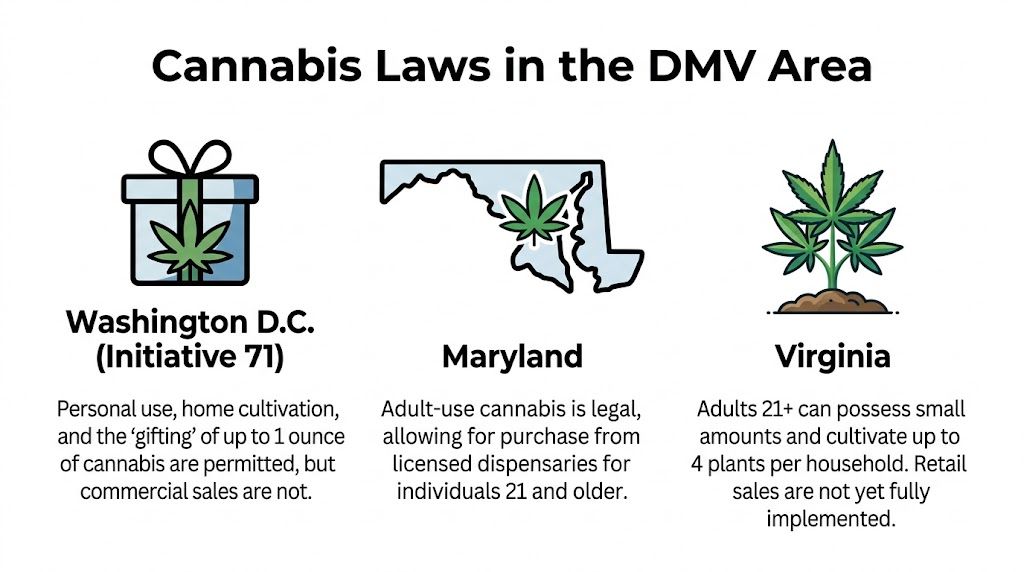
A professional weed delivery service in DC should make the basics clear. Who can order. Where the order can be delivered. What ID is needed. How payment works. What kinds of products are available. If those basics are vague, that’s a warning sign.

What adults usually care about most

People rarely want “delivery” in the abstract. They want a service that removes friction.

  • Safety: Couriers should verify identity and follow a defined process.
  • Consistency: The menu should be curated, not random.
  • Discretion: Packaging and handoff should stay private.
  • Convenience: Ordering should feel as simple as other local delivery services.

Practical rule: If a service can’t explain its process in plain language, don’t trust it with your order.

Gray-market setups often create the opposite experience. You may not know what you’re getting, when it will arrive, or whether the person handling the order is following any standard at all. Professional delivery is less about flash and more about removing uncertainty.

Your Step-by-Step Guide to Ordering Cannabis Online

The first order is usually the one people overthink. In reality, the process is simple when you know the checkpoints.

A person holding a smartphone showing an app for ordering cannabis products with an easy interface.

Step one, confirm that you’re eligible

First, you must be an adult 21 or older, have a valid government ID, and be able to receive the order at a DC location.

That last part is where visitors from Maryland and Virginia need to pause. Your home state doesn’t stop you from ordering in DC. Your physical delivery address does. If the handoff is outside the District, it isn’t the right setup for a DC cannabis delivery.

Hotels, private residences, and other lawful DC locations can work if the service can complete ID verification and the handoff can happen appropriately. If you’re unsure, check the provider’s buying guidance before placing the order. A clear walkthrough like how to buy weed in DC helps first-time customers understand what to prepare.

Step two, browse by product type, not by jargon

Most menus look easier once you sort products into familiar categories.

  • Flower: Good for people who prefer classic inhalation and strain variety.
  • Edibles: Better for those who want smoke-free use and measured servings.
  • Vapes: Popular for convenience and portability.
  • Concentrates: Chosen more often by experienced users looking for potency.
  • Tinctures: Useful for people who want a flexible format.

If you’re new, don’t start by chasing strain names. Start with the kind of experience you want. Fast onset or slower onset. Smoked or not smoked. Shorter session or longer-lasting effect.

Step three, place the order clearly

Once you know what you want, submit the order through the website or by phone, depending on the service. Green Express DC states a $50 minimum, offers cash on delivery, and describes a menu that includes flower, concentrates, vapes, edibles, and tinctures in a straightforward way.

The best ordering process is boring in a good way. You pick products, confirm details, and wait for the courier. No mystery steps. No coded language.

A quick visual overview can help if you’re new to online cannabis ordering:

Step four, prepare for the handoff

Keep your ID ready. Make sure you can receive the courier directly. Don’t send someone else unless the service says that’s allowed under its process, and don’t assume a front desk can always complete the exchange for you.

The delivery itself is usually the shortest part of the whole experience. The courier arrives, verifies your ID, collects payment if the service uses cash on delivery, and completes a discreet handoff.

A first-time example

Say you live in Silver Spring but you’re spending the evening with friends at a DC apartment. You can place an order for delivery to that DC address, provided you’re there with valid ID when the courier arrives.

Now change one detail. You head home to Maryland and ask the courier to meet you there instead. That no longer fits the District delivery framework. Same person, same products, different location. The address changes everything.

Bring your questions to the ordering stage, not the drop-off stage. It saves time and prevents avoidable problems.

What to Expect from a Premium Cannabis Menu

A premium menu should help you choose, not overwhelm you. The main categories each serve a different kind of customer, and once you know the basics, the menu becomes much easier to read.

Flower for classic variety

Flower is still where many adults begin. It’s the most recognizable format, and it gives you the widest range of strain styles.

Sativa options are often chosen by people who want something that feels more active or social. Indica products tend to attract customers looking for a more settled evening. Hybrid flower sits in the middle and can be useful when you don’t want an experience that feels too directional one way or the other.

Pre-rolls make flower simpler for people who don’t want to grind, roll, or keep accessories around. For visitors staying in DC briefly, that convenience matters.

Concentrates for experienced users

Concentrates can intimidate newer shoppers because the names sound technical. The easiest way to think about them is by texture and handling.

  • Shatter: Usually chosen by people who want a stable, glass-like concentrate.
  • Wax: Softer and easier for some users to work with.
  • Live resin: Often selected by people who care a lot about aroma and flavor.
  • Rosin: Appeals to customers who pay close attention to extraction style.

If you’re new to concentrates, ask yourself one question before ordering. Do you already know how you plan to use them? If not, flower, vapes, or edibles may be the better place to start.

Vapes for convenience

Vapes are popular because they reduce setup. A disposable can work well for someone who wants a compact option without extra equipment. A cartridge may make more sense for customers who already use a compatible battery.

People often choose vapes when discretion matters. The format is small, fast to use, and easy to store. That’s part of why it fits naturally into the modern dc delivery service model.

Some shoppers don’t need the strongest product. They need the easiest product to use correctly.

Edibles and tinctures for measured use

Edibles appeal to adults who don’t want to inhale anything. They also require more patience. Effects usually take longer to show up than inhaled products, which is why rushing the second serving is a common beginner mistake.

Tinctures are different. They give people a flexible format that can feel easier to manage when they want more control over how they consume.

Here’s a simple way to think about the menu:

Product type Often chosen for
Flower Familiar use, strain variety
Pre-rolls Convenience and no prep
Vapes Portability and discretion
Edibles Smoke-free use
Tinctures Flexible routine
Concentrates Potency and experienced use

A curated menu also matters for quality reasons. Green Express DC describes its selection as lab-tested and 100% organic, which gives customers a clearer baseline than informal channels where product handling and sourcing may be harder to verify.

Making Premium Cannabis Delivery Affordable and Convenient

Price and convenience usually decide whether someone places the order. Even people who care about quality still want the process to feel reasonable.

How the service fits daily life in DC

Delivery is already part of everyday behavior in the District. DoorDash alone supported more than 65,000 active delivery workers in DC and completed more than 8.8 million orders in 2024, according to DoorDash’s DC economic impact overview. That same on-demand expectation shapes how people think about cannabis delivery too.

So the question isn’t whether delivery feels normal in DC. It does. The better question is whether a cannabis service makes ordering simple enough to match what people already expect from food, grocery, and parcel delivery.

Practical cost questions people ask

Customers usually look at affordability in three ways.

  • Minimum order size: A clear minimum helps you know whether a quick restock makes sense.
  • Menu range: A broader spread lets buyers choose between everyday options and premium picks.
  • Rotating deals: Bundle offers can help regular users shop more efficiently.

Green Express DC states a $50 minimum, which keeps the starting point easy to understand. It also highlights rotating specials such as concentrate bundles, multi-unit vape deals, and seasonal promotions. That matters because “premium” doesn’t always mean buying the most expensive item on the page. Often it means buying from a curated menu with clearer product standards and then using specials wisely.

Convenience is mostly about reducing hassle

A strong service doesn’t just move products. It reduces the small annoyances that make ordering feel complicated.

For most adults, convenience comes down to this short checklist:

  1. The menu is easy to browse
  2. The ordering rules are stated plainly
  3. The delivery area is clear
  4. The handoff process is predictable

If those four things are in place, the service feels workable for both regular DC residents and people visiting from nearby parts of Maryland or Virginia.

Cannabis Safety, Storage, and Common Questions

Buying safely is only half the job. Using and storing cannabis responsibly matters just as much, especially if you’re trying a product type that’s new to you.

Two small clear containers filled with cannabis flower buds sitting on a windowsill during daytime.

Use carefully, especially if you’re new

The oldest advice is still the most useful. Start low and go slow.

That’s especially true with edibles. People often misjudge them because the effects usually take longer to arrive than inhaled products. If you don’t feel something right away, that delay doesn’t mean the product isn’t working.

For flower, vapes, and concentrates, the onset tends to feel faster. That can help some users gauge the experience more quickly, but it can also lead to overuse if someone keeps going without pausing to assess how they feel.

Store cannabis like any other adult-only product. Keep it secured, labeled, and out of reach of children and pets.

Store products in a way that protects quality

Good storage is simple.

  • Keep flower sealed: Airtight containers help preserve aroma and texture.
  • Avoid heat and direct sun: Light and heat can degrade product quality.
  • Separate product types: Don’t toss everything into one drawer loose.
  • Secure edibles carefully: They can look like ordinary snacks if you’re careless.
  • Keep packaging when possible: It helps you remember what you bought and how to use it.

Common questions

Do I need a medical card to order?
Not for adult-use access framed around the process described here for adults 21+ in DC. What matters most is age verification and a lawful DC delivery location.

Can a service deliver to Maryland or Virginia?
No. Delivery must remain within the District under DC courier rules.

Can tourists order in DC?
Yes, if they are adults 21+, have valid government ID, and can receive the order at a lawful DC location where the handoff can be completed properly.

Can I get delivery to a hotel?
Often, yes, but hotels have their own access and lobby rules. Confirm the details before ordering so the courier can complete the handoff smoothly.

How do I pay?
Green Express DC states cash on delivery, so customers should be prepared before the courier arrives.

What should first-time users order?
Usually the simplest category for your comfort level. Many beginners choose flower, a pre-roll, or a lower-intensity edible format rather than jumping straight to concentrates.

The Future of Convenient Cannabis Access in DC

Cannabis access in DC is getting easier to understand once you strip away the noise. Adults in the District, plus visitors staying in DC from Maryland or Virginia, can use a dc delivery service legally when the delivery stays inside DC, the customer is 21+, and the handoff follows the District’s rules.

The broader delivery world in DC keeps evolving too. The District’s Personal Delivery Device program has already logged more than 500,000 miles for other goods, according to DC’s law governing personal delivery devices. For cannabis delivery, that doesn’t describe the current standard, but it does show how seriously DC takes last-mile logistics and monitored delivery systems.

For now, the key features are already available. Clear ordering. Age verification. Discreet service. Lab-tested products. A process that feels modern instead of murky.

If you’re in DC and want a straightforward option, the next step is simple. Review the menu, confirm your delivery address is in the District, and order only when you’re comfortable with the product type you’ve chosen.


If you want a straightforward way to order cannabis in the District, Green Express DC offers a clear menu, discreet delivery, age verification at drop-off, and service for adults 21+ at DC locations.